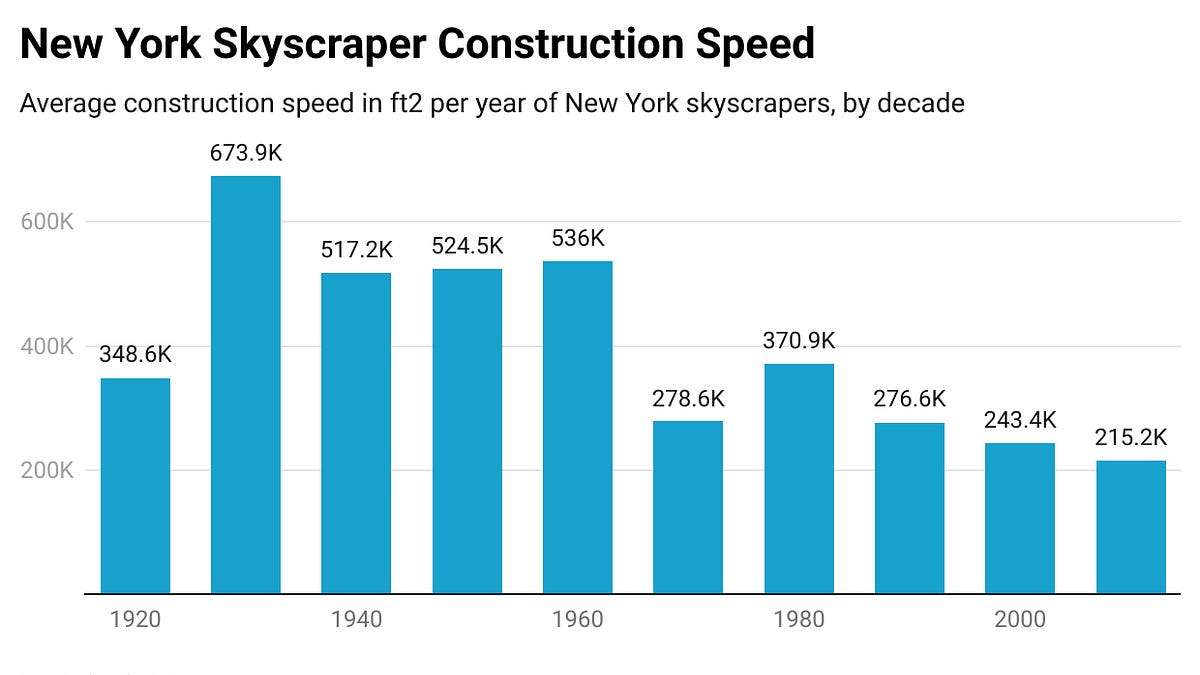
When Did New York Start Building Slowly?
(Note: the analysis below of floor plate size vs construction speed is incorrect due to autocorrelation effects.
constructionphysics.substack.com
191 points · by mfiguiere · 3y ago · 241 comments
For New York specifically there's another factor that it's strange the article omitted: Robert Moses.
Prior to the mid-1960s, it was fairly simple: if Robert Moses wanted something built, it was built. If he wanted it blocked, it was blocked. This made the process of getting approvals a known factor. Moses chaired a wide variety of authorities including NYC Planning Commission, the Parks Department, and more. He was the sole authority to negotiate with the Federal government for NYC projects.
This kind of central oversight allows certain projects to be completed much faster than it would be in other setups, but it also allows for a number of bad outcomes - corruption, ignoring the public good, environmental destruction, and more. As such, over time more process gets added. It's easy to criticize process, but many of the rules were written in blood with the best of intentions.
If you get a good dictator, things get done with little friction, because the power rests on a single person's shoulders. But if you get a bad one, you're stuck with it.
Democracy might be slower and less inefficient, but it's reliably slower and less efficient.
Most "dictators" in Eve actually end up being pretty good at their job, because it is a cutthroat market, and the most precious currency is players willing to fly for you and they can easily leave to join another group should you piss them off and not take care of them.
The U.S. was clearly designed with the second interpretation in mind. The revolution was a result of taxation by the British Parliament, and their anger at the British crown was that the king did not stop the parliament. The president / executive branch is a single person, and it represented their view of preferring an accountable monarch over distributed accountability dispersing Parliament.
They also designed the house seats with very lower upper bounds on the number of people represented by a single person, and the design of voting districts reflects a view of accountability over representation.
However, the prevailing meta game of politics is using the representation interpretation. And the design of the U.S constitution is quite bad when that is the understanding. It's just not designed for it. And the pubic has been trained, in almost pavlovian way, to interpret the "accountability" interpretation as "populism" with negative connotation.
For example, the President could appoint the cabinet and judges, but the Senate has to approve them. The president could negotiate treaties, but the Senate has to approve them. The president could veto a bill, but Congress can override it. And so on, and so on. That's not a dictator.
The president has been moving closer and closer to a dictator, though, because Congress has become more and more useless. They have become so tied up in political trench warfare that they can't actually govern. They often can't even pass a budget, which is their most basic job. So the president rules more and more by executive order, which is very much not the way the system was supposed to work.
It's a bit more complicated. Colonials paid lower taxes than people back in England, too.
See also https://www.econlib.org/archives/2016/12/bruce_bueno_de.html
> His stories about George Washington, none of which I knew, are even more fascinating. Bueno de Mesquita claims, quite plausibly, that a huge part of George Washington’s motive for fighting the Revolutionary War was to protect his substantial, and critically placed, landholdings in the Ohio Valley. I’m not saying that I agree with him, but his story made me realize that a large part of my belief in GW is romantic: because I learned about him so early in life, that romantic view is harder to shake and I’ve been less willing to put GW under the public choice microscope than with any current or recent president.
> An excerpt about GW’s wealth:
>> His last position, just before becoming President, was President of the Patowmack Canal Company–the Potomac Canal, as we know it, from the Potomac River. What that canal did was bring, make it possible to bring produce from the Shenandoah Valley–which George owned–up to the port in Alexandria, which had been built by Lawrence, by the Ohio Valley Company, in which George had a direct interest, and shipped goods out. So it was a very profitable undertaking–or so he thought it would be, in the long run, for him. And that’s what motivated him. Most people think of Washington as–besides a great hero, which he certainly was–as kind of a gentleman farmer. Economists have estimated the worth in real dollars adjusted for inflation, not appreciated, of George Washington’s estate, in contemporary terms; and it’s about $20 billion dollars. He is by far the wealthiest President. He is the 59th wealthiest person in American history. Three of the American founding fathers are in the list of the top 100 wealthiest Americans in all of history: Hancock, who was wealthier than Washington–made his money smuggling; and Ben Franklin, who was not quite as wealthy, who made his money because he had a monopoly on the printing press. These are the folks who led the Revolution. These were not the downtrodden. These were not the oppressed. These were people who stood to lose huge amounts of wealth because of the King’s policies. And so they fought a Revolution. Which was, by the way, not very popular. Sixty percent of the colonists either were neutral or opposed to the Revolution.
As usual, there's a Wikipedia article listing some others: https://en.wikipedia.org/wiki/Benevolent_dictatorship
(Relevant disclosure: I'm not French.)
That’s why the US founders loathed democracy. A Republic was the answer they came up with.
Over time legitimate bugs and requirements at the time fall by the wayside but the code remains. I don't know how we fix that problem when it comes to legal code though.
However, there isn't much incentive for it. A law getting struck down has no negative effect on Congress or state legislatures. That's a problem IMO
https://www.iheart.com/podcast/105-behind-the-bastards-29236...
https://www.nytimes.com/2020/05/28/nyregion/power-broker-tv....
Respectfully, we already know this part. It's at the top of every single thread like this.
The more important questions are:
* Are all of these rules still necessary?
* Are any of these rules more obstructive than beneficial?
* Could any of these rules be refactored for a better benefit to obstruction ratio?
The problem will not be solved as long as every time it's discussed, it becomes a "should we have any rules or no rules at all" discussion. We know the vast majority were put in place because something prompted them. What's less discussed is how to fix it, or at least stop making it worse.
Isn't the point of the U.S. checks and balance system that it's basically impossible to 'fix' 'bad rules' that are viewed as beneficial by at least a quarter of the population?
Regardless of how 'bad' it's considered by the majority?
They did things in-house. There’s an anecdote in the book about how they had a building on Randall’s Island with 100 draftsmen on call at any time. The minute the federal government announced more money was released they’d whip up designs for highways or bridges before anyone else and have the proposal in.
There’s a lot of stories like that. Moses and his organization actually built shit, they designed and project managed their own stuff.
We don’t do that any more. It’s not just that we hire construction companies, we hire companies to manage the construction companies and then another company to manage the managers. None of those people have an incentive structure that rewards building fast and on budget.
This problem is endemic to every government function at this point. I am convinced we could solve half the problem with public works by just like building a government department to actually deliver the government services themselves instead of what we do now. Which, of course, is how governments mostly used to function before neoliberalism and general corporate dominance took over.
this is a giant issue in the angloshere
And noone own the outcome for quality of the result.
When an issue arises, before anything is foxed there are 15 years of lawsuits between these companies to figure out who's fault it is
In Britain, we had 100's of highroses built non-cpmpliant with fire safety, apparently the builder, the owner, the fire inspector and the local government are not responsible for compliance.
The leaseholder of the individual apar5ment has tonpay for fixing it.
Some people bought partial ownership, i.e. 25% of the apartment, the rest is owned by investors. Well, theybare responsible for 100% of the maintenance (this is a government scheme)
So some people have bought an asset for £40k and now much pay 100k to fix it. And they cant say no
Having family members who worked inside government and having (briefly) done so myself, I completely agree with the grandparent. Government departments are basically just sprawling hierarchies of middle-management. Very few people who actually do things or take responsibility for anything. Those who want to are likely to get fed up and leave very quickly.
It's all about contracting things out to the usual suspects of consulting firms, who inevitably are only interested in dragging things out for as long as possible and leeching as much money as they can.
There was a recent report comparing metro construction in Italy with the USA that came to the same conclusion. They concluded that in-house expertise is by far the biggest factor in delivering large-scale projects on time and on budget.
Cities used to/should have public works departments. Not hire a contractor who hires a paver who rents the machinery to fix a pothole. The city should just own it all and hire someone as it will forever need to fix potholes.
https://pedestrianobservations.com/2023/03/12/the-issue-of-c...
This is how things were done for a long time, but anywhere the government delivers value is quickly "privatized" the next time a conservative government is elected.
Privatisation also often allows a short term financial boost at long term net expense.
The question we are tasked with answering is: why?
You just basically named two continents and said they build faster than the US and you're accusing someone else of simplistic takes?
Which European country builds infrastructure faster than the US?
Alon Levy is the most accessible source for this kind of cross-national comparision. https://transitcosts.com/ and https://pedestrianobservations.com/2023/03/03/we-gave-a-talk... is a good place to start.
https://pedestrianobservations.com/ and the less feisty https://transitcosts.com/ are the canonical sources on comparative infrastructure costs.
I remember staying at the Shinagawa Prince, three years in a row, and it overlooks that big-ass office park, on the other side of the station.
One year, I look out, and there’s a huge empty lot.
The next year, there’s a steel frame, for several buildings.
The next year, the lights are on, and the buildings are obviously occupied.
Also, their standards are very high. They weather massive earthquakes, quite well.
https://www.youtube.com/watch?v=-txmGH11sh0
https://www.rbth.com/travel/335939-moscow-metro-big-circle-l...
And this is all under massive sanctions and a less democratic and more corrupt system.
Or you can just go with the simple stupid answer of corruption as if Europe isn't its own cesspool.
Ah yes, Norway and Greece are known for having the same climate.
The temperature range is literally 100 degrees Centigrade - record in Greece ks 48 Degrees C
Record in Norway is -51 degrees
Plenty of farmland. Maybe could use some hospitals.
A real need to rebuild post-world wars seems to have become some mind virus we have to constantly crank out mega projects.
Can we get over the ridiculous hallucination we need to “drill baby drill” and grind through all the resources to goto Mars? You and I will be dead before that’s tenable let alone implemented… can we let the future sort itself out a bit?
Why do we still buy into the story of post-war shell shocked paranoids who spent decades huffing leased gas fumes, expropriating the world from everyone else dropping democracy bombs.
Decades of television as a carefully curated propaganda pipeline has messed the last generation up.
Old infrastructure wears out, and often it fails to meet modern standards and should be replaced (ex old houses often cannot be insulated to modern standards, old bridges we now realize were not built strong enough). Many have for various reasons concluded that some of what we have built in the past was a mistake and so we should tear some things down to replace with something else. (ex replace highways with mass transit)
While we don't need to build or rebuild everything we did in the past, there is still a lot of things that if we would build our life would be better.
It is to the credit of our modernity that the project was completed at all. The real lesson here is not one of generalized slowing, but of a lack of rational analysis, particularly when a wealth of information is available.
Based on around 100 interviews and many diagrams and reports, we managed to decompose the New York construction cost premium over low-cost countries, which is about a full order of magnitude, into the following items:
    The stations are overbuilt by a factor of 3, which contributes an overall factor of 2 cost premium
    The systems are not standardized, which contributes a factor of about 2.3 cost premium for the systems and 1.35 overall
    Labor costs (including supervisors and other white-collar workers) are 50% of hard costs in New York where they should be about 25%, contributing a factor of 3 premium on labor costs and 1.5 overall
    Procurement problems including the privatization of risk, change order risk, agency micromanagement of contractors, general red tape, and profit stemming from too little competition double overall costs
Soft costs are depending on what one counts either 21% on top of hard costs where they should be 7%, or 46% where they should be 20% - agency micromanagement of contractors
- general red tape
- too little competition
Unfortunately, the people who would use it are not the people that sign off on paying for it. Those people had checklists of irrelevant requirements, slow response times, almost certainly pressure to select "certain" vendors (i.e. those who threw money into lobbying the right folk). It got to the point where they seriously considered hiring a consulting company whose sole purpose was to help others navigate all the red tape that gets thrown in your way when you try to get government contracts.
In the end, they realized that they were better off pivoting entirely to the private sector instead of doing a half and half approach.
I seem to recall a similar tale with the lead pipe retrofitting in Flint, MI... contractors to do the job were picked not necessarily by speed and capability, but by other qualities. Regardless of how they were chosen, though, the city failed to deliver. Despite the crisis starting in April 2014, residents and activists had to sue the city in 2017 to actually get the work completed, and it still isn't done. Mostly done, but not completely... 8 years later.
Reminds me of a demo I did for some Congresscritters once. The staffer said "It'll take $50k per record to bring this database online" so they refused to look at the live, running demo I had of the database online. I heard, later, that someone else got "$50k per record" as a contract.
This reads like a lack of democratic influence and even direct corruption.
That is, these "stakeholders" are not concerned that the voters would be unhappy with their performance, and would fire them (directly or through an action of a newly elected official). They seem to be conveniently shielded from feedback of the population which they nominally are hired to serve.
That last part isn’t true in my experience, but that makes it harder to solve: every procurement officer I’ve worked with has been very scrupulous about not favoring a vendor but they’re operating under rules for things like fairness and security which are hard to comply with. A huge company can hire a room full of people to document how they’re complying with everything but a startup is going to run into exactly the problem you described. The big guys all support this since it has the effect of limiting options without actually being illegal — who’s going to argue against risk reduction, right?
And owners have never lied about the superiority of their product, or what other people think.
Except that is pretty much all they do.
Maybe we've now built everything that's easy to build, and all that's left is the hard stuff.
Ones like this:[1]
[1] https://www.cnn.com/style/article/steinway-tower-intl-scli/i...
https://www.theguardian.com/cities/2019/feb/05/super-tall-su...
In 2009, NY started working on a high-speed rail study, which finally completed last month after 14 years. Now, the completed version of the study recommends a 25-year project that will increase train speed from 80MPH to...wait for it...90MPH.
Insanity.
If there is a mission, a shared common goal and a belief that the benefits of the mission will be as fairly shared as the effort then you get the "magic". Corruption is looked down upon, stupidities are challenged.
But if there is no mission, no expectation that the benefits will accrue to "society", then "getting paid" is the most obvious and sensible response - one is resigned to the stupidities of the project and just accepts them.
Basically, a society with a safety net people trust will find it easier to have a mission that everyone believes.
When you're a startup, you build features fast, you're not afraid of breaking things. Big features are scoped out within days, development starts, and everything is done within a couple of weeks or months. It is so different when you start working for big tech companies, in FAANG for instance some of the small features will take developers months to build given all of the process required to do (RFCs, collaborations with other teams for different services etc)
Many of our greatest works were built on pools of blood that would not be tolerated today.
"Homebuilders don’t seem to think the burdens of OSHA and other safety regulations are all that high. Complying with OSHA is the second lowest category of perceived jobsite regulatory costs."
https://constructionphysics.substack.com/p/how-much-safer-ha...
You can’t build fast on a city that’s been around for a while. There’s too much shit already there. And not just infra, but also simply people, and culture and everything else that comes with human beings occupying a space.
You could probably build the entirety of Manhattan out in the middle of Wyoming somewhere in 10 or 20 years from scratch with a reasonably sized set of resources because there’s nothing around and so little to deal with. It’s just the nature of a place with a lot of people.
Seems like a weird set of metrics whose relevance isn’t clear. Of course approved construction projects are going to take longer - demolishing a 19th century 6 story building is trivial compared to a mid century high rise. Construction is a cutthroat business, so I’m sure that if velocity was the gating factor, the companies would find a way.
I’ve been involved in construction projects as a stakeholder, and NYC isn’t slower to navigate if you have a team that knows how to navigate NYC. I can think of a couple of projects in random suburbia, CA that took longer to permit than the total duration of a NYC project.
Government contracting is totally different, as New York law is knowingly designed to maximize employment. Most government projects do not allow a single general contractor and require separate bids for different components of the building, for example. You also cannot design and build a project in most cases.
Not sure anyone would ever be able to prove causation, but it would definitely be interesting to look at. For all I know maybe it’s not a factor at all?
Alternative is lower margins, but they aren’t that big in typical development projects anyway (in normal times)
They have excellent general contractor skills, but no experience in whole house construction. It has already been an interesting ride (as of now, they have dealt with soil conditions and dug grade beam trenches for the garage foundation), and there's still 98% of it left to play out over time.
- Dollar cost was 1/4 to 1/3 what a builder estimated. (Labor savings)
- I saw continuous progress with no surprise delays.
- It was easier and cheaper to do custom solutions or adjustments as unforseen issues came up.
- Was fun and I learned a lot.
Minuses:
- Material costs were higher than if contractors bought due to retail purchasing.
- It took over a year, versus 5-6 month estimate from builders.
- Was a lot of personal time and learning.
There's also the very subjective tradeoff between opportunity cost of taking time off from my career vs the benefits of doing more manual labor and learning a lot building a house.
With interest rates low, easier to just hold construction note for another year.
As the US becomes more and more divided on every level: ideologically, religiously, ethnically, culturally, etc this is only going to continue.
Now projects like that are likely harder as the companies that can do it are 1) busy, 2) expensive, 3) not in your area.
NYC is an example of a runaway complexity. So now 1 mile of Manhattan subway costs about the same as 1000 miles of 6-lane freeway.
The correct way to fix it is: don't. Stop encouraging density, instead make sure that other cities can thrive by providing incentives for companies to build in sparse areas.
It's also the only workable way to provide affordable housing.
If we look at Manhattan, it's a complete runaway disaster: 73000 people per square mile.
Probably when Frank Sinatra was alive but certainly not now.
What can you get in New York that you cannot get somewhere else?
Art/museums... top notch collections
Restaurants... you can find any type of food here
Sports.. I used to go to the US Open tennis every year... then there is football, baseball, MLS soccer.. all of these are within 1 hour
Sit down at a restaurant table on a sidewalk and just people watch
Broadway shows
Concerts
Beaches are close by
Hunter mountain for skiing is not too far
3 airports that have flight going everywhere
Those are just a few........
Different people make different choices and that's perfectly fine.
>Construction companies, which have given millions of dollars in campaign donations in recent years, have increased their projected costs by up to 50 percent when bidding for work from the M.T.A., contractors say. ... Consulting firms, which have hired away scores of M.T.A. employees, have persuaded the authority to spend an unusual amount on design and management, statistics indicate.
or this:
>"Worker wages and labor conditions are determined through negotiations between the unions and the companies, none of whom have any incentive to control costs."
All they say is that the reason starts with the number of people employed. If you continued reading past that point, they talk about other non-union incentives that drive up costs, like:
>Critics pointed out that construction companies actually have an incentive to maximize costs — they earn a percentage of the project’s costs as profit, so the higher the cost, the bigger their profit.
They also talk about the "soft costs" of NYC construction, like:
>The project plan called for the hiring of 500 consultants from a dozen different companies
And of course bureaucracy:
>Officials have added to the soft costs by struggling to coordinate between vendors, taking a long time to approve plans, insisting on extravagant station designs and changing their minds midway through projects.
So while we can probably agree that unions are part of the problem, it's disingenuous to act like they are the whole problem.
I wish they had different names because they are quite different.
Oh, sure, they throw money in the pot for candidates, but in Europe, unions take actual political positions on important matters. They do not often get their way, but they act as an important counterweight in politics to the interests of the rich and powerful.
The answer is corruption. America is horribly corrupt, much like Latin American nations, and unlike western European nations. So unions in Europe actually work the way they're supposed to, whereas in America they're just another corrupt institution, probably much more corrupt in fact than most others, and cause more problems than they solve.
How do you get America to have unions like those in Europe? I have no idea, but I think it's like asking how you can turn Afghanistan into a country similar to Norway.
Easy. Allow the employee to pick the union - you can have more than one union per employer. Or no union at all if that's what the employee wants.
That's the only change needed.
If like, add a second change: It's not longer necessary to make an employer be a "union shop" any employer can have employees represented by unions, if that's what the employee wants.