Home Price to Income Ratio - Updated Chart | LongtermTrends
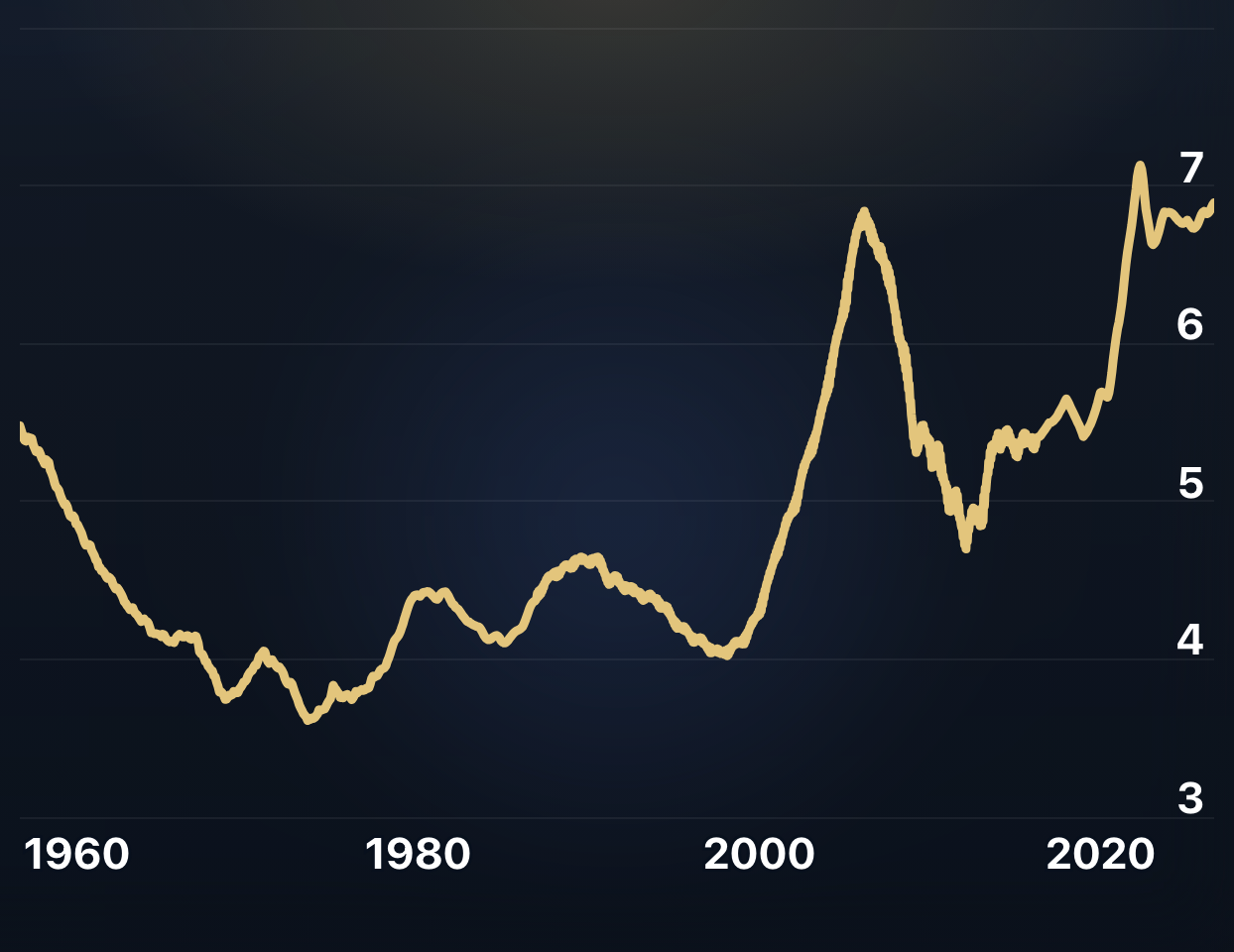
How affordable are homes in the US? This ratio divides the Case-Shiller Home Price Index by the US median annual household income.
longtermtrends.net
233 points · by mennaali · 3y ago · 234 comments
This isn't to discount the shift of ownership from human persons to corporate persons, that's a factor too. But just numbers of available houses versus population plays a role.
If homes are a good monetary investment, that means home prices are going up, which means supply is not keeping pace with demand.
If home prices are going up at a rate faster than wages, then they are becoming more expensive for our children. Not in a round-a-bout way, but in a direct causal relationship way.
Homes can either be affordable or an investment, not both. If homes are to be affordable that means more need to be built.
Try pricing what it would take to buy a plot of land and build a home on it. In some places there are very expensive local regulations that must be satisfied. However, just the base value of some land with utility access, physical materials, and labor to assemble the home is "unaffordable." If the difference between the cost to produce a home and the sale value of the home was larger than there would be more home builders. If reducing the cost of housing is important to you than you should focus on ways to reduce the cost of producing homes.
The amount of bureaucracy is insane. Often times we have been the go between for different departments of city that have offices in the same building as each other. They all point the finger at each other. Can’t get answers to the power pole questions from LA DWP without Bureau of Street Lighting, Bureau of street lighting won’t do anything with out LA DWP etc… it’s madness.
House will be 3200sqft, very nice with a pool but lots of value engineering (thanks to my dad). Construction budget is $2m. Will be getting a construction loan. Requires monthly income of $35k combined. Lucky I’m doing this with my twin brother, so we might just be able to afford it, but currently can not due to interest rate rises since we started. Swinging big.
Bank appraised finished project at $3.5m.
My take away from the whole process is that LA infrastructure is terrible, and the city has effectively made it impossible for new construction by family’s. LA DWP single handedly cost us a year in permitting and its incentives are just so not aligned with home owners. My dream is we can go solar and batteries and tell them to get lost. I now have a real respect for what Starlink is doing. Down with the entrenched utilities!!!
You have to be rich to build a house in LA. Renovation is the only real option for individuals. Which just drives up house prices. New houses built is the only way out I think, and the government seems to only be making it harder.
Only if the houses are selling at the higher price. There are a lot of empty, unsold houses where the owner is refusing to reduce the price. Property economics is weird.
Misses the fact that homes are bought (most of the time) with borrowed money and leverage.
You can either look at that as increasing the supply of money or lowering the cost of money, and its reflection in housing prices.
A big chunk of that demand is for 2nd or 3rd or even 4th properties as investment rental properties. Can’t afford a house in the sf Bay Area, no problem, go buy 4 investment properties in the Midwest! I know people who’ve done that.
Also look what houses are built, they aren’t starter homes in many areas. They are “luxury” (luxury per home marketers, sq ft, and price, I won’t go down the rabbit hole of what I personally think).
Building more will inevitably fix the housing market, even if one investor owns every single new house.
I'm not convinced it's that simple. Houses aren't widgets that you can flood the market with an unlimited supply to drop the price as much as desired. Homes cost a lot to build and use limited resources, which means at a certain point building more increases the cost.
Picture a city that is building only 1000 homes a year and then they decide to start building 10,000 a year. Will the prices drop? If the prices were very high due to excess demand, probably not because there is enough demand to absorb those 10k units without meeting all the demand, so prices won't drop.
Ok then, let's go all out and build a million units (let's imagine that land is somehow available for that in this thought exercise). Will prices go down? No, prices will go up! Ask anyone trying to build a home in a tight market, labor prices are extremely high because there is so much demand for a limited supply of labor. If this hypotetical city tried to build a million units, labor costs will skyrocket and so will the price per unit.
There are no efficiencies of scale left in a mature industry like house builing. Building more doesn't make the per unit cost cheaper, it actually makes it higher due to labor availability.
Land is available. What's not is infrastructure, and economic surplus to maintain all the required new homes and infrastructure (roads, pipes, power grid, etc).
Housing suffers from the same curse as the transit infrastructure, or the nuclear industry, enormous economic and political inertia keeping/prefering the status quo, any new projects are small, low-efficiency, lack economies of scale, lack innovation (because copy-paste building just one more is the lowest risk thing).
Look at the recent California zoning remedy program, so few real estate developers are taking it, because it turns out that those small local markets are basically incompetitive cronyist distopias, and it makes no sense for them to get into a fight with the zoning/approval board.
Supply and demand aren't quantities, they're functions. You may be trying to say that demand is inelastic around the present point, but I suspect it actually isn't.
Not familiar with USA market but wondering: Are current houses just more fragile and fell apart within 50 years?
Obsolescence gets overlooked but it is important. Not only are houses often poorly constructed, but many are simply no longer desirable. For example in my area, anything pre-1960 is likely very small, possibly without a garage, and may only have one bathroom. The modern homeowner wants something better. Houses in the 1970s were frankly, weird. They don't fit modern tastes at all. Many houses built in the 1990s are falling down already because they were so poorly built. So my point is, you have to take into account not only the top end inventory number, but also that lack of desirability is a real thing that drags down actual available inventory.
You have no idea what you're talking about. Houses are built to standards significantly higher than they used to be (aka, with standards).
Contractors skimp where they can but, due to threats of litigation, those cut corners are cosmetics.
In the US, modern houses tend to be larger, have better insulation (from what I've experienced), but can be cheap in some aspects (e.g. interior doors tend to be hollow, whereas older houses typically had solid doors). Overall though, I'm not sure if new or older homes were better built. I know some really well built old homes, but some very poor built ones too, and this goes for modern homes as well. Most should last 50 years though.
Shitty wildcat builders throwing down entire subdivisions of deeply defective homes is a serious problem in the Phoenix area, I know that for a fact.
There are a lot of old abandoned homes. I would never live in a home built before 1978. Almost certainly that home is full of lead-based paint and asbestos.
We're closing in on 50 years past the 1979 lead-based paint cutoff - the vast majority of homes in my area, and I extrapolate that likely most areas, have been remediated. With asbestos - probably the worst issue in my area is that if you have asbestos shingles you want to remove they are stinking heavy and so cost a lot to dump. I live in a 1915 home that is a great example of houses in my area - has gone through multiple renovations in that time such that the guts are fundamentally new. Probably the biggest issue with these older homes is insulation, as unless you truly take them down to the studs, they are never going to be as airtight as modern homes.
One of my colleagues lived in such a multi-apartment block where there was a common toilet for the entire floor, so four households. In freezing weather, the toilet was bitterly cold.
Tell me how that makes any sense.
But beyond that, housing as investment property alienates people from the natural reward of caring for housing. We ought to be leaving into and communicating peoples' natural desire to make home livable. Instead we rip people from it, we punish people by forcing them to switch apartments when they're perfectly happy.
So many people effectively live in in slow motion life long exile.
99 percent invisible did a podcast series on the reality and nuance of homelessness. It is the best take I’ve seen and really opened my eyes on a number of things. Episode 3 covers housing first, but I would recommend going through the whole thing.
In a lot of cases they wouldn't have become mentally ill or a fentanyl addict if they weren't homeless. Yes, addiction drives tons of people into homelessness, but homelessness can also cause addiction since a homeless life kinda sucks.
There are hardly any takers.
As has always been true in real estate: location, location, location
Its not only the us dealing with this.
In many Western countries a large part of the population has been incentivised by both tax cuts and monetary policy to own property that it's become very hard for governments to change those policies to again make houses affordable without huge cuts of the wealth of their middle-class.
Additionally, the pure supply and demand argument is insufficient because it does not explain why we have failed to create the additional supply to meet the demand. In a pure sandboxed supply/demand analysis with no other factors, we would expect to see supply increase as demand increases since in theory it means building homes is more profitable. The high school version of supply/demand is that they balance eachother eventually and the timeframe over which that happens is influenced by the elasticity in price of the good in question. Something about how the housing market functions has changed in some locations.
there is also, at least anecdotally, a shortage of skilled tradespeople across construction in general. post-2007 basically reduced the incoming pipeline to zero, and so now there is this missing labor cohort that would be really useful right now.
Additional supply did come on, and has dropped recently in response to rates.
It's really not more than high school supply/demand. There are just a good number of factors which make up each at each location, and at least one of them is large and unpredictable (interest rates). There is always a lag on the supply side because only so many houses can be built at any time. It's the same for many commodities like oil and gas.
Actually computing a good supply or demand curve has always been the difficult part, not the theory. But supply lag and interest rates make up a big component of property supply and demand.
Up until this month prices in this market were declining and homes sitting on the market for weeks to a month or more with lots of price drops.
It's weird spring comes around with interest rates just as high and we are back to bidding war frenzy that was 2021/half of 2022.
Thanks for pointing out what should have been an obvious error. Yikes.
Regulations exist to mitigate tragedies.
Reason being that the article mentions interest rates, but then just shows graphs comparing to sales price. Ironically, showing a metric that took interest rates into consideration would probably highlight why the current situation is even worse, because rates have skyrocketed but prices have only come down a little bit. Of course, as others have mentioned, that is because overall sales numbers have collapsed. Owners won't sell at a loss if they don't have to, and overall employment numbers are still high. But over time people are forced to sell for various reasons, so in 5 years prices will either go way down or stay flat as wage inflation catches up.
But in Europe, we lived like that for at least two generations now. This is what a stable state, fully urbanised society looks like. Here, it's typical for someone with a mid-level management position in a bank or an IT company, with million dollar net worth and managing dozens of employees, ride a train to job an hour each day, because they can't afford to rent in the city. And people who live in the city are simply those who's families bought pre-WWI. Or those with a regulated rent contract passed down generations from the 1950s, being an overwhelming portion of the family's effective net worth.
But it would really be great if your assertion had been true, in 2021 alone 6M houses had been sold so there would be at least several million people so rich that they buy houses like groceries.
1. https://www.npr.org/2021/12/06/1061896221/everyday-people-ca...
Supply and demand. If supply drops and demand doesn't...
That's what /r/REBubble refuses to acknowledge.
Nobody's giving up their 2% if they don't have to.
However, you are correct that the price is pretty sticky at the moment.
[1]: https://time.com/6223185/airbnbs-empty-short-term-rentals/
When you look closer, each unit on the axis represents 1 year of a person's income. Each line on that graph represents 2000 hours of life toiling for a basic living necessity.
Outrageous.
I have a hard time seeing how this can be anything but a major problem in a few years, if not before.
Unless, the very thin chance 1. Owners don't need or want to sell 2. No inventory is added through building 3. People somehow pay cash and support the prices ...or some combinations.
Fundamental economics really thereafter.
And yes, some more inventory would help. That said, as the population ages, who is going to buy all the McMansions? Price not only need to adjust to interest rate but demographics.
What life event would cause someone who currently owns a home at a <3% rate to sell?
It’s a once in a generation type of rate. You’d have to be a complete fool or have some kind of crazy life circumstance to sell.
Over 30% of employers in the US exclusively hire remote employees. Post-pandemic it’s hard for me to imagine someone in the home ownership socioeconomic class giving up that kind of leverage advantage to move for a job.
[X] Doubt
Yeah, you’re going to pay some more interest if you get a new mortgage, but don’t you just adjust your monthly finances and eat it? As long as you can hit your long-term financial goals, the “once in a generation” rate doesn’t seem so important.
The McMansions will be unlivable by that point. They weren't built to last.
Also, Levittown construction and materials are not comparable in any meaningful way to McMansions.
All buildings are depreciating assets. This was true before the idea of the McMansion existed.
It’s the land that is scarce and is the appreciating asset.
The truth of the matter is that any house that is around long enough gets repaired over time.
May be appreciating. Depends on where it is. A lot of land in metro Detroit hasn't appreciated in certain timeframes. Nor on some barrier islands.
What are you talking about?
The US population is projected to continue growing throughout most of the 21st century.
If you're waiting for people to die so you can afford real estate, you'll be waiting a long time.
Sales will pick up a little; some people will need to move for reasons they cannot avoid. Some people who don't have fixed rate mortgages will have to sell because they can no longer afford the payment. But right now, sales are pretty low.
We have learned from histories, and we know exactly how to prevent populist land reform. It simply requires convincing half the lower class to fight the other half.
People have plenty of places to live. This is more about the fact that people want to have the same financial opportunity to own a house. It sucks that the older generation had an opportunity to buy a house that has risen in value, with an area that got gentrified with more stuff around them, and were able to refinance during Covid at like 2-3%, while the younger generation is SOL. This is a very valid reason to address, but has nothing to do with homelessness.
Actually, there is a 6.5 million home shortage in the places that people actually live (https://www.cnn.com/2023/03/08/homes/housing-shortage/index....).
That shortage has nothing to do with landlords, though, and everything to do with shitty zoning and with constructing new homes being incredibly slow and burdensome in most big US cities.
Then how do you explain the massive number of evictions and hockey-stick rise in rent prices from 2010-2020 without blaming greedy landlords?
"Oopsie doopsie rents fell up?"
People get displaced, move outside of the area, and find places to live. In some cases, they buy houses in rural areas for a lower cost, and then 5-6 years later the gentrification radius grows and their house goes up in value. Look at Northern Virginia for example of this.
The main that is missing is good public transport system (or government level investment in autonomous driving). In Europe, its natural to commute about an hour or so to work, often from a different town to a bigger city. In US this happens as well, the difference though is that you have to sit in traffic in a car.
You mean the economic principle of supply and demand?
Quick Google search took me here: https://reventureconsulting.com/the-myth-of-surging-construc...
Graph shows a spread opening in 2021(don't know if his analysis is sound)
Why wouldn't construction companies build more homes? Maybe because they know it will adjust again?
The banks only care that housing prices remain astronomical--the mechanics are not important--so that mortgages must be taken out.
And, as recent history shows, the mortgage casino is "too big to fail" because of the globally-systemic role of mortgage-backed securities.
An individual is fucked if something happens to crater the price of their house. Nobody hedges, really. It’s a toxic system.
If you own it and you're using it as much as you want, you living quality is not at all affected by fluctuations in its hypothetical price.
Your ability to borrow against it is a downside, but maybe we also shouldn't be supporting that.
If they've already paid off the house and they want to sell it without buying another house, sure.
If they have a mortgage on the house, someone gets screwed, and that someone is the bank that issued the mortgage. The mortgage is secured by the house. You can just let them take it.
If you have 25% equity in the house, and something happens that knocks down the value by 30%... the person getting screwed is you.
It’s TBTF because it’s the source of the vast majority of household wealth. We turned housing into a retirement program, stealing from future generations.
In any case, far from noise, the cause of steadily increasing prices is restricted supply.
https://progressandpoverty.substack.com/p/no-silver-bullets-...
Prices have jumped, as a double whammy.
It’s all about supply: there is very very little and it’s a desirable area.
Even if rates stay at around 4-5% in a few years when all of the low-rate fixed mortgages have ended, prices will have risen, and I would guess all that would happen is a slight abatement of rises, not a reduction.