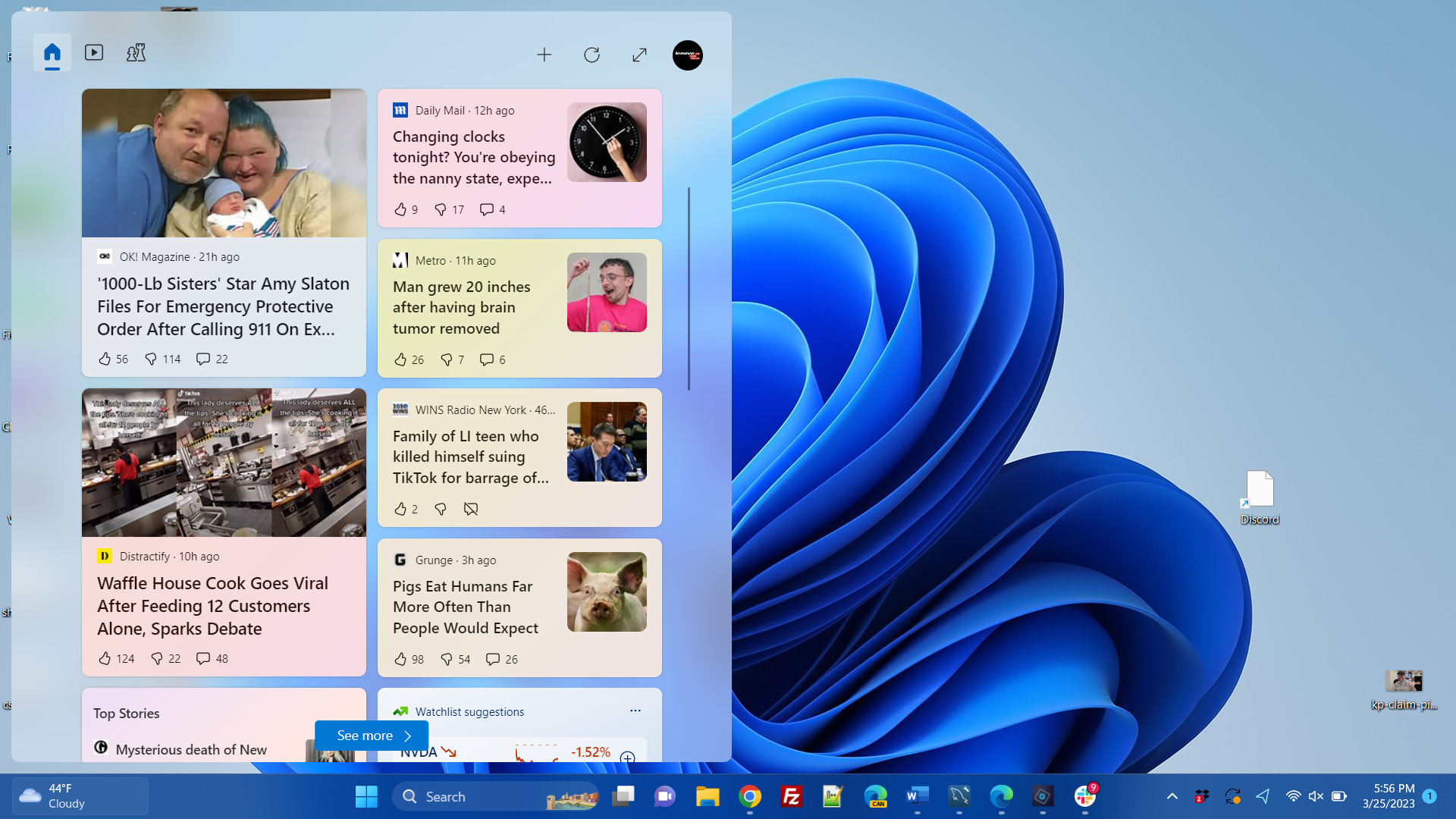
Get Off My Desktop! Windows Needs to Stop Showing Tabloid News
Microsoft’s distracting us with trashy articles when we’re trying to work.
Tom
1725 points · by taubek · 3y ago · 850 comments
I use 10 now, as locked down and 'fixed' as I was able to make it (custom ISO via NTLite with a bunch of crap removed and some fixes steamrolled in), but really I look forward to ditching it altogether - which is a shame. For all the MS hate in the OSS community, I always thought Windows did a lot of stuff well (when it was good at least).
The telemetry, changing things for the sake of changing things and forced crap constantly being added is enough. I'm so in love with awesomewm at this point, and the fact that I can customize and program every part of my UI, allowing me to have something absolutely perfect and tailor made.
Then, how is Microsoft supposed to properly track your interests and sell that information to their "partners"?
It's been a long time since Microsoft made an operating system. What they make today is basically a spyware-platform where you can run applications if you are really disciplined and persistent. I don't understand how people keep up with it.
I've used Linux on my desktops and laptops for decades now.
Windows has many issues, but it never decided to break on me in the middle of the day. For me, an OS is not a religious affiliation but a tool, and Windows performs much better as one.
I don’t have to do this stuff with Windows. It just works. I don’t mean to downplay the efforts Ubuntu developers have gone to in order to get it to its current usability. It’s pretty good, it just has a bit more maturing to do before I can make the permanent jump. A while back, I read that Ubuntu was hiring a product manager for the desktop, or maybe gaming? Anyway, I wish them luck, and hope they’re able to make strides on the experience.
In fact unless I was new and heavily tinkering with my distro, linux has easily be the more "stable". All my problems were...definitely me problems.
At the end of the day, they're both OSes running on a jaw droppingly wide variety of hardware, but whenever I look up a problem I have on linux, I find an answer that makes sense.
Meanwhile, the brand new, mainstream hardware I bought for gaming with windows forcibly sold to me with it, spent a year not being able to play audio properly while microsoft publicly insisted it had nothing to do with them, until it was quietly fixed in a windows update, which I'm sure had nothing to do with them.
Also, waking my computer from sleep occasionally just crashes my entire system, or even booting it up will cause it to crash or bootloop a few times. It's genuinely amazing what "paid development" gets you from monopolists.
To be fair, though, there was a short-lived period a couple of years ago where a lot of laptop trackpads wouldn't work, and I had a work-issued laptop that didn't seem to want to play nicely with an external monitor.
So I wonder if this is largely what you're used to. I run Linux on all of my devices, which are hardware I've chosen myself and had high confidence would have good Linux support. It's only been the work-issued machines that I've had issues with... so I probably just have a sense of how to get things to play nicely because it's what I've used primarily for so long.
And while macOS isn't as free as Linux, it's certainly less "spyware" than windows.
Would you mind sharing your Win10 setup? I use it too, but it's a stock version with just some basic cleanup.
I still think the future is Linux. I see Microsoft and Apple taking their O/S in directions that are anti-consumer.
It was more stable, that's why I used it. Then starting with a certain Windows 10 update I had to reinstall the system multiple times because automatic updates kept breaking it overnight, it started crashing the USB driver, suddenly it kept randomly switching keyboard layouts by itself, and somewhere around the third ruined weekend due to an unbootable system I had enough. Switched to an Arch-based distro for 3 years in which I only had one update-related issue and it took me a whole 5 minutes and one reboot to fix. Now I partially use Mac OS and while I'm disappointed by some of its aspects I can at least be certain it will boot tomorrow and it won't install a system update without my confirmation.
Oh, how the turntables.
Intel is pretty good about upstreaming drivers into the kernel. The only bugs I've ever ran into are around brand new wifi cards that haven't been mainlined yet. And even then I don't think I've seen that in about ten years. Nvidia on the other hand is a huge pain on Linux, but thats deliberately done by Nvidia.
> reduced laptop battery life.
Been using Linux as a daily driver for over 15 years and laptop life has been better than windows nearly the entire time.
To be fair, I cut my teeth automating Linux environments in physical datacenters. So I've lived in a world where power consumption mattered, know how to select hardware with good driver support, and can tune the os.
That said, you can get a brand new Lenovo idling under 5w without that knowledge and by simply installing tlp. With additional know how you can get it under 3w.
> For me, an OS is not a religious affiliation but a tool, and Windows performs much better as one.
Funny how you and I have the same value but wound up at opposite conclusions. I guess it's all about the tools and how we need/expect to use them.
Edit: grammar
Every now and then I get my hopes up that the year of Linux is finally here and I install the latest.
I have a simple heuristic. If in the first day of setting up the system I am required to fire up the terminal, it means that more pain is coming in the future, so I immediately delete the Linux partition.
I am still using just windows and macos for my personal computing needs.
Oddly enough, this means that Linux tends to work better as the computer it's running on gets older. The reverse is true for Windows -- updates tend to make it slower and/or have more compatibility issues. A computer that worked better with Windows a few years ago will not-infrequently perform better under Ubuntu today. It's not usually suggested on new PCs unless it's spec'd specifically with Linux compatibility in mind.
The main thing that kept me on Windows for years was games, but once I jumped into using Proton via Steam on Linux (and now the tweaked Proton GE), I can run almost all of my game library at full speed. The few games I can't play are due to anti-cheat software like Battleye.
I use my W11 22H2 as a daily driver because of that: it just works (TM).
Also, I don't see any kind of news or the likes on Windows, and it feels really close to Windows 7. Here are the things I've done so far:
- Bought a Windows 10 Education license from a shady website, and it's been working fine for the past 4? years. The upgrade to Windows 11 Education went smoothly as well.
- Local account only. No Sign in to Windows crap.
- (Most important imo) Installed OOSU Shutup10++ (it's for Windows 11) and turned almost everything off there.
- Bought a Start11 license for 5 USD and installed it, and switched to the Windows 7 start menu using it.
No ads anywhere in Windows, feels like Windows 7, talks much less to whatever 3rd party people MS have contracts with to get my data.
FWIW, I did try daily-driving Linux Mint Cinnamon, which is the best Linux for me imho. However, there is a show-stopping bug as follows:
I have 3 monitors, with the main one being a 4K over DP. My monitors are set to turn off after 5 minutes, and in Windows, they turn back on just fine when I move the mouse (minor annoyance: display scaling is not reflected across all application windows till I minimize and open the window again but no big deal). For Linux, the DP monitor won't get detected; it behaves as if my other 2 monitors are the only ones connected. I have to turn off the monitor switch and turn it on again for it to be detected. I looked around but didn't find any good way to solve it...
Overall, when there is not some specific hardware issue, I've found linux running much smoother and more user friendly _for me_. Gnome is a lot less cluttered, things are easier to find. It is also often much better in supporting older hardware and, ironically, older windows applications.
I wonder why there's a difference in our experiences here?
Well I've had the exact opposite experience. Windows was an endless source of bugs, crashes, and instability. Linux (Mint) is rock-solid, clean, fast, pretty, and stable. I've had more blue screens that I can count but I remember less than a handful of kernel panics over the last 10 years. No more fiddling around in settings, no more having to use external tools off some forum thread to accomplish something as simple as updating drivers.
The only issue I give you credit for is the battery life, which is indeed better on Windows by some ~20%.
Linux has its own pain points, I agree, but especially after 2019 they are rare. With Pop_Os! I never experience any of the stuff I deal at work. I dare say Pop makes Linux boring - because everything works out of the box.
Every time someone mentions Linux driver problems, I see that name.
For me, the strategy that has worked for the longest time is to get boring computers. The boring Thinkpad, the boring Vostros and Latitudes, the boring ThinkStation and ThinkServer boxes. Large PC makers don't want their corporate-oriented products causing support calls, and that forces them to not be overly creative with their implementations. With that powerful incentive, the hardware is usually well supported by the two boring operating systems (for generic hardware) out there. Either that, or get a machine that's designed together with its OS (and know the odds of you installing anything other than that are slim).
Desktop stability and reliability hasn't been a top-level OKR at Microsoft for many years. The company has been growing more product driven for years and falling victim to roadmaps being driven by muggles.
The only place where you can actually design a truly stable and reliable desktop is with open-source kernels and user software.
I suspect you are dual-booting, which is itself a hacky middle ground full of bugs. Linux and windows will never share a drive well.
>> reduced laptop battery life
??? Odd. I find battery life on my laptops far better on linux, generally because linux knows how to actually stop doing things when asked. Windows, no matter what you do, will randomly decide to install/download something.
>> general UI clunkiness,
For me, the fact that linux UIs don't change every few months, and when they do I can undo them, makes window the clunkier UI. It is monday morning here. I have so far had to restart Outlook twice on my work computer as new "updates" are applied. I'd take a thousand clunky-looking widow borders over MS's daily popup pollution of my screen time.
Linux is the opposite, nearly everything has a documented fix. It can be fixed in less time than it takes to backup, reimage, and reconfigure your machine.
This was also the era of major desktop environments playing fast and loose with there UX. GNOME3 was released in 2011. Ubuntu started defaulting to Unity in 2010, and started their Wayland competitor (Mir) in 2014. KDE Plasma 5 (2014) defaulted to fancy composting, and felt really bloated relative to the others. The only desktop environments that really kept true to the good old days (~2008) are XFCE4 and MATE (the GNOME2 fork). KDE5 isn't bad, either, but it's still a bit too bloated.
The other problem caused by proprietary video drivers was package versioning. It's tricky to have the right kernel version and Xorg version necessary to run a proprietary video driver blob; and keep the rest of your system up-to-date. Ubuntu found its initial success by creating a generally stable package repository roughly as up-to-date as Debian unstable. Unfortunately, Ubuntu became a bloated mess with strange things like Unity and Mir bundled in. Archlinux has been a good alternative, but it does expect a level of familiarity with shell utilities. Linux Mint (an Ubuntu or Debian fork) is still my first recommendation to casual users. One of these days, it will be NixOS, which is a giant leap in stability and package versioning.
The last change of that era that has been breaking the Linux experience is the switch from BIOS/MBR to UEFI/GPT. This shift was slow and messy, with most hardware adoption following the release of Windows 8 in 2012. GRUB used to break in one predictable way: windows overwrites the MBR, replacing GRUB with its bootloader. Now, with UEFI, boot entries are saved directly to the motherboard, and the bootloader itself lives in the ESP partition. The windows installer will put its bootloader in the first ESP it can find, and you don't get to choose which one that is. Now you have to worry about the ESP running out of space, but that's about it: everything else has been generally resolved, and the UEFI bootloader experience is very solid (apart from the windows installer caveat).
Now that AMDGPU is mature, and NVIDIA's drivers are relatively well maintained (and packaged), the Linux desktop experience is even more stable than its heyday back in 2008. If you install a distro that targets relatively recent package versions, like Archlinux, Linux Mint, or even Fedora; and you use a solid familiar desktop environment like MATE or XFCE4; you can avoid most UI/UX clunkiness and have very little need to fiddle with your package manager. Boot issues are pretty unlikely now, so long as you install in UEFI mode (not legacy BIOS emulation), and completely avoid MBR.
Oh boy where to begin?
>Nvidia and Intel driver issues
Not a personal dig, but this is a result of having been spoiled. I still remember the small dime novel that came with my box of WinNT 4.0 workstation, all it did was list the various hardware that was on its hardware compatibility list. You wanted to buy some piece of hardware? Better do the homework because not everything was going to be compatible or even supported at the same level. Today everyone expects everything to just work out of the box when you throw an operating system at it. They've completely forgotten the need to even check for compatibility, they've outsourced that to the operating system. They expect it to 'just work' without input.
When it works well it's great! It's magical! But people forget that it's a relatively recent thing and that to get the best use of your hardware you're advised to research it before purchasing and to make sure you check compatibility with the operating system(s) you plan to use.
>package manager bugs
OK, this has hit us all eventually. Valid. But I've noticed most of the time when I've run into this it was a result of me doing things that I really shouldn't or at least which should prime me to monitor my system more carefully. Such as installing Debian packages into Ubuntu. Sure it can work, especially if you do your best to install any needed dependencies. But you'd better know what you're doing and watch for issues after doing so. I'm sure there are other ways the package manager can crap the bed. It's not all on us when it does so. But I really don't think Windows is any better in this regard. I've had stuff eat itself there too with applications and systems upgrading DLLs and leaving me up the famous creek without a paddle.
>reduced laptop battery life
Valid as well. But have you looked into tlp? Have you tried tuning it for battery life?
>general UI clunkiness
This heavily depends on your desktop of choice. As a Mate desktop user I've been fairly happy with how my UI behaves. To the point where it is actively annoying to be in another desktop now. Different strokes for different folks though. If Windows is the UI you rely on to the point you have muscle memory, I can sympathize. I'd argue there is a desktop that can match that UI for you on Linux but you'll have to customize it a bit and you'll have to test for which one is closest to what you prefer.
But if your preferred desktop UI is indeed Windows, it's not Linux's fault that it is not Windows any more than it would be OSX's fault it is not Windows. You have to adapt and accept that things work differently in a different operating system. Not wrong. Not misconfigured. Different.
I can rebuild an engine, but I pay a mechanic to do it. I don't buy cars as pet projects. I just want to drive the goddamn thing.
I would pay the NSA money in addition to letting them spy on me if I could just have a working fucking computer.
have you used Windows in the last 20 years?
To make it even worse, no one likes doing the last 20% of the work to make things stable and even less people like maintaining finished projects, so basically everything in Linux is about 80% done and gets replaced before it even hits the point of being reliable.
Heh, in my experience Bluetooth is actually entirely broken on Windows. I simply cannot get my headset to connect to my Windows laptop, but it works just fine on my Linux laptop out of the box.
this is hackernews, not usernews
One reason I think Linux (the kernel) would be a poor fit as a Windows replacement is the lack of a stable driver ABI. Linux is a monolithic kernel and all the drivers are expected to be part of it. It is a model that works because it fully embraces open source and community driven development. But not all manufacturers want that, first because they may not want to, open their code, or maybe they can't due to licensing arguments. It also means they need to invest significant resources into getting their code accepted by the community. The Windows driver model drove its rich hardware ecosystem. And if you think switching to a Linux driver model is going to be better, more free, think again, because we already have that with Android. Manufacturers fork the kernel and don't give much back to the community, just having them comply with the GPL is a struggle, and hardware support besides what is built into the phone is extremely limited, and because they don't work with the community, support for what's in the phone isn't carried on for more than a couple of years.
And Windows really strong point is backwards compatibility. For example, I still use the "free" Photoshop CS2, 20 years later, works perfectly fine as a binary, I can run stuff that dates back from the 3.11 era, though as I understand it, it is mostly emulation at this point. This is part of the reason people use Windows. Microsoft tried to start clean with Windows RT, it was a failure. Apple can get away with it because they have complete control over their ecosystem, not Microsoft.
Also, games.
My homeserver runs linux and at work I use Linux, shrug.
Currently I consistently get BSOD after 5-10 minutes of use and have spent 10-15 hours troubleshooting it.
I've railed in the past about how Windows users think it's acceptable to constantly reboot your machine, experience crashes, etc. Perhaps I am too pampered/spoiled, but I'm pretty sure 99% of Windows users are just experiencing Stockholm Syndrome.
As it is though, I'll just give up on VR and whatever else I like that doesn't work on Linux before I go to 11.
Way too many of my hobby stuff is better dealt with on Linux
I've used Linux since I was afraid to touch BSD (in early-mid 1990s, i386 and TMS). I grew up on nix and found the whole shit-can of ~1992 horrible. Then Linux appeared. Of course I switched. Now I am back to BSD and Linux (Slackware).
I have never had a prob (save for some audio with a CS* chip that was fixed by loading MS-NT & copying their firmware from a hot running machine and dumping it back into some otherOS - Dell Lat 360 or 36x).
Mostly true, it's been a long time since Microsoft made a CONSUMER operating system.
Windows Server isn't plagued with this crap, it costs a whole lot more, but doesn't have this nonsense. Also, isn't designed to be a desktop, the recommend install model these days is to install without the desktop gui (you basically get a powershell prompt, and that's it).
If you do Windows development you'll probably have a Visual Studio license which will include a server license for "testing". I use that license as my base OS.
For gaming / work. You wont have a better OS to work on as a .NET Developer considering Visual Studio is top tier, I guess VS on Mac comes second close, and Project Rider, but otherwise, Windows is the main platform.
I otherwise use Linux on personal devices.
I work in .Net for a lot of backend code, mostly in WSL/Linux on VS Code. And it's not been horrible, though I'm much more efficient with Node or Deno at this point. Since .Net Core (and now .Net 5+) the space has changed a lot.
I only used .NET for modern Unity development, tho. I was using VS for C/C++ before using CLion and Riderfor that.
One word: Adobe.
Once the Adobe suite goes completely online, Windows will be considered a lot less essential in the office, at least on the client end.
I don't think most big companies will move away from Windows completely, there is simply no worthy competitor to replace the office suite and to have it all integrated from top to bottom.
As for these news you can disable them if you find them annoying.
If not for games I would NEVER run modern windows at all. It is explicitly anti-user. It violates my consent all the time with their Edge shenanigans, and it pushes all the MS services like Cortana that I simply do not care about. At this point it’s hard to say that windows takes less fiddling than Linux to set up, if you include the time spent fighting the OS and time spent disabling Microsoft’s crap
This can be done in a user respecting and useful way but that doesn't make $
I get that a company the size of Apple or Microsoft are going to want to have syndication deals. It should not be integrated so directly with the OS though, and should absolutely be removable (really, out of principle it shouldn't be installed by default).
But otherwise, I agree with you. Windows should not be in the business of syndicating news. That should be the job of a third party widget (maybe provided by MSN!) that you install if you're interested.
I agree with you though if it exists it should optional and from credible (or from user selectable) sources.
..but its the popularity of Android and Google which put Microsoft to this direction. They get away with it, why not Microsoft? On my Nvidia Shield TV, I have to watch about 33% of my startup screen with commercials. Commercials which sometimes aren't meant for my children. What have we come to that we accept this behavior from a TV? And Google gets away with this. (I'm not trying to downplay Microsoft's behavior, however.)
After a lot of GPO settings and hacks I've tamed W10 to be acceptable, but it's still crappy on principle.
If Steam was not available on Linux then I would likely still have abandoned Windows and just limited my gaming to whatever runs on a Nintendo Switch.
Anyway, My husband decided to stick with Windows for his gaming computer (same hardware as mine) and my Linux computer (with ZFS) can load every game in under half the time it takes his machine.
It did take a day to figure out the magic environment variables to better performance in games, but now that I got them I just copy paste them for new games.
I mostly like it, but it does have one major downside.. the 4k font scaling is terrible compared to windows. When I adjust font scaling on windows it only modifies font size. When I do it in mint, it messes up a bunch of other things, and games start running at the wrong screen size etc.
So I still ended up mostly using Windows almost entirely because of this issue.. (These search ads/news can be disabled that this post is talking about, so not a problem for me).
For you, nothing. The UI is just more Windows-esque.
It's often recommended to Windows users to make their transition to Linux desktops easier.
This is my biggest complaint about Windows (which I no longer use), in that it had the chance to be, and once was, an opportunity to bridge the gap between MacOS and Linux. More open than the former, more opinionated than the latter.
Enjoy :)
More importantly: the core framework just outright omits many of the core features that I've come to expect in tiling WMs. There's no support for i3-style window stacks, for example; I've tried several community solutions, but they're all trapped on a too-high abstraction layer and inevitably end up fighting with the WM in ways that you simply never need to deal with in first-class implementations.
All in all, I'm planning on returning to i3wm. For me, it's a bigger struggle to try building up a usable environment from scratch than it is to start with a solid foundation and then replace the undesirable components (i3bar => polybar, bindsym => sxhkd). AwesomeWM is very fun to work with thanks to the great APIs and documentation, but I can only wholeheartedly recommend it if you need absolute and total power over the UI, since that's AwesomeWMs whole schtick.
https://techcommunity.microsoft.com/t5/ask-the-performance-t...
Telemetry returns information about applications crashes to the "mothership" and MS is pretty quick to update the application compatibility database to fix problems.
In the Vista era, the OS was able to detect programs that crashed and give the user the choice to report it. It could even, with consent, check to see if there was already a known solution, which might involve an updated version or might involve changing compatibility settings.
None of that needs the MS personal info vortex and none of that requires trampling on consent.
https://social.technet.microsoft.com/wiki/cfs-filesystemfile...
https://www.howtogeek.com/wp-content/uploads/2009/09/1pca.pn...
http://s3.jasonlitka.com/wp-content/uploads/2007/05/bluescre...
So I was thrilled when I saw a headline saying that removing media would be fixed in Windows 11. The article informed me that Microsoft's solution was (pause for effect) to remove the system tray icon.
Apply palm directly to face.
I'll admit that modern Windows is more stable than in the past. But how much of that is simply the benefit of memory safety in C#? Also stricter oversight of third-party drivers.
Back when the love letter crisis was ungoing I had a Linux machine fill the disk with log messages and deleting /var/log/messages didn't free the space because there still was a process that had the file open.
In a similar situation in Windows you can't delete the file. Either way it is a problem like looking at Cthulhu and something bad is going to happen either way you resolve the situation.
Yes, it is. The job of a proprietary OS is whatever that company says it is. If it's shoveling annoying ads to users, that's its job, and having annoying ads is a very sensible thing in a proprietary OS since the company is driven by profit, and they can make more profit by including lots of annoying ads. If you don't like the product your vendor has sold you, then you should choose a different vendor. A Free OS that doesn't come from a company with a profit motive won't have this same problem.
There is not, and has never been an alternative to windows for all use cases. Most notably: a gaming rig (One of few remaining use cases for stationary home PCs these days, so perhaps the most relevant for the idea of the Microsoft monopoly on the desktop). If you want to reply that Linux is a perfectly usable OS for a gaming rig these days then please reconsider. It's just not.
I actually don't understand how Microsoft reasons around these things. There is zero way that these news links actually "pay for themselves" in income vs customer alienation. There must be something else to it.
The fact that Valve recently released a gaming handheld that runs Linux, and is wildly successful, should be a hint on the status of gaming on Linux
Complaining or justifying why you have to do something that doesn't give you choice is a victim's way of thinking.
If you want the world to continue to become less free, keep blaming the world for your choices.
Your choices, good or bad, determine the world that we all live in together. It's up to each individual to make right choices for this world to change.
For everything development related, Windows is just that layer that runs WSL2, and dropping the WS makes it better.
no, linux is not "perfectly usable" for every single task imaginable, but you know what? neither is windows, or osx, or ios, or android.
People are used to all the bullshit windows forces them to do, and since they consider that the default, thats just how life is for them, and nothing they can do can change that. Ask them to use linux? they will have all sorts of things they need before "its ready", but all the shit they put up with on windows does not get to go in same category, because they already accepted that thats just life.
You know that feeling when you move from Windows to Mac, and suddenly realize that there is a paradigm of personal computing that doesn't involve multi-gigabyte updates to the operating system every other week? Maybe you don't, but it exists. There is a similar experience when moving to Playstation (or Xbox) for gaming, and suddenly noticing how much time you were spending in keeping video, mouse, and keyboard drivers up to date, and fiddling with all the settings that ultimately make little difference in how games actually play. I know, I know. "Mouse and keyboard." "Framerate." "Mods." I don't care. Moving to a console has been liberating. Since the advent of getting everything running at 60 FPS on the current-gen models, there's really nothing holding it back. Also, as an outstanding bonus: no cheaters in online games!
Could you please elaborate? It was impression that SteamOS (based on Arch with KDE Plasma) does cover all bases - what's missing?
let me guess, Photoshop and Autodesk?
I think if more people tried Rather than just assuming they would probably be pleasantly surprised.
The assertion that, because they put ads in, that it is the business-optimal thing to do is weird.
That's just semantics. The job of an OS is to be an OS, not to be an advertisement delivery mechanism. At least primarily. Just like a car is primarily for driving, not sampling random smells, even if a carmaker makes a car that can do that.
   This has been the case for a while. I worked on the Windows Desktop Experience Team from Win7-Win10. Starting around Win8, the designers had full control, and most crucially essentially none of the designers use Windows.
   I spent far too many years of my career sitting in conference rooms explaining to the newest designer (because they seem to rotate every 6-18 months) with a shiny Macbook why various ideas had been tried and failed in usability studies because our users want X, Y, and Z.
The more painful it is to eat your own dogfood, the more it's necessary to do so. But it has to be mandated from the top down.
If the only people with the power to actually change the product aren't even using it, the god-awful UI/UX decisions in the latest version of Windows begin to make sense.
How on earth could you ever pretend to do you job well without using the product you're designing?
The thing is, it means Microsoft has completely abandoned Windows users that use Windows because it's not MacOS.
IMO, Win7 with the Classic theme was peak UI. It's been downhill ever since, starting first with replacing 3D button controls with flat buttons, which reduces discoverability and relies on using too much negative space. Over time it turned into displaying less information on the screen, like Win11 eliminating the option to have task bar items show the window text, and instead merely having the application icon, which then hides how many windows an application, and making switching between windows in an app requiring two clicks instead of one.
When I eventually install Win11, I'm going to have to buy WindowBlinds and Start11 just to make it usable.
> I fought passionately against things like the all-white title bars that made it impossible to tell active and inactive windows apart
That change was the exact point in time that I knew sanity was gone and that Windows would get progressively worse over time. You can even end up with one window inside another where they sort of blend together. It's mind boggling and it's still the default.
Whoever is responsible for that mess should be banned from touching UI design for the rest of their life. Lol.
But mainly I like that it's the same every time unless I alter something, that it's very consistent, and that it's not constantly trying to steal my attention.
   $ ls tmp -al
   ls: -al: No such file or directory
No association, just a happy user when I had Macs.
What's so good about it?
The only reason I stuck with Windows on my desktop machine for so long was gaming, and the last time I tried switching over was 10 years ago. Spoiler: it was a shitshow.
This time, things are MUCH better! The Mate desktop environment is simple, stable, clean, does the job and gets out of your way (kinda reminds me of Windows 2000). Steam's Proton makes running games a breeze. All of my favorites just work. I could even run battle.net as a non-steam game, USING Steam's Proton!
And the kicker? Blizzard's recently opened beta of Diablo 4 just worked. As in, I clicked install, clicked play, and it just worked. Perfectly. As if I were still running under Windows. I've never before seen such sorcery.
So bye bye Windows, except when I'm running one as a VM.
The time of the desktop has come.
I did, on my Windows 10 box. The issue isn't random games that no one would ever have optimized, the issue is bleeding edge games that most people want to play, and play right now.
If you didn't, can you? If (the royal) you can't, get started in the time remaining, download speeds allowing, the year of the Linux desktop isn't here.
Genshin Impact and Fortnite are unusable.
Unreal Editor requires Windows too.
And I don't know how usable VR is on Windows.
Plus the random assortment of windows programs for which there could be a Linux equivalent but you really need that one that only works on Windows for some reason.
But at this point it's just a matter of time, I guess.
Not that this takes away from your overall point.
Others refuse to support Linux thinking it’ll bring more bug reports, but there was an interview in recent years where the game company realized the Linux community knew they could submit bug reports, they submitted good bug reports (that affected all platforms too), and didn’t see software as a black box for consumption but a community effort. They ended up praising the Linux community for their bug reports even if the number of reports were higher.
Apparently it happened in July 2022.
https://www.gamingonlinux.com/2022/07/unreal-engine-5-editor...
These last few years have been moving way too fast, whew.
Thanks for telling me.
This!
What keeps me working on Windows (besides the fact that I somehow have completely missed the in-OS ads) is the time it would take me to replace all the random little quality of life apps that I've gotten used to. I'm sure there's a great Linux clipboard manager that does everything Ditto does on Windows but I don't have to go and find it, get used to it, figure out all the quirks (and the things it lacks that Ditto provides, and all the things that it provides that Ditto lacks, etc, etc).
Get a cheap small box that can run Linux and slowly start to build the tool familiarity alongside your defaults.
That's pretty much how I did it. Went back to Windows less and less until it was only ever for Windows-only android flashing tools (which is about once every 6 months). Still annoys me how much space Windows takes up to dual-boot just for this use-case. Bloated PoS.
[0]: If you're going to do it. I'm not saying you need to do it, I'm not that guy.
I have a subscription to GFN, not to play games not supported on Linux but to play on max specs without needing an expensive rig, and both Genshin Impact and Fortnite are supported there.
Anyway, it's never going to be a full drop-in replacement. Like you can't just replace your XBOX with a Playstation and play the same games. But still, Linux is a very valid option even for gaming.
Usually desktop Linux works great until it suddenly doesn't, and then the real fun of figuring out what's wrong begins ;)
The teenager me would have no problem, he had a (fairly) working Enlightenment config and tried an array of distros, and it was fun to tinker. But he had way, way more time, and didn't spend his own money on the gaming hardware.
With my 7 year old GTX 1080 and Ubuntu/Steam Proton I can still play most games at very high settings (except raytracing stuff).
Been a Linux user for over 20 years, still use it for work, and yes Proton does look great, but I don't see using it for gaming anytime soon.
But I've been using Linux desktops for years on my laptops and virtual desktops, so I had a pretty good idea of what to expect before changing my PC over.
But for games I'm completely intolerant of annoyances, which is why I took so long with this step.
I also have much, much less time than I did as a teenager, so I can only stomach console gaming at this point. Games need to Just Work.
Microsoft wants to sell me the british royalty and reasons why millions of people are excited about german hearing aids. I don't really get this at all. What is their snoopware even good for if this is the best they can come up with?
IMO the most important aspect of a desktop environment is that you never notice it. That's what I loved so much about Windows 2000 (and why I lamented every UI change they made since then).
Giving maximal screen estate to whatever I focus on while being as distraction less as a WM just can be.
However anyway, glad you found something that works for you! That's what choice is for
However I understand if people don't like that, it's new and maybe won't last it sure is easier to stick to a taskbar, etc when you are used to it.
I use i3wm and a split ergonomic keyboard. I use a shell instead of a file manager. I am fine with 99% of people never doing that, so long as I can.
I'm almost impressed with what people willingly put up with.
Not here to eulogize over what I moved to, but I think it's important people consider why they're still using Windows. It's not your friend.
The other day I was frustrated with several Linux quirks my laptop was experiencing and decided to give Windows 11 + WSL2 a try.
The sheer amount of bloat, sneaky privacy settings, ads, clunky UI etc. literally make Windows unusable. I was willing to put up with the switch (leveraging WSL2), but the entire operating system feels like a browser with toolbars from the 2000s.
An operating system should boot my computer and give me access to my hardware on my terms. Full stop.
Any exfiltration of telemetry about my use of the OS without my uncoerced consent is a much worse quirk than any bug I have ever encountered in Linux.
[1] https://en.wikipedia.org/wiki/Embrace,_extend,_and_extinguis...
It's an exfiltration path in practice, from what I've seen far more than an ingratiation path, despite what MS's intentions may have been. Once you get devs able to spin up a DB via Docker in under a minute vs. the desktop installs, refresh/update, etc... it's a path away from MS.
There may even be some developers who prefer WSL on Windows over Linux, especially at work. When Group Policy turns off all the adware/spyware and annoyances in Windows 11 Enterprise, it isn't quite as horrible of an experience as it is at home.
[0] https://abevoelker.github.io/how-long-since-google-said-a-go...
I sadly still need to use Excel in a VM sometimes, because the text import crashes in Wine. But apart from that, this year has finally been the year of the Linux Desktop for me. And 3 months later, I can say that it's been a bliss :)
PopOS feels exceptionally responsive. Looking back, it's hard to justify why Windows was feeling so sluggish on a PCI5 NVME with 64GB RAM and high-end GPU...
I still need to check whether all my favourite games are supported on Linux. Also, a lot of my games are from GOG rather than Steam. And I need to choose a good distribution. My laziness and indecisiveness is holding me back.
But I really think the time is right for something better. An OS on a Linux-like foundation, with an Apple-style UI (but better, because plenty of stuff there still doesn't make sense), capable of running all games. Probably developed and polished by a big hardware manufacturer trying to eat Apple's lunch. There's System76 of course, but they're small. I want something that's for everybody. A new standard to draw everybody away from the increasing piles of crap from Apple and Microsoft.
You can check ProtonDB for compatibility. The information is valid even if you have the GOG version of the game. For games that are not on Steam there is WineDB but I find that the UI isn't as nice as ProtonDB.
Steam has a Linux launcher and let you install Windows binaries directly. For GOG or Epic games there is Heroic launcher which is very easy to use.
Don't overthink your distribution choice, just go for one of the major general purpose distribution (Ubuntu, Fedora, Mint, etc) and you'll be fine no matter what you pick.
All said, I really liked PopOS, it has some very sane defaults, good out of the box support for hardware as well. Most of the support is upstream via Ubuntu, but a lot of UI tweaks and custom additions are coming from System76, and they have been doing very well. Will likely switch back for the next LTS release.
My solution for this is to have 2 computers.
I have a macbook as main computer, with all my documents, study, etc.
And I have a desktop computer with Windows for gaming only. I treat this pc as a console, it’s only for gaming. Any OS annoyance is similar as a xbox/ps5 annoyance, but it’s still more flexible than a console.
Wouldn't Excel Online be enough to do the trick? It's supposedly feature complete.
It is not. For one thing it is missing macros, power pivot, many solvers and support for third-party add-ons. It also screws up some visual things like text placement and the like.
People use Microsoft Excel for the stuff that just nothing else does.
Any reason for not using Google sheets or similar?
The downsides I will acknowledge are the modal dialogues (which are worse on macos) and the fact that many system tasks require diving into the win32 api, although I've at least always found that to be well documented.
At the time of 7, Linux desktop options were not great
Windows went downhill from 7. Although I still prefer it over macos.
I have high hopes for Asahi, which I'm hoping will save my despicable work macbook
I can't think of any other user-facing features I'd miss if the UI otherwise reverted to Win98. Several things, I'd like better in their Win98 versions.
Under the hood, it's nice that it doesn't crash nearly as often, and the driver situation is better. NTFS support is nice (consumer Windowses didn't used to have that) when the alternative is FAT32. Beyond that, not much I care about.
Despite its generally good quality (particularly regarding software and hardware compatibility, which is important for an OS), Microsoft's potential to innovate and monetize Windows further appears limited.
This plateau is common among operating systems, with hardware breakthroughs in the 90s and 00s sparking innovation in PCs and later in mobile devices. The same could be said about business computing OS innovations in the 80s and 90s. But now the OSes for all this hardware and purposes roughly meet customer and consumer requirements. So what more innovation could there be?
In response to this stagnation, Microsoft has to resort to adware and spyware to profit from the Windows franchise to extract further financial growth from the platform. They could probably earn a stable income from Windows for many years by just maintaining the OS in an ethical way, but "stable income" is not what tech companies are looking for, they are looking for infinite growth.
I had, in a sense, the opposite experience.
I was discussing in a social circle of mine the reasons why one should avoid as much as possible the upgrade to Windows 11... and I completely failed to persuade anybody.
Non-power users use a very limited subset of O/S functionalities (I'd say that as long as device and applicative support is sufficient, the O/S is essentially transparent to them), so, from their perspective, all those ideological and "weakly concrete" motivations are essentially pointless.
I definitely bothers me ideologically because this is a large scale covert assault (and it will have long term effects), but sadly, to non-power users, it's completely irrelevant.
What we need is Linux laptops being sold in supermarkets. 99% of people won't even notice they aren't running Windows anymore.
Why? Because of all the numerous and significant backend improvements, a relatively less schizophrenic UI, and more.
Certain things that affect power users and common users alike, such as proper Intel 12th+ Gen CPU support and variable refresh rates, are Windows 11 exclusive, not being backported to Windows 10 (let alone 7).
To be clear, I have my fair share of gripes with Windows 11 that I've worked around. But overall it's an easy upgrade over Windows 10.
"Look at all these new features we have! (…that are so minor or quizzically irrelevant that you'll wonder why this is a whole version number upgrade instead of a .1 release).
Oh, and we rearranged a bunch of stuff into weird, often obscure, places with no justification, but we're calling those features, too!".
So, now at least I have some things to look up, even if I intend to skip Win11 for other reasons.
I would argue against that. Just the fact alone that you can’t use Windows 11 Home without your machine being connected to a Microsoft account is proof enough that Windows is more anti consumer than macOS.
Linux provides easily the best dev environment, is free, gives you all the control you could possible want, runs on lots of hardware and is speedy even on old hardware. Most of the internet is probably hosted on some flavour of linux, and open source frameworks so it's easy for you to do the same.
Windows is good for games and if you need to use Excel? It also has the best drivers for my printer. Am I being unfair here?
I've never seen anything as abhorrent as the stuff this article is reporting on, in macOS. A lot of Apple's hardware policies and anti-consumer, I'll give you that — is there anything in macOS that you're aware of, that's in a similar ballpark?
As someone who hasn't used Windows in more than 10 years the whole desktop is full of distractions popping up unasked. IMO it's horrible for a productive environment because it doesn't allow to focus properly
I switched from Windows to Arch Linux on Thinkpads for about 15 years and had a great time and learned a lot, but dealing with things on a daily basis was why I switched back to Windows 10 a few years ago, along with a new gaming habit during the pandemic. Gaming on Linux with Steam is wonderful these days, but the daily overhead of random stuff to deal with was too much when sometimes I just want to play games.
I'm running linux mint and I haven't had to fiddle with anything for years
Android OEMs do the same. Some are worse (looking at you, Samsung) and do horrible things to stock images in the interest of service integration and capturing long tail software sales. You could argue Google does the same over a AOSP-level base image with Google Search/Play.
Things like LineageOS give a clean android experience, but it's hardware dependant.
And call me old fashioned, but scrombling onto Google to find w10privacy, download it, unzip and run it as an admin kinda sounds like the hell the Windows XP era community got into with adware removers just installing more adware. You can buy the first spot on Google. Much rather see a Github page, source, releases, etc.
The risk is worth it for the life that LineageOS really breathes into an older device.
I rather spend time on getting some weird hardware to work (yes this is still occasionally a thing in Linux land), that getting my system "reasonably spyware free" (as we have no clue what actually happens since it's closed source).
I don't want to buy the overpriced hardware that comes with Apple.
For Linux, I'd like something that provides some kind of stability without me having to search for obscure shell commands for fixing new issues every 2 weeks, which unfortunately has been my experience with using it on my laptop in the past. Maybe it has gotten better, I'm open for recommendations.
When buying new hardware, I make sure to check Linux compatibility before I buy something. In general, I prefer widespread and quality over new or cheap.
That is probably (next to using a enduser-friendly distro like Ubuntu) the most important point to circumvent nasty bugs and digging deep into the OS.
What is left are problems, that are mostly easily solved with a quick internet search and maybe copy pasting something in your command line.
That will probably happen at some point, but not every two weeks. More like in the first month after setting up your system and then once a year or when you add new hardware to your stack.
I did that once. Every single component had an OSS in-kernel drivers.
Compositing wouldn't work with an external display connected. After about 10 years of Linux on the desktop that was the last Linux desktop machine I ever used.
And the hardware is too good for the software longevity. A 10 year old Windows machine works fine if you have decent hardware (so, desktop, not laptop) but Apple EOLs and rots the software compatibility of your perfectly functional hardware after 7 years
For the software side, you need to learn it, just like anything else. You've spent years, perhaps the majority of your life, learning Windows. Of course there are going to be things you'll have to learn again. But you'll be better for it. I'd rather learn to use a system that respects me than one that treats me like a commodity.
Or, you know, you could buy it preinstalled, with support, form a vendor that actually supports Linux on the hardware.
It's absolutely not perfect, and part of that is there's too much choice, but if you're willing and able, you can make it work for you and yours most of the time.
And yes, I do think it's much better than it was.
Also under the hood Windows is pretty good technology for the most part, letting this solid technology base being vandalized by anti-social middle management assholes is almost a criminal offense by whoever oversees this stuff (but I guess the fish rots from the head).
I'd been playing with Linux for a while but hadn't got beyond the dual-booting phase. Then at some point I realised that if I put as much effort into Linux to learn how things worked etc. it would probably be just as good in practice. Why did I continue to put up with Windows? Turns out I was right. I haven't had Windoze in my house for well over a decade at this point. I never had to use Vista. One of the best choices I ever made.
Just a couple weeks ago I was backing up some scripts and adding some arcane linux lore to my obsidian database when it occurred to me that I haven't re-installed my OS in 2.5 years. That felt pretty wild to think about, especially when I consider all the scripts, packages and late night pamac hammering I occasionally do when I find a curious piece of software. While I tinkere with my linux installs far more than windows, they seem to have held up over time far better. Whether this is a consequence of the software itself, my behavior changing, or whatever, I cannot say for sure. But it's been a far more pleasurable experience using and maintaining my linux systems than windows installs.
I think there is a distinct difference between people who compute for the sake of computing versus people who compute as the means to an end. One is a person who uses tools at least partially for the joy of tool usage itself, while the other a person who uses tools to complete tasks, the other . I cannot fault the latter for just using whatever works, if they are happy in doing so. But I think those of us who fit into the former category are far more likely to engage with linux and its brethren. My computer is a machine which, largely, I demand does what I instruct it to do. I prefer an OS that will do so and then get out of my way and I will accept idiosyncracies in exchange for this. So long as a laundry list of dependencies doesn't explode overnight from a goofball update or my nvidia drivers don't just disappear because they feel like it, linux meets those needs very well.
"Have you looked at _any_ other alternative?"
If you mean "trying to talk others round to it", you might mean "evangelise" :-)
I’m annoyed by the “thoroughly pizzled” features in Windows such as the OneDrive file shredding system, attempts to stuff ads up your nose, etc. The thing is I can turn that crap off with a finite amount of effort, whereas Linux desktop enthusiasts can spend forever tweaking their desktop and it “just doesn’t work” no matter what you do. My satisfaction with a new Windows 11 machine I just built is about as high as my satisfaction with my Ubuntu server, the difference is that the Win11 machine has a GUI and the Ubuntu server doesn’t.
You’ll have to live with it. Some people prefer Windows, no matter how wrong you think they are, how horrible you think the experience is, or how evil you think Microsoft is. I guess you don’t use it anyway. Just continue.
You don’t have to be condescending. What kind of validation does hating on Windows bring to software devs?
Then a few days later, a colleague shared his screen, with the French UI. The text was cut off mid-sentence. Something like "type here to". The remainder would have actually fit if not for the random icon displayed at the right of the search field.
I was later to the Linux Desktop party, and it was the default ads, bloat, and telemetry included in a base Windows install that was the final nail in its coffin.
I still use Windows for work, but that's outside of my control.
Another vote for PopOS here as acknowledging nod to fxtentacle.
I quit my job to avoid using it and I would do it again.
install Windows 95
skip Windows 98
install Windows 2000
skip Windows ME
install Windows XP
skip Windows Vista
install Windows 7
skip Windows 8
install Windows 10
skip Windows 11
This is so consistent that I beleive there are two teams inside MS alternately developing next version.
They say, though, that Windows 11 is the last version and there will be only updates since. I really hope this is not the case.
It was actually Windows 10 they said that about, so...
from new era Macs it went 7, 8, 9, X. Then intel macs, still macos X.
I do know they're up to version 16 or something of whatever the OS is called these days. probably just MacOS.
I didn't believe either of them!
Win98se was considered damn good, compared to what had come before. Disruption for little benefit, at launch, though.
2K was only for businesses, bad driver support and lacking in some software support on account of using the NT kernel before hardware & software vendors were expecting home users to have it.
ME was a pointless refresh of 98. Buggier and with system menus subtly messed-with to no purpose. The first miss-step of the Vista/8 variety.
XP was good by SP3. Not so much at launch.
Vista, yeah, slow as hell while adding nothing.
7 was still slow as hell, but wasn't as ugly and our hardware had gotten better so it was less-noticeable. Not much to recommend it aside from "XP's going out of support, and it's less-ugly than Vista".
8 was pointless and ugly, like Vista.
10 was another 7: de-uglified 8, but not much else going for it. Adware and shitware and spyware galore. This leaves 7 as the last "good" Windows.
11's 10 on steroids, so, two scoops of shit instead of one.
I actually miss all those transparent windows :)
OSs are offers organizations, some may be friendlier than others. MS has shown not to care for your privacy the least bit. Apple at least tries to uphold the facade of respecting your privacy: so they probably will go to greater lengths.
Linux (+ desktop packages) otoh are closest to what I consider a does-not-skrew-me-over OS-friend. Al east they do not have a public history of sneaky deals with 3-letter agencies and/or a business model that involves me being the product.
And maybe it's because I opt for the Pro version of Windows, but I don't have the advertisements people complain about. No Candy Crush, no news/tabloids, just my list of apps and a few shortcuts to things I've used.
I used Linux for around 5 years, with Arch as my distro of choice, after which I switched to Windows 11. Most of the time, I didn't face any problems - but the problems I did face sometimes took me hours and hours to solve.
And there were always issues that were basically unfixable: hibernate, battery life, security, CPU drivers, hardware acceleration etc. I say basically here, because I could have spend hundreds of hours to address some of these things, but I'd still end up with something very brittle and maintenance intensive.
Some people will immediately point out that I should have been using a more "User friendly" distro like Ubuntu, but Arch has been the most stable and easiest to maintain distro of any that I tried. With Ubuntu and its ilk, the inevitable issue would take me ages to track down, because I had to first fight my way through a dozen layers of abstraction and figure out which of the hundreds of packages was the culprit. No, a simple and minimal install has always served me best with Linux.
And yes, I tried other distros - every single major one - and I faced the same (or similar) issues in all of them.
And outside of the OS, the entire Linux philosophy seems to be as user-unfriendly as possible. Packages, because they're maintained by someone in their free time, are very barebones and need extensive configuration to function. Which is especially annoying because I constantly needed to edit config files, each one with it's own unique syntax that required multiple Google searches to discover (and rediscover if some time had passed).
With Windows, the only true issue I faced was with the telemetry. I bought an enterprise license, disabled it all, validated it with some external tools - and the problem was solved. I never saw ads, slowness or any UI/UX problems.
And the benefits were numerous, I now had access to high-quality, powerful software for free. And these programs were easily configurable and usable - no googling necessary! On Linux, I sometimes wondered how so many people could quickly create graphics and audio, because that was always an incredible chore on Linux. Now it feels like a breeze, almost as if I've been catapulted a century forward.
In fact, the reason why I switched was because there was a very insidious hardware problem that I couldn't track down on Linux, even after spending months on it. When I installed Windows on my secondary drive (to update my BIOS), I found the problem in one minute using ThrottleStop.
And security wise, Windows is also far superior. Aside from the obvious Linux vulnerabilities, Windows allowed me to spin up lightweight sandboxes with system integration to isolate browser tabs or files I downloaded. As someone that used QubesOS for some time, this really impressed me.
All in all I see no reason to go back, the only thing I miss is i3, and how it made using a single screen feel just as productive as using three.
But on topic - the latest Gnome on Rocky 9: if you open Settings then the first... tab? is WiFi settings. For some reasons when the Gnome builds the list of available networks it demands sudo password prompt. But with or without entring it you would be prompted the same password again. And again. And again. No, you can't navigate to some other tab while the prompt is open. No, you shouldn't be asked for sudo/UAC/whatever elevation to display the list of WiFi networks.
'User friendly', my ass.
Oh, and to be clear. The Intel driver would disable turbo boost even when the laptop was plugged in and the CPU wasn't running hot.
I had other issues when the CPU would run hot, but that turned out to be a faulty sensor triggering BD_PROCHOT. In fact, this was the issue that ThrottleStop allowed me to find and solve.
EDIT: The reason why I knew that this was a faulty sensor and not BD_PROCHOT doing its job was because I manually measured the temps on various components, each of which was completely within its normal operating temperature.
maybe at one time, and it might be cool if that were true...but I would say HN is probably 90% fully committed to the Apple ecosystem at this point
no different than the general public for their age cohort...we are slowly running out of people...even "technical" people, who understand systems under the hood
But 10 can be made pretty acceptable if you bring out the group policy editor.
So true! We are pushed around for the sake of pretetious crap.
I use Linux daily, but its not ready for everyone, creative apps for example are nonexistent, And games aren't exactly plug and play.
In addition to not having a distro that combines gnome + zero hassle driver installs + friendly defaults, it was Ubuntu till they ruined it with snap, and now there is still nothing like it.
I just hope canonical gives up on snap.
The same thing happens in web development. The developers and designers of news sites don't want to create an unusable mess of ads and auto-playing videos, but the business development guys love that shit.
Under the hood there's price discrimination on the Hypervisor and other services that regular users wouldn't use, but there seems fundamentally to be no difference in the interface between the two versions of the OS.
I'd assume enterprise customers (the real "pros") will have their IT department deal with removing all the crap and adjusting the group policy so the experience is somewhat productive. So Microsoft doesn't have to care at all about "productivity", and is free to bombard users with all the crapware of the worlds as long as there's some remote way to disable it.
Ha ha ha. You know what happens when you "assume," right? I work for a Fortune 250 with 30K employees. We just "upgraded" the fleet at the start of the year. We're getting all the crap by default. It takes about 10 seconds for Edge to start and show the landing page with all of the stupid garbage. At least they NO LONGER prevent us from changing the start page on our browsers, and you can turn off the start menu crap. The only thing I can figure is that they got a discount on the licensing for leaving this stuff enabled. Like the general public, I assume that most people inside the company just live it.
Literally would pay more (kind of feel like I already have) to avoid advertising. If they sold Surfaces with Enterprise by default I'd be happy.
The price was pretty stiff, so it looks like I got priced out of the reasonable default experience.
Also, I've never seen an ad in my win 11 installation, on win 10 it was trivial to remove them from start.
A non-OEM Windows pro license bought from a legit reseller is actually quite a bit more than $200, at least here in Europe.
As mentioned in the article, it can't get used to ads or tabloid news everywhere, it just feels wrong. I could spend some time removing them, but I'd rather not have to fight with Microsoft every time the product updates, I'd rather just avoid using it entirely. It is insane that you pay for a product, but is still served ads or tabloid news.
When I use debian for my server usage, I have most of the essential tools available, but when I use windows I either have to install a whole bunch of tools, or make do with the lackluster experience. I dread having to fix a windows server installation.
MacOS as well feels overrated, the UX has gotten noticeably worse over the years, unnecessary notifications that doesn't go away themselves, lackluster window management out of the box. MacOS is best for me when it exposes its unix roots so I can just get to work, the native stuff feels half baked at best. It does feel fast at least (m1 is a beast, by far the best laptop I've ever owned)
Linux (Arch) feels like it puts the user in control, I've had less errors for my arch home-server (which does see quite a bit of traffic), it does have sharp edges but I always feel in control of what is going on, or at least have the tools to fix it.
The desktop side is not quite as reliable, I've had to tinker with the bluetooth settings more than I'd like, that and audio (which may be a kde issue). Steam has been great, and I rarely have to jump into windows anymore.
Linux (Debian) feels solid, it has been super reliable over the years.
I may have become too used to the Linux way, which is why I am shitting a bit on Windows and MacOS, and those product definitely aren't for me. So take my rant with a grain of salt.
In late 2019, when I got my new work computer, I decided to try it out.
The Windows 10 experience was surprising. Imagine never having problems with wireless bluetooth, WiFi, graphics card etc. Imagine everything always working and never having to worry about updates breaking anything. That is what I got with Windows coming from Linux.
Thankfully, I had given up on macOS a long time ago after a few years of use, because it is deliberately developer-hostile. Added bonus is the fact that I don't have to take the label of an Apple user... and it is not based on what non-Apple users think of Apple users. I couldn't care about it less had the devices worked for me. It is entirely based on how other Apple users talk to you when they think you are an Apple user. It always made me wonder how otherwise intelligent people can be like that about a brand. They act like they are "different" in a way that they should feel better about themselves because they bought this product. It somehow feels disgusting to be associated with them.
That's exactly how I felt when I started using MacOS after many years on Windows laptops!
The drivers often just work. The sad thing is for desktop usage you often have to choose the drivers preferred way of updating. I.e. downloading graphics card updates, as opposed to through the package manager. I haven't investigated whether it is possible via. chocolatey yet.
Linux desktop still feels quite grassroots. Especially as it is community effort to bring a lot of drivers to it. It is still quite sad that the Nvidia support is as poor as it is.
I have only experienced the elitism or whatever you want to call it from non-tech friends and family. Apple's marketing definitely worked. Also the entire Intel saga was quite bad for their brand in regards to developers. At work some of us have been upgraded to m1, and others are still on intel the last few generations before m1 was published. It really is apparent how different those machines are. Intel macs are loud, overheat and unstable as all hell, while m1s are super solid for the most part. I wish I could buy a Linux laptop with the same specs and quality, I would pay a pretty penny for it, I have to give asahi a shot one of these days, if the company allows =D
Both Mac OS and Windows have had this stuff sorted out for decades. Windows was not as good at it 20 years ago but it was still very good at it. Mac has been phenomenal at it even longer, largely because of the limited number of hardware configurations.
It has always been a chore in Linux. Always. It's a hard problem to solve with the extreme diversity of PC hardware, and Microsoft really started doing a good job with it around Win 95 and later. Prior to that Dos & Windows 3.x you did have to jump through a lot of the same hoops linux is famous for.
Linux has gotten better but is still relatively terrible about this. Users are not supposed to have to search compatibility lists and tweak config files to the degree they still are.
That said I don't even know if it is a viable option for windows server, but probably not =D
And I'm a power user who loves systemd. :)
The original post I replied to argued that Linux puts the user in control, unlike Windows or OSX/Apple.
My point is that for the last 10 years or so, it has become increasingly difficult to avoid certain parts of a linux-based OS, such as systemd and dbus, that reduces user's control over the system in the name of convenience.
I would like a Windows without scheduled tasks - no longer possible. In the same way as Windows does things on it's own, I would feel less in control if a NON-ROOT app could open a connection to a wireless network, or auto-mount a block device, or start a service/daemon, or change audio settings. It's less about how dbus or systemd is set up, but more about capabilities. I can't say much about how a Linux with those things installed could again be made secure, private and obedient to root user, because I never had them installed. That's not the point. I simply don't like what it CAN do.
PS: I have 3 Linux systems. 2 of them run musl. It's actually A LOT easier to change glibc with something else than have a desktop without dbus.
The different libc backend is a bit of mess though and it can be quite cumbersome to get good compatibility of programs between libc variants.
The only reason, and I mean the only reason, that I continue running it on any of my machines is that software often won't support Linux for edge case situations like VR games.
Also performance is just trash. If you've tried to run windows on a non ssd in the last decade, it's an absolute slog.
I'm slowly but surely trying to cut this windows software out of my life.
This is also making me strongly consider moving off of .net and looking into any alternative I can find for it, which the only real option at this point is probably Kotlin.
https://learn.microsoft.com/en-us/windows-server/administrat...
It's not necessarily or often a huge problem, but it's still enough to cause this. I've never had chkdsk fail to fix these little issues.
Even MS themselves moved from their proprietary .NET implementation to .NET Core, which works just fine in Linux. But I'd give a +1 to Kotlin anyway, its a great language. I'm also fond of using Python with Pydantic to enforce type checking.
I feel like people give open source way too much credit in general when it comes to how it can be abused. There is still a very very large barrier to control over the ecosystem when it comes to core, so if Microsoft decides to start getting to 4E the project I fully believe they'll succeed.
I will 100 percent look into that python option though. The main reason I've ruled it out is performance. JVM and Core just thrash python in terms of out of the box speed.
It feels like both of the major desktop/laptop operating systems have been on a downward spiral for a good long while. I'd left Windows about 15-20 years ago for Linux, and then made it to Mac — but to my surprise I found Mac was a lot worse than it used to be and definitely not stable.
That's what I feel now — which is least worse?
That is hard, because they're both pretty damn bad especially if you don't want to use an Apple account or Microsoft account.
Linux is least worst, but let's be clear that to say that you're already accepting terrible power management on a laptop and fun with audio visual things and having to hope your job doesn't require some piece of proprietary software.
Least worse if you do need proprietary software? It's all bad, may as well use Windows with a Mac wallpaper or vice versa just to signal general disdain at the hellscape we've collectively incentivised.
Can you clarify this comment? I haven't seen any stability problems in macOS for years.
If you go for a ThinkPad however there are usually no issues. Plus you can usually fix the power issues by just installing the right drivers or disable one or two well documented settings
They're natively Linux machines to begin with. All the manufacturer-coded power management stuff is upstream in the mainline kernel already.
S3 was disabled on some models which meant for the first 6 months of release you couldn't go to sleep.
The new thinkpad yoga x gen 10 uses a intel webcam which uses a special binary blob and doesn't work out of the box, but only if you buy it with windows installed, which makes for a fun game of "does-this-laptop-support-linux-out-of-the-box"
The thinkpad x1 carbon gen. 6 has problems when waking up:
* Sometimes not waking up until you plug in a power problem
* Sometimes having to disable/enable the trackpad to make all buttons work again.
I'm quite happy with using linux on my devices, but many modern thinkpads have issues.
Edit: didn't want to sound aggressive
Unpopular opinion but to stop Microsoft's shenanigans = legislation. Opt-in by default would be a good start. Transparency tools to show what's being exported to MS. How about stopping forced major updates too.
User needs protective legislation fast.
If not for GDPR, my email and phone would be still vacuumed up by every e-shop and sold in bulk to some shady data aggregator. If not for the upcoming USB-C charger law, Apple would be putting their Lightning holes in all devices. Sometimes the invisible hand of the market has to be forced I guess.
Legislation is usually too little and too late, heavy-handed, and hard to change. But it's better then the current state of things, where the users are constantly screwed with no viable alternative for their OS.
Often EU regulations, especially tech-related ones (e.g. the USB C one) come with baked in provisions for how it will be updated to stay relevant in the future.
The upcoming DMA and DSA will hopefully enable a lot more interoperability and interchangeable software and standards.
Microsoft's Windows bullshit (the EU already established they can't force you to use their browser, why are they allowed to do it once again) will need a heavy slap down too.
> Many people in tech, and especially americans, sneer at the thought of regulation, but I don't see any other way to un-fuck the most popular personal computer OS in the market.
The only people who sneer generically at regulation are people who either misunderstanding or are just oblivious to how much their lives are shaped (in probably 90% of the cases, even in the US), for the better by existing regulations. One can argue on the merits of a specific proposal or law, but otherwise it's just absurdity like a house cat.
It is pathetic how they promote (push like madman) telemetry as a tool for improving user experience while all it is used for is ruining it and exploit their paying users for their own benefit only (marketing).
So yes, Windows does collect some information akin to a keylogger.
I immediately embarked on my search with safeties off - Noscript, Ublock, disabled
I surfed through various Indian websites - times of india, yellow journalism websites, local language tabloids, desi xxx sites - I expanded my search globally- dailymail, cnet, piratebay - my cpu fans whining in protest as i trawled through the darkest, most malware-infested, crypto-miner-laden, chumbox-ridden corners of the web. The average number of trackers was now in the triple digits but still i felt i could do better. That i had seen worse. Suddenly,it clicked. I could almost feel time stop and spacetime warp around me as my dsl connection struggled to load up tomshardware.com. Ding Ding, My quest had ended by a healthy margin.
So thanks for the coffee, tomshardware.com
Also, analogy between a sometimes visited scoped web page and the operating system that you use 100% of time when your computer is on and is the foundation of any activity? Are you mad?
Are you perhaps distracted from the message by those awful annoyances, ironicaly demonstrating the harmful nature of those in Windows too inadvertently?
In view of this, it's hard to read this article as "why is Windows showing their stories and not mine?".
https://www.bleepingcomputer.com/news/microsoft/windows-10-h...
    - `regedit`
    - go to `HKEY_LOCAL_MACHINE\SOFTWARE\Policies\Microsoft`
    - add a key (folder) `Edge` (ignore the folder `MicrosoftEdge` if it exists)
    - in `Edge` folder, add a `DWORD` with name `HubsSidebarEnabled` and a value of `0`.
    - in Edge, go to `edge://policy` and click on `Reload Policies`
- it should list the policy and the 'Discover' button should disappearI'm curious (as a KDE user myself), why KDE and how do you know it's the one you want given it's not accessible? Why not any other desktop environment?
By the way, your testimony to the KDE team could matter!
When I click in the search box, it converts into a drop-down list of news headlines.
If I want news, I'll click on news. Don't force it on me : I avoid news normally, because I find it's almost all unpleasant click-bait. I do not appreciate being forced to look at it, even for a few moments.
Seems to still work.
> Turn Discover back on to see your feed. You can always turn it off in Settings. Turn on Discover
At some point I saw something about the Kardashians from my taskbar! Wtf, I though that with all this analytics Windows would at least show me something about Cardasians.
I mean MS365 is nice, VSCode is nice, GitHub is nice... I gladly pay for all of it (not VSCode atm of course). But I really prefer them all from my clean KDE (or sometimes Gnome) environment. It's like Windows is the cheap part of the ecosystem, if you want to go full premium you replace that part of the chain with something else.
Incidentally, Apple News is not uninstallable (fortunately, you can disable it) on Mac and it needs to be for mental health reasons.
I've never had something unexpected like that actually get to me the way those news notifications did, and as a result, I've become almost militant about managing notifications. Life is too short to have your day ruined by some product manager/growth manager trying to get clicks to earn an extra $2,000 bonus.
You are sharing your screen and suddenly you access the stupid "news" menu, popping up with tabloid and perhaps the weather at best.
I try my best to use this software and disable what I can, but after an update to the OS or Edge you have to reconfigure stuff, and suddenly it has added back some horrible defaults.
Okay, it's "free" I guess.
I have a Windows installation that I boot sometimes and pretty much every time I do something despicable happens, though I understand I am not the target audience.
Compare to powering on a Linux machine and bringing it up-to-date in one shot with "sudo dnf upgrade."
I used to think educating people was a solution, which it might be to some extent... truth is without regulations brought and enforced by people who understand the modern digital world and have the end users best interest in mind (lol), the cat will never go back to the box.
It's not fun, it's 2022 and fixing OS level issues shouldn't be what we spend our time on
Sorry to sound like the trope of an annoying mac fanboy, but Windows is grosser than ever, and I want nothing to do with it.
Currently the notification center on my mac has stories from USA Today and The Washington Post. It's not that different.
At very least, since many of us have enough to concentrate on as Developers, the install should either ask you "do you want loads of crap to read from the news?" or it should be a simple global switch.
I think probably as a big company, Microsoft have lost the Bill Gates character who could decide everything in a holistic way and not random groups of people with their own objectives slinging mud at the OS to see what sticks and annoying everyone in the process. How much has been tried and dropped in the last 10-15 years of Windows?
I don’t understand how they think such hostility is a good idea. It only makes me despise the site and note never to return. But presumably some people go for it?
> Autoplay it!
>> Oh no, they are scrolling away from it now, how do we get them to keep watching it?
> literally make it always present on the screen no matter where they have scrolled to!
The road to hell, these days, is often paved with marketing OKRs.
Their mobile aspirations were a walled garden because they wanted in on one of the ecosystems that was good for them at the expense of developers and users. I'm convinced that Microsoft would have a large share of the mobile market today if they would have tried to create a product that was good for users and developers instead of a product that was good for Microsoft.
I don’t have a car and no idea which company’s earnings they think I care about. Nobody takes a step back and wonders whether it makes sense
Feels like a real design by committee decision
Meanwhile, despite being more experienced in what I do than 20 years ago my productivity is not increasing much, mostly due to the barricades introduced (when I am not distracted and able to work I am more performant than before). And the biggest component in it are the tools and 'services' that forgot how to support users instead of asking users to support the whims and needs of software, making the life of software vendors not the life of the users easier. Which is especially true for Windows which is in an eternal and constant incomplete reshuffling of concepts while previously working easy matters got ruined and confusing to use. Taskbar, notifications, navigation, positioning of frequently used features, behaviour and reaction to actions are altered, with less benefit than the mere change disrupting the user workflow.
The software highjacks and intentionally diverts the attention of the user instead of helping them work. Having higher and higher maintenance level instead of being helpful.
Never ever asked marginal but broadly advertised things pushed through without choice generating noise and nuisance in daily, hourly work! Focusing on experimental AI matters while a simple switch between windows and similar elementary things are more difficult than 20 years ago is maddening. Shortly: I am increasingly dissatisfied with what and how MS is doing (while not having a bright history to begin with). I feel increasing disgust trying to do anything with Windows. This will not end well in our relationship.
I am super annoyed about my Sony Android TV which for weeks shows me a huge "Audi" add that fills half the home screen. I am not going to buy that car ffs!
If all goes well, the entire government will be forced to switch off from microsoft and use something more reasonable.
What I mean is preparing a custom ISO for installation.
I realize that technically it should be possible: https://learn.microsoft.com/en-us/windows-hardware/manufactu...
I have to handle relatives Windows machines quite often and have to reinstall Windows quite often.
I like how Rufus adds a default local user to standard Windows ISO. So something like this with more customization would be fantastic.
Bluetooth connection to my headset sometimes causes the entire system to hard lock, requiring physical reset.
Sound sometimes goes static-y, have to reboot to fix.
I had to download a third party tweaker app to disable a sound output device that I didn't want to use.
Tearing of full screen video, I don't even remember how I fixed it.
A notification about something called "snap store" keeps coming up and needs a command line fix to dismiss.
The built-in app store keeps notifying me about a firmware update for my wireless keyboard. I'm not interested, and there is no way to dismiss it.
Firefox on Linux has an obnoxious habit of refusing to open a new tab until I restart it for updates (that were installed automatically, not through the system updates app). Sure, I want my browser up-to-date, but this is not an issue on Windows where it will never force you to restart the application. I looked around why this is the way it is, and the answers were that it had to do with how Linux works.
And, yeah, games.
I have a BT keyboard (keychron), mouse (mx master 3s) and two headphones. They've all always connected instantly under Linux.
The headsets can use LDAC and aptx HD, which are both unsupported under Windows but work perfectly under Linux.
The mouse has noticeable lag under Windows, while under Linux it's indistinguishable from its wireless (non-BT) dongle. Installing the Logitech app and drivers doesn't change anything.
The keyboard and headphones usually take a while to connect under windows.
Except for the mouse, I've had these same peripherals on multiple PCs, all with Intel wireless cards, and all have exhibited the same difference in behavior between Windows and Linux.
> I had to download a third party tweaker app to disable a sound output device that I didn't want to use.
This is weird, I can disable any and all sound peripherals from the pulse audio control panel. I don't use ubuntu, though, so not sure what its default apps are.
One thing I vaguely remember is bluetooth being started with more options that you generally need. Can't remember what options I removed but using a more bare Bluetooth driver often fixes things.
You can control your sound output via alsa, usually a alsa control is shipped with Ubuntu.
Annoying you with snap is one of those typical Ubuntu things why people stopped recommending it.
So yeah, try using not Ubuntu
So, as another poster said, my solution is to have two pcs. A laptop with Linux I use basically all the time, and a desktop with an actual GPU for when I want to play or mess around with my photography.
This arrangement works well enough, since for my everyday needs the iGPU is more than enough, and I would rather not lug around a 10-pound brick with a dedicated GPU. And, in my particular situation, it's actually cheaper since my desktop is a hand-me-down from work which only required a new GPU, which at the time was beefier and cheaper than what I could have had in a laptop.
- I don't game that much anymore, but yeah, I hear games are still far from 100% on Linux.
- There are various graphical issues linked to fractional scaling (I think), such as random lines appearing near the edges of windows or windows leaving behind lines when being dragged around, etc.
- My external monitor doesn't appear to be affected by energy management settings (dimming/sleeping after some time, etc.) whatsoever.
- There is no option to disable the touchpad when a mouse is connected.
- Middle mouse button is paste instead of autoscroll with seemingly no global way to change it (I wonder who came up with THAT genius bit of UX).
- A lot of things can still only be achieved via the terminal.
Unix was the first to start using 3 button mice as standard, almost a decade before they really showed up in Windows world, and paste on middle mouse click has always been the standard behaviour in the Unix world, so changing it now would be very weird for *nix users. Whether Linux should follow the common Unix defaults or Windows defaults for their UI/UX has been a long running debate in the community.
I would personally be really confused and annoyed if I sat down at a Linux machine and middle click didn't paste, because that is the behaviour I've been seeing for literally 25 years.
https://discussion.fedoraproject.org/t/dnfdragora-missing-up...
Shame that Microsoft haven't given Linux Office 365, because Microsoft ♥ Linux. Right?
For my basic needs, I've found that the office web apps actually work much better than the classic ones. Outlook, in particular, is much snappier. I use it daily on Firefox on Linux for work, since they're married to MS.
One thing I’ve noticed is remmina isn’t quite the same as mstsc windows Remote Desktop but I think it is high praise that I could even get to the point of someday expecting it…
However for years the main thing holding me back is the lack of a proper RDP alternative. And yes I've tried them all, nothing comes close to RDP on Windows.
I use it all the time to connect home from work, so I can separate work from personal stuff, as well as from my laptop when I'm away. I just have Firefox installed on my laptop, RDP takes care of the rest.
I use Linux at work because I have good IT support and I don’t rely on any windows only software. Neither are the case at home.
The markup for Apple hardware is really not big at all. They just don't have a budget option. If you compare macbooks to really any competing device the prices are similar (and the competing device will be much worse). Same situation when comparing iPhone to flagship Android. In fact, new iPhones are often cheaper than new flagship Android phones.
There was once a time where what you said is true, where a truly great Windows laptop could be had for half the price or less than a mac, and a flagship Android phone could be had for half the price or less than an iPhone, but that was in the past. Now, there is almost price parity.
Click on open a new tab and tabloid news are shown below the shortcuts of often used domains / links. Same when swiping left on the start screen (don't know what that screen does as I never used it due to the SHOCKING content..)
There cannot be any good in this and it should stop. I see this as a notch to getting people accept more cookies etc so Google can present more relevant content (it's not like I browse any gossip page besides HN). But somehow I doubt that better content will be shown in those ad spaces if I allow for more cookies.
This article itself on my mobile has in its body:
> Sponsored Links / The 5 Books To Read To Transform Your Life / Blinkist Magazine
You need to do the same on Windows and MacOS. I remember finding the latter very confusing the first time I tried to play a movie with a projector connected and the lid closed. It would sleep, unless I first connected an external keyboard.
I have also tried my work laptop on the same docking station setup though, and it uses an Nvidia GPU. It seemed to work fine too. I suspect the dual GPU is not well supported on Linux.
If i want entertainment, i open entertainmap apps or websites.
I was wondering, that Microsoft is not in able to reduce all these things when you select a "work profile" at installation.
They use windows too (i hope, or did their employees switch to apple or linux?), they must know, what productivity killer such "Features" are.
Disable search & news, install Microsoft PowerToys and use PowerToys Run. Never open the start menu again
It's really quite embarrassing to see the low quality content and to imagine that somewhere within Microsoft a human actually made the decision to allow this content to flourish within the OS.
My guess is that there is some product manager at Microsoft who has a bunch of friends who are creating the interfaces and garbage content generation "news" feeds and they are simply milking this for profit before it gets turned off.
Not like there’s actually an incentive for them to do that, but I can dream.
I don't think its ridiculous to consider a hacker/developer edition in 2023.
You can buy a Visual Studio (formerly Technet/MSDN) subscription[0] which includes not just Windows clients but servers as well for ~USD$1200.
>I don't think its ridiculous to consider a hacker/developer edition in 2023.
Which (unless things have changed dramatically in the past few years) is exactly what such a subscription provides.
Such a subscription enables access for all current (and many old ones) products and, IIRC, these versions (unless changed from Technet/MSDN) are not consumer versions that allow you to "un-fuck" Windows and you'll have access (need to download ISOs, so storage will be necessary) to just about all of Microsoft's offerings.
Which, of course, can be used forever, although I'm guessing that a new subscription every five-ten years or so will update everything you may need.
[0] https://visualstudio.microsoft.com/vs/pricing-details/
Edit: Fixed typo.
> Our mission is to empower every person and every organization on the planet to achieve more.
Seems like a fail to me…
I did notice some dark pattern bs in the Windows menu with the search bar looking like a system search, but it providing web search results. Does Microsoft think this is endearing them to anyone as a product?
The "Microsoft’s MSN content network, which syndicates content from hundreds of web publishers: some reputable, some less so" is drastic in its understatement, and MSFT cant even make anything these days without adding telemetry on one side and "content" noise on the other straight out of a Philip K Dick fever dream.
In any case, i am sure you can remove those things because i have done so ages ago
At least it is silo'd away into its own app, and not part of the OS UI, unlike Windows.
Now, I only check the news on Saturday morning, to know what's going on in the world. It leaves breaking news time to get the facts straight, and to filter out the non-news of the week.
1. Service provider provides good service, but charges for it
2. Service provided becomes commoditized; cheap, easy to get
3. Service provider bottom line decreases
4. Service provider supplements service revenue with ad revenue
Cable TV was a notable example of this pattern. Now it's happening to MS Windows.
MacOS is locked in to vendor's hardware.
Linux's support for closed source drivers is not that great.
I wish there was an open source OS with stable driver ABI, so even closed source driver blobs would work for decades.
straight outta snatch
Can we not outlaw deceptive chumbox ads and make this cancer of poor quality gossip "news" for-profit disappear?
Laptop: Debian
LTSC is awesome, everything removed it's just an official vanilla Windows 10. I use it as a daily drive without any problems.
https://www.oo-software.com/en/shutup10
Not open but free of charge and effective!
It also has a KDE version, which is similarly a fantastic GUI and actually influenced a lot of the design patterns people today associate as "windows-y" (I forgot where I read that one though, so I can't cite that particular tidbit)
Absolutely! I've been using Fedora for a long time and have been very pleased with it for my home systems.
Although I prefer XFCE[0][1] over Gnome or KDE, and would definitely recommend it to recovering Windows users.
[0] https://spins.fedoraproject.org/xfce/
[1] Note that I don't use the "spin" I linked, rather I have multiple Kickstart[2] configs (including a 'desktop' config), but XFCE is XFCE.
[2] https://docs.fedoraproject.org/en-US/fedora/f36/install-guid...
non-snark reply: we're once again going to have the "what is fake news" argument again I suppose.
Just the other day I had to get some bloat ware off a friend's computer since it was making it unusable.
Sounds like something I would see on hacker news.
> right clicking on the search box and unchecking Search -> Show Search Highlights.
>It's ok for windows to push sponsored content because Tom's hardware is sponsored content, but its not ok to push bad sponsored content.
I dont understand how you could arrive at this claim. Surely the only reasonable diagnosis of the problem is that Windows is pushing content at all.
True journalism no longer exists and the reason is that nobody wants to get killed for uncovering the truth.
What's the best way to help improve the Linux Desktop experience?
it really pisses me off.
Noice
I have auto ZFS snapshots, the choice of 5+ competent desktop environments, every piece of software I need and use (including Halo, emulators, etc), an immutable OS, rollbacks to nearly any point in time, have never, ever, ever had anything "break", and have never remotely seen an advertisement or nagware, ever. Not to mention that my NixOS skills directly translate to running servers the way they're meant to be run. With my recently setup zrepl, I also have an exact replica of all of my data on a portable SSD. I can travel with a single laptop and know that I can literally get it back to its identical state in about 15 minutes, should it ever be broken or stolen. Entire classes of anxieties eliminated in a way that other OSes can't even dream of, on top of complete control, and again no nagware.
It's about tradeoffs and I'd much rather put up some up front investment and then never think about it again. Go re-install Windows and watch how long it takes to disable all the telemetry, un-privacy features, default browsers, application and desktop configuration, etc. And then realize for maybe 3x that cost, you could learn something new and move past all of this nonsense. Or just keep dealing with Windows Updates and Bing shoved everywhere it doesn't belong.
Therein lies the rub, or lies the lie to be exact, a 38-year old+ lie: Windows was never an operating system (neither is MacOS for that matter). The system worthy of that name, operating system, is only a type 1 hypervisor (such as Xen because open source), where you truly operate over the system(s): any issue with some weird quirk in a machine? nuke it from orbit and spin another one.
Your Adobe Photoshop application has nothing to do with your Fortnite game, and both of them have nothing to do with your browser and your propensity for tabloids: they should have never been and should never be on and under the same "operating system", perhaps not even on the same disk. Isn't it insane that we must sometime restart the operating system with all the apps because some single app crashed? How could this system design ever use the name "operating system"?
The only benefit of cohesion is the corporate benefit: the system, and hence you, your data, your consumption patterns, are easier to manage if they are under one "operating system". And you, the faceless, nameless, general you, because you don't actually care about your data, about your attention, and perhaps not even about your life, oppressed as you are into being choiceless, hence powerless, deserve "operating systems" such as Windows, MacOS, and companies such as Microsoft, Apple, Google, Amazon, and nowadays "Open"AI.