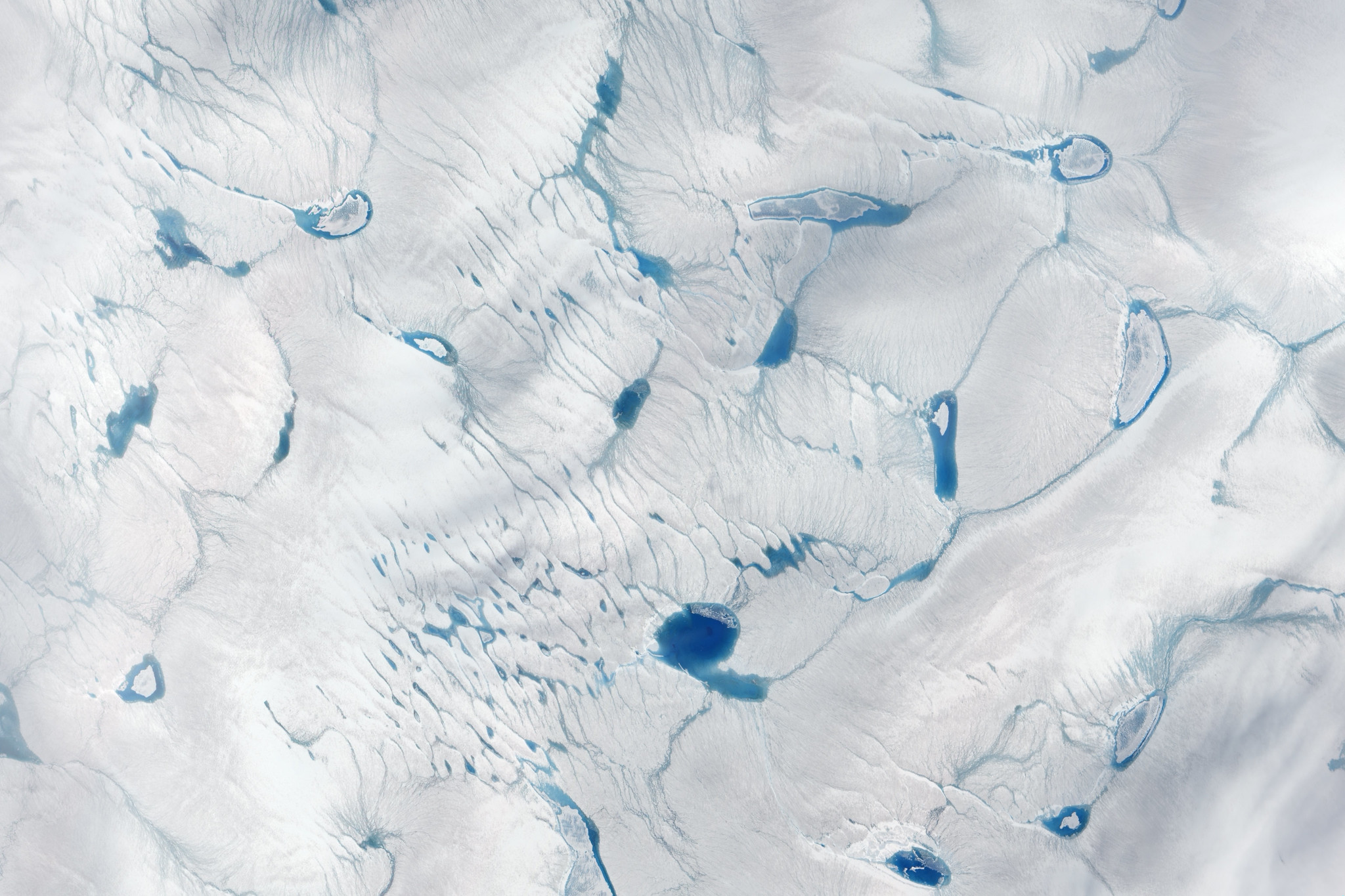
The Greenland Ice Sheet is close to a melting point of no return
Once we emit about 1000 gigatons of carbon, much of the massive ice sheet will melt irreversibly. We’ve emitted 500 gigatons so far.
AGU Newsroom
183 points · by geox · 3y ago · 209 comments
This article’s title and its content are completely at odds. Here’s a critical passage:
> As the ice sheet melts, its surface will be at ever-lower elevations, exposed to warmer air temperatures. Warmer air temperatures accelerate melt, making it drop and warm further. Global air temperatures have to remain elevated for hundreds of years or even longer for this feedback loop to become effective; a quick blip of 2 degrees Celsius (3.6 degrees Fahrenheit) wouldn’t trigger it, Höning said. But once the ice crosses the threshold, it would inevitably continue to melt. Even if atmospheric carbon dioxide were reduced to pre-industrial levels, it wouldn’t be enough to allow the ice sheet to regrow substantially.
> “We cannot continue carbon emissions at the same rate for much longer without risking crossing the tipping points,” Höning said. “Most of the ice sheet melting won’t occur in the next decade, but it won’t be too long before we will not be able to work against it anymore.”
So…we potentially have hundreds of years to bring temperatures back down before the “tipping point” triggers? Forgive me for not being super alarmed.
100 years ago we’d just barely started dumping carbon into the atmosphere. That is a long time.
EDIT: to be clear, yes of course it not enough to stop dumping carbon into the atmosphere in the next hundred years, but it does give us (potentially) decades to figure out large-scale carbon capture and sequestration even if we exceed the thresholds described here (1000 gigatons).
> But once the ice crosses the threshold, it would inevitably continue to melt
Bear in mind that the atmosphere retains carbon dioxide for ~50 years, that other melt events are dumping methane into the atmosphere from permafrost. It's not just one factor heating the planet.
People think of climate change like a river. You reduce emissions, you reduce the size of the emissions, you reduce the size of the problem.
But it's more like a bathtub. Emissions are the water filling the tub, but the real problem is the water level already in the tub. If you reduce emissions, you reduce the size of the flow into the tub. But....water is still flowing in and the water is still rising.
If we had zero emissions it would take earth systems much much longer than 50 years to bring things back down to where they were.
It's 300-1000 years [1].
[1] https://climate.nasa.gov/news/2915/the-atmosphere-getting-a-...
To further reiterate:
hundreds of years or even longer for this feedback loop to become effective.
Though, generally for emissions we are talking about a first order derivative. Just because you've slowed down from 100 to 50 does not mean you won't still run out of roadway.
So, if we are a hair away from that tippingpoint, and magically go to zero emissions, we'll still hit the tipping point. Hence, it's not two lifetimes, but that is the total runway left so far for this.
You can also consider the other extreme where CO2 is dumped into the atmosphere that everything shortens up. Another analogy, boil some water, put it off the burner, drop a small amount if ice in the water. The water won't cool off fast enough for the ice to not melt. It may take 10 minutes for that to happen, but the point of no return was when the water started at a boil.
"Between 65% and 80% of CO2 released into the air dissolves into the ocean over a period of 20–200 years. The rest is removed by slower processes that take up to several hundreds of thousands of years, including chemical weathering and rock formation. This means that once in the atmosphere, carbon dioxide can continue to affect climate for thousands of years."
During the time of elevated CO2 levels, the temperature continues to rise.
Previous research identified global warming of between 1 degree to 3 degrees Celsius (1.8 to 5.4 degrees Fahrenheit) as the threshold beyond which the Greenland Ice Sheet will melt irreversibly.
We've also known about the global warming problem in great detail for well over 50 years at this point. Since then we haven't figured it out but made it worse -- most of our cumulative emissions have happened in just the last 50 years. Why do people still think we can figure this out in a matter of decades without having to drastically change our fossil fuel habits?
Because people haven't come to terms with the fact that humans are not Children of God nor disembodied Cartesian rational calculators, but actually a loquacious and smartish hominid, designed by selection for small group interaction. There is nothing to suggest this species is capable of planet-level cooperation towards a communally-decided end.
Add to that the fact that path-dependent history has placed that species today in a situation where it's organised into huge 17thC mutually-hostile groups ("States"), incapable of anything more than opportunistic cooperation because of their religious and anachronistic founding concept ("sovereignty"). Most people have no idea that this contingent organisation is not the natural and inevitable state of the world, so aren't open to the possibility that it dooms them to sclerotic inability to face today's challenges.
I'm just going to put it out there - our progeny is going to hate our guts.
Then again, maybe afterward humanity will hold us up as an example for what not to do, how not to solve global problems. They'll be able to use history to quickly and effectively shut down the naysayers. Of course that's assuming they bother to learn anything from history...I mean we sure as hell haven't!
Once we've emitted enough CO2 to reach 2 degrees warming, it will almost certainly happen that all the ice melts. And there's a point where that will be certain, even if we learn how to remove all CO2 we emitted from the atmosphere. Is how I read it.
The ice on this island is enough to cause about 7m of global sea level rise on its own, iirc.
If so, sed 's/cool the planet/cool Northern Europe/' Though yes, it'd be locally pretty dire for agriculture. Maybe they could switch to farming fish in all the newly-flooded lowlands...
https://www.earthobservatory.nasa.gov/features/CarbonCycle/p...
The effect is real, and big enough to feel with the naked skin. One generally says one kelvin per 100m elevation, although the Greenland surface will be different from that rule of thumb.
That's not true in Europe nor Asia nor South America nor Africa, although I didn't climb mountains specifically in Greenland to be factual. Better value is cca 0.6C per 100m, or 6C per 1km (sorry, no conversion to feet/yard vs F and similar fun games for lazy sunday afternoon... seriously, with all the love, fix this shit guys, we are not living in 15th century when similar stuff was common and accepted).
It depends on many factors including humidity and local meteorology.
That part discussed about moving surface down doesn't make sense - you can lower glacier only to base rock/soil level. But at this level, where glacier starts, its already the dreaded temperature they want to avoid, so glaciers should be melting from the bottom with this logic. If they mean that once ice melts the rock temperature rises well yeah, that's a no brainer, its a different surface. Ice has surface temperature below/around 0, any rock hit with sun can easily surpass that even during winter.
I know reality is more complex out there, one of my todos is to have sleepover (no tent) on nearby Mer de Glace in Chamonix, France. Just me, gazillion stars, mountains crumbling around me and glacier cracking beneath my ass.
Yes, that's generally what happens to glaciers even ignoring climate change. The bottom melts, but is replaced by snow/ice that accumulated on top. Glaciers grow top down, not bottom up. But, if you lower the top so it's warmer, less ice accumulates, which can't replace all that melts, and so you get net shrinking.
It feels very short sides.
I'll almost be relieved when we're officially inevitably fucked... at least these "nearly there!" articles won't keep popping up.
1: https://tenor.com/view/truck-crash-test-pole-doesnt-reach-gi...
The front of the train has already hit the pole. Cars nearest the front are already crumpling, killing thousands and leading millions to migrate farther back into the train.
Meanwhile, those of us fortunate enough to be in cars farther down the line are starting to get cynical about doomsaying because when we look around us, all of our cars seem mostly fine. Sure, maybe we hear a little rattling (food prices, heat waves, more hurricanes every year), but that's just random chance, right?
And, sure, maybe it seems like more and more people keep showing up from cars closer to the front with the luggage and settling into our cars, which are—if we're totally honest—starting to get a little crowded.
But the train is fine, right? We look out the window and the scenery is still trundling by just fine so there's no reason to stop the engine, right?
Bearing in mind that extreme weather events have been killing people in large numbers since there have been people to kill in the world, please name at least one specific event or group of weather events that have unambiguously killed thousands of people as a result of man-made climate change. I'm honestly curious about what they might be, because I've seen many (in my mind partially dishonest) narratives in which a hurricane occurs, as hurricanes have occurred since the length of human civilization, and it's called a man-made climate change even despite a lack of concrete distinction.
Name at least one person who was unambiguously killed by smoking.
Nobody says 'game over' because that's not helpful. It can always get worse, and hope and action is the only way it ever gets better.
I think a lot about this article from Harpers in 2015: https://harpers.org/archive/2015/04/rotten-ice/
In it there are scientists that more or less say we were in mitigation phase then, not prevention.
The problem is you can't admit that we're officially inevitably fucked in public. If you did that, funding for climate science and climate mitigation would dry up, because there's nothing we can realistically do about it. Trust in governments would evaporate - the purpose of a government is to keep us all safe, but if we're all fucked anyway, it'll quickly become every man for themselves. Currency would lose its value, because it assumes that there will be a future better than the present where you might want to buy things. So everybody has an incentive to parrot the "Things are looking bad, we have a serious problem, but if we all band together and lower our emissions we can solve it!" line.
If we had taken Al Gore's warnings in the 80s and began an aggressive push to move off of fossil fuels then, we could perhaps have avoided the whole climate change problem. We didn't, and we can't now. Instead, the rational approach is to accept that the climate will change, there will be consequences of this, and then do our best to avoid the worst effects of the consequences. That includes:
We should be building seawalls and flood barriers around major low-lying areas. Every major city should have an evacuation plan for how to get everyone out in a natural disaster. If the road capacity for this doesn't exist, we should build it. We need systems in place to deal with mass migration. We need housing tech, ways to quickly build housing in new locations because the population is soon going to be forced to move to new locations. We should be researching ways to add back the seed diversity that we've extinguished over the past 60 years, because major agricultural staples are soon going to be out of their climate windows. We need local renewable energy - the biggest benefit of renewables isn't going to be reducing carbon emissions (it's too late for that), it's divorcing ourselves from global energy supply chains that are going to get increasingly unreliable.
My wife works in climate investing, which was a sleepy backwater when she started 12 years ago but now is the hot field to be. There's billions of dollars in capital chasing hare-brained carbon capture schemes that have basically 0% chance of working. That capital should instead go into mitigation efforts, programs that accept that we're fucked but try to avoid the worst effects of that. But if anything, government policy is going the opposite way - we're making it harder to migrate, refusing to build housing or transportation infrastructure, telling people they're on their own when a hurricane hits, and centralizing seed ownership under Monsanto.
I am unclear why anyone ever trusted government or believed government would be the avenue for resolution of this problem
You either understand history, or you trust government, you can not both understand history and trust government..
The second people put their trust in government was the second humanity was fucked. In the best of time Government is like fire, is a troublesome servant and a terrible master.
>the purpose of a government is to keep us all safe
When has that ever been the case... The purpose for government is to provide a framework for non-violent dispute resolution, and to safe guard natural rights and property), and maybe form a national defense force. Not to provide individual safety and security.
>>Currency would lose its value, because it assumes that there will be a future better than the present where you might want to buy things.
No fiat currency actually needs the future to look worse than today to encourage spending today and discourage saving for tomorrow. This is why fiat currency required inflation, and why deflation is feared above all else with fiat currency. You have to have spending today, you have to have people spending in multiples of what they really have in currency (i.e debt spending) and you have to have that in perpetuity.
In short, Fiat Currency is a legal pozi scheme that is destined to fail at some point anyway....
Providing for national defense, non-violent dispute resolution, and protecting natural rights and property sounds an awful lot like "keeping us all safe". I'm not sure what else you think that could mean.
Well.. the second law of the thermodynamics guarantees that.
> The problem is you can't admit that we're officially inevitably fucked in public.
I see several people attempting to start a career off of just that, some of them are quite successful, even. It helps if you add a lot of theocratic and pseudo-religious ideology into your message. People need _something_ to latch on to after all.
> because there's nothing we can realistically do about it.
We are a dynamic species. My proposition is we are currently living through a sort of "modern dark ages." Government imposition and corporate monopolization are at all time highs, to the extent that most new wealth is captured and not used to create new technologies and to progress the species. This is an artificial situation and it is not sustainable.
If you let this cloud your judgement of what is possible you may arrive at this position and feel it is logical. I suggest to you that it is actually a form of insanity or odd religious fervor to actually believe this.
Perhaps, in afterthought, more generously it's a desire to not lose any current level of comfort that you enjoy while "realistically" being able to solve the problem. A solution to this problem will obviously require drastic and hopefully generally positive change, something we've been known to do sporadically many times before.
There is something we can do about it: we can keep improving, evolving, getting better. The solution will only be found in the future, with tools maybe outside of our grasp today.
Nothing is inevitable, until it happened. Till then, you and every other pessimist cand still be proven wrong. My money is on the creativity and ingenuity of the race that started in the trees, went to the moon and is currently birthing an even greater intelligence.
This article talks about 7m of sea level rise over the next couple hundreds of years. That's pretty bad, but its easy to imagine something even worse.
We won't know when we pass points of no return until well after we're past them (and even then, living in denial may be an understandable option). To know if the brakes will work, you have to actually step on the brake first.
But we have lost a lot of biodiversity as a result of global warming, yes. Things like palsa bogs which won't come back for a long time even if climate returns to preindustrial tomorrow.
https://en.wikipedia.org/wiki/Doomsday_Clock
Someone ought to make a parody clock at this point.
Case in point, if you've watched the news over the past week you'd expect Paris to be a warzone with protests everywhere and the city burning to the ground. A freind visited last week, going to all the usual tourist places, and said they didn't see a single protest or building burning. There was uncollected trash though - in neat piles next to the bins.
https://dailysceptic.org/wp-content/uploads/2022/12/image-35...
Also, the trend on graph only looks alarming because it's been truncated and covers a relatively short period of time. Go back to old IPCC reports and the graphs show levels were much lower than today and then grew rapidly at the start of the 70s.
The droughts, the floods, the fires?
But the melt rate is increasing with increasing average temperatures. Wikipedia quotes a melt of 5 E 11 tonnes in 2019. Perhaps the doubling time is about 10 years? At that rate it'd take about 5,000 years to melt away.
Five thousand years is a long time only if the melt rate remains the same. If the melt rate continues to double every decade, then 12 doublings increases the melt rate to 4000 * 5 E 11 = 2 E 15 tonnes/year. Then the Greenland ice cap could be gone in about 120 years.
At that doubled rate it would take 5,000 years, but if that rate doubles every 10 years, at the rate 10 years from now, it would take 2,500, at the rate 20 years from now 1,250, at the rate 100 years from now about 5.
Greta Thunberg probably felt helpless. But she turned that feeling into anger, and that anger into action. Henry Rollins said he stays angry, because he doesn't want to accept what's wrong with the world. (I don't think he has as positive an impact as Greta, though)
You, yourself, cannot fix the world's problems. Neither can Greta or Rollins. But if you really feel like you're not doing enough, then hold yourself accountable. List the things you do every day to affect change. Just write down what you're doing. Then when your inner voice says "What the hell are you doing about it?", answer it. If your inner voice says "That's not enough", then do more. Or don't! But be at peace with your decisions.
Either many people who work in climate change have some serious critical thinking problems in this field, or the core ideas of good scientific thinking have gone down the toilet for climate change.
Serious question.
What impact has she had? I haven't seen any changes from her actions. People knew about climate change before she came around. What changes did she create?
WFH isn't just a pandemic response measure, it's a climate change measure. We should all fight to WFH, even if we hate it, to reduce carbon emissions.
People can't even write code now without it being a carbon intensive activity, it's pretty insane...we just can't stop.
Not quite easy to figure out "Which set of companies are hiring for a role I can fulfill?"
Edit: And within moments, I of course find the URL to do exactly what I want: https://climatebase.org/organizations?l=&q=Engineering%3A+So...
and then realize the dirt poor uneducated masses already have a low carbon footprint because THEY'RE DIRT POOR
More practically, try to downsize your life and carbon footprint. Avoid the performative virtue of buying lots of "green" things. (Many goods like EV's have a huge carbon footprint to manufacture. And eco-tourism via airplane is right out.)
And maybe donate to a non-profit or two that are trying to mitigate the harm that climate change is causing to people much less fortunate than you.
You can't build long-distance UHVDC power lines yourself. Really big changes can only be done at the state level. If you need a new car, an EV is still better than a new gas car, but having public transport and rail network is even more efficient. But you can't create a properly functioning well-funded transport system yourself.
As an individual the best you can do is insulate your house, and if you need heating, get a heat pump. Domestic heating/cooling energy use is significant, and needs to be electrified before it can be decarbonized.
Some things like rooftop solar panels + batteries do work, but that is offloading switching costs to individuals, while the fossil industry is still getting subsidies. Grid-scale solar farms and storage are more cost effective. Wind farms are even better, but you can't build ones tall enough in your backyard.
The policies which are currently in place are not there because of the desires of some handful of politicians but because of the desires of the masses. If you'd banish all the current politicians, their replacements still wouldn't be able to enact policies of rapid decarbonization, degrowth and an actually enforced major reduction in consumption of energy, goods and transportation, because their constituents wouldn't accept that.
Distend social media and focus on high-quality, low-throughput content. Rationality is not based in the vox of the masses.
This required giving up on some other goals though. I don't know that there's a lot you can do that is sacrifice free.
I've also gone to a mostly vegetarian diet -- preferring to source meat only from local farmers I've met in person. If I haven't met the farmer, I won't eat the meat. This reduces the amount of meat I eat, but still lets me seek it out. Maybe this helps, maybe it doesn't, but it's a pretty easy rule to follow that doesn't require me to be a strict vegetarian. I can have my beef stew as a treat, but also know that I'm not contributing to a massive industry of wasteful excess with every meal.
This can be a refuge for thousands of animals, give you tons of cool stuff to watch go on in your back yard, and it'll almost certainly save you money as the plants won't struggle to grow and thrive in your area.
That's going to depend on the individual. Some people feel just fine driving a hybrid automobile every day as their big contribution. Some people quit eating meat, quit flying, quit driving altogether, and some even protest. Of course there are many options and many different levels of guilt and helplessness that individuals deal with.
But perhaps you could address your need to feel like you're doing something. You don't have to do anything. You can give yourself some slack. This isn't a problem that you caused, and it's not a problem you're going to solve.
What do you do when a loved one is in the later stages of terminal cancer? Do you fret and feel like you need to do something? Do you yell at the doctors to try one last thing? Do you cry over loss? Maybe but eventually in a healthy person that will all end. Once someone is in hospice, it's time to work toward acceptance and appreciation and to try to enjoy the last bit of time left as much as one can. We're in a sort of planetary hospice situation right now.
You feel like you're changing nothing because you are. It's logically impossible to have an impact as one person of billions.
That said, there are other related causes you can give time and effort to that have a direct positive impact, such as volunteering in ecological restoration in your free time. Protecting native biodiversity and restoring ecosystems— which are becoming every-more-threatened due to climate change, habitat fragmentation, and invasive species— is very rewarding work, and more accessible than most people realize. No prior experience or tools needed, just time and energy. You can search for "environmental volunteering" or "ecological volunteering" for wherever you live, and decent odds there are options for you to choose from.
Otherwise you have to make green choices a win/win or change people’s minds.
EVs are a good example of a win/win. Most people weren’t willing to sacrifice range or power in their vehicles. But now that the range and power is there and electricity is cheaper than gas it’s more of a win/win.
Changing minds is a lot harder.
The "political" problem is how to solve the economics problem. As long as society "subsidizes" damage to the environment, by not charging the damagers, then damage will continue to be extremely lucrative and near impossible to stop.
But the incentives for Big Energy to resist change are so huge, that I don't see a timely solution without explicitly co-opting them.
I.e. solving their economic problem to solve our environmental problem.
Get every Big Energy CFO into a room and establish what kind of incentives they would need to find hard CO2 drawdown legislation a financially attractive opportunity worth pursuing with greener alternatives en masse.
New massive subsidies for Big Energy would not be a fair use of citizen's taxes. But the alternative of continuing to "subsidize" their destruction of the environment is far more costly.
And the side benefits of greater energy security and independence, international stability, etc., would be worth a great deal too.
We have to develop technologies that improve our efficiencies and reduce our emissions.
Don't over stress it though. You can't change the world but you can set great seeds with examples.
Respectfully, I think a better plan is to work hard to reach a position of power and/or leadership, and then make changes that affect millions. Minor changes in my household have relatively zero impact in the big picture.
That's also true of hundreds of global and international problems.
The best approach is to accept that which you cannot change.
Everyone should fight to WFH, even if you hate it, because the benefit to reducing carbon emissions is known and significant.
You can be conscious about your consumption and set great examples. Or you can decide you don't care and keep ordering stuff on amazon every day, shove meat and fish everyday in your mouth, change car every few years while flying regularly and pretend is somebody's else problem.
And yes, your or my individual vote will never determine an election. I know this and still vote.
They use satellite data to check that various countries and companies keep their promises. E.g., a country receives money based on the promise that some rain forest is protected, then they are paid to check that no logging takes place there.
That's one of the few use cases for software that I believe can actually help.
That's based on the assumption that the CO₂ removed from the atmosphere is worse that the produced nuclear waste.
buy stuff as if the garbage man does not exist...in 1880 they didn't have trash removal
buy one set of clothes you wear pretty much every day until they fall off of you
buy a few tools that will last you forever
no more disposable anything, remember the trash man doesn't exist
wash clothes by hand
cook everything yourself, even better grow your own food
sorry no biking, rubber is an industrial process...you walk everywhere just like great grampa did
no need to worry about fossil fuels...you won't be using them in any capacity other than maybe a nice fire in the winter in your wood burning stove which will be the only "appliance" you own (good news - they last forever!)
etc etc
this is probably what sustainable living looks like until we get star trek matter synthesizers
you'll never get a date living like this but you'll also never again worry about 98% of the crap of modern life
This is ridiculous. If petroleum were used solely to produce bicycle tires and things like seals for appliances, the world would be unimaginably 'greener'.
That entire list is just disingenuous, defeatist nonsense.
Sure, manufacturing a bike takes some energy, but there's huge value in people using e-bikes to get everywhere.
Get the best minds in the world together and ask for an action plan for salvaging climate within two generations...100% chance it will be some variation of "live like its 1880"
>sorry no biking, rubber is an industrial process
Bicycles had rubber tires as early as 1870 and before that, rubber was widely available in the 18th Century.
If you're going to snark, at least snark correctly.
There are plenty of people around the world that live like this and want to raise their family this way.
And lots of intentional living communities.
But location is everything.
You're doing the right thing. Saving the planet isn't sexy. It's getting a few more years out of your old car instead of buying another. It's skipping a few generations of iPhone and making your current device last longer. It's skipping that vacation to Aruba this year. It's researching dozens of brands at your supermarket and being a patron of those with better practices, rather than those you prefer.
"Stage 1: We say nothing is going to happen.
Stage 2: We say something may be about to happen, but we should do nothing about it.
Stage 3: We say maybe we should do something about it, but there's nothing we can do.
Stage 4: We say maybe there was something, but it's too late now."
By means of initial subsidies renewables are now producing cheaper energy than fossil sources. This causes the normal market forces to act (economies of scale, tipping points, etc.) which make it very likely that renewables will be the predominant energy source of the 21st century.
We, as humanity, know what causes it, why it happens, what can be done to stop it, and even a few things to revert parts of it. The knowledge is there. Scientists proved things. Engineers built stuff.
The literally only thing is that we are currently unable to stop this madness because of a lack of… motivation to do so.
There are numerous reasonings why this is the case, from inequality to geopolitics over profitmaximization up to straight out lying and denial. Many indeed have a point somewhere. It’s just that it doesn’t matter if they have a point - the global problem must be stopped, now.
Maybe… while many of us here on HN are busy prompt engineering AIs… could we use that momentum to craft arguments for every single person not willing to act for humanity?
Everyone who 'doesn't believe in' climate change has a vested interest in maintaining the status quo - they profit from fossil fuels or from misinformation, or they're narsessistically enjoying other people's discomfort from their arguments, or they're just stupid. There is no point trying to convince them. We have to fix the problems without their help.
https://cei.org/blog/wrong-again-50-years-of-failed-eco-poca...
Is the climate not changing then? Of course it is, always has and always will. Do humans not influence the climate then? Of course they do, especially since the industrial revolution. Does this portend a catastrophe? Well... there opinions vary. I'm convinced the changing climate will poise some problems which will be dealt with - just like humans have always dealt with the changing climate. The difference here is that there are more humans - which could make things more difficult - who have more advanced technology - which will make things easier. Assuming cooler minds prevail and the sabre rattling around the world does not lead to a bigger conflict I'm convinced humanity as a whole will make it through whatever changes the climate makes to come out richer and more advanced still.
Would we be better off if we were not as reliant on fossil energy sources? Yes, we certainly would given the pollution - and I'm talking about true pollution here, not CO₂ - involved in the winning and use of these sources. Build more nukes, get serious with fusion, develop a sane form of hydrogen storage, go for it. Not because of the climate boogeyman but because of the above reason as well as the fact that these energy sources are concentrated in some of the more troublesome regions in the world where they have already led to numerous conflicts.
Do I trust climate models? No, I do not and with reason. I did study this stuff a few decades ago when the models were 'less advanced' than they are now. I know of too many fudge factors in these models, too many adjustments which are made to make them follow the observations where the reason for and effect of those adjustments are not understood. From what I have been able to keep up with things are not much different now - apart from far faster computers and more complex models with more parameters and their accompanying fudge factors.
[1] https://therionorteline.files.wordpress.com/2018/07/lead64.j...
Nothing has worked on a scale large enough to make any difference.
Greed and nationalism and small mindedness and selfishness and war prevent humanity from addressing its fate.
It's going to be nasty future for those who survive and this period will simply be the time in history in which humanity knew and did nothing.
Every time you lay down on your pillow,
your eyes close on a world to which you can never return
Thus it has always been and always shall be
For example, you could measure a hamburger in front of me. Predicting when, and if, I’ll eat it is much harder.
Scientists (TM) and the private plane travelling climate circus are sure that this will cause the temperature in the year 2100 to be reduced by a whole one hundredth of a degree.
[1] https://www.georgesoros.com/2023/02/16/remarks-delivered-at-...
I haven't yet seen a graphic yet that explains the calculation, and I'm left cynically thinking that they are mistakenly using a Mercator projection when calculating the contribution for Greenland.
https://en.wikipedia.org/wiki/Mercator_projection#/media/Fil...