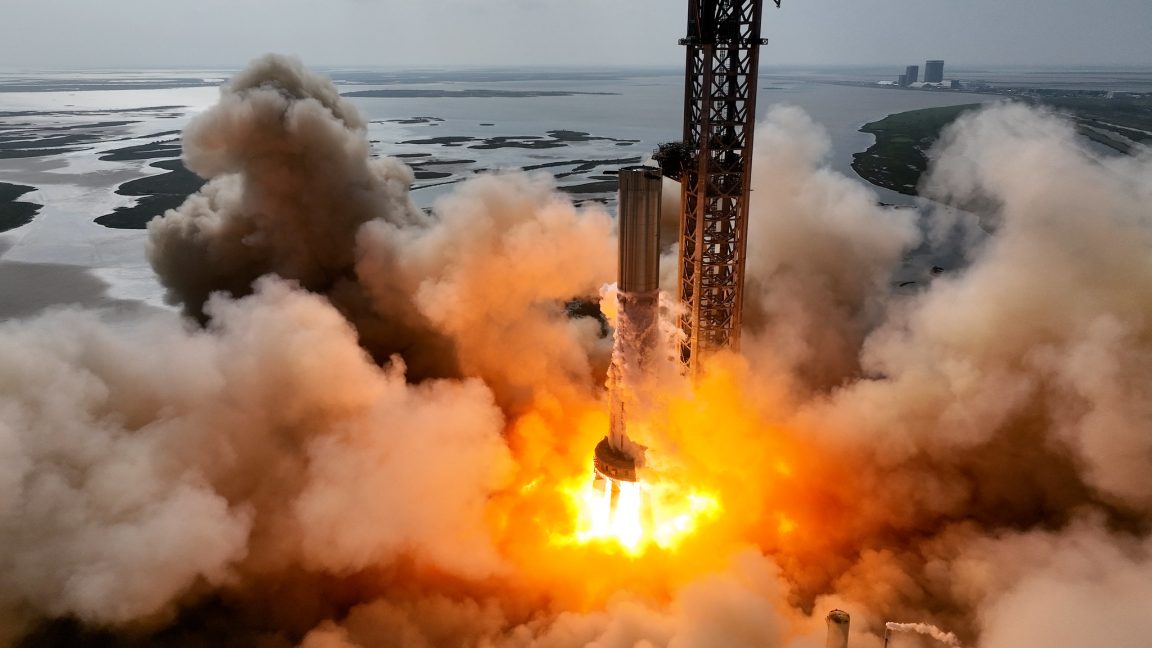
SpaceX moves Starship to launch site, and liftoff could be just days away
No fooling—Starship rolled back to the launch pad on April 1.
Ars Technica
285 points · by kristianp · 3y ago · 236 comments
I'll be legitimately happy if it doesn't explode on the launch pad and at least gets any debris into the ocean instead of on land. This is just the beginning.
But wouldn’t it be amazing if it did make max Q, then coast, then ORBIT on the first try? It’s never happened before. But imagining the possibility gives my imagination a little bit of awe.
Starship would be the first system to run purely on our optimism! ;p
https://stanfordreview.org/stanfords-dark-hand-in-twitter-ce...
https://nypost.com/2023/03/24/malinformation-censors-excuse-...
https://www.wsj.com/articles/white-house-covid-censorship-ma...
That's only garbage if you believe democracy and liberty are garbage.
it's a bit fun to imagine that is the case. It is reminiscent of the "buy the whole farm" scam discussed in the film "Django Unchained". In which a huge outlandish performance is made with the stated intent to buy one seemingly desirable (in the eyes of the seller) item, but buyer's the real item of interest is disguised as just something that comes as part of the sale.
They can test / simulate as much as they want on the ground but the first full launch is bound to reveal issues.
Best case those issues just stop it from reaching the desired level of performance, more realistically they mean it goes boom at some point.
Pegasus (company's first try overall), Antares, all of the Minotaurs, Atlas 3 and 5 might count as new... Epsilon, H-2 (new?), Vega, Ariane 1, 3 & 4... And the Ariane 1 is both totally new on a systems level and an institution's first attempt at building one. Long March 5, 6 & 7.
Of the investor-backed launch startups, I think it's either no company got it first try... or Orbital Sciences counts as making it first try with Pegasus. Not sure if they count as an investor backed startup.
Speaking of previously proven technologies... the Space Shuttle made it to orbit on it's first launch attempt as well... with crew.
Once it is well-clear of the pad – blowing up is a lot less bad. But still, ideally they want it to make at as far through the flight plan as possible. If it blows up early in the flight, there's a lot of stuff that happens later they won't even get the chance to test this time around. Sure, they'll get the chance to test it next time around – but that'll be another delay in an already delayed project.
(This isn’t supposed to be a dig at SpaceX… just a factual statement. I find this risk-tolerant approach to be inspiring, actually.)
And knowing you have an issue is half the battle.
Similarly probably one regular camera in each tank and similar pressure and temperature sensing. With the engines, IIRC these are refined Raptors which don't have the "christmas tree" of instrumentation, so probably just pressure and temperature in all the key areas.
This feels like quite a difficult reality to internalise given we all grew up seeing only a select few exceptional people, with the stars aligning in their career, be able to do that.
Hopefully, SpaceX will set up some kind of excursion package where you get a Starbase tour, a primo front row seat to a launch and a limited edition T-shirt. Forget Taylor Swift tickets for >$1K when Starship can literally rock my world.
We might be less than 50 years out from Starship or similar launches being as boring as a plane taking off or a train passing by.
I'd even lay 50%-ish odds that they'll do back to back payload launches in 30 days or less by the end of next year. That'll of course depend on things going very well over the next few months so they manage to get a Starship to orbit and back on the ground at the launch site this year.
I think astronauts usually go through very rigorous testing and training. And I'm not sure that is something we can engineer ourselves out of.
> When it comes to the G-Forces being pushed on you, many roller coasters have peak G’s at or above these limits. Most people are probably familiar with the different rides at Walt Disney World so let’s use those for examples. At EPCOT, Mission Space is a centrifuge-based ride where you go through a simulated launch and landing on Mars. The sustained G’s on that ride is 2.5 G’s, close to how many G’s New Shepard will experience during launch.
> For the descent, Blue Origin says you must be able to withstand 5.5 G’s, if you ever rode Rock ‘n Roller Coaster at Disney’s Hollywood Studios, you would have experienced up to 5 G’s during the initial launch of the ride.
Epcot Mission Space (the "Orange" version) is pretty intense as it's really sustained G-forces, but manageable. During the ride, you have to reach in front of you to press some buttons, and that's when you feel the G-forces most. But for SpaceX/BlueOrigin, passengers do nothing.
Rock n Roller Coaster itself for the peak G is done by kids, not a big deal.
3g is low enough that most humans shouldn't black out, even without training.
I'll also point out that professional astronauts are expected to remain functional for the entire assent (including emergencies, where g forces might peek much higher), which is not required for passengers.
I remember reading that the Titan 2 pushed so hard that even the astronauts, who were pretty tough test pilots back then, were happy when the engine finally shut off.
Forces depend a lot of the specific vehicle. The space shuttle peaks at 3 G, I've seen numbers from 3.6 to 4.5 (again peak) for Crew Dragon on the way up, 3-5 on the way back. Soyuz seems to be 4 on a good day and 10 on a bad one, plus the momentary forces during landing.
Since we put anyone willing to pay a few bucks on carnival rides that sustain (!) up to 3 G for minutes, and the profile can likely be adjusted at the expense of reduced payload capacity, I don't expect this to be a big problem.
Don't get me wrong, Shatner has worked hard to keep himself in shape. And he didn't get to orbit. But if you keep in shape (and are rich or famous) it may be an option.
To me it seems if we see orbital success in the next 5 yrs, mass production of starship thereafter and SpaceX sticking to their Earth-to-Earth transport idea - this seems plausible. Airliners developed about as quick, but then again its a far harder environment - it's nice to dream.
[1] https://www.youtube.com/watch?v=zqE-ultsWt0
(edit rambling on about the wrong system)
Even if Starship delivers everything promised, I doubt orbit would be within reach of wage earners. Similarly we could afford to pay for a ship to drop a few tons of rock off Guam, but going to the bottom of the Mariana trench and returning alive would be a different kettle of fish.
I imagine the price of getting mass back down from orbit would bump your cost up a bit right?
Forget tourism, at that price beaming solar power back to earth approaches viability.
In a speech to USAF in 2019, Musk said SpaceX's out of pocket cost per launch could be "maybe like $2 million," which would be about $20,000 per ton.
Adjust numbers for inflation accordingly.
A shame we won't get to see the booster land. And it sounds like they aren't trying to capture the upper stage either, unless they have a really big drone ship.
They did the same thing with the early Falcon 9 landings, bringing them in to a "soft" landing over a set of GPS coordinates in the ocean. Once they can demonstrate this process to a certain degree, they can start working through the permitting process to try actually bringing them in over land.
Possibly similar with the upper stage too, just so they can practice and learn.
Also, Elon just said "(Orbital Flight Test) More than days away, but hopefully not many weeks away"
I find it amusing how close this sounds to your average run-of-the-mill Early Access steam game. "Next patch will be more than days. And more than weeks. But not more than many weeks! Probably... We hope...I think"
The only thing that would be a failure is if it blows up on/near the pad and damages the facilities they've built over the last two years or so that would put another delay in the testing regime. This rocket is significantly more "slapped together" than past rockets and has been designed in a way to minimize cost as much as possible. It would be extremely surprising in fact for this flight to be a complete success.
1) Significant failure: the rocket catastrophically fails on the pad, damaging the ground equipment significantly.
2) Program setback: the rocket clears the pad, but fails to reach Max Q and requires significant redesigns (we might see some built prototypes scrapped if that's the case) or if the ground equipment needs significant redesign or repair after launch; I exclude the addition of deluge from that since it probably won't be there for first launch, but is already planned for installation.
3) Somewhat successful: the rocket gets off the pad and fails to reach Max Q, but the failure is the result of some less fundamental issue such as valves getting stuck, etc. causing termination of the flight.
4) Success: the rocket gets past Max Q without significant issue.
5) Very successful: Ship achieves planned trajectory.
And everything thereafter is just gravy (soft landings, tiles not falling off, etc).
All rockets, including those well out of their testing programs, will abort/scrub at some point. Just this past week a Falcon 9 mission out of Vandenberg AFB was automatically aborted at 3 seconds and then rescheduled a couple of times before successfully delivering its payload to orbit. I would count that a success: they didn't destroy the rocket, they didn't destroy the payload, and they got the payload to where it was suppose to go. Successful despite the abort.
The only case I can think of where an abort would indicate a failure would be if they have to pull the rocket off the OLM and do extensive modifications or redesign on something. I don't anticipate that... that kind of problem almost certainly will end in some flight anomaly rather than an on-pad abort. We could say that the SLS rollback to the VAB was this kind of failure, but it was relatively minor... they fixed some stuff that they couldn't do so at the pad, but didn't really do any significant redesign or rebuild. I don't expect that sort of scenario for Starship. Starship isn't dealing with finicky liquid hydrogen and appears to be overall much more serviceable than SLS.
Is this for a reusable Starship, or just the lunar lander mission for Artemis?
Rather than giving them a budget of $X to accomplish goal Y, specific rocket designs and decisions are written into the budget to try to ensure facilities and contractors in various states are given a slice of the pie.
SpaceX's success has come with direct partnership with NASA, within specific projects where those inside NASA fought to run the development as an open bid for commercial services, rather than as NASA-engineered projects with work doled out to cost-plus defense industry contractors. SpaceX is not the only beneficiary of these projects, the goal is to try to cultivate multiple successful service providers that can sustain their own businesses.
There has been plenty of opposition to these commercial bid projects within congress, but the success and efficiency of these projects so far have made them hard to argue against.
NASA also wrote SpaceX checks for the development of Falcon 9, the Dragon cargo capsule for space station resupply missions, the Dragon crew capsule for space station crew missions, and various other probe and satellite launches along the way.
I think these were good contracts that benefited both organizations massively, let SpaceX survive, and let NASA contract for services without paying the entire development cost since that was shared with SpaceX's own investment and other customers.
But it's definitely not a situation that can be boiled down to SpaceX vs NASA, it's been SpaceX and NASA together since the Falcon 9 development program began.
SpaceX can take as much (bussiness) risk as Musk deems acceptable
Some of them, though, really know what they're doing and are just better at doing stuff.
SpaceX want (and need) to deliver the best viable product to market as soon as possible, everyone involved is focused on this singular vision.
NASA will have its funding cut or expanded on a 4-8 year basis. Politicians, agencies, states and other companies will lobby to get investment in their preferred areas. Even scientists/departments/entire universities will lobby to get their personal pet projects on to a mission to further their own agendas.
Frankly im unsure how a public space program can even operate most the time.
Also NASA is a former of it's self, funding wise.
The difference is that a faction within NASA has been fighting to run these and other projects as open-bid commercial service contracts, where NASA can provide detailed requirements but not dictate specifically where and how the vehicles are built, and this has encouraged diversity and competition in these markets.
Traditional NASA development projects (like the SLS rocket) are micromanaged by congress in the budget, where congress dictates specifics of rocket design to ensure specific contractors in specific states receive a slice of the pie in defense-industry style cost-plus contracts.
If that were to play out, that would mean the demand for building the AI ecosystem would only increase, and even if it were for off-world deployment, it would still disrupt industries and economies on Earth.
24 minutes between Earth and Mars isn't horrible (although that is a 48 minute round trip to get an answer) but if people were living in a colony then even the current generation of LLM AIs could significantly improve daily life.
  - energy yield of weapons
  - ratio of their AI's IQ to theirs
  - cost/mass to orbit
On the other hand, it might be a lot more possible for a civilization on one planet to win a nuclear war against a civilization on another planet. Same with bioweapons: on Earth it would be stupid to try to use an "enhanced" ebola or COVID or bird flu as a weapon because you'd infect your own people as well as your adversary. But if you're separated by a great distance, that's less of a concern.
In a way, the "dark forest" interpretation is too optimistic. The assumption is that one species will always try to destroy another independent alien species if they find one. But I wonder if it's even worse among members of the /same/ species but different cultures that are separated by a great distance.
Will come? It is here. Have you not heard about intercontinental ballistic missiles?
In that case I have this bad news for you. Multiple actors around the globe maintain the capability to fling warheads at others (through space).
Not sure what you mean by “destroy ourselves”, but our capability of destruction is not constrained by cost/mass in orbit.