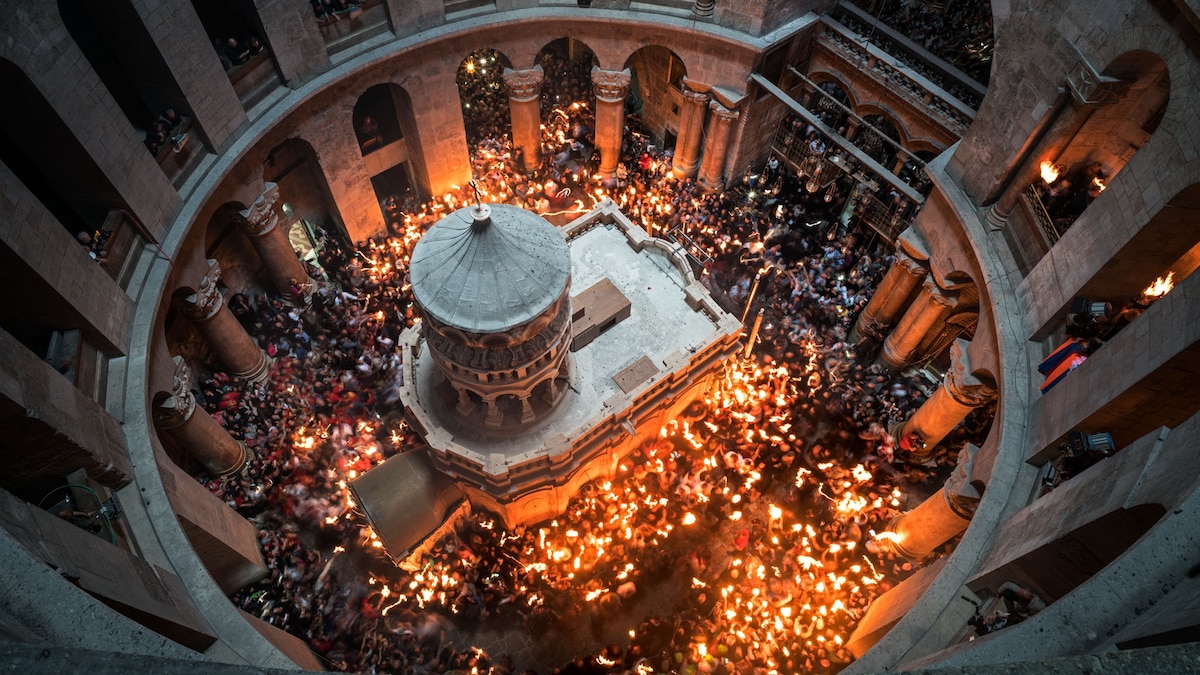
What archaeology is telling us about the real Jesus
Believers call him the Son of God. Skeptics dismiss him as legend. Now, researchers digging in the Holy Land are sifting fact from fiction.
Magazine
41 points · by Brajeshwar · 3y ago · 97 comments
There almost certainly was a man from Nazareth named Jesus (we have pretty good unbiased sources there).
However, unless you are a follower of his (or potentially some related religions), there are obviously mystical things associated with him that you likely do not believe to actually have happened. Even followers disagree about the veracity of certain stories.
So where does that leave us? There is undoubtedly a “real” Jesus, but was he anything like the person we think we know? 2000 years of being one of the most famous people ever is certain to leave a skewed perception of who you are. Hell, we don’t even know the true story of celebrities and religious figures today.
Unfortunately, much of the discourse about this seems to be heavily biased, cloistered (literally), or commercial (Nat Geo and History seem to butter their bread with this topic each spring).
And ultimately does it matter? How many of the attributes stories would need to be proven false to make Jesus seem “not real”?
What made rome react to these movements the way they did, were they able to identify the real risk they posed (it did end up becoming a massive source of unrest and radicalism in the empire), did they understand the risks inherent in martyring apocalyptic religious leaders?
It's also a good entry point for understanding the process of history as a practice and discipline. For example we can be pretty sure jesus was from nazareth because it's mentioned in mark, the earliest gospel, and nazareth was a nothing place nowhere, there's no reason to fabricate an important figure being from there. Similarly his nativity story is probably a later attempt to link him to bethlehem, a city of deep significance to jews at the time. That's an interesting technique! There are lots of those, historians aren't just people who know facts about history, they are practitioners of this discipline.
It's one of the most researched, most discussed subjects in history and the movement that started there is one of the most impactful regardless of your personal relationship to it. So it's a good place to get an understanding of the concepts and techniques of history and historicity.
I don't think so. The pagan "religions" were not very big on "everyone, even the poor, the sick, and the lame, is equal." Slavery was accepted almost everywhere. Women were very definitely second-class citizens. "Giving charity" was not a central concept in the Greek moral universe.
I mention the last one especially because in the pre-Constantine era, the notion that other Christians were your brothers and would take care of you was pretty powerful. That was not a common thing back then.
* Polemarchus claims that justice is helping one’s friends and harming one’s enemies and that this is what one owes people (332c). Socrates’ objections to Polemarchus’ definition are as follows: (i) Is this appropriate in medicine or cooking? So in what context is this the case? (332d)? (ii) The just person will also be good at useless things and at being unjust (333e). (iii) We often do not know who our friends and enemies are. Thus, we may treat those whom we only think are our friends or enemies well or badly. Would this be justice? (334c). (iv) It does not seem to be just to treat anyone badly, not even an enemy (335b). Discussion between Socrates and Thrasymachus follows (336b-354c).*
* Adeimantus complains that the guardians in the just city will not be very happy (419a). Socrates points out that the aim is to make the whole city, and not any particular class, as happy as possible (420b). Socrates discusses several other measures for the city as a whole in order to accomplish this. There should be neither too much wealth nor too much poverty in the city since these cause social strife (421d-422a).*
Jesus wasn't anti-slavery, because he was a Jew and slavery is directly supported by Jewish law and scripture, sometimes with quotes from God himself. Jesus even commands slaves to obey their masters.
>Women were very definitely second-class citizens.
Read the Pauline epistles, particularly 1st Timothy. "I do not permit a woman to teach or to assume authority over a man; she must be quiet."
>Giving charity" was not a central concept in the Greek moral universe.
What linguistic root is the word "philanthropy" from? It isn't Hebrew[0].
[0]https://sofii.org/article/philanthropy-in-ancient-times-some...
Read any Hindu upnishads especially Bhagwad Gita[0]. Chapter 16 especially defines the code of conduct for good peoples. Here is the opening statement.
श्रीभगवानुवाच |
अभयं सत्त्वसंशुद्धिर्ज्ञानयोगव्यवस्थिति: |
दानं दमश्च यज्ञश्च स्वाध्यायस्तप आर्जवम् || 1||
अहिंसा सत्यमक्रोधस्त्याग: शान्तिरपैशुनम् |
दया भूतेष्वलोलुप्त्वं मार्दवं ह्रीरचापलम् || 2||
तेज: क्षमा धृति: शौचमद्रोहोनातिमानिता |
भवन्ति सम्पदं दैवीमभिजातस्य भारत || 3||
renunciation, peacefulness, restraint from fault-finding, compassion toward all living beings, absence of covetousness, gentleness, modesty, and lack of fickleness; vigor, forgiveness, fortitude, cleanliness, bearing enmity toward none, and absence of vanity.
Bible on the other hand is directed responsibility for the dark ages in which people were tortured for having different beliefs, women were burned for witch craft, believers in other gods were eliminated brutally. Scientists were killed for stating their theories. Remember Bruno was burned on stake for merely saying earth revolves around the sun. World history is filled with divine crimes sanctioned by Bible. There are hundreds of examples to read from history. For example Goa inquisition in which is Indians were tortured to death not because they didn't believe in Jesus. But because they also continued to believe in the gods they used to worship[1].
There are enough references in the Bible. One only needs to read it critically.
[0] https://www.holy-bhagavad-gita.org/chapter/16/verse/1-3
[1] https://archive.org/details/FrancisXavierSJTheManAndHisMissi...
Consider that passage from Flavius referencing Jesus. It is somewhat different in the Arabic translation version. Some people goes as far as to doubt if this passage is altogether an insertion of later christian scribes.
On the other hand, they usually argue that Jesus being born in Bethlehem is made up to match some old prophets, and then they accept that if Jesus was completely made up he would not be from Nazareth. (*)
There are more analyses like that in "Gospel of Afranius" by Kirill Eskov (who is known for "The Last Ringbearer"), and I found out only today that it was translated to English recently, wikipedia says Dec 2022. Enjoy!
(*) it is relatively rare that someone will observe that there could have been another settlement called Bethlehem just closer to Nazareth.
But they don’t know much more. They’re constantly trying add to that bare outline, but the additions are no more than speculation.
This speculation changes frequently. The changes are based in trends in historical methodology unrelated to the Christian faith.
Was Jesus a Buddhist? Did he travel to India? In the 1960s he did.
Are these historians actually adding anything? It doesn’t seem they are.
Historians can provide missing context. For example, when the demon says “I am legion”, it was probably not a reference to Roman legions.
But there really isn’t a historical Jesus.
Myths tell us about ourselves. The sad thing is when people distort or weaponize myth to control others for personal egocentric agendas.
Ultimately many of his apparent teachings seem to be timeless: finding joy in living simply; understanding that heaven is within; etc. Lots of overlap with Buddhist teachings on cessation of suffering. I'm not religious and still try to incorporate the beauty of these ideals!
It seems like it isn't an objective science as you're implying; how does one measure such a thing? There are so many garden paths that lead to horrible rigid dogmatism, which we know to be the case when reflecting on history.
What works for me is just incorporating the helpful parts that help me live a more harmonious life, while respecting philosophies of others and trying to do no harm. Perhaps not to you, but that is the point of Christianity to me.
(atheist)
And speaking of being 'historical', as in written down by a witness, there are things in the bible that strikes me as 'filled in'. I only go to church during easter, so it I had it read to me very recently.
Like the story of Jesus praying in Getshemane, it was supposed to be jesus' personal prayer, who witnessed that?
Or Jesus personal discussion with pontius pilate, again, who wrote that down? Maybe someone interviewed pilate again later, I don't know, that doesn't seem too plausible, as I never heard the name pilate written down again as one of the accounts.
Or when Jesus got tempted by the devil, again he was supposed to be alone. Did he tell his disciples afterwards, or is this completely creative writing (or oral as the first christians did it)?
These are just some of the thoughts I had while listening to the sermon. My point is I think that there was some artistic license in the whole mythology of Jesus. Maybe 'to make it flow better' or something like that.
The Religion for Breakfast has some interesting videos on the subject:
https://www.youtube.com/watch?v=4fyI1XOselI - Introduction to Biblical Archaeology
https://www.youtube.com/watch?v=SCy7NuujCLc - How Did the New Testament Form?
https://www.youtube.com/watch?v=yV9VPM7lIoQ - Did the Gospels copy each other?
Also: https://www.youtube.com/watch?v=Z6PrrnhAKFQ - Who Wrote the Bible (Useful Charts)
https://www.youtube.com/watch?v=XKp4yWGTfXo - 10 Changes Made to the Bible (part 1, Trey the Explainer)
https://www.youtube.com/watch?v=kX62bRIG-OI - 10 Changes Made to the Bible (part 2, Trey the Explainer)
In the case of Mormonism, we have tons of other sources from outside the faith, and the claims made by the faithful were largely recorded more-or-less as the supposed events were happening. Our view, and the religion itself, would likely be a ton different if our sources for all that were more like what we have for Jesus and the events of the Gospels. Plausibly, what survived might hardly have any basis in reality whatsoever.
At least those elements of the lore, I believe are constant from the very first followers. A story must have a connecting thread, even though it may have many modifications.
I'm just saying this from a storytelling perspective of the early christians, not that I believe it really. I shouldn't even probably attend mass at this point.
Maybe Josephus? https://en.m.wikipedia.org/wiki/Josephus_on_Jesus
I'm not a historian but it says most accept the authenticity of the name mentioned and being persecuted but that it's been manipulated over time.
At best you can argue Jesus existed. So what? At the time there were a number of apocalyptic preachers, hence the format of the book of Revelation.
I'm shocked that a religion didn't form around this guy
https://en.m.wikipedia.org/wiki/Simon_bar_Kokhb
Who actually formed a sorta Jewish state for three years after beating the romans.
I wonder if his story isn't as good because he created the promise land but failed to maintain it. Almost like it's better to be vague like Jesus and avoid doing anything that you could end up losing. Though they could have just said it was on purpose, like Jesus.
People talk about the actions of Jesus and quotes as if it's historical certainty because of how long and how many people believe
What’s strange to me in this whole debate is that there are folks that will take a single mentioned name on a incomplete stone tablet as absolute evidence of a person to exist thousands of years ago, but demand many contemporary non-biblical references for the existence of a man named Jesus from Nazareth. It seems strange that such effort is made to deny his existence, almost as if he existed then his divinity did too? It’s not an all or nothing equation.
Question the claim of his divinity…of course that requires extraordinary proof (or perhaps simply faith), but is it really that difficult to believe that the man existed?
The whole article reads much more like a believer going on a quest to develop a more personal connection to events which they have faith occured. That's fine, and I'm sure is interesting to believers, but it did nothing to convince me of the historical Jesus.
Josephus is the only one I've heard put forth (and I am aware that many believe the one mention of Jesus by Josephus was a more recent edit).
It wasn't clear to me that it was an open and shut case that there was a man from Nazareth named Jesus.
Tacitus talks abut Jesus in The Annals, and if we don't take that collection at face value, a lot of our understanding of Rome becomes shaky.
Personally, while atheist, I believe there likely was a Jesus of Nazareth. I just reason that if they were going to invent someone out of whole cloth they would have made up someone more interesting than a carpenter from Nazareth. It's kind of the coolest part of Jesus to me, how ordinary and humble his beginnings are.
Like you said, he clearly was a real person even if all the controversial stuff is proven false.
Though the part where you get your ideology integrated into the ligitimacy of large countries is maybe hard to achieve.
Perhaps Marx and socialism is the closest analog.
I have a picture of the Jesus Boat. For some reason, I didn't go to that fenced-off place in Capernaum. I did go to the (supposed) room of the Last Supper.
Even if you're not a believer (as I'm not), these places are very moving. Totally worth the trip.
Edit: the Jesus Boat has been accurately dated to Jesus' time. There's no evidence that anyone in particular rode in it.
I haven't heard of this. Is it some replica or an actual artifact?
The amazing part isn't that someone thought a man was God; the amazing part is that we just remember the one guy, because EVERYONE was a potential messiah among the resentfully-semi-Hellenized Jews of the region. They felt ripped off, and rightly so, the only ones who had gained from the exchange were the ones who had stepped out of their Jewishness (or, in the case of Antipater, maybe weren't quite 100 percent Jewish to begin with . . or so the rumors went). Prophets were everywhere. Josephus memorably rode that prophet train to get into Vespasian's good graces, thus providing us with one of the most entertaining primary sources of all time. He is a lovable scoundrel.
Josephus, Tacticus, and whatever else we can glean. Our secular archeology for the person of Jesus is pretty scant, but that's not all that surprising, you could say the same for Exodus, or, really, for any personal-scale events seen through the long lens of deep history. In the words of an anonymous German diarist stuck in the ruins of Berlin May 1945: "These are strange times," wrote the woman. "One experiences history in the making, things which one day will fill the history books. But while living through it, everything dissolves into petty worries and fears. History is very tiresome. Tomorrow I'm going to look for nettles and try to find some coal." What was her name? Where did she go? We don't know, and never will.
It's not that amazing. Christianity would likely have remained a local sect or died out altogether if Emperor Constantine hadn't converted, then put the political and cultural weight of the superpower of the day behind the religion, with imperialist power after imperialist power carrying the torch in Rome's name.
Jesus' brother James was in Jerusalem long after the crucifixion, and he and his followers thought Jesus' preaching was just for Jews. Paul had the radical idea of preaching to the Gentiles. They didn't like that, and called him back to Jerusalem to explain himself. He was undeterred.
But Paul's Hellenization, and just as importantly, that of the Jewish world at the time, is hugely influential, not just for Christianity but Judaism as well. The Book of Luke and Acts, taken together as a single authored unit (which it almost certainly was), as a single example, could be read as a sort of Odyssey, and it actually sort of reads that way even to godless contemporary such as myself.
This is really interesting comparing it to the development of Gnosticism across Greek, Judaic, and Christian, how they passed along a philosophic school across faiths. Almost a sort of "meta-Pythagoreanism".
Fascinating stuff.
I’m sure I’d had my doubts before, but that class convinced me to stop believing for good.
Gotta hand it to the Jesuits for teaching that class though; all these years later and I still have a lot of respect for that order
If you want an athiest take on it, checkout the popsci historian Bart Erhman
Not everywhere is the US, you know.
I don't mean you, but it is somewhat comical that the side that hates Trump and Christianity, is also the side that gladly voted in a Catholic into the highest public office.
Now granted, we can get into a discussion about Biden's adherence to Catholic teaching and morality, but there is no denying that he is Catholic and Christian.
Politics is very weird, especially when it mixes with religion.
The majority of Democratic voters are Christian (65% in 2020 from the Western branch of Christianity/ 42%-23% Protestant-Catholic.) [0]
The idea that Democrats "hate Christianity" is Republican propaganda that has been very effectively pushed through media, but it is also ludicrously false.
> Now granted, we can get into a discussion about Biden’s adherence to Catholic teaching and morality
Well, its pretty much impossible to be a politician in either major US party and have policy that doesn’t conflict with significant parts of Catholic social teaching, though which parts differs by party.
[0] https://en.wikipedia.org/wiki/Religion_and_politics_in_the_U....
I'm not sure why you'd think any significant number of Americans hate Christianity. I think Christianity is incorrect, but I don't hate it. I also didn't gladly vote in Biden, and his Catholicism wasn't even a factor, his politics were simply the least objectionable option.