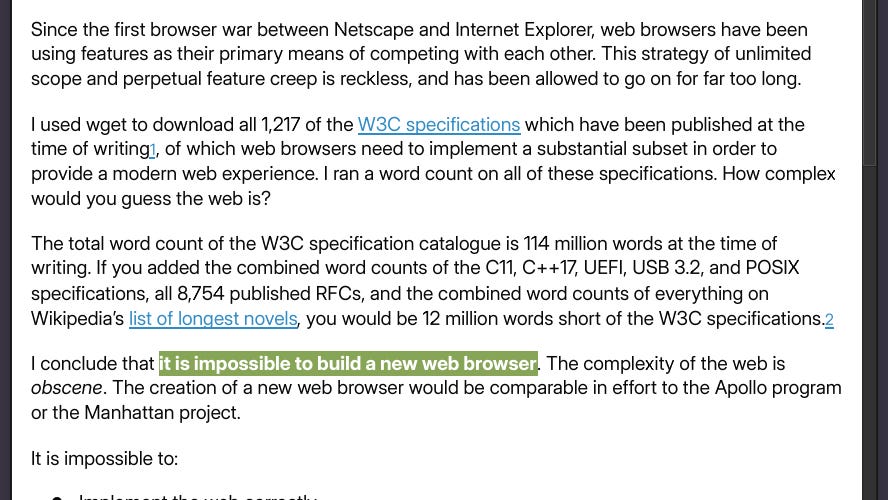
How we're building a browser when it's supposed to be impossible
“How is the SerenityOS team making such good progress on building their Ladybird browser, when we've heard for years that it’s impossible”?
awesomekling.substack.com
515 points · by RMPR · 3y ago · 325 comments
Seems similar to how Wine is developed: instead of just going down the list of API functions to implement, the emphasis seems more on "let's get SomeProgram.exe to run" or "let's fix the graphics glitch in SomeGame.exe". Console emulators (especially of the HLE variety) seem to have a similar flow.
I did this with the CPU for my GameBoy emulator: I picked a game I wanted to work and just kept implementing opcodes each time it crashed with an “opcode not implemented” error.
On the web, you may get Twitter's feed rendering acceptably, and then two days later they ship an insignificant redesign that happens to use sixteen CSS features you don't have and everything is totally broken again.
Watch this video of Andreas doing exactly this, albeit for a simpler web app https://www.youtube.com/watch?v=W4SxKWwFhA0
At one point, he deletes half the HTML file to isolate where in the site the problematic code is. In a way doing a kind of binary search. After a few iterations of this, he comes up with a very small case that exhibits the problem he's trying to solve.
It's clear he knows his way around the codebase and where to make changes, but isolating these test cases is probably as important. And presumably if you fixed enough of these issues (while following the specs), 99% of the modern web should work just fine.
this is not directed at you, but at this attitude which is very common and which I see all the time: everyone is lightning fast to come up with reasons that something won't work.
why?
why do people say things without understanding that almost any given problem has subproblems, and that those can be solved.
in humans, negativity is always just under the surface, and positivity is often buried deeply, and I do not understand this. I don't think I ever will. people just love to be contrarians.
Instead of it being criticism, the commenter could've seen it as a positive. Every time a site changes, you discover functionality you haven't implemented yet. Over time, you've implemented more and more. It's progress. Progress is good. Choosing the negative interpretation is so endemic and arbitrary and simply unnecessary.
It's not negativity to point out a downside to an approach to a particular problem. It's potentially useful to get feedback on a development approach. Constructive criticism is very important in engineering projects because it encodes assumptions of limitations we all have.
A positive statement like "oh those sub problems are solvable!" doesn't really provide any help. No shit the problems are solvable in a perfect world. Such statements aren't even necessarily constructive because they don't offer any analysis or advice. It smacks of toxic positivity[0].
If Twitter rendered fine, chances are some other site render fine today. The same it was with Wine.
But that's not how you use web. If 90% of the pages worked in browser I wouldn't use that browser, ever, because chances are I'd hit one that didn't at least once every few days.
however the aim to build a reasonably sized and not ossified-to-previous-spec web browser is very interesting, especially if it's well engineered and made to be portable
Good insight.
I was going through this same spiel in my head the other day.
It's a flow that if properly managed can provide a good feedback system. It provides the developer positive feedback and at the same time successful milestones.
Say I'm building an emulator for a simple architecture with a few dozen opcodes...
"Alright. Let's start. Where do I start? How about NOP." So you implement NOP. You write some tests for it. Maybe you build a pretty printer into your opcode and you test it on disassembling a single byte file with a single NOP opcode.
Suddenly you have a working dissassembler! It's obviously an artificial toy, but it works.
Maybe next you add an INC instruction. Add some tests. You'll need registers...
Build a simple one INC opcode binary file. Maybe add an executor in addition to a dissassembler. Suddenly you've got registers working. And if if add another INC opcode byte, you can see your emulator changing behavior based on real external input!
And so on. It's an interesting flow, you're right.
And emulators that have gone this path have all regretted it, because they end up making hacks to make <popular game> work, because everyone simply wants to play <popular game>. Dolphin is still paying the price of that method years down the line. Project64 took years to unfuck themselves up, ZSNES is forgotten and overtaken by many more that have done the proper thing.
So, sure, you can get some initial usage. But making a browser isn't about being able to open twitter.com
Loading Twitter (etc.) is not really the goal, it's more of a prioritisation mechanism for tackling a huge spec. Actually getting Twitter to run is a nice reward for all that hard work though, and a series of such rewards keeps the contributors motivated in the marathon that is building a browser.
By targeting a single website, you end up accidentally writing in those site-specific fixes _in_ your implementation. You only realize it's fucked up because you visited Twitter. but maybe it screws up another site. Maybe something else depends on a quarter of that functionality, and you've accidentally broken it.
When ZSNES did its thing, which, just to remind people, was back when Pentium IIs ruled the roost and CPUs topped out at 450mhz, doing things the proper way was not a choice because the proper way needed 3x the CPU power of doing things the ZSNES way that worked.
Dolphin became popular because it could actually play games, and I bet if they had instead spent an extra 3 or 4 years working on code that was "correct" without releasing anything, well odds are they wouldn't have such a large following and would not have attracted so many contributors.
Users do not benefit from "perfect code" that they never get to use because it is still in development.
So the web is maybe only 1.2 specs with 114,000 words? I think it's considerably more than that. If that estimate is off, it's by no more than a factor of 10, IMO. No need to exaggerate.
Given that he omitted huge specs like WebGL etc. I wouldn't say it's wildly wrong. But I'd love to somehow arrive at a better estimate.
Is this not the corporate equivalent of creating a walled garden (perhaps not the right phrase here, gastric moat sounds more apt), by exhausting the resources of all that should choose to attempt to scale this mountain of junk?
That being said, I can't make any suggestions as to how you could shortcut through that other than just having decades of experience in the field.
As for WebGL, the WebGL parts are actually quite little. https://registry.khronos.org/webgl/specs/latest/1.0/ is only about 20,000 words. I gather it defers significantly to GLES20 (PDF, 204 pages, ~60,000 words), and GLES20GLSL (PDF, 119 pages, ~30,000 words), and it has GL32CORE in its references (PDF, 404 pages, ~125,000 words), but doesn’t actually use cite it in the text and I don’t know if it’s relevant. There doesn’t look to be anything else significant that wouldn’t already be included.
But really, WebGL is a fairly thin layer atop OpenGL ES 2.0, just removing some functionality and applying some restrictions. I believe you would reasonably expect a browser to use an existing OpenGL ES 2.0 implementation, so I’d be quite content to exclude the 90,000 (or perhaps it’s ~215,000?) words of that, just like it’s common to reuse an existing JavaScript engine (though you also don’t have to). Yet note this: it seems that even if we include it all (and presuming I haven’t missed anything, which I admit I could easily have done, I’m not conversant with these specs like I am with HTML/CSS/JS specs), it’s still under 0.2% of Drew’s massively-inflated figure.
—⁂—
¹ Whew, https://262.ecma-international.org/ took me several minutes to download, despite being only 7MB. Sigh; the trials of being in Australia, where things hosted in the USA are often inexplicably painfully slow—like, sub-256kbps. When already downloaded, it renders in under four seconds, which is really fairly impressive when it’s doing all that layout on a document a million pixels tall—this ain’t a PDF where you can only render one page at a time. The HTML Standard is almost two million pixels tall, and also loads completely in under four seconds—simpler styles, perhaps? I refer to it often enough that I build it locally so I don’t have to download its 13MB all the time, or compromise with the multipage version that you can’t search through as easily.
The entire premise given in Reckless, Infinite Scope is that the number of words in the specification is positively correlated with the intractability of implementing a given thing. From this foregone conclusion, it tries to quantify how much worse the task of implementing a Web browser is. The problem is that that the premise is a bad one; even if it takes more time to read a wordier spec, it is easier to implement one that describes well-defined behavior than a terse one that glosses over things and leaves huge gaps of undefined behavior. This is not just conjecture—it tracks with the development and progress of implementing, say, the HTML parsing algorithm; it is easier to implement a correct and acceptable HTML reader in 2023 armed with only the spec than it was to try to do the same thing in 2003 which involved reading the spec and also reverse engineering how other (esp. proprietary) browsers deal with the pages that you find authors actually publishing in the wild. This is a task that was made easier because the standard got bigger.
The point is that its broken methodology doesn't even matter; we don't have to try to come up with better ways of evaluating whether a spec should be included or not because its whole premise is flawed to begin with. Any attempt to produce an input set that you can then use to run a word count analysis is a moot academic exercise at best that will only tell you how many words it contains.
The thing is, it's not just the HTML standard. It's also all the standards it references. And all the standards they reference, and all the standards those standards reference, ad infinitum.
For example, HTML 5 references SVG 2 which references CSS 2 which references Unicode and XML 11. Or, to go the same route, HTML 5 references SVG 2 which references CSS 2 which references CC.1:2004-10 (Profile version 4.2.0.0) Image technology colour management which references (normative) ISO/IEC 646:1991, Information technology — ISO 7-bit coded character set for information interchange, IEC 61966-2-1 (1999-10), Multimedia systems and equipment — Colour measurement and management — Part 2-1: Colour management — Default RGB colour space — sRGB and TIFF 6.0 Specification, Adobe Systems Incorporated among other things.
Yes, some of those overlap (as many standards will reference many the same standards), but the number of those standards is definitely non-trivial. Some of them you can probably pull in as system libraries or external libraries. The question is, how many?
Edit: and some of them are definitely not relevant to the web, but how would you know until you read through the spec that references it, and through the referenced spec to find and understand the relevant bits?
I implemented a few specs in my short career but nothing even close to that. It's actually mind boggling that we manage to have all those moving parts fit together.
Is WebGL needed? I've browsed the web for years with it disabled and have not suffered any inconvenience. I'd probably say it's not needed, but I'm a bit on the fence about it and can understand if people would disagree. All browsers implement XSLT, but is that actually needed for a functional modern browser? Maybe not? I can't remember the last time I've seen it used, but perhaps it is. And do you include HTTP? Or is that too low-level? Do you include PNG and SVG or just PNG? If you include SVG then why not PNG?
There are some obvious "we need this", some obvious "we don't need this", and a lot of unclear and somewhat subjective area. I do know that you can't really say "yes there's bad data, but it probably cancels out against stuff omitted"; if anything, it only underscored my point that the list is not good.
An uncurated or minimally curated document dump is not the correct approach in the first place, if you do that for SMTP you'd end up with a lot of irrelevant documents too simply because the specification is a few decades old and stuff gets superseded, some things never sees real-world implementations, things no one uses any more, etc.
I started making a better list when the article was originally posted, starting from "okay, let's just check what you need for a useful browser normal people can use every day" and ended up with a few dozen things, but I never really posted it as I wasn't quite sure that was fully correct either and because I never really figured out some of the questions above.
I think most of the complexity stem not just from the word count, but rather that everything interacts with everything else. Consider the relatively new "position: sticky" in CSS. Okay, great. But it doesn't work well with flexboxes, or RTL, or negative margins, or z-index, etc. etc. [1] Adding what seems like a fairly simple feature is quite complex because it interacts with so many things. It's not hard to imagine a fresh new HTML and CSS which allows all the features the current does but does so in a much simpler and orthogonal way, which would of course break backward compatibility and every website.
[1]: In 2020 anyway; I'm not sure on the current state; here are some of the links of my post from 2020 which like most of my posts I never finished:
https://bugzilla.mozilla.org/show_bug.cgi?id=1488080 https://bugzilla.mozilla.org/show_bug.cgi?id=1498772 https://bugzilla.mozilla.org/show_bug.cgi?id=1519600 https://bugzilla.mozilla.org/show_bug.cgi?id=1490487 https://bugzilla.mozilla.org/show_bug.cgi?id=1488950 https://bugzilla.mozilla.org/show_bug.cgi?id=1514291 https://bugzilla.mozilla.org/show_bug.cgi?id=1528957 https://bugzilla.mozilla.org/show_bug.cgi?id=1472602 https://bugzilla.mozilla.org/show_bug.cgi?id=1455660 https://bugzilla.mozilla.org/show_bug.cgi?id=1450601 https://bugzilla.mozilla.org/show_bug.cgi?id=1424384 https://bugzilla.mozilla.org/show_bug.cgi?id=1341643 https://bugzilla.mozilla.org/show_bug.cgi?id=1526342 https://bugzilla.mozilla.org/show_bug.cgi?id=1519073 https://bugzilla.mozilla.org/show_bug.cgi?id=1414874
And most specifically in layout and rendering. HTML, JavaScript and the parts of CSS that aren’t, y’know, doing anything, are all very straightforward, despite having the significant majority of the word count. If anything, I’d say that in web matters implementation difficulty is inversely proportional to word count, because its verbosity pretty consistently comes from precision (which makes implementation easy). Layout stuff would be much harder to define exhaustively in that fashion, nor is it done so in most places.
That is definitely the main issue.
And you're completely correct on the needed/non-needed/subjective front. Many of the standards reference (in a recursive manner) a lot of other standards. A listed some here: https://news.ycombinator.com/item?id=35524018 As an outsider it's impossible to know whether TIFF spec or ISO 7-bit coded character set for information interchange are relevant, an need to be studied, or are there just because they define some minor values referenced in some more higher-level spec.
If you don't think the estimate from Reckless, Infinite Scope is wildly off, then you either didn't read the methodology and do a spot-check of the dataset, or you really don't understand the scope of what gets published by W3C and how little much of it has to do with Web browsers or how many revisions of them there are.
For example, changing "greater than" to "greater than or equal to" might require only a single bit of change in the machine code.
But we don't, really. Example:
Write a function that keeps track of the name and weight of each person added, then prints the list, sorted by weight, lightest to heaviest.
I asked GPT this. My 140 character, unoptimized query resulted in 816 characters of c++ code.
Used to be true, I doubt that it is anymore.
There are too few (I could find exactly none, to be honest) sites are around these days that are unreadable when rendered strictly according to a newish (say, 2019) HTML/Javascript spec.
The proliferation of front-end frameworks means that almost no site is going out of spec, and because any site that doesn't meet a large portion of the spec is invisible to search engines, having the site be broken when sticking to the various specs is no issue.
In short:
1. With practically all large-traffic sites using a framwork, a browser that strictly sticks to the specs and the specs alone is not at a disadvantage.
2. With important on SEO, a site that is unreadable on a recent spec is not going to be found anyway by the large body of traffic.
Conclusion: a browser that sticks to the spec and the spec alone has a fighting chance.
It's the complexity and edge-cases of an exceptionally large, complicated and self-contradictory spec with thousands of edge-case when different parts of the spec are combined that's the problem.
I'm not really sure if "you need to be bug-compatible" is still true; it probably was 15 years ago, but Chrome, Firefox, and WebKit tend to be pretty decent these days.
The end result is that validation is not that much interesting anymore, because the idea was that valid (X)HTML document should parse the same accross all browsers (which it mostly did, but that did not say much about how it was actually rendered).
The validator badges were kind of a backlash against the tag soup of the day; part of the reason for that was that everyone who knew how to program a VCR could get employed as a "webmaster" in those days, but also because the authoring tools for non-tech authors weren't as good. HN sees a lot of posts from non-tech people, often written on WordPress, Medium, or whatnot. 25 years ago it would more likely have been "tag-soup'd" by some non-tech person who just learned a bit of HTML.
Nowadays, HTML parsing is exhaustively defined in the form of a couple of state machines, so it’ll behave the same everywhere. It’s genuinely easy to implement perfectly (though it’ll still take a while because there is quite a bit of it).
The way that web specs are handled means that better specs actually bring a lot of those things into the spec. i.e. browser implementers will define a new spec that clearly explains the quirk, and then align on the implementation. There is also a huge test suite which can be used to test conformance.
It's not perfect, but it's definitely a significantly better situation than we had.
The version of the browser native to SerenityOS hopefully still uses the SerenityOS GUI libraries
WebKit and Blink are similar in how they have their different counterparts like QtWebEngine or WebKitGTK. The equivalent to WebKit and Blink in SerenityOS is called LibWeb.
There used to be Gecko as an option here too, but Mozilla decided that it shouldn’t be usable outside of XULRunner and made it effectively unembeddable unless you’re willing to commit to XUL.
The rendering was done into a pixel buffer with inputs being passed though a few relatively simple C++ classes.
I think that a small embedded version would make for a great UI framework with minimal dependencies.
and their goal is to use it to incrementally rewrite SerenityOS
I don't think I've ever seen a crash in either Serenity or Ladybird that I could attribute directly to memory management. For volunteer C++ projects, their memory management seems to have been done excellently. Using modern C++ features and things like error return types instead of null seems to be a key part in making the browser this good.
It's also worth mentioning that as far as I know Ladybird doesn't implement a JIT engine, using bytecode to execute Javascript instead. That should also make life significantly easier for memory management.
It's still a young browser and I'm sure there are some nasty memory corruption bugs lurking in the depths, but I haven't seen those yet.
> browsers were only topped by a few things like major operating systems
And they're even closer once you subtract out things like device drivers.
   > Not Ready For Implementation

   > This spec is not yet ready for implementation. It exists in this repository to record the ideas and promote discussion.

> Before attempting to implement this spec, please contact the CSSWG at www-style@w3.org.If you work in the web space you quickly learn to shrug, double check that browsers do actually implement this version, and proceed.
people often discourage building web browser engine because it is "hard" or something like that
like... how is it different from building a compiler?
You gotta build HTML parser, CSS parser, figure out a fancy structure to represent those concepts and modify at fly.
Also there's difference between making it work and making state of the art.
That persons says that there's shitton of RFCs - yea sure, but you don't aim to support everything from the beginning.
Let's start with HTML + CSS, then build basic js interpreter
- the web is numerous specifications: HTTP, HTML, CSS, JS, SVG. At worst, a regular compiler needs to worry about macros and the language syntax
- each of those specifications has numerous versions which, in some cases, can be significantly different from other versions of the same language or protocol. A language compiler generally only focuses on one version of that language
- A browser needs to support broken websites. A compiler only needs to fail gracefully
- A browsers output is graphical, which is much harder to unit test
In short, you’re dealing with a harder problem across a broader number of specifications. I would liken writing a browser more closely to writing a new graphical OS than writing a compiler.
(“Browser” here means “browser + engine et al” and not just a reskin of Chromium).
In fact there's a good reason to keep graphical tests to a minimum: web specs do not dictate things down to the pixel level, so pixels can shift around from version to version, requiring the occasional golden data rebase.
Fun aside: Chrome's test suite contains a font named ahem.ttf where (almost) every character is an identical black rectangle. This allows tests to include text without relying too much on the details of a particular font.
Our two posts aren’t mutually exclusive.
Yeah it's "just" building some parsers and figuring out live updates, but you have to keep in mind that this is ~the internet~. People have been uploading broken, against spec, webpages since forever. Coding a web browser as a serious project (so not as a flight of fancy) borders on the impossible mostly because of that.
The main sites people test against/use aren't the "simple" CSS/JS/HTML sites from the past. Few people will care for a browser whose main job is to be able to render a neocities website. People want their popular sites working - Discord, Facebook, reddit, twitter. All of those are big JS apps.
The real bugbear here is JS though, HTML and CSS are complex but workable. JS is an ever-moving target as spec implementers (mostly Chrome) dump more and more of the jobs a browser was meant to do as the user agent into JS[0]. (And that's without delving into how widevine became part of the spec, which means it's legally impossible to make a fully spec compliant browser.)
Polyfills can offer a lot of fallback/lenience, but polyfills are a moving target too - older browsers get deprecated, polyfills get removed for performance/optimization reasons, so your baseline spec for functional JS becomes ever-increasing unless you somehow get the people making popular JS libraries to accept that your browser project is important enough to keep the necessary polyfills around for.
[0]: Presumably so that Google can take away the User part from the browsers job as the User Agent, but typically covered up as a poorly defined "privacy problem".
> The real bugbear here is JS though, HTML and CSS are complex but workable. JS is an ever-moving target
What you characterize as "JS" is, in reality, more HTML and CSS than JS. JS is a language. The fact that all the behavioral details of the HTML and CSS objects and related host objects have bindings available to JS programs does not make those things "JS"...
Doing a new JS engine from scratch is an order of magnitude easier than doing a browser engine. It is directly analogous to the eminently tractable "building a compiler" problem that the other commenter mentioned.
A browser that's unfinished really cant be used by users at all. Either it lacks security, so nobody should use it, or it lacks vital features (of the spec, not end-user features), so nobody can really use it because every time a website relies on that API something doesn't work.
But that's just one aspect, next you need to add support for CSS [1] and Javascript [2], each of which has had lifetimes of work invested in the standards and implementations.
So yeah, while it's doable to build a new browser, if you want to build a big one that has feature parity or is on-par with the existing browser landscape, you need a large team and many years of work. And that's just the practical aspect, the other one is, would a new browser actually be better? Could it compete with the existing market? So many players have just given up over time.
The difficulty of building a state-of-the-art browser is almost entirely about performance. Everything else is straightforward by comparison.
Many of them are just as ad-hoc, even if they are better defined, and meant to cover some holes in previous ad-hoc specifications. For example, the entire `subgrid` spec is patching one specific hole which actually has a proper general definition: "These <children> however are independent of the parent and of each other, meaning that they do not take their track sizing from the parent. " [1]
So instead of solving that general problem, we have a hyper-specific patch for a single feature. Which will definitely clash with something else in the future.
I mean, the entire web components saga is browser developers patching one hole after another that exist only because the original implementation was just so appalling.
> The difficulty of building a state-of-the-art browser is almost entirely about performance.
But that performance is directly affected by the numbe rof specs and features.
[1] https://developer.mozilla.org/en-US/docs/Web/CSS/CSS_Grid_La...
A conformant C++ compiler is in the same ballpark as a browser, but a naive C compiler is orders of magnitudes simpler.
Recreating the Windows OS is in the same ballpark as a browser, but a simple OS that boots and runs command-line apps is orders of magnitudes simpler.
People don't casually start new C++ compilers or projects such as WINE, but they do start toy compilers and OS all the time.
Most new compilers are somebody’s hobby project that will never see the light of day, I have like four of them in various states of unfinishedness.
I’m only half joking but I’m pretty sure there are some PR companies pushing “trends” on the behalf of big corps.
It would be stupid and uncapitalist not too…
Because that way any one wanting to build a new one can starting by pulling in a bunch of libraries (layout, rendering, etc), and then just customise the bits they need (ideally publishing them as a new iteroperable library that others can also use).
I think that you are right; this is what will be needed. However, that alone won't do because it is also needing to write them to be good, and not too slow/inefficient and not too incapable of doing many customization stuff.
And, ensure things are properly separated. (Looking at your examples, it seems like it is properly separated, to me. You can define styles independently of parsing them, which improves efficiency as well as allowing adding other steps in between such as "meta-CSS" if desirable.)
In some cases, it may be desirable to modify parts of the libraries, although then it may be necessary to maintain a fork of that library, which is not always desirable.
(For example, I may want to add proper support for non-Unicode text, and being able to customize text layout functions, including all possible text directions (vertical, horizontal, boustrophedon, etc). Adding other CSS rules might also be needed for some other purposes, too. And then, we will also need to do accessibility features.)
(I like to use C programming; looking in issues, it look like they might be added, so that can be good; unfortunately, Rust has a Unicode string type and this can be problematic even if using C, unless the Rust programming is done very carefully to avoid this problem.)
- https://github.com/pop-os/cosmic-text does text layout (which Taffy explicitly considers out of scope)
- https://github.com/AccessKit/accesskit does accessibility
- https://github.com/servo/rust-cssparser does value-agnostic CSS parsing (it will parse the general syntax but leaves value parsing up to the user, meaning you can easily add support for whatever properties you what). Libraries like https://github.com/parcel-bundler/lightningcss implement parsing for the standard css properties.
- There are crates like https://github.com/BurntSushi/bstr and https://docs.rs/wtf8/latest/wtf8/ for working with non-unicode text
We are planning to add a C API to Taffy, but tbh I feel like C is not very good for this kind of modularised approach. You really want to be able to expose complex APIs with enforced type safety and this isn't possible with C.
We would like to run the Web Platform Test suite [3] against Taffy, however these are not in a standard format and many of the tests require JavaScript so we are not currently able to do that.
[0]: https://github.com/facebook/yoga
[1]: https://github.com/DioxusLabs/taffy/tree/main/test_fixtures
[2]: https://github.com/DioxusLabs/taffy/tree/main/scripts/gentes...
[3]: https://github.com/web-platform-tests/wpt/tree/master/css/cs...
And this is much more than that: custom JS interpreter, SVG, CSS renderers and so on...
Another aspect is that for any complex, large-scale project like browser, lots of, if not most of, effort is actually in the long tail: to make 90% or even 99% websites work probably is as hard as making the rest 1%.
So while the team probably could cruise through when working on current gen spec and popular sites like Discord/Twitter, it's what left is going to be a nightmare to manage at the end.
But again, nothing is impossible, and I really look forward to having a new browser engine in the wild.
If I recall correctly, the work Andreas did at Apple was mostly focused on performance, and Safari has long had a reputation for excellent performance. Maybe you’ve also done that type of work, but otherwise I’ll trust his judgement.
And there are a hell lot of details with the plattform called the web.
But I would think in this case here, they have no intention of going to 100% by all means, to support all the broken pieces of web garbage out there. The goal is to implement the W3C specs. (they are even working on fixing the specs)
Oh and Kling specifically worked on browsers before, so that is a good base.
"I've had the opportunity to work on production browsers for many years (at Apple and Nokia)"
I made a comment about why browser is hard in general. I don't in anyway suggest or imply this team would struggle with performance, so not sure why their (amazing) background would be relevant.
The two most important keywords in Drew's blogpost is *serious* and *security*. There is not one mention of either of those words in this blog post; hence Drew's points still stands unchallenged.
You can try, but so did Servo which was a 'serious attempt' and not even the Rust hype could convince the masses that it was better than Chrome.
It moves slower than people assume; I installed Opera 12 last year for the craic – the last version built on their Presto engine, released almost ten years ago – and it works surprisingly well with many sites. I did have to use mitmproxy to rewrite some trivial stuff like some CSS prefixes and s/(let|const)/var/ in JS. Flexboxes are supported, but grid isn't so that failed for some sites.
> Drew's points still stands unchallenged
His points are based on a faulty assumption to start with: he counts all sorts of documents, but that count is spectacularly wrong as it counts many things it shouldn't. I mentioned this at the time: https://news.ycombinator.com/item?id=22617721
Is it a large project? Sure, as many software projects are. But "impossible" and "comparable to the Manhattan project"? Certainly not; it's just that there's not a whole lot of money to be made with a new browser engine or other broadly shared motivation.
And Drew himself answered you at the time on points made to your comment, that is things you said shouldn't be included that should and others you said were incorrectly included but were instead excluded in first place.
Whether the web is "too complex" is a different matter and open to interpretation as "too complex" is subjective. But the data very wrong and therefore the article is wrong. A "correct" conclusion with faulty arguments is just as worthless as an incorrect conclusion: any possible solution depends on a correct understanding of the situation. "Global warming happens because of pornography, therefore we must ban pornography" is just as useless as "global warming is a fake fraud" even though the conclusion of the first is correct.
Even Mozilla can't do it.
Chrome is the sole benchmark. If it works in Chrome, it's fine, if it doesn't the site is broken. Standards never enter the discussion.
1. A unique use case or feature that cannot be easily implemented in the existing browsers. Something that breaks the current architecture and turns the current use cases into afterthoughts. ("oh, yeah, right we actually need to render html somehow at some point, can the intern do it?")
2. A significant breakthrough in software engineering productivity, a major step in terms of abstraction and safety. Something like the combination of a LLM and formal methods.
This browser does not check these two boxes (using C++, albeit hopefully a more modern dialect, and targeting plain old browsing). So it is certainly great for the spec - and should be paid for by the W3C, IMO, great for the people developing this as an exercise, but it will never dethrone Chrome.
(To be fair, the tech landscape may be sufficiently different that the same won't happen again, too.)
Having to only target one rendering engine when developing a rich text editor would be much better than the current nightmare it is.
(There would be an accessibility problem to solve, we need some new APIs for screen readers and canvas)
It's a lot of fun to watch them build Ladybird, and a testament to what a small passionate team can do.
Google Docs used to be contenteditable based, but moved to a custom rendering engine. They are a large enough company to be able to invest in that. Small businesses aren't, and have to rely on content editable.
Ladybird as a contenteditable polyfill would help smaller teams, or single developers, achieve the same, while also building on the existing tooling and APIs for contenteditable.
Is THAT why you can't cut & paste with the mouse in google docs like you can on every other site? Take me back to the old way then please.
While it’s easy to take shots at the current state, I find it hard to imagine another path to delivering a cross platform application over the network. What we have now is actually pretty rad.
We built it stone by stone, incrementally, and now I don’t have to package my application for N platforms unless I want to meet users in their app stores.
If we spent all the effort we used up on making JavaScript work on Java instead, I’d be typing this from my Moon habitat.
But we instead chose a pig, buried it under layers of lipstick, and strapped a jet engine onto it. Sure, it’s airworthy, but was it the best way to allocate resources?
Failing that, an optimized binary blob that could achieve the same using training data over modern browser specifications. If you go to ChatGPT and start talking about ISO32000-compliant implementations and poke at the edges, you can get it to start writing a PDF engine pretty quickly.
I'll be curious to see how this plays out. History seems to show that boosting performance later is a monumental challenge.
Early Chrome showed that Firefox was leaving a lot of performance on the table, and it took Firefox a long time to catch up.
In a lot of projects, early optimization hurt the development speed and maintainability, sometimes killing the product.
It is easier to see performance bottlenecks once a product is wildly used than adding optimizations everywhere we suspect it might become a problem later.
edit: clarify
The real difficulty with browsers is building a better one than the existing ones. If you make a new browser. It does exactly the same thing as the other ones. It's a great technical accomplishment but it has a very low value. Which is why nobody bothers at this point.
At this point there are only three browser engines with any audience still worth talking about: chromium, safari/webkit, and firefox/gecko. Obviously the first two are related but they forked so long ago that they are quite different at this point. In terms of what they do there are some minor differences but they basically render the same websites in more or less the same ways. There is very little point in picking one over the other at this point.
I actually use Firefox and I'm pretty happy with it. I don't think it does a lot better/different than the other two at this point but I like not selling out completely to Apple/Google. Google treats me like a product rather than a user and Apple seems more interested in telling me what I can't do rather than enabling me to do things I want to do. But objectively, both do a fine job of rendering websites and allowing me to browse the web. Just like Firefox does. And given that there is no practical difference, I choose to use Firefox.
I wish them luck, though. We could use some real competition in the web browser space again.
i dont want to consent to be tracked, i dont want to login, i dont want a presonalized feed, i dont want to subscribe to your news letter, i dont want your ads, ethical or not
js is still an issue, but maybe a day will come when i can say to the model 'pretend you are js interpreter; what is text the output of this minified react garbage and show it as markdown' and just pipe it to lynx or w3m or worse case eww
A) Document-oriented standard. Perhaps HTML standards are "good enough" for this?
B) Media/Art/Gaming.
C) Business & Data CRUD/GUI
(And don't link that XKCD cartoon about 15 standards. There are zero for these categories.)
· uMatrix : A version with even more extended filtering characteristics. With special attention to javascript calls/loads control.
· uBlockOrigin.
· DecentralEyes.
· CookieAutodelete: Special attention to cached content deletion after leave an specific site and to add previous write permissions.
These are essential and needed features within any browser.
https://www.reddit.com/r/CRUDology/comments/10ze9hu/missing_...
GUI's, desktops, and mice are still needed for biz and productivity. HTML browsers have been a goofy mess for this, requiring bloated buggy JS libraries with long learning curves. Let's Make Gui's Great Again! (No, I'm not a Don fan, BTW, but his trollisms are catchy.)
ECMAScript conformance test results looking good, 87-88% passing at the moment: https://libjs.dev/test262/
I see weekly summary articles about Ladybird development are now being published: https://linus.dev/posts
But I was disappointed that it just crashes on any github page... and SerenityOS github is literally the first link on the Ladybird default homepage :)
edit: oh it doesn't crash on github page, it crashes on the github issues page.
From Serenity OS page [0]:
> This is a system by us, for us, based on the things we like.
Really wonder where the event horizon for really functional programming is.
And that's not meant to be a pithy response. That's the Serenity culture.
https://github.com/WebKit/WebKit/search?q=Andreas+Kling&type...
The goal is not to have a browser, but to build one. This browser is affiliated with the SerenityOS project, which is reimplementing an entire desktop OS and all applications from scratch.
From the article.