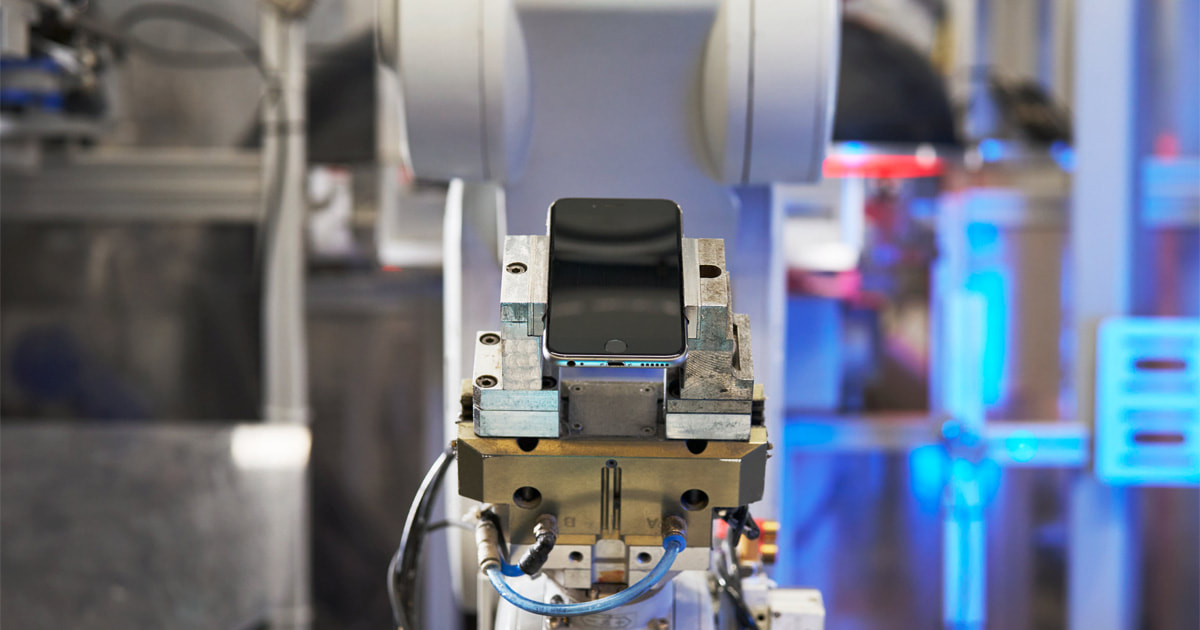
Apple will use 100 percent recycled cobalt in batteries by 2025
Apple today announced a new 2025 target to use 100 percent recycled cobalt in all Apple-designed batteries.
Apple Newsroom
445 points · by feross · 3y ago · 280 comments
> The development of fiber alternatives for packaging components like screen films, wraps, and foam cushioning has kept Apple on track toward this ambitious goal. To address the remaining 4 percent plastic in the company’s packaging footprint, Apple is innovating to replace labels, lamination, and other small uses. In the last year, Apple developed a custom printer to introduce digital printing directly onto the boxes of iPhone 14 and iPhone 14 Pro, eliminating the need for most labels. And a new overprint varnish found in iPad Air, iPad Pro, and Apple Watch Series 8 packaging replaces the polypropylene plastic lamination found on boxes and packaging components.
Oral History of Grant Saviers, part 2 of 2 https://www.youtube.com/watch?v=Od830KDrLUU https://archive.computerhistory.org/resources/access/text/20...
"We actually made the imager, the raster imaging guts for the Apple LaserWriter. And I was just fascinated by Apple's business model. They shipped, drop shipped from I guess it was Fuji or from Ricoh or Cannon. I guess it was Cannon. They bought the Cannon engine with no controller and they told us when to ship the controller, the power cord and the manuals in a box for the customer to put it into the printer. So they never touched the printer at all. It was a brilliant <laughs> business model. No inventory. <laughs> No payables, you know, all receivables. <laughs> "
Cobalt was/is the most conflict associated of the battery inputs. Thus R&D has pushed cobalt content lower and lower over the years.
The net result is old batteries contain tons more cobalt by weight than these new batteries Apple is expecting to use in 2025.
Of course I feel remiss not to point out how Apple is the party responsible for killing the user replaceable battery.
I personally like nonserviceable batteries because I want my devices to be water resistant, but I'd be more hesitant to throw a battery in the trash than I would be to throw a dead device in the trash.
People have the option of recycling used devices, whether they be battery devices or smartphone devices, at a multitude of retailers.
Only the LEDs I have in table lamps have survived more than five years. All enclosed bulbs die from cheap components and heat damage.
I'm all for enforcing user serviceability, however it has the potential to be a backwards step for the environment if stern statutes are not put in place and actively policed, with the onus being on the party performing the replacement.
So I'd think you just need to get the incentives right: make it easy and convenient to return and provide a financial reason to do so.
On the other hand, last year I replaced all the smoke alarms in my home. It is essentially impossible to recycle the old alarms. Here's what my town says:
"Only a single household smoke alarm/detector will be accepted with your trash for garbage collection. If you have more than one, they must be disposed using one of these listed options; https://deq.nc.gov/conservation/recycling/general-recycling-... or, check manufacturer for take-back program."
Here's what my county says (in the "unacceptable items" section):
"Smoke detectors contain trace amounts of radioactive material. The recommendation is for consumers to return the smoke detectors to the manufacturers or contact NC Radiation Protection at 919-814-2250."
Here's what my state says:
"The Solid Waste Section recommends that it is safe for a single household fire/smoke detector to be disposed of in a lined municipal solid waste landfill."
No manufacturer has a take-bake program. The county isn't on the same page with the town and the state. So in the trash they went, one per week. Took 3 months to get rid of them all.
Meanwhile, I know loads of people who have traded in, or simply handed in, their old iPhones in an Apple Store. I can’t imagine anyone casually tossing an old iPhone in the trash the way my feckless bench-neighbour did.
My guess is that batteries are more-often recycled than phones/laptops, even just on data-privacy issues alone.
It shouldn't be that hard for a company with so much know how and control over their products.
Is that a net win in your book?
That's not to say that there wouldn't be some that have the general form factor of today's iPhone, but without the iPhone as a runaway success to copy, the rest of the market would not have standardized on that form factor to nearly this degree.
Apple will not provide user replaceable batteries. That’s clear. It’s probably too expensive and complicated for them to do that and have waterproof devices. They instead offer replacements, and third-party shops know how to replace batteries too. With the airpods, Apple needs to be roasted endlessly for creating time-bomb trash though.
But staying realistic, Apple massively improved the repair ability with the iPhone 14 by sandwiching the phone instead of fitting it on the back plate. They also improved the repairability of their laptops recently.
The worst excesses of Apple’s poor internal design seems to be behind us.
> no one is criticizing Apple while being pragmatic [...] it is expensive and complicated for them to do that and have waterproof devices
and
> with the airpods, Apple needs to be roasted endlessly for creating time-bomb trash
I feel like every discussion of airpods and e-waste on HN totally misses the mark. The average lifespan of a pair of airpods (across all users) is probably not very different than the average lifespan of a pair of wired headphones -- people lose/replace stuff all the time, and wired headphones fail because of stress! Just because 1% of eco-conscious power users are now forced to throw away usable headphones doesn't actually make a big difference in terms of total e-waste. Also, it takes ~4000 pairs of airpods being thrown away to match the by-weight e-waste of throwing away a single 70 inch TV. Even if you are just worried about batteries, a single e-bike battery is like 2000 times larger than an airpod battery. If one was trying to minimize e-waste through by improving the reusability, Airpods just seem like totally the wrong target compared to the hundreds of much larger products with slightly worse rates of reuse / recycle
Ofc I refuse to believe airpods would last 6months before I dropped/lost/etc them. But that is just me rather than a criticism :D
Honestly I feel like they should just be much cheaper and have a trade-in program for it to make sure they're properly recycled.
Other than the battery, what are there of valuable components in it? A tiny chip and a speaker with a tiny bit of copper? If they can fully automate the recycling and production of them, that almost seems the more sensible thing to do. But right now they're just too expensive for that to be reasonable.
Not long ago we heard the same PR garbage about glue and solder being necessary for slim laptops but somehow the Framework isn't that much of a brick either.
I just want Apple to sell ME the battery. I dont want my battery to by crypto signed to my device.
>They instead offer replacements
Exactly, _replacement_. They wont just sell me a battery. You have to give them serial number, which in most cases means client PI. You also have to send old battery back for ~$40 credit to make the whole thing any financial sense.
>and third-party shops know how to replace batteries too
Apple store replaces battery in 2 hours, third party needs to explain to every single client why he needs to wait couple of days because you cant actually keep a stock of genuine batteries. Apple also wants to have access to third party service center books for 3 (or was that 5) years for "auditing :)))
"Battery technology and recycling alone will not save the electric mobility transition from future cobalt shortages" https://www.nature.com/articles/s41467-022-29022-z
Nothing drives a corporation to recycle and reuse more than the shortage of raw materials.
They don't mention cobalt shortage at all. Making it sound like the environment is their primary goal.
I care about effects more than motivations.
None of this matters really.
If I get someone to do the right thing, for the wrong reasons, then score one for me!
Of course 2025 isn't very far away so it is probably only a small impact.
[0] https://www.theguardian.com/global-development/2019/dec/16/a...
Edit:typo
What exactly is throwaway about that when compared to the hundreds of variants Samsung and others produce with a 2 year lifespan and then no updates after?
The 5s got one in 2023.
https://www.makeuseof.com/apple-security-updates-for-10-year...
I don't know about that. It technically still works, but you will feel it being slow because developers keep updating their apps to take advantage of new technologies and features. Even browsing the web keeps getting worse because web developers seem to cruft up their websites as much as the hardware can bear.
I really think around 5 years is the limit to be able to use your phone as an general purpose, internet connected device. If you want to repurpose it into an iPod Touch or Smarthome remote controller or something after that that's still doable even if you're using a deprecated version of iOS.
The story with iPads is a little different. If all it is for most people is a streaming service and article-reading machine those can last 10 years or more and the OS probably should have a longer life and a higher priority on making the batteries easily serviceable. I'd actually love a stripped-down, barebones version of iPad OS that makes it dumber but more secure. Sort of like booting in safe mode, for when people want to repurpose old devices.
Repairability is a fair complaint - but the initial lifespan of $android is max 2 years. I consider it broken once it does not receive security updates. So $android phone is “broken” after 2 years.
If that's your definition of a lifespan, "max 2 years" is absolutely not true. Android has two types of support: new major releases and security patches.
An average Android usually supports new major Android releases for 2 years, but security patches usually go longer. Not as long as an iPhone, but more like 3-5 years.
Nexus 5X & Nexus 6P (released September 2015) - last update January 2019 [1] ~ 2.25 years Pixel & Pixel XL (released October 2016) - 2019 (can't find a good reference) ~ 3 years Pixel 2 (released October 2017) - December 2020 [2] ~ 3.3 years
[1]: https://9to5google.com/2018/11/07/nexus-6p-and-5x-final-guar... [2]: https://www.androidpolice.com/2020/10/05/pixel-2-and-2-xl-re...
My conclusion: an iPhone outlives (at least) 2+/3+ android phones
I have an iPhone. I'm just sick of their hypocrisy. This is nothing but marketing to get you to buy more product from them. "oh apple is so good to the planet, so security oriented, they really value your privacy"
Maybe customers should reevaluate their shopping habit impact on the environment and stop chasing the next new thing?
Surely far more of the world's battery production (by watt-hours or kg, take your pick) goes into cars and grid storage than iPhones?
> 232 million iPhones, 61 million iPads and 26 million Mac and MacBook…
- (last year) https://www.businessofapps.com/data/apple-statistics/
I'll assume the batteries are 8 Wh for iPhone, 30 Wh for iPad, 52 Wh for the Macs[0]:
= (232 * 8) + (61 * 30) + (26 * 52) = 5038 MWh = 5 GWh
Which is more than I was expecting, but at the same time Tesla is on track for 1.8 million cars this year at a minimum of 54 kWh each = 97.2 GWh
So, yeah; good on Apple, more of this please from other electronics companies, still tiny compared to automotive.
[0] plausible guesses only because I don't have a breakdown of sales by model and I don't care enough to go looking
8Wh is exceptionally low (even guessing), it's just 2.22Ah for a Li-Ion (cobalt based). IPhone battery is 3.2Ah ~ 11.5Wh.
52 Wh for the Mac; that's a rather low estimate for a Mac, it has 3 cells in series, likely 2 or 3 in parallel. 2.8-3Ah per cell (at 3.6 nominal voltage)
Considering how many units are shipped annually, that adds up to quite a lot actually.
Most EVs worldwide are powered by cobalt-free LFP batteries. A decent fraction of EVs sold in the US are also LFP powered (all standard range Model 3 & Y). Cobalt is a short-term problem that'll be a memory a few years from now.
It will definitely add up.
This sets a good precedent but we'd need other manufacturers (who I'd guess are more cost-conscious) to follow suit before it changes much.
I’m not aware that Apple has noteworthy production facilities. Other than IBM, Dell, Lenovo, TSMC, Intel, Samsung. With Samsung as exception, which produces literally everything.
Then again, if we're to talk about hypocrisy, the cobalt impact on environment (not to mention child, including slave-slave, labor) is downplayed towards token "green" PR.
(And "recycled" cobalt can just be any previous cycle's "new" cobalt, meaning still driving cobalt mining forever - it's just an accounting trick to make it appear less impactful. Except if they promise to only use cobalt mined before 2025 in perpetuity).
Let’s assume Apple decides to only use recycled Cobalt.
Q1: Is there any change to the amount of recycled Cobalt?
Q2: Is Apple a kind, environmentally-friendly, generous, caring corporation?
Q3: If Apple decided to use batteries without Cobalt, would that decrease Cobalt mining?
Q4: Could Apple reduce the number of phones they produce (decreasing Cobalt usage), and would Apple do that for environmental reasons?
Q5: Let’s assume their new policy actually makes zero difference to the amount of Cobalt mining: would Apple still claim to be environmentally conscious in their marketing?
I think this should create a substantial market for recycled cobalt, which will drive up the level of cobalt recycling, which means there would be less actual cobalt mining.
That’s not just an accounting trick.
They’re not in a situation to promise anything like this, though. Nobody is going to ask when the cobalt was mined when you bring a device for recycling. Of course, recycling is not perfect and not using any would be better. But it’s still much, much better than not doing any recycling.
Right now using a magsafe battery charges the built in battery which is then drained by iPhone usage. Ideally what would happen instead is iPhone usage would use the magsafe battery first, then the built in battery.
The result of this is that magsafe batteries effectively are equivalent as replaceable ones.
The phone does use the MagSafe battery first, it just uses it through the internal battery, but that is just a matter of semantics. It shouldn't have a notable impact on battery health.
Or to put it another way, imagine you had a battery that only lasted a single minute, and a magsafe battery that lasts a full day. How long is your phone going to last? What will happen is that both your internal battery and magsafe will be drained, with the magsafe being drained the most. Eventually your internal battery will die, and so will your phone.
The other issue with using the internal battery (pass through, or charge) is that you're wearing it down more.
Maybe the behavior is different in an iPhone 14?
But that could be different when that constant charge/discharge is happening at high capacity levels, lithium-ion batteries are weirder when they are at their maximim voltage. My knowledge is rusty at this point so let me know if I got any of this wrong.
Is that actually true? Lithium batteries seem kind of fussy.
I'm not entirely sure how the internal power routing works, but my understanding is that it's not adding cycles to your battery if you're using the power as it's being added, even if it's going through the battery.
You'll likely see more degradation from the wireless charging waste heat effecting the battery.
It doesn’t hook into the same charging system the phone uses for normal? Is that special for MagSafe? I don’t really understand how it’s different and can’t find anything online to read more about this.
Turn around and you’ll notice the same pattern in packaging of candies and biscuits, water and milk bottles, pretty much everything. There will be products packaged or made of non-plastic of some sort but they will be in the minority, niche and more expensive.
While plastic and other non-recyclable materials are more favorable from the economic and regulatory perspective any type of “eco-friendly” material and production cycle will be losing this race.
Kudos to Apple though for setting up their own standards and continuously raising the bar!
And even more recently the moves in the geopolitical game made the extraction of rare earths and its environmental (and social, etc.) costs a renewedly current topic.
I am not sure that cobalt has a specially bad place in the whole context of extraction. (Apart from the non irrelevant fact that 'cobalt' comes from "kobold", because its ore is toxic.)
... for eco reasons.
EDIT: for example Tesla Model 3 Standard Range uses LFP chemistry.
Cobalt sourcing is of course an issue. But it's worth noting that it's usage is not unique to just lithium batteries. A lot of cobalt is consumed and not recycled in the oil industry and it's used in a variety of other industries as well. Why is it that child labor is only ever an issue in the context of batteries?
And another point is that of course not all cobalt mines are operated by child labor. Sourcing responsibly is an option if you need cobalt. You might have to pay extra for it.
And another point is that cobalt isn't by far the only thing that is commonly sourced in ways that perhaps aren't that nice. There's a wide variety of minerals, oil, etc. that are also produced under circumstances that you might rightfully criticize for being similarly inhumane, dirty, etc. And a lot of that finds its ways into global supply chains.
There's a bit of selection bias going on here. When it's batteries it's an outrage. When it's fuel you buy at the pump, you don't give it a second thought. Was it maybe some Nigerian oil or did it come from Iran, Russia, or some Canadian tar field? Did they use some Cobalt from the Congo to refine it? Most people neither know nor care. The point isn't whether there is or isn't child labor involved but that mostly people don't care enough to bother finding out.
They have steadfastly refused to differentiate between the concepts of abandoned/donated devices vs. stolen ones -- very convenient for them, as it drives more sales of new devices and increasingly hamstrings the used market.
This is a valid complaint, but at the same time that differentiation can be messy and difficult to systematize in a way that's not enabling thieves.
Something I've advocated for in the past is a feature in the firmware that allows new owners to request an unlock from the original owner, which could be as simple as an email and/or SMS that the original owner can answer yes/no. This isn't a perfect fix, but it takes Apple out of the loop outside of acting as a relay, and if the original owner in fact abandoned or donated the device in question they'll have no qualms with unlocking it for the new owner.
The cobalt is either recycled (100%), or it's not (0%).
How much of this "100% recycled cobalt" makes up a single battery?
Is it 10%? 1%? 99%?
Is the battery 10% made of 100% recycled cobalt, and 90% made of non-recycled material?
I hate this "100% recycled" wordplay. Any reasonable person would interpret it to mean "the batteries are 100% recycled" which seems to not be the case, given how sly they are being with the description.
Still, kudos to the recycling effort, but don't try to trick me.
It's the same trick nearly every company in the US plays with "made from 100% reclaimed ocean plastic."
Sure, it is made from plastic that 100% was reclaimed from the ocean. But if that plastic only makes up 1% of the item, and the rest is 99% non-recycled plastic, then you're effectively just tricking any individual not paying attention.
Of the cobalt that is used in making the batteries, all of it came from sources that had previously been used in something else, subsequent to it having been mined originally. None of it came from cobalt where it was mined and then this is its first use in a product.
And then there being no other claims about the recycled-ness or lack thereof about the rest of the battery.
It doesn't feel like trickery to me, but it certainly doesn't paint the full picture.
Also, the phrase “use 100 percent recycled Foo”, though in principle ambiguous, AFAIK is only used to mean “100% of the FOO we use is recycled”.
what's a better way to run an economy? every consumer of food goes out into the fields to pick what they will eat? Or there are specialized pickers who pick the food and drop it off in bulk near the people who will eat it? And on the other end of that process, should we all dig our own latrines? Or have a toilets+sewer system run by professionals?
cobalt is a commodity product. when you melt chunks of cobalt together, you can't tell where the cobalt came from any more. Who give a shit how Apple handles its cobalt? If it's doing it on a large scale, economics will dictate what is cost effective because how the economy handles cobalt is actually important, but how individual players do is completely unimportant. If it's important how certain waste is handled, yes, set up waste streams so that experts can make sure all the parts of an old phone are handled, don't as laypeople discuss the cobalt separately from the lithium, lead, etc.
I'm just pointing it out because for a community of people who take smug self-assurance in both their technical prowess and ability to be rational and unswayed by emotion, you all know fuck-all about economics, wear your <3 recycling hearts on your sleeves, and have your heads in your asshats.
Being drawn in to this discussion, you've most-all been bamboozled by PR/marketing despite all your ad-blockers and sophistication. If we've agreed that specialists will pick and deliver the food, it's interesting to learn about it, yes, but do we need to hear how each other feels about that?