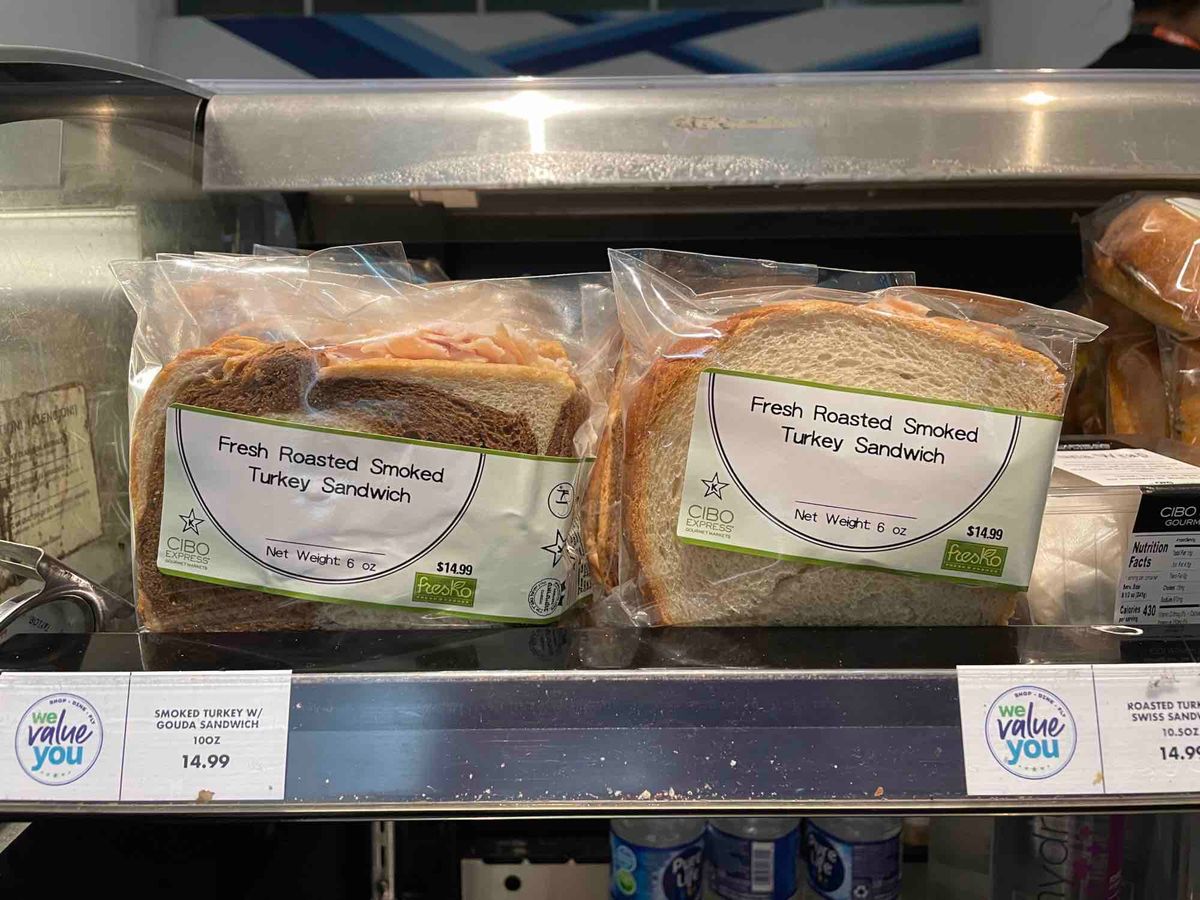
Why Does a Plastic-Wrapped Turkey Sandwich Cost $15 at the Airport? - Hell Gate
We filed a public records request, but the Port Authority is treating airport pricing like a state secret.
Hell Gate
671 points · by raybb · 3y ago · 611 comments
On the one hand, airports need to make money, and with people buying cheap airline tickets, airports have found a solution by turning themselves halfway into malls, and charging businesses extremely high levels of rent, which the airport justifies because it's a captive audience that can't go anywhere else. Most of the $15 sandwich is ultimately going to the airport as rent, not to the CIBO food vendor as profit.
But at the same time, there's public outcry over the absurd pricing, so the airport has to mollify lawmakers by insisting it'll come up with a policy where they won't charge more than 10% for what would be comparable in Midtown. The airport is trying to blame those greedy vendors! But this is a trick. Who could ever define that? Sure you can compare Starbucks with Starbucks... but you can't compare a CIBO sandwich because it doesn't exist outside of airports, which is by design. That's the whole point, that easy comparables don't exist, and when a journalist tries to use a FOIA request to get at the comparables, they're stonewalled.
The airport is trying to insist it's preventing jacked-up prices, when in reality it's the airport charging rent that generates those jacked-up prices in the first place, and it tries to pretend like it plays no part. Evil, but clever.
This is entirely overlooking the fact that you are a captive of the airport as long as the TSA screening process exists. At best, going through security is annoying and adds anywhere from 5 minutes to 2 hours of wait time, and at worst it is legitimately traumatizing.
Prices are high simply because people are punished for leaving on foot, and people are prohibited from bringing many goods through security.
A big problem is that it often isn't a free market. Joe The Sandwich Guy can't just randomly decide to open up a store inside the airport. There's a limited amount of space, a lease can easily last a decade, and any that come up are usually granted rather than auctioned.
The airport is actively trying to provide a varied selection of products, which inherently means competition is limited: someone complaining about the price of a turkey sandwich isn't going to get a Big Mac solely because it is a few dollars cheaper.
All of this is often made even worse because they aren't actually different vendors. Multiple stores are often owned by the same vendor, the different stores are just "exploiting various retail strategies".
Nothing is actively illegal. Everyone just independently realized they could make a shitton of money because travelers are forced to either pay their prices or starve.
Take a major hub like LAX which is already segregated by groups of airlines across subsets of terminals. How many options do you have to choose from post-security for something as simple as burgers or pizza? Let alone something like pasta or something like Indian or Chinese food.
“We have both Panda Express and McDonalds” is not a sign of competition.
Not to mention that TSA over and over again fails their undercover inspections. In some cases 95% of weapons and explosives make it through TSA without any issues! Airport security literally is theater. At best it'll result in the terrorist attack being moved from the airplane to the security queue.
Obviously that's not a "normal" thing to have done, but in a world with lighter security, I remember airport food being around the same level as mall food court options, so it was an interesting option for getting out of the house. I'd be curious if there's some lower-security path towards making Airports more of a common space, not that there's any chance of it happening.
An airplane flight is practically a high-tech bus trip. Airport security probably is useless, otherwise there'd be an analogue for public transport. And as people regularly point out, the cost-benefit of airport security is probably net-negative. I bet almost nobody would choose a high-security airport over a low security airport if they had a choice.
While that's a pretty extreme statement, airport security's usefulness is definitely in question. Most other airports outside the US are significantly less strict (don't have to take off shoes, for instance), and there have been tons of youtube videos showing how you could easily slip in weapons of various sorts through airport security.
It's practically a meme about the fact that they throw out all "might-be-bomb" liquids into trashcans right next to you -- in the same receptacle.
It seems much more like security theatre, and maybe thanks to terrorist groups, but more thanks to sensationalist media + clever people who take advantage of the capitalistic system (one of the heads of the TSA just-so-happens to make the machines they use to scan your luggage, "private" business on the side that he gets paid for.)
In addition, TSA Precheck / Clear / Global Entry are all ways to pay to have less inconvenience -- but have you seen any statistics they've been able to give out about stopped terrorist attempts? Don't you think that would be a thing that would be promoted if it was happening?
the terrorists have already won. They did more damage causing these security measures than any actual killing or bombing.
If you need something to eat in an airport, there’s a bunch of snack options you can bring in. It’s not a movie theater. I’ve brought in Nuts, sandwiches, home baked bread wrapped in tinfoil. TSA just doesn’t want you bringing in the liquids. Am I going to get a warm meal with a drink on the side? No. Will I be full? Yes. Will is save $15. Yes. Will it take some planning and prep work? Yes.
A. It’s less expensive
B. It tastes 100% better
That is enough to keep you hydrated and getting a drink while traveling.
And isn’t the “waiting two hours an exaggeration”?
I flew out of MCO (Orlando) around spring break and while it was hectic, it wasn’t that bad just looking at the line. Of course I fly enough that having Clear and TSA pre-check makes sense.
I flew out of Atlanta - the busiest airport in the US for years and it didn’t take me that long to get through TSA even without PreCheck
That's true, but sandwiches are not among them.
Why not sell fresh squeezed juices right as people get out of the security?
The Port Authority:
"based on the average of three lowest prices for Comparable Products at the approved Comparable Concession Locations"
Per this definition from the specification, they were required to go out see what prices "comparable concession locations" charge for a turkey san, take the three lowest prices from that search, add them together, then divide by 3.
There are parts of the SVG spec that aren't this well specified.
> That's the whole point, that easy comparables don't exist, and when a journalist tries to use a FOIA request to get at the comparables, they're stonewalled.
If that were true there would have been no reason to stonewall. Just release the three prices and the names of the vendors used, and watch NYC argue endlessly over the details of "comparable" turkey san vendors.
But with the stonewalling this sounds a lot more like, "Let's just charge $14.99 and call it a day," and then forget about it-- because who in their right mind would ever do a Woodward&Bernstein on a goddamm' turkey san price at the airport?
And then Christopher Robbins over here is like, "JFK airport, fuck ya' life, that's who!"
Edit: clarifications
I think you’ll find that the list includes things like “Airport stand A”, “Airport stand B” and “Airport stand C”
The same situation applies to the rest of the economy - people celebrate their house going up in value, without realising that your plumber and coffee will also go up in price, because the plumber's and the barista's rent has just gone up! Even if you never have to buy a house, rising house prices mean that every service around you becomes more expensive because they've got to pay rent.
Industry didn't just move out because western workers want too much money, they moved out because western landlords want too much money.
You have to start with the assumption that things like this are only intended for the very well-heeled to begin with, particularly in this price range where the difference between about $2 and $20 is not actually significant to the buyer.
It is well-known that most travelers are not in this catagory, and plenty of millionaires will not ever spend close to $20 at the high end for something recognized as worth $2 at the low end. Even if they could do it without any financial pain.
Sometimes that's how they got to be millionaires anyway.
Anyway, you've got to have more than enough sandwiches for every one of the real high-rollers who might be passing through that day, you would never want to have less than enough.
Plus every now and then someone else will get hungry enough to bite.
There's no intention for there to be alternative choices which are more economical.
So a lot of the sandwiches are going to go to waste.
So they need to be able to afford to make enough to waste most of them.
Which could only result in spiraling costs.
Overpriced lower-quality outcomes follow greed in a self-fulfilling way when you do the math, but when all benefit is directed only to the greedy party, it does no-one any good since they are not capable of being fulfilled.
Apply this to so many other parts of the economy, and look what we have.
More greed and more waste to go with it, and ordinary workers can't afford what they once could.
Let's start with this presumption: do they really? Are they privately held? Why? Were they built with private money or public money? Isn't the purpose of airports to facilitate access to the local economy, thus benefitting local businesses, and should thus be funded from general tax revenue?
Like so much in the US, payment is demanded for anything of remotely private benefit, even if the majority of the benefit is to the commons. Take TSA Pre-Check, or Global Entry as an example. In other countries, these programs (electronic entry) are the default for all citizens, provided for free, because they make airport operations more efficient as a whole, which means the airport can service more people, more efficiently. But in the US, it saves the individual a few minutes, so be prepared to pay a yearly fee for the privilege!
It's precisely for reasons like $15 turkey sandwiches that New York airports are to be avoided (i.e. as stopovers). Treating the traveling public as feudal serfs is practically the definition of mismanagement.
Part of the airport's willingness to give Ryanair a discount is the expectation of full planes with a lot of seats, so there are more people to sell to.
e.g. [1] Table 6, Warsaw Modlin airport charges Ryanair 6 PLN (€1.30) per passenger, vs the normal 40 PLN (€8.50). That's obviously significant when they sell flights for €15 or so.
[1] https://www.researchgate.net/publication/317710545_Internati...
I guess a really nice, mall-like airport with amenities you don't want to use (because they're too expensive) is still slightly better than a smaller airport whose amenities you don't use (because they don't exist). At least you have an option, though it doesn't stop it from being annoying.
Sidenote, maybe LAX needs $15 sandos if it means they can afford to unshit their airport.
who tf is wolfgang puck
Just a guy who's got three Michelin starred restaurants.
I clearly remember a Burger King in one of Moscow airports, probably DME. It is a regular Burger King serving everything one would expect, except the 1.5x prices.
In Stockholm (Arlanda) there is standard McDonald's (among other chains) in the terminal.
It's the biggest-ticket way to do it, therefore it should provide the biggest bonus for some individual. Maybe even more than one individual could be intended to share the glory.
The long-time franchisee was a very well-established & respected Houston-based restaurant corp that came in a decade ago on their strength of multiple local restaurants of various cuisines which were popular, successful, and affordable for at least occasional dining for most Houstonians.
This could not hold up, recently dethroned by a nationwide airport-centric conractor with a deal crafted to compete on purely financial terms.
related:
https://www.houstonchronicle.com/politics/houston/article/ho...
https://www.msn.com/en-us/news/us/pappas-sues-houston-over-h...
Firm that prevailed:
>With an operating presence in 12 countries throughout Europe and the Americas, Areas offers a very broad range of food services designed to meet the expectations of both travelers and landlords in airports, highway service plazas and railway stations.
Doesn't appear they would ever expect to prosper from non-captive food service.
I can only imagine some of the councilmembers who voted in favor of the change could reason that sandwiches already cost $15 so they might as well take a bigger cut of that themselves.
Thus far we have suppressed the urge.
My related take in this is that airports are expensive to maintain because you waste a ton of space on vendors and seating areas. If airports were just shacks next to a runway, they’d be much cheaper to run.
So you can’t really charge people for sitting/waiting (though the private clubs sort of do just that). Then you charge people for the other purpose (rent on vendors) and that pays for everything.
But you can’t tell your customers “it’s actually really expensive to build these giant buildings to just hold CIBOs and Dufry” since they won’t believe you (or worse call for smaller more efficient airports to be built with fewer services).
So you just sort of play this very bizarre merchandising game.
Flew Ryan air once to, I think it was some airport nearish to Venice, Italy. And it was pretty much a shack next to the runway. Walk down the steps off the plane into a small building, notice a conveyor belt. Walk through the next door, pick your luggage off the same conveyor belt. Walk through the next door, you're at the bus stop.
That was literally Berlin airport, before it sadly closed.
Then we privatise large international airports..
Meanwhile the smaller loss-making airports stay in public ownership because no-one wants to buy them.
Auckland International Airport Ltd (AIAL) was floated on the (Australian) Stock Exchange in Feb-1999, making it one of the first gateway airports globally to be listed publicly. [Auckland city council has reduced its ownership] to the current 18%
The right thing to do would be more expensive airline tickets that account for the total cost of flying (including the pollution they cause) and then charging an honest price for the sandwiches.
I mean, this sandwich costs almost as much as some airline tickets.
For example Brussels -> Vienna for 13 euros and it runs weekly.
How do you know how much they should fly?
Our society uses the price system to allocate those transportation resources. The price already factors in alternatives and discourages the activity relative to its burden on society.
At the end of the day you're just arguing that there should be a carbon tax on flights
Too bad we can't have nice trains. I mean Amtrak is okay but it doesn't even compare to the rail systems in other countries. Guess we're stuck polluting too. Thanks, Elon
There’s a special place in hell for the executives of taxpayer subsidized services that turn around and gouge their customers.
But that's correct. The rent charged by the airport has no impact on prices inside the airport. They are high because of the captive audience.
Store revenue within the airport is determined by customer willingness to pay. Willingness to pay does not take store rent into account; it is a function of prices and alternatives. So the stores set prices at the level that maximizes revenue, and the rent charged by the airport is a fight between the stores and the airport over who gets how much of the revenue. If you limited the amount of rent the airport could charge, the first-order effect would be that prices would stay exactly the same, the airport would get less money, every store would get more money, and customers would be completely unaffected.
If you wanted to return money to the customers, you'd need to increase the level of competition between stores.
Commercial airports in the US are owned by a local, state or regional public entity.[1] They need to be self-sustaining and break even but they don't need to be profitable in the same sense as a private business.
Further, passengers at these airports pay a significant amount of "taxes and fees" on their fares that go to support operations at these airports [2]. These include a passenger facility fee, a segment tax(one per takeoff/landing), a Sept 11th Fee for security and Federal ticket tax(pays the FAA.)
[1] https://yourmileagemayvary.net/2022/08/14/who-owns-airports/
[2] https://www.farecompare.com/news/airline-ticket-taxes-and-fe...
It’s pretty easy for a journalist to get the RFP/extension/whatever. I’d guess that there are journalists figuring out the business now.
The problem is the business model - which could be considered price gauging - not the airport.
That would decouple airport mall rent prices from falling airline ticket prices.
Not every shop out to do no buisness is money laundring. Some are also regulator laundring.
Same thing happens at stadiums, although not quite as bad as airports, but the prices - especially for the quality - are pretty ridiculous. I've only been to a few bars, but I also scoffed at the prices there as well.
In food services in general there's this weird thing that the ultimate price on the product doesn't matter. The food-selling place will have paper-thin margins regardless. It will either be rent, or equipment and cutlery, or the need for highly trained and specialised staff, or... (and often all of those, and more, coupled together).
At least in places that last.
Not 33%.
The actual rule of thumb is one third ingredients, one third labor, and one third overhead including rent. And you hope to have a tiny sliver of profit left over, by making them a hair less than a third.
But that's also just a rule of thumb, as both labor costs and rental costs have a great deal of geographic variation compared to ingredient costs.
Despite the "port authority" rules on 'street pricing', the real reason is lack of competition.
A single vendor receives the food contract for the airport, and they now have monopoly positioning and a captive audience. When business X is the only seller, and when the customers are held captive and unable to "go elsewhere" [1] then prices will naturally rise to the maximum the captive audience is willing to pay.
[1] How many air travelers are willing to exit the security perimeter, to then need to take a cab to somewhere (most airports are not located near dense shopping/restaurant areas) to purchase food, to then have to go back through security to return to their flight? And what few even have enough time between flight legs to even consider that "go outside the airport for food" trip as even possible? Plus by the time the "cab fee" is factored in, even if they could find the identical sandwich for 5.50 on the outside, the $10 + tip or more cab fee there and back would make the sandwich $15 or more in the end anyway.
If my limited experience with hospital shops is anything to go by, yes, but it’s not the shop killing your pocket.
The landlord says some variation of ‘you’ll be the only coffee shop’ and the rent is about 8x what is sane.
The shop gets guaranteed business but has to charge a lot to pay the rent.
(If you didn't follow Bridgegate when it was happening, strap in for the most petty government overreach you've ever read about. I've read this article a number of times and honestly, you start reading and you can't look away. It's so good! https://en.wikipedia.org/wiki/Fort_Lee_lane_closure_scandal)
Part of the answer is that people going through airports are often buying expense account ones, and they're quite price flexible.
I bet the government is involved on that decision from your local one.
In the end you can extract X amount of money from all the passengers and that gets split between the landlord and the vendor.
So it's not just that the vendor has a monopoly, if they didn't have a monopoly there would still be some amount they'd pay in rent for the captive audience.
If this logic doesn't work, then there are some unstated assumptions.
And other people feel better about raising taxes on people if they do so by raising taxes on corporations that then raise prices on people.
So, lack of competition inside the airport would not by itself be able to explain this pricing.
Corruption or incompetence within the Port Authority would explain it, and though I will withhold judgment, it's hard to think of what else it might be. It's even easier to jump to that conclusion when they also deny and conceal when asked for an explanation.
That sort of regulation is never very effective. The VA requires that vendors that sell them medical devices do not sell those devices at a higher price elsewhere. They end up buying a lot of SKUs that are only sold to the VA.
It doesn’t need to be anywhere near that extreme. Lots of people pay exorbitant prices for food at movie theatres and those facilities tend to be in commercial high traffic areas with tons of food service options such as malls, downtown streets, etc.
It’s really not hard at all to grab a bite before going into the theatre yet people still end up buying the ripoff theatre food!
And most theatres don't even give you real butter on the popcorn anymore. It's now this "artificial butter sauce" junk.
It’s about the port authority not publicly revealing what the 3 market comparable prices are.
I guess that the lack of competition isn't the only answer, in many cases there are many restaurants/stores in an airport and all of them are very expensive.
The price of the rent in the airport also has to be taken in account. In many airports the restaurants pay outrageous rent values that won't allow them to sell cheap food.
If you lift the peel off, many times they're still operated by the one contractor that has a contract for the whole airport. Even restaurants that typically don't franchise will still run operations under a franchise arrangement in airports. E.g. The Starbucks employees at an airport will be employed by HMS Host (a common airport food concession contractor).
Another captive element is alcohol. Many places only allow licensed establishments to sell it (ie: bars/restaurants), so no competition from the convenience store type concessions. And may be forbidden to consume alcohol outside licensed establishments so can't just buy a beer if convenience stores were legally allowed to sell it so they don't.
(Can recall good times at Amsterdam Schiphol where you could buy a beer for a not-too-insane markup from the convenience store and consume wherever, while in Philadelphia, you were paying like $10+ for one to consume wherever, ugh).
Whether it's silly or not, this isn't some new thing to boost revenue at airports. The US has long prohibited the "importation" of food items through airports. In fact, that was a key theme to the 1971 film, La Mortadella[0].
I'm not saying it's a good policy (I even "smuggled" some wonderful Dutch gouda into JFK myself a few years back), nor am I saying it makes sense in this day an age, but it (IIUC) has nothing to do with trying to make you pay more for food at the airport.
Did you know that the bananas we have today are different from the ones we had 50 years ago? The standard banana back then was wiped out by a fungal disease. Today’s bananas are all one variety of GMO, and resistant to such fungus.
That’s why produce is particularly scrutinized.
You can do that at a movie theater too. At least, I did it back when I was poor. Well, not with a sandwich, but I got some M&Ms and a drink at a nearby supermarket to take into the theater, because that saves a lot of money.
There is also the question of health code regulations. I know that in any restaurant which is inspected by County health inspectors, outside food is prohibited. So if you make a sandwich and you bring it into a McDonald's and you order a Coke and fries to go with your turkey sandwich, you will probably get kicked out. The main reason is because if something were to happen medically, whose food is to blame? Is it the food you prepared at home and brought into the restaurant? Even worse if you shared it to people who didn't know it wasn't prepared at the restaurant. The restaurant could potentially be liable for medical costs of people who got food poisoning, and their license to prepare food could be jeopardized.
Now, having said all that, this is not the case in airports or on airlines. They all allow you to bring in food you prepared at home, because an airport is not a "restaurant" with one kitchen where food is prepared. Aboard an aircraft, you could also eat your home-prepped turkey and Swiss sandwich instead of a delicious, hot, in-flight Kosher meal. If you get sick, well you get sick. I don't know if airlines can be liable for food poisoning, but they sure are cautious about peanut allergies these days.
A comparable, frankly better looking, sandwich at Whole Foods in Columbus Circle is $7.99.
https://www.wholefoodsmarket.com/product/whole-foods-market-...
Don't be a cheapskate! head over to Zabar's Cafe and pay $29[0] for a ham and cheese sandwich! /s
[0] https://gothamist.com/news/why-does-this-ham-and-cheese-cost...
7-11 is the worst offender I've seen. Cheap sandwiches or salads for $8+. $3+ for a 20oz soda. No prices listed on anything. Or if they are it's only when you buy two or more.
Profiteering plain and simple.
I guess it depends on how posh you want your sandwich.
You really have to try to get a Subway (the chain) sandwich that expensive. Same with a burrito from Chipotle, although that may be heretical[1].
---
1. https://flowingdata.com/2017/05/02/sandwich-alignment-chart/
[1] https://www.reddit.com/r/nyc/comments/12i4fot/29_ham_and_che...
Here’s Thundercloud, a popular chain (often described as “a step up from Subway”):
https://thundercloud.com/main-menu/
I also checked Jersey Mike’s, another familiar chain, and a regular size “original Italian” is $9.95 here.
I will say that generally Texas tends to have lower prices on food than coastal metros like NYC/SF/LA, but the airport prices mentioned in the article for NYC still seem absurd.
It is not the competition. It is about extracting maximum of what the customer could pay. Same reason beer is expensive at the event venues. The second part of your comment explains it perfectly.
[1] https://www.jfkairport.com/at-airport/shops-restaurants-and-...
The real reason is greed. Competitors can work together to fix prices and they usually do. The reason again is greed.
Competition lowering prices only works when the barrier of entry to the market is very low and it's possible for many actors to compete. For SaaS businesses, where competition can virtually scale infinitely, that's true. Not at all for airports, where competition can only be very limited due to material constraints.
And there you have it, a perfect description of value. The sandwich costs $15 at the airport, because at the airport it’s worth $15. It may be worth less elsewhere, but that’s its value there.
They’re not selling a sandwich, they’re selling a sandwich you can have between flights.
At the airport, the vendor captures most of the surplus value due to their monopoly. Elsewhere, the consumer captures a lot of the surplus value due to robust competition between different vendors.
Literally every bit of theoretical marxism, including the Labor Theory of Value, the "absolute general law of capital accumulation", the "tendency for the rate of profit to fall", and the entire set of predictions around "dialectical materialism" are all debunked by more than a hundred years of history. Can we drop it now, or do we have to be enamored by his fashionable nonsense for another hundred years?
Without the artificial barrier of the security perimeter, you'd be able to order food to be delivered to the airport.
I always travel with sandwiches that I either make at home or buy. Throw it in your carry on bag and eat it whenever you want.
[0]: some restrictions on liquids or if you’re crossing a border with certain foods
Correct. A sandwich is worth more if you want a sandwich than if you don’t.
It was called the 18% price protection policy program where concessionaires had to quarterly list 3 comparable vendors for each item sold showing how their item offered was only less than 18% above that of those found within a 10 mile radius of the airport. In reality, it was too much asked of low skilled and low margin vendors with power to enforce not being exercised due to managements prioritization of more pressing matters.
In reality, there was little by way of enforcement, it was too much regulation to pass down to those vendors even, with that being only 1 of 5-10 policies an excel sheets they had to provide quarterly data on, entered manually. They vendors had so much turnover themselves and employees who didn't specialize in providing that sort of data, they would always fall behind with all the policies and regulation they had to comply with that enforcing it on them was hollow and without power. And when they did provide data, it was poorly formatted, required man hours to read and research and in the end might not even have been a valid "comparable" data that was provided, but, to verify their data provided would require manual audits of physically inspecting 10-100 individual comparables that were given that it was a nightmare, and thus, never got done. There wasn't enough staff at either the vendor nor the airport authority to properly see the implementation of the price protection policy.
The city could technically use its power to make it a priority, but, there were always much more urgent matters at same position that it was a on the back burner, it seemed.
On Alibaba, 50 cents.
On Amazon, maybe 1.5 USD.
In the airport, 35 USD. This was back in about 2015.
I did not buy it, and got by as best I could.
Such extraordinary prices materially impact the experience of traveling. To my eye, they seem shortsighted.
I also finally realised some years ago all the "duty free" shops are a giant con.
Yes, they are duty free - but they're all charging about twice the high-street price.
I never buy in airports, which can inconvenient, and it is always unpleasant to witness when I travel. If I were running an airport, I would look to make the experience of travelers as pleasant as possible, rather than actually making it unpleasant.
Same as ZERO COMMISSION EXCHANGE outfits that, yes, charge 0% commission on the receipt but have jacked up all exchange rates by 10% instead…
then, even worse, the fact that they "announce" your gate only 30 minutes before embarking! .... they do not want you to sit in a chair if front of your gate.. absolutely not! they want you to hang around and spend.
but, the worst: when they heat the water in the toilets so you cannot drink it! In Greece they even put a fake "not potable" sign, so you sure buy the world's higher overpriced bottle of water.
Is actually to maximize surface area for airplanes to park in a single terminal. Next airport trip, pull out a gps and look at where you are walking.
>announce your gate 30 minutes
The airline you are flying on only has X number of gates but X+y planes at that given time. So they will hold off on gate numbers to optimally fit you in. Lots of pilots talking to ATC telling them they don’t have gate info from their carrier yet
I understand it may appear as though they are trying to get you, but they are trying to be efficient
In my experience, I was able to purchase 0.50€ water at airports in Athens, Mykonos and Santorini. One trick that I saw some merchants use was to not to sell bottled water at all, or claim it had ran out, and that they only had 7€ Gatorade or whatever.
Inexperienced (euro-pampered) me went to a money exchange place that charged a fee because I know it costs money for them to have random icelandic kronar on hand so that's fair, then they don't need hidden fees right? I also knew the bank from name, it's a household name in my country.
Later at home I checked and I paid out of my ass for the exchange rate, never mind the fee on top...
I thought I was being clever by doing it at departure where you can compare and say no. At the destination airport, you have no choice but to exchange, everyone will need the local currency to pay for things and so I thought it's better to be prepared than potentially be paying the prices of the desperate. Yeah. No.
(A few hours of air time later, I learned that in Iceland you just pay by bank card for everything at iirc 0.3% fee and you don't need to exchange no cash.)
An even better solution is to get a card like TransferWise (revolut are exploitative assholes and I don’t recommend enabling this employee exploiter) that charges very very reasonable rates so that you don’t even need to exchange or can use an atm if cash is required.
Can you get cash out of local atm machines using your foreign card?
It seems bizarre to shuffle around the cost structure like that, but I guess it's a marketing thing that works because most people don't know any better?
So yeah it works as intended. Same trick as advertising prices without taxes, tips, cleaning fees, and other mandatory fees you’ll end up paying.
A charger right this second, at the exact location (airport, past security) is obviously going to cost more.
Both because you are being charged a convenience premium, and because chances are nobody would bother setting up vending for 50 cents (just think about hiring cleared employees, supplying your store on that side of security, rental of that very limited space)
In general, I find myself much less outraged at what things cost once I became versed in market dynamics.
If you are a businessman who forgot his charger in the hotel and your flight got delayed, you are thrilled to pay $35 for it (vs not having it at all since nobody would bother selling it)
I think the point they're making is that it's curious that "a charger right this second, at this exact supermarket" is nowhere near 33 usd in 2015 prices. It's specifically airports, not about waiting for 3 weeks (or even 3 hours) of shipping.
a supermarket is a place you "go to" vs the airport terminal is a place where "you are."
If I am going to the supermarket, I have the luxury of time and I probably have the luxury of for example going 10 minutes further for a better deal.
When I am at the terminal, I am at the terminal. I can't go anywhere else. The product is either there or or it isn't
Take the vice tax for example, most Islamic countries probably at alcohol cheaper at their airports.
Same goes with countries that have items with pricing power, I always get certain gifts at Japanese airports since the price it usually cheaper with tax free comparative to the rest of the country.
US airports though... Never worth it. Overpriced af
Then I checked if I would spend my local money for some candy, but I noped right out. On principle I weren't going to pay those prices.
You’d also need to find a revenue source to maintain the airport and pay salaries which is kind of important
If you have a layover in a train station, e.g. with Amtrak, you can just leave the train station and go to a nearby shop if you need something.
These prices work in airports because there are little to no repeat customers, AND there is no competition to drive the prices down.
> On Amazon, maybe 1.5 USD.
There's a decent chance neither of these pass the minimum safety requirements. It would be fairer to compare with a socket adapter from a supermarket.
e.g. Tesco, £4.50 for two, vs. Heathrow Airport £11 for two.
It's been years now since I checked, but I remember needing (within hours) a specific ethernet card (for a box running Solaris x86 -- back in the late '90s/early noughties driver support for Solaris was quite limited) and went to a BestBuy store as they had it in stock near me.
I checked later on and found that the price in the store was 30% over MSRP.
As such, the fact that the price was the same at an airport vending machine vis-a-vis an actual store doesn't surprise me that much.
Which is why, unless I'm in a situation like I described above, I stay far, far away from BestBuy.
Obviously, this is anecdotal, so I imagine YMMV.
This has similar econ dynamics to defense contracts.
The market competition between companies is entirely limited to competing for the exclusive, government granted monopoly of winning the contract. This is known as rent seeking in economics terms.
Once rent seekers win, the expectation is that the agency who governs the contract actually does their job and prevents price gouging. This can sometimes be done well, but usually, it isn't. My experience is that most govt regulators are complacent, mediocre, low energy desk jockies who default to doing as little as possible. This structure of management is why the US DoDs JSF (aka f35) program is such an absurdly horrific example of massive cost overruns and under performance.
I have an econ background, and one did an internal presentation at Booz Allen about the pitfalls of BAHs rent seeking dynamics encouraging top engineers to get sucked out of real projects (causing them to under perform) to instead work full time on writing proposals in response to govt RFPs. After all that's how you get promoted at these companies because what they say they value isn't actually what they value.
Yep. But the upside is that they're often the only thing standing between you and more or less infinite profit; and they're hardly an obstacle if you have the right set of keys.
OK. The real answer is that The Port Authority of New York and New Jersey that regulates vendors at its facilities is a more wretched hive of scum and villainy than Mos Eisley. Clearly George Lucas had experienced one too many visits to JFK. Or was it LaGuardia?
But when public groups restrict data even after an FOI request, it's hard not to wonder if something foul is going on.
Disclosing the price charged for a sandwich seems far less sensitive however. My hunch is there is likely no record of the comparison sandwiches, and I hope the author of this article appeals their records request to find out if that's true or not.
What requires protection here, other than the absurd consumer price gouging among a captive audience that occurs in EVERY airport across the country and those that let it occur? They are absolutely right in the article, this should be something easy to be transparent about, and shouldn't be a secret process run by lobbying restaurant companies, city management on the grift, and decrepit municipal process.
Because people keep paying for them.
The fault of price gouging lies firmly with consumers. If consumers are willing to tolerate ridiculous prices, then guess what, vendors are going to keep charging ever-higher ridiculous prices. Why in the world would they not?
If no one, or at least much fewer, people were willing to shell out $15 for a sandwich, then that sandwich would not cost $15.
If you're going to be hungry, bring food with you to the airport. If you don't want to deal with being hassled while going through security about it, then eat it before you go through security. It's very simple.
Sure there are always going to be exceptions--flight delays, you're running late, your kids' blood sugar is dipping, etc, but if you adhere to this very basic principle more often than not, sandwich prices will go down.
As noted elsewhere in this thread, the Port Authority is one of the most corrupt government organizations you could find, so it would be unsurprising if it ended up being that there were two or three parent companies behind all the concessionaires.
No competition, no innovation, no reason to not gouge tbe punters.
Kinda makes sense because of lack of hand-washing facilities, but those aren't impossible to set up.
If you ask airport staff, they’ll know where it is.
There aren’t a ton of options there and it’s often in the basement but you can choose between a few options and get a decent meal (considering) without getting fleeced.
That’s where ground staff, baggage handlers, etc eat every work day.
Could you please list which airports you've been to have this, and where it is located in them?
It's not that I doubt airports have staff canteens, it's more that I have trouble believing anyone can just waltz into them. And a casual web search brings up only results about one airport actually having one open to the public.
But I don’t remember having trouble doing this in Europe or Canada.
It’s not publicly advertised because airports prefer you go to the overpriced airside concessions they can charge obscene rents for, and airport workers just know where it is; they don’t look it up.
Next time you fly, ask a janitor or other airport employee (the ones in the shops don’t always know and/or eat at the concessions because they have discounts) and see for yourself. It was typically ground staff, janitors, security guards, baggage throwers, public transit employees eating there.
https://travel.stackexchange.com/questions/74945/is-there-a-...
https://www.cntraveler.com/story/new-york-airports-free-unli...
People spill a lot of ink about whether regulators should force industries to be markets. Feels like we don't focus enough on the downstream case where regulators try to impose markets and fail
Just stop buying these expensive sandwiches.
On my travels, a bag of chocolate brioches has always been good
If you bring a jar of peanut butter they won't let you bring it through, but if you spread it (all) on bread, they will.
https://www.insideindianabusiness.com/articles/indy-airport-...
Even though IND doesn't nearly have the traffic like 3 NYC airports, it's still 24/7 airport and the self-served Farm Fridge food kiosk was super great in terms of prepackaged meals and pricing (half of the selections were under $10 - I flew to IND last month.) The Soda machine also charges $2 / bottle of Coca-Cola like other non-airport retailers instead of price gauging.
Now it’s pretty but it takes four times longer to get to your gate as you have to walk past all the stores whose rent is paying off the bonds used to renovate.
I preferred ugly.
Things you can't get through security check ('liquids'): yoghurts, the salad dressing on a salad. Doubtful about hummus.
On international flights: some fresh fruit (e.g. apples, US CBP), and some dried fruits and nuts, depends on country, see guidelines.
Useful tip: buy trail mix in bulk and repack in a small ziplock food bag in your luggage.
Paying the fees for TSA pre-check or Clear to opt out of unnecessary screening feels like paying the mafia to opt out of unnecessary physical injury and property damage.
At SeaTac, there’s separate lanes for Clear with and without Precheck.
Fuck you very much for normalizing automated tyranny.
Anyone got a recommendation for a JFK lounge that's a good deal when you're paying for access?
this is becoming a plague, for a further recent example, i cant ask an alexa instance what it just said, it will quote HIPAA as a reason to deny the command
Pret used to charge pretty much the same as a regular store. It would be the only place you could get a bottle of water for £1.
I flew over Easter and It’s all fine up massively. £3.50 for a bottle of water. Nearly £6 for a (very average) coffee.
Almost a doubling of prices. Especially great when the flight was delayed 3 hours - but we got out £3 voucher from easyJet…
Having battled jails and prisons on similarly vague local comparison pricing for their commissary items, my bet is that none of the comparison procedures are being followed. They probably just expected the stores to be good and regulate themselves. Which never happens.
Can anyone name airports where these aren't standard prices?
Many/most of the restaurants are ones that you could also find locations for outside the airport, and their prices are the same as outside the airport.
On the way back (SFO), it’s basically Burger King or one of the airport sandwich shops, and $20+ per person.
I don’t know the details of why it’s one way or the other, but clearly it doesn’t have to be like this!
It is hard to understand why politicians or the very agencies we pay to protect consumers do nothing about this. A $5 bottle of water is abusive. Oh, yes, and in a lot of these venues you are not allowed to bring in your own food and drinks.
Let's thrown in a place like Disney World in FL scanning everyone's ID's and fingerprints on entry. Not the same thing, of course, yet one of those "What the fuck???" things that you never hear media, politicians or consumer protection groups/agencies talk about. Ever.
At work, we have self-checkout kiosks for food. There is a "Triple Meat" breakfast burrito with eggs, potatoes, onions, bacon, ham, and sausage. It weighs 10 ounces. There is a "Vegetarian" breakfast burrito, with eggs, potatoes, and onions. It weighs 7 ounces.
The vegetarian one costs OVER $1 MORE than the heavier, and more ingredient meat version.
Go figure, but my personal theory is bad data, not bad thinking.
If you fly a lot, you’re probably a business traveler spending “someone else’s money” and you’re going to get reimbursed.
If you fly a little like most people, you’re probably in “vacation mode” and aren’t really thinking as carefully about money.
If you’re a really frequent traveler, you might even have airport lounge access and taking advantage of free “well liquor” and food.
Of course the whole captive audience thing is true. But as my southern momma would say “we got food at home”. Eat before you leave home if you are concerned.
They are literally in the business of just leasing space to other companies.
with all the typical tricks
I thought the large pastrami sandwiches for almost $20 was crazy before the pandemic. But for a regular size ham & cheese?
see https://nypost.com/2023/04/14/inflation-raises-price-of-ham-...
Lower could maybe sell more, but could also just clear the same inventory faster. Such that you need more information to answer.
Could they be gouging customers? I mean, maybe? Gouging usually requires duress on the buyer, though. So probably not.
The airport knows how much foot traffic there is, how much spend per person and can therefore adjust rent to gouge everything except 10%.
But on a square foot revenue basis that's store is the best performing of whatever chain we talk about - and it has a guaranteed yearly revenue which makes nice for the bank loan and the volume deal for the suplliers and ...
it's a win win for everyone apart from the customer
https://www.walmart.com/ip/Brunswick-Boneless-Kippered-Herri...
Can I bring Durian fruit past security?
Airport food is bad and expensive, get over it. Pack your own lunch if you care, especially if what you're going to eat is a prepackaged sandwich anyway.
In Venice, relatives often wait in the car on the side of the road. Meanwhile, at the airport, the town has declared (and pays traffic police for) a strange 'no stopping' rule on the roads leading to the airport.
...wait, they want _me_ to pay to drink a Sam Adams? Sorry, my misunderstanding. No deal.
It has less to do with the actual price of making the goods or service
https://airportllc.com/who-owns-jfk-airport/
> JFK Airport is owned by the City of New York and is managed and operated by the Port Authority which got the lease from New York City in 1947 to build an airport in Queens borough to serve the large NYC Metropolitan area
Otherwise, the sandwiches would clearly cost more.
That math doesn't check out at all.
And the amount of homeless people are also on an upper trajectory.
Doesn't feel good for the land of the free.
For a $2 sandwich, I would need to sell 100 at $3 to make a $100 profit and just 10 at $12 to make the same.
Disney: Hold my beer.
Sounds like a bargain.
This is the price that generates the highest profit to those responsible for setting the price.
It’s just basic supply and demand. Travelers are already exhausted from travel so they are willing to pay high prices for small comforts. Also, some travelers are business travelers and their company foots the bill.
If all travelers collectively stopped buying these foods, the price would drop. But people keep buying them, understandably.
So no, it is not just a simple issue of supply and demand, it is an issue of lack of governmental transparency.
The article is trying to understand how they determine the base price.