218 points · by todsacerdoti · 3y ago · 293 comments
From the footnote 1: https://www.goldmansachs.com/terms-and-conditions/Deposits-A...
MAXIMUM DEPOSIT LIMITS
The maximum balance for your Account is $250,000. We will include any funds deposited into your Account but not interest
or Daily Cash you’ve earned when determining the maximum balance limit. We may reject and return any funds transfer if
your Account exceeds the maximum deposit limit. You authorize us to return any funds that exceed the maximum balance
limit by check.To be clear, there is a difference between the ability to do something and the will to do it. That is why I referenced the debt ceiling. The government could easily spend more than the debt ceiling. It is also unlikely there would be serious repercussions to just abolishing the debt ceiling. And yet we constantly have to have the debate of whether we should raise the debt ceiling. It is a game of political theater. Are we sure something similar could never happen with a bailout big enough to save Goldman Sachs?
They are highly liquid instruments, but in a bank run, Apple likely wouldn't be any more able to convert them to actual cash than any other party.
1. GS going under and Apple bails out its customers who hold these accounts.
2. GS going under and the US government bails out everyone.
Both are as close to 100% that this conversation is effectively meaningless. I just think it is an interesting hypothetical.
* If you need cash in an emergency it's possible that Apple stock will be negatively effected by the same emergency.
* Anything that causes FDIC to fail will negatively impact Apple Stock, causing you to lose a lot of the value you were trying to protect against that exact situation.
* Cash in a bank account is more liquid than a stock. It's common for the sale of a stock to result in usable cash after 3 business days. I can withdrawal from a savings account 24/7. If you have an unplanned and urgent situation cash is fantastic.
* The odds are higher than the US Government stays solvent over the next 120 years than Apple does. Governments are designed for more long term stability than companies.
Apple would have to be backed by something other than the dollar for this to be remotely possible.
FDIC is a much, much, better explanation.
https://www.betterment.com/cash-portfolio#:~:text=FDIC%20ins...).
Insurance is $2.75M but IBKR isn't a bank and isn't subject to the same problems in the same ways (e.g. bank runs).
HOW AN ACCOUNT CAN BE OWNED
Individual Account
An Account may only be owned by one person.
Payable-On-Death (“POD”) Designation
You may designate one or more beneficiaries (up to six) to receive the funds upon your death for your Account.
from https://www.goldmansachs.com/terms-and-conditions/Deposits-A...And Apple isn't catering to small business here.
Now that they're announcing Savings, I'm thinking to re-evaluate my Ally savings account. Apple's is better, but I'm already seeing mentions of Betterment, Robinhood, and Wealthfront here. What I'm looking for is a no-fee, high yield, good FDIC insurance. I'm also looking to start a long-term investment account for my young kid, and it would probably be convenient if I could do them both with the same bank.
Any recommendations?
https://www.ally.com/bank/cd-rates/
For kids we did go with Chase, and I maintain a balance to avoid fees and allow for a monthly transfer for allowances. I have a recurring transfer from Ally to Chase to keep things level. Easy to setup and forget about.
https://account.chase.com/banking/first-banking
That aside... I think you may want to look at US Treasury "Series I Savings Bonds". The rate changes every 6 months but you can lock in a 6.89% for that time (if you get them before April 30, 2023). Again, you need to keep them for at least a year and other terms apply. Their website is not great but once you get over that....
They're money market funds so are covered by SIPC insurance.
If I understand your post correctly, this is not like FDIC insurance. Money market funds can always lose money and are not SPIC insured like FDIC insurance. (Please correct me if wrong.) What does it mean to "lose money" in money market funds? Most money market funds are buying very short-dated debt (about 90 days or less) -- like commercial paper [CP] (very popular before 2008) or US Treasury bills. For CP, these are not principal guaranteed, like US Treasuries (please ignore the Tora-Bora cave dwelling DeFi crowd that worries about the US Federal gov't going bankrupt -- I expect there will be a few replies to this post!). As a result, it is possible for the CP issuer to go bankrupt and be unable to repay the principle borrowed.I think you are confusing SPIC insurance that covers you if the brokerage firm files for bankruptcy. No matter the losses from a brokerage firm, you will be covered by SPIC insurance as:
The limit of SIPC protection is $500,000, which includes a $250,000 limit for cash.
To be clear, money market funds are not cash. They are consider securities under US securities laws. You will be covered up to 500K USD. In my personal opinion, they are about 95-98% as safe as US Treasuries -- usually a very good investment.But you can choose to invest your cash directly into the high yielding money market funds by placing a trade.
The relevant tickets are FDRXX and SPAXX.
Do note that this is different than changing your core position.
Sometimes there are gimmicky rates that are nice to take advantage of for a bit, but they usually have some annoying requirements to get the high rate and limit the amount you can get.
If Apple isn't losing money on a temporary rate to get some customers then Ally will have it's rate go up, as it's one of their main competitive advantages.
Also, the Chase cards are usually better to get as the opening bonuses are among the highest out there, making them far more advantageous to get for overall straight cash back. Ideally you get the less useful cards like target and Amazon after getting their line of cards. Discover and Chase often times will have Amazon and target for five percent on their quarterly cards as well.
Chase points on one of their Sapphire travel cards are also extremely valuable. Some of their travel partners can have offers that reduce the hotel prices down to fifty percent or more of the cash price. And the guaranteed increase in point value for plane tickets is also very nice. Never been able to justify the cost of their more expensive Sapphire, but the Sapphire preferred usually pays for itself after just one trip.
The one thing to be wary of is their 5/24 rule, but usually that only hits churners.
Privacy guarantees are an undervalued benefit.
Amex is sometimes used to abbreviate American Express.
(Personally I have a American Express Blue Cash Preferred card for the 6x on groceries, streaming services, 3% on gas.)
Edit: In the very least it will educate many uninformed folks like myself they are getting shafted at their current banks. Double edit: Thank you for all the helpful links and information!
I'm currently very happy with the Vanguard Cash Plus account for savings (https://investor.vanguard.com/investment-products/cash-inves...), though I think it's invite-only. I see you've got plenty of good suggestions in replies, though - you'll do fine. Good luck! :)
Banks capitalize (hah) on unsophisticated deposits to underpay them and profit from the spread. Check if your brokerage has a short dated government securities money market fund (Fidelity = SPAXX [1], Vanguard = VMFXX [2]). Not investing advice!
[1] https://fundresearch.fidelity.com/mutual-funds/summary/31617...
[2] https://investor.vanguard.com/investment-products/mutual-fun...
Needless to say I'm going to be trying it out! Thanks Apple!
Edit: It looks like they have a checking account too (https://www.betterment.com/checking), which also has better terms than Chase.
People who know more about this stuff than me: is there any reason not to just move over completely? Technically Betterment is not a bank, but it sounds like these cash accounts are backed by accounts at banks that Betterment manages for you, which means they're insured (and in fact, you can insure more than $250k because multiple banks are involved). Is there any downside I'm not seeing?
There is some small risk that if betterment folds, those funds aren’t protected. It’s afaik never been really tested in court. FDIC would protect only the underlying bank - not betterment. It’s a very small risk though. But a real bank doesn’t have that risk.
A lot of these small investment companies like betterment or wealth front are on pretty shaky financial grounds - so it could come up sooner than expected.
Is it possible they'd try to claim first-dibs on your funds that are living in other banks if they went under and had to pay back shareholders?
If you do have that much in short term savings, then that savings interest is taxed as ordinary income, pretty bad for a high income tech worker.
Meanwhile money market funds are yielding over 4%. Interactive brokers is offering over 4% and it’s insured to some ridiculous amount (standard 250k + extra coverage from Lloyds of London).
You can buy 3 month or 6 month treasuries with yields well over 4%.
I don’t know why anyone would want to keep cash in the big banks, unless they really need it liquid in the short term.
Credit unions are typically more competitive than big banks in general. If you truly want to make the most out of every penny then you should be unbundling your bank services (checking at CU A, savings at CU B, credit at X, etc.). This is especially easy with credit unions because they are typically part of a cooperative that streamlines inter-bank transfers (it usually takes < 24hr to transfer between my savings and checking).
There can be higher yield options for long-term savings (depending on market conditions at the time). The classical wisdom is to keep your money in CDs[1], but you're locking in an interest rate for <duration>, so if interest rates go up you could lose out.
If you're saving for more than a couple (1-3) of years you really should be looking at handing over some of your money to someone who profits when you profit (money market or brokerage). Remember that even at the current ~5% of CDs, the banks have ensured that they will be making a profit even during moderate market turmoil.
It's also not a bad idea to invest in something that is guaranteed to maintain value (such a gold or platinum), to hedge against recessions.
I don't agree CUs are more competitive always than big banks. I think for the most part big banks have better credit card offerings for example. There are lots of reasons someone would go for a big bank like Chase for credit cards.
My CUs are west-coast, and I moved to the east coast last year. I haven't run into any problems. On the off-chance I had to walk into a brick-and-mortar bank (depositing cash is about the only reason I'd need to do that, so never), I could visit a coop instead.
> I don't agree CUs are more competitive always than big banks
Absolutely. We're on a mainstream brand miles reward card because my wife likes traveling. CC rewards at my CU were basically worthless - the rates were pretty competitive, though.
Until someone like Apple comes in with a one click UX to open a bank account and set everything up, existing banks have no incentive to make existing clients happier because they're extremely unlikely to move banks (or even to open a better yielding type of account)
My previous employer had at least two different Ceridian installs, one was for W2s and the other was for regular payroll, they used different passwords, half the time they'd expire out by the time you logged in and you'd have to get HR to reset it, etc. And even if you want to go back and mess with it, when does it take effect? A lot of people don't have a cushion sitting in a bank account and can't afford to have a paycheck disappear and then spend a couple days pairing their credit card payment to the new bank account etc.
That's why you can get those $600 promos or whatever if you open a new checking account and turn on an auto-deposit. Most people will set it and leave it.
I stopped using BoA because the in branch experience has declined. I never used Wells Fargo for obvious reasons.
That's the "wholesale" savings interest rate. The less you are making compared to that, the more your bank is profiting.
As an aside, the interest the banks earn from this is newly created money.
With 17 trillion dollars currently deposited, that's $833 billion of inflationary pressure every year.
[0] https://www.federalreserve.gov/monetarypolicy/reserve-balanc... [1] https://fred.stlouisfed.org/series/DPSACBW027SBOG
> With 17 trillion dollars currently deposited, that's $833 billion of inflationary pressure every year.
specifically, this part, what do you mean by pressure and which way is it pushing
> that's $833 billion of inflationary pressure every year.
Best high-yield savings accounts in April 2023:
https://www.bankrate.com/banking/savings/best-high-yield-int...
0.3%, or something similar.
I’ve been using different banks with real high yield for a long time. My current choice is almost 4% (after climbing a ton last year with all the hikes). A number of banks offer similar rates.
Some places are starting to offer non trivial rates on checking. I think AmEx may be paying over 1% interest on their checking accounts (I know, think it’s new) instead of the common 0.0005% if you’re lucky enough to get interest at all.
Sadly you have to shop around. Even credit unions often don’t offer good savings accounts, even if better than the big banks.
Capital One is paying 3.5% right now for "Performance Savings".
Note that these rates change in relation to the federal interest rates. You'll sign up for a great rate, and in 3 years it can go back down to a half percent
1. The rate is 0.25 percentage points higher than Goldman’s own Marcus account. Apple extracted 0.25% in rent from Goldman and gave it to their customers.
2. FDIC insured through Goldman, and the max deposit is the FDIC limit, $250k.
3. Easily usable in Apple Pay, so almost like a high interest debit account.
I’m moving a bunch of cash over once I set it up
edit: unclear whether deposits are allowed, or just Daily Cash from Apple Card.
edit 2: super easy to set up on my iPhone and yes, you can transfer from any linked bank account via ACH
US 3-month Treasuries are paying 5.125% and are State tax free so if you're not planning on touching the money in the near term that's an even better position. They're about as liquid as securities get so if you do need to sell them for cash there's not going to be any meaningful hit to their valuation. At most it'll be a couple bucks of transaction fees (if that) which would easily be made up by the additional interest and tax savings.
Nobody should be moving money around different savings accounts for yield... use products designed to make it easy.
https://www.blackrock.com/us/individual/products/314116/isha...
example: https://fixedincome.fidelity.com/ftgw/fi/FILanding#tbindivid...
[0] https://investor.vanguard.com/investment-products/cash-inves...
(There's also the consideration - and, to be clear, I'm not supporting this myself, particularly since "timing the market" is often a fool's errand; but it's worth considering to recognize how your first-order reaction misses many nuances - that if you have a strong conviction that a stock market crash is imminent, then holding dollars that devalue due to inflation to then be able to buy in after the crash is still profitable)
https://www.nytimes.com/2023/04/18/business/goldman-sachs-1q...
Even higher rates. Still FDIC insured like normal. Doesn't plug into Apple, but has plaid-like integration so you can just log into your other account from UFB and do a transfer easily.
Perhaps I'm misreading the article, but isn't this just for Apple earned rewards, not as a general savings account?
You can also transfer your current rewards balance to the savings account.
> To build on their savings even further, users can deposit additional funds into their Savings account through a linked bank account, or from their Apple Cash balance.
Also, external deposits are allowed from a linked bank account.
It is also in Apple's best interest to drive deposits, as most of these agreements end up with the bank (GS) and the provider (Apple) splitting the interest earned. Even if they are currently passing most of the interest to the customer for now, they will want to build up deposits as high as possible so they can lower rates in the future and print money.
While not huge on an individual basis, it could be a large $$ across the entire Apple Card user base (from Goldman's perspective)
https://phatwalletforums.com/topic/109/best-nationally-avail...
https://www.doctorofcredit.com/high-interest-savings-to-get/
4.15% is good, but there are better options, including with big banks like Bank of America (4.50% currently, though with an initial deposit requirement of $100k).
TD is not even close to offering 4% https://www.td.com/ca/en/personal-banking/products/bank-acco...
And RBC only gives higher interest rates for 3 months https://www.rbcroyalbank.com/investments/psi/hisa.html
However the GIC is not like a savings account where there are minimum balance requirements to get an advertised rate.
https://resources.bankofamerica.com/email/render-resource/40... https://olui2.fs.ml.com/Publish/Content/application/pdf/GWMO...
Big banks like Chase and Morgan Stanley have similar deposit products tied to their investment/wealth management arms:
https://www.jpmorgan.com/wealth-management/premium-deposit https://www.morganstanley.com/campaigns/wealth-management/qu...
They are not really competitive due to the high initial deposit or total balance requirements, as there are smaller banks that offer higher yields and no requirements. These products mostly function as an incentive for higher net worth individuals to maintain the relationship with their existing big bank.
First LLMs, now this. This is absolutely revolutionary technology, and it's no surprise that it originated from a $2.6T company with an absolute army of the smartest engineers on the planet. The technology preview is VERY impressive. Apparently you can take some of your money, and escrow it with Apple, who will then pay you interest on the balance. Absolutely insane space age technology.
2023 is such a wild year in big tech, with all these revolutionary inventions like "savings accounts", but it's disappointing that Google didn't get there first. Sundar really needs to launch a Manhattan Project style effort to get ahead of this. I heard a rumor that Microsoft is working on this crazy stealth project with OpenAI called "checking accounts", where not only can you deposit money, but you can ALSO draw against it with a 100% carbon-neutral device called a "check".
If there's any truth to this rumor, buy MSFT and sell GOOG. It's pretty funny that even Kurzweil didn't anticipate this level of ridiculous technological achievement. The Singularity is here, baby!
> Starting today, Apple Card users can choose to grow their Daily Cash rewards with a Savings account from Goldman Sachs, which offers a high-yield APY of 4.15 percent
Meanwhile, Marcus by Goldman Sachs just bumped their APY to 3.9%.
https://www.bankrate.com/banking/savings/marcus-savings-rate...
However, given recent trickery around stealing iPhones and taking over entire accounts: https://www.wsj.com/articles/apple-iphone-security-theft-pas...
I worry this makes iPhones that much richer (heh) of a target. I would be hesitant to add a significant amount of money to my wallet’s savings account as it would create an incredibly financially potent single point of failure in the event my iPhone is stolen and compromised.
A financial product that is only available to iPhone users seems like a reasonable business, but if it's only available in one market it's limited and you can't build much else on top because it's slicing the market to granularly.
I realise that international financial products are hard, but isn't that the reason why Apple is delegating the finance part to Goldman Sachs (and I suppose, theoretically, others in other countries) – so that they don't need to deal with the nitty gritty in each region?
They could expand to Europe and Canada without too much effort, but I’m not surprised to see them start with the US.
a true sweet spot
Less than half of French people even have a single credit card
Got a source ?
https://www.cartes-bancaires.com/cb/chiffres/ says 76M cards over a population of 67M (50M for people over 18yo). Sure some people have multiple cards, but that sounds hard to believe. (Also that's not counting non-CB credit cards. Those are pretty rare in France, but I have one)
(Maybe I'm misunderstanding what you said in "a single credit card")
adoption across countries https://www.statista.com/statistics/968220/credit-card-owner...
your link seems to be confusing debit cards with credit cards
Apple card is not a debit card, which is widely used in Europe, with much less credit card/debt normalized vs. the US
That’s a pretty unfair characterization of CC borrowing in the US. I’m sure there are some instances of that but most people have either a minimal amount on CC or none at all.
I thought myself fairly responsible until the pandemic hit and now I'm nearly $18K in the hole on credit cards I'm crawling out from under slowly.
But the recent bank failures have shown that the US government did not even hesitate to cover depositors who put themselves at risk. Goodbye moral hazard.
I wonder how long that APY is going to sit at that level (and what the maximum balance limit is), given than Goldman Sachs' Marcus accounts offer 3.9% and I don't think there's any balance limit and there is no minimum balance requirement either. https://www.marcus.com/us/en/savings/high-yield-savings
EDIT: I see the max balance limit is $250k https://www.goldmansachs.com/terms-and-conditions/Deposits-A...
Has anybody tried this? Any advice?
edit: their ad is slightly misleading. Rates start at 1%, go up to 3% with a regular direct deposit, and up to 4% when reaching 100K net deposits.
They are not a bank, but spread your deposits over multiple banks if needed in order to achieve high FDIC insurance limits.
They also issue revocable unique login codes for some 3rd party app authentication, which I appreciate a lot. Some other 3rd party connections just use Plaid or similar.
I wonder if that's part of their deal with Apple, and if/how Goldman Sachs is incentivized to offer a better rate to their Apple-associated product then their own in-house brand.
I think the 0.25% extra interest they are offering is reduced marketing expense (general advertising but also things like getting an extra 1% for referring/being referred).
Sometimes Apple is too US centred.
Apple will only offer its card (and now savings account) outside the US if and when it can find a partner that is willing to do what it has persuaded Goldman Sachs to provide in the US, the high interest rate we're discussing being one example, and it thinks doing so will be worthwhile in terms of addressable market and potential profit. This means that a) most countries will never get Apple financial products, and b) it's quite possible that Apple Card will never be available outside the US, not even in fellow high-income countries with comparable iPhone adoption rates.
What's next? With Apple Watch and Health Monitoring the next step could be Apple Health Insurance? or Apple Mortgage?
I don't see any similar need to get into health insurance though.
https://9to5mac.com/2023/02/16/apple-card-future-goldmans-sa...
> In January, a report indicated that Goldman Sachs had lost over $1 billion through its partnership with Apple for the Apple Card. Despite this, however, the company says that it remains committed to its partnership with Apple and expects it to be lucrative in the long run.
This is about offering a consumer product, and attempting to disrupt the market for banking services in the US.
Savings Connect [1]: 4.50% APY, no minimum balance, no fees
Platinum Savings [2]: 4.75% APY, min. $5000 balance to qualify for APY, but once you qualify 4.75% APY on whole balance (not just balance above $5000)
I use the savings connect personally and am considering whether or not I want to open a platinum savings account.
First of all, there was nothing "lazy" about the brand plastering. I am 100% confident that thousands of hours were burned in meetings between GS and Apple executives over precisely the manner and terms of said plastering.
Second, I don't think you fully comprehend what they've done, here. When you transfer money into your Apple(tm) Savings(tm) Account(tm), you have to modify a 64-bit fixed-point integer in TWO separate computers somewhere. Not only that, but you have to do it in the context of this Alien Technology called a "transaction", which requires all kinds of crazy shit like locks, semaphores, mutexes, etc. Then it has to get fsynced to a DISK, man! A disk! Sure, the old Apple may have been cool and all, but if you think Woz knew anything about writing to a disk, I'm not sure what to tell you.
Oh, and then, if that's not hard enough, you have to write a log of the event somewhere, with a timestamp. Do you have ANY IDEA how hard timestamps are? I bet you a thousand Apple engineers wracked their brains for weeks over how to represent it. Julian? Gregorian? Unix Epoch? Picoseconds since the big bang? This is NOT trivial engineering, here.
And the interest calculation? I bet you're thinking just use FMUL? Ha, enjoy your $0.0700000000000000000001 interest payment, dumbass. Apple engineers are smarter, they know that you need to package up the balance data into JSON, obtain an auth token from Tim Cook, sign the data with another token, ship the data off so some insane microservices rube goldberg contraption, and poll the event queue until the answer comes back. Sure, it's STILL going to have an IEEE754 mantissa error in it, but at least it was done The Right Way.
It takes ten thousand engineers with an average IQ of 130 and an annual comp of $300k each to figure out how to modify 64 bits inside a distributed transaction and then flush the results to this disc made of iron and glass spinning at 7200rpm. Give Woz or Hertzfeld the most lubricated office chair on Earth and I guarantee you they can't spin that fast. THAT'S the technology here.
And don't get me started on the app. I bet you anything that prior to modifying ALL 64 bits, you have to allocate half a GB of ram in a janky Swift runtime in order to draw some pixels first. Read some books, man. The old Apple were such mewling pussies they were all like, "OH NO THE UI COMPONENTS ARE EATING 4KB OF RAM, WE HAVE TO OPTIMIZE THIS!". Not anymore. New Apple doesn't care about any of that. Just throw 128MB of random shaders at the GPU and it will work itself out. Hell, why even bother with that? Just launch webkit, every other app on the planet does anyway.
Anyway, I'm just saying read some books and educate yourself on how incredible this new technology is. My grandmother used to hold up the checkout line at Kroger to write checks from her checking account using ANCIENT technology, and it was really suboptimal for everyone involved. Now Apple comes along and BAM! Checkmate, Gertrude. Good luck holding up the line with your SAVINGS account. This is what true innovation looks like.
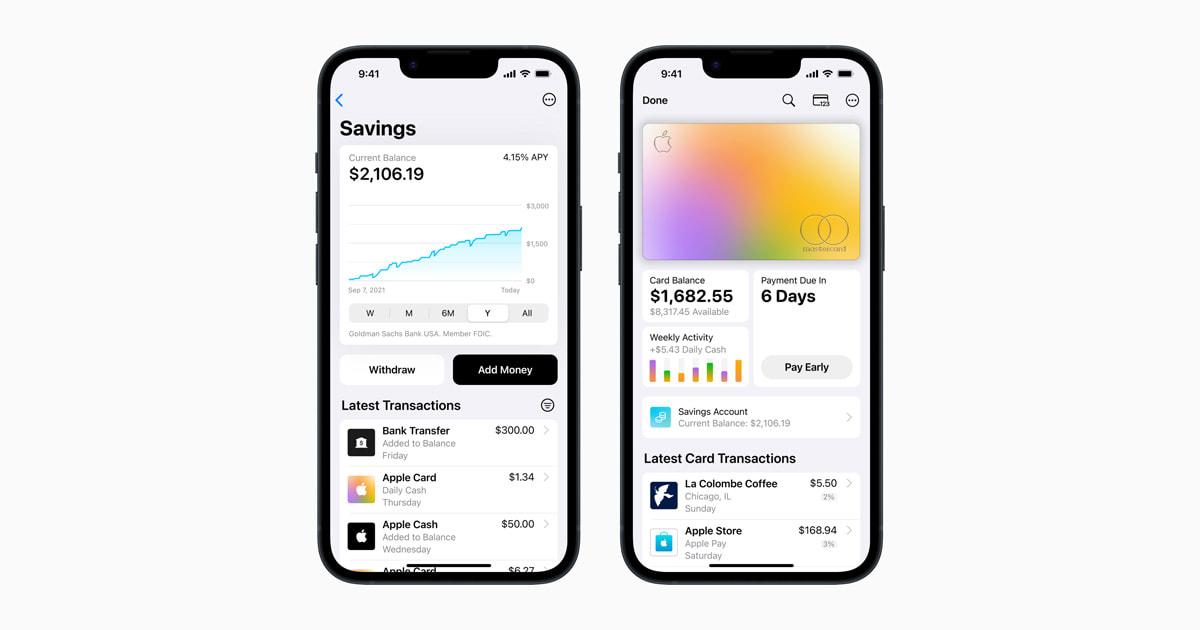
Anyone have thoughts?
And my favorite:
SaveDifferent
https://www.marcus.com/us/en/savings
Seems like they want people to go via Apple.
Citi's fancy "Citigold Private Client" savings account for people with $1M+ in it is at 0.35%.
(My favorite bit about that account: they have an interest rate tier starting at $10,000,000,000,000+ on https://online.citi.com/US/ag/current-interest-rates/savings...)
In the very least it will educate many uninformed folks like myself they are getting shafted at their current banks.
I also wouldn't call it below market rates. I'd call it "below the highest market rate" because rates for savings accounts vary and there isn't a standard "market rate".
Other reputable banks like Amex or Discover are only returning 3.75% right now.
https://www.cit.com/cit-bank/bank/savings/savings-connect-ac...
It is also part of First Citizens which is a decent sized institution:
Amex slightly lower, citizens access slightly higher.
Banks looking like they may lead to a more questionable experiences have even higher rates to offset higher chance of frustrations.
It's a common tactic to offer premium rates, and then drop the rate precipitously once they meet some quota N months later. Capital One did this circa 2020, for example.
That being said, if you're willing to play the game and monitor your monthly interest rate updates, go for it.
Otherwise, if you're a normal person who likes to ignore their HYSA account, it's prudent to go with people who are offering a rate closer to 4% (e.g. Marcus by GS is currently at 3.9%).
UFB, I note, does not offer a debit card.
4.15% is not the highest yield currently available, but it would put them fourth on this list[0] of ten, making them better than average even on that rarified list. This without fees or minimums, which would put them behind only Betterment, which is not a bank, but a brokerage account.
As always with an Apple offering, there are ways that some people under some circumstances can find better terms so long as they don't care about some of the benefits Apple is offering, but that's a very long way from "below current market rates," and comes from a company a lot of people are already trusting with their funds.
It's fine if you already have an account with UFB, carry on! And next month when it's a different company leading the pack, transfer. And the month after that, while Apple is still consistently in the top five.
0. https://www.investopedia.com/best-high-yield-savings-account...
The delta between, say, 4.55% and 4.8%, on the amounts I'm holding, may not be worth the potential extra headache of working with a lesser known bank. Introducing more risk (or just taking time to open more accounts) to earn, say, an extra $8/month... at some point becomes not worth it.