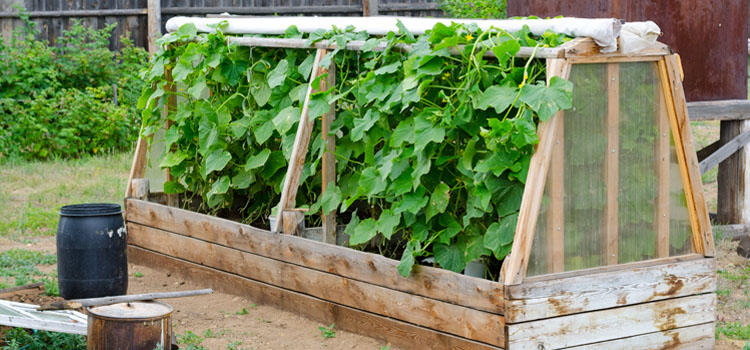
How to Make a Hotbed for the Earliest Sowings
Hotbeds are horticultural alchemy. But what is a hotbed and what makes them so magical?
GrowVeg
115 points · by teleforce · 3y ago · 64 comments
You will need a layer of something over the raw manure to make sure it doesn't scold/burn/kill your seedlings. Its not just the heat that will kill, but the raw piss. You will have difficulty putting seedlings in raw manure.
https://plantura.garden/uk/garden-design/hotbed this has better pictures.
You will still need to think about thermal management.
The victorians used to have hotbed out the front of green houses. They were made of brick, angled at about 120 degrees. They had a bed for the manure, that ran around the outside and took up ~50% of the space, and a bed inside that was just soil. This allowed them to change the manure to keep the temperature even.
Is another layer between the soil and manure required?
For something like beans, you would traditionally dig a deep trench (as in 4foot) and put a layer of manure, with news paper on top, by the time the roots got that far it would be rotten enough.
It might be better to use coffee grounds or fine wood chippings, as they are equally as warm but less toxic in the raw state.
In order to supplement the nutrient content of fully composted manure, you can age and then dilute human urine (https://www.sciencedaily.com/releases/2020/01/200122080500.h...) assuming you aren't sick or on medications (https://morningchores.com/urine-as-fertilizer/).
One thing I hate about gardening articles and videos is they often use terms that are not consistent with different locations. Where I am in Northern Europe, what we consider 'spring' is going to be very different from what someone in Southern California considers 'spring'. 100 years ago where you audience is going to be in a small location near your printing press this may have been acceptable, but today when your audience is global it really is not.
If I had to hazard a guess, this article was probably written with a British audience in mind, where "spring" loosely corresponds with March through May.
And in the natural world things can be really spread out. Plants have different niches based on being early or late. Shoots will come up in the winter. And some plants will be dormant until much later.
I wonder what better term you think there is where spring is used? Like in context it obviously means the start of the growing season. The suggestion is thus that the technique would be used that way before the start of the local growing season.
Here we get several feet of snow and frost into May, so it might be something I would do now. It probably wouldn't work good in February when there's piles of snow and temperatures well below freezing.
Lettuce is one of those vegetables, that once it gets contaminated with bacteria, you are kind of screwed. You can really wash it off and lettuce is usually eaten raw. Having it grown in a pile of manure may make it harder to keep from being contaminated.
I hope you don't buy organic vegetables because have I got some news for you... Between copious amounts of manure and liquified fish as fertilizer, you could always tell by the smell which farmers were looking to cash in on organic produce.
Why would anyone fertilize their crops right before harvesting them for sale? This makes literally zero sense, as it would just be throwing away money. It's like the urban legends about people lacing marijuana with 100% pure cocaine or whatever.
That was neither said or implied.
"Horta" is any green leaves you like, blanched and served with oil and lemon. Sure, it tends to be Dandelion or Rocket or whatever, but I don't think it's specified by the greek ya-yas, its whatever is to hand.
I had no idea Tiberius was a farmer.
Also, it was a largely agrarian society, so even an emperor could have had a few turns at managing fields at some point in their life.
When Diocletian, the first of the "Dominate" era emperors, voluntarily left power (the only emperor ever to do so), he returned to his palatial fortress on the Croatian coast to pursue gardening and especially cabbage farming.
At one point after his retirement, a group of senators from Rome was dispatched to visit him and convince him to go back into the purple due to the collapse of the tetrarchic system he'd set up for Imperial administration.
While the senators argued with him, Diocletian famously brought them to his garden and pulled out one of his own cabbages. He then asked the senators how they could expect him to possibly come back to the stresses of Rome when he had managed to raise such beautiful cabbages in the peace of his new home.
It is from this that we get Bread and Circuses: https://en.wikipedia.org/wiki/Bread_and_circuses https://en.wikipedia.org/wiki/Cura_Annonae
It was more a moral/identity narrative than a thing they actually did. They certainly owned the villas but whether they engaged in any way with the actual work (even in the capacity of "boss") of such places... maybe their servants, or their wives...
Other fictional writing I read suggests engagement in "trade" was beneath the senatorial classes, and so acquisition of land and it's economic exploitation underwrote what was considered "acceptable" sources of revenue.
Oddly, not entirely unlike the British Landed classes. They didn't like to admit that their land holdings had coal mines, where sheep gently grazing was acceptable.
Perhaps he was an inspiration to the Avatars cabbage guy.
Aerobic digestion. Ie: with lots of airflow/oxygen (lots of heat also helps!)