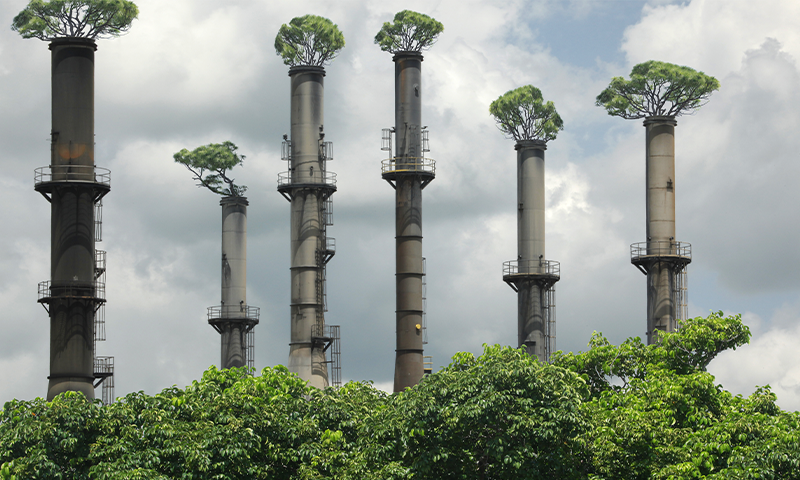
How Can We Stop the CO2 That Plants Store from Leaking Back Into the Air? - Nautilus
One question for Eli Yablonovich, an applied physicist at UC Berkeley.
nautil.us
50 points · by rbanffy · 3y ago · 166 comments
If we could create a carbon capture machine that turned CO2 in cinder blocks using the energy from a nuclear reactor, we'd really be set.
just my $0.02
I want to see this movie.
The movie might still be good but not because of the plot. But hey, it worked for The Matrix.
We have a lot of high-carbon energy substitution to do before DCC makes sense anywhere, let alone in the middle of an ocean, but before people trash DCC too hard I wanted to gently remind everyone that 1: industrial processes work better at scale, and 2: nature gives us magic rocks containing obscene amounts of low-carbon energy, so "inefficient" isn't necessarily a condemnation once we get past the energy substitution phase of decarbonization. I applaud the people working to de-risk the technology today so that when the time is right it can get off the ground.
https://today.tamu.edu/2016/11/29/6000-years-ago-the-sahara-...
Not sure there is evidence it was a forest, so wouldn't really be a "re-forestation"
You would need some sort of a Navy to guard this against sabotage.
Technically easy, economically and politically difficult. Ultimately I'd suspect it would need to be done at such a massive scale where the overhead of running a nuclear plant safely becomes minimal relative to the underlying costs to mine/refine uranium.
We could also adapt building design so that some portion of the steel and concrete used in traditional construction could instead use wood-derived materials. This would help a lot since steel and concrete are both very carbon intensive. Steel production alone accounts for 8% of ALL global carbon emissions!
Subsidize the lumber industry if you have to.
Also, update building requirements to favor sturdier materials. Most homes in the US are made of pine 2x4s that get obliterated by minor tornadoes. The homes of my great grandparents and beyond are all made of cypress 4x4s and 2x6s and higher. They've been hit dead on with tornadoes and terrible hurricanes and the worst that's ever happened to them is some missing shingles. When I was a child in the 70s and early 80s, you would find all sorts of old abandoned sharecropper homes lining River Road that were made of cypress with corrugated aluminum exteriors. The rich would buy these homes up, one by one, strip them of their exteriors and take the frames for use in their new homes. Why? Because it's cheaper than buying the new stuff, and clearly the materials are sturdy.
Growth mindset for the biosphere is where it’s at.
https://www.junglekeepers.org/
I just got introduced to these folks by our founder who I also just learned is supporting them substantially (Dax Dasilva / Lightspeed):
https://thelogic.co/news/lightspeeds-dax-dasilva-commits-40m...
* You produce biochar, which is almost pure carbon, and therefore you are only sequestering the weight/volume of the carbon, not all the water and other stuff.
* Biochar can be used as a soil amendment to improve microbial cultures and store carbon for hundreds or thousands of years
* You can produce energy in the form of heat or wood gas
* You can produce wood vinegar, which may have some agricultural or industrial uses
I think there's a nascent industry in converting biomass into biochar and sequestering it, but it would be very interesting to see it done with forestland more generally.
To expand on that, biochar seems to be the majority of carbon removal delivered commercially to date:
Of course the entire CDR industry is nascent.
Bio-oil via pyrolysis is another option. Charm Industrial is trying to scale that up.
I've looked at pyrolysis for home sustainability and have yet to find a good set of resources for it outside making charcoal.
Where's a good place to read up on it with an eye to practical applications ?
That said, it's not clear what impact smothering the ocean floor would have in the habitats there, nor how we would get the wood to sink reasonably rapidly and stay sunk -- we don't want massive logs floating back up and hitting ships.
I (personally) believe we are better served by heating the wood in an oxygen free environment (pyrolysis). This produces a charcoal like substance and energy, we can bury the biochar or use it as a soil amendment to achieve the same result (hundreds to thousands of years of sequestration) and get energy out of the process.
After the logs become fully submerged and settle, I do not believe that they decompose rapidly, but (again) cannot find reliable sources. The state of Florida has a licensed program for "Deadhead Logging"[0], but much of the content I've found about that program is specific to river ecosystems, not oceans.
A 2020 article entitled "First evidence of microbial wood degradation in the coastal waters of the Antarctic"[1] offers a few nice quotes:
> Wood submerged in saline and oxygenated marine waters worldwide is efficiently degraded by crustaceans and molluscs.
> Our results establish that there is ongoing wood degradation also in the Antarctic, albeit at a vastly reduced rate compared to warmer environments. Historical shipwrecks resting on the seafloor are most likely still in good condition, although surface details such as wood carvings, tool marks, and paint slowly disintegrate due to microbial decay.
[0] https://floridadep.gov/water/submerged-lands-environmental-r...
The most expedient way of "getting people out of their CO2 producing cars" is to focus on the "CO2 producing" part, i.e.
1. Get people into electric cars, which even on the current grid cuts your CO2 emissions by over half due to better efficiency, and
2. Convert the electric grid to 100% clean energy.
And it turns out there's a lot of money to be made in doing this too.
> 1. Get people into electric cars, which even on the current grid cuts your CO2 emissions by over half due to better efficiency, then
> 2. Convert the electric grid to 100% clean energy.
These both need to happen, yes. Cars existing is fine, just need to reduce usage for daily activities by 90% or so and also convert most of the grid to clean energy.
Then after that factor in parking lots! Sometimes I think more solutions need to involve "reforest parking lots". In some areas that alone would do far more for walkability than adding sidewalks. Parking lots build heat deserts that radiate heat back up to pedestrians (sometimes alarmingly so), but trees add pleasant shades and cool and hydrate the air around them. Add a bunch more trees and other foliage to existing parking lots and a lot of currently inhospitable suburbs would become a lot more hospitable to pedestrian travel.
I disagree with this sentiment. I hate cars, and what they have done to society. They are demonstrably and objectively not “fine”. They are the primary destructive force in society, and can and should die. Quickly.
And why can’t we use other forms of energy to power these machines w electricity?
You aren't going to motivate people to be better for the environment (by, say, buying a more expensive 40MPG vehicle instead of a 35MPG one), when it can so easily be wiped away by a guy just leaving a tool on for a few minutes more. Same situation with banning straws - nobody cares about the 1.6 billion masks in the ocean now (literally).
Maybe in terms of particulate pollution, but in terms of CO2 that's absolutely unimaginable.
Its worse in volatile organics, particulates and NOx. Mostly volatile organics due to the two stroke cycle.
But not because a chainsaw is particularly bad, but because a Camry is exceptionally good.
Why is the Camry good? Because it has a four stroke, fuel injected, computer controlled engine and $300 of catalysts breaking everything down. The smoke of the Camry's emissions is water condensing out.
That cannot possibly be true. That's a 16 hour drive through 1000 miles of mountainous terrain, requiring multiple tanks of gas, vs an hour of a small two-stroke engine spinning a little turbine.
That sounds like nonsense.
(FWIW I support banning gas-powered leaf blowers. But your claim is still bogus.)
Can we stop with "we don't need solutions like THIS, we need this other solution." We're going head first into a climate crisis. We need all solutions here.
No, we don't. Right now we need to cut the 90% of the problem that is caused by the same 3 things.
If you have some solution for a small part of the remaining 10% that is profitable or neutral, go for it.If you are arguing for research, so we can do it later, also, great. But if you want to divert attention from 90% of the problem just so you can improve your favorite 0.01%, just go sit in a corner somewhere until you get reasonable.
In other words, the problem is solved. Any gargantuan efforts that we apply now are just about trying to get there a decade or two faster. Given the history of worldwide coordination attempts, it's not clear that it is possible or worth it.
1. Every nation with a declining birth rate is shitting their pants about it and trying to raise the birth rate. It is seen as an existential crisis to not grow in population.
2. Birth rates have already been dropping for decades and carbon emissions are continuing to climb because we keep finding new ways to spend money on creating carbon emissions.
EPA press release said emissions were decreasing under Trump.
https://www.epa.gov/newsreleases/greenhouse-gas-emissions-co...
Except population is exploding in Asia and Africa and western nations are intent on importing as many of those people as possible.
What’s baffling to me is how much overlap there is between the “we need to reduce CO2 emissions”, “having children is selfish”, and “we need more immigration” crowds. One of these things is not like the other.
Alarmism is a good way of moving people to action but it isn't accurate.
Who is this "we" [1]?
It's win/win.
> However, ships emit only between 10 to 40 grams of carbon dioxide per kilometer. The carbon footprint of airplanes is 20 to 30 times more than ships.
https://8billiontrees.com/carbon-offsets-credits/carbon-ecol....
https://www.europarl.europa.eu/news/en/headlines/society/201...
Seems better than BECCS, but otherwise not as good as other options.
Nuclear provides non-carbon-emitting base load for situations where we don't have enough batteries to ride out dunkelflaute[0] and we haven't hit peak uranium yet. Biomass carbon sequestration buries carbon that we liberated into the air back into the ground.
In order to deal with the problems we caused, we both need to stop causing the problem and fix the damage we did.
[0] German word for "dark wind lull", i.e. no sun and the wind ain't blowing.
https://news.stanford.edu/2022/02/09/turning-carbon-dioxide-...
Like, maybe that's how it got there in the first place. Our ancestors cut down trees for fuel, caused global warming and came up with this great idea to sequester it as coal under the ground. They save the environment, but end up living in caves and huts. 6000 years later we come around, dig up the coal, burn it, cause global warming, and then... decide to sequester it back in the ground as coal again. EDIT: It remains to be seen whether we will also end up living in caves and huts (again)
Gardeners call inoculated charcoal biochar. Historical examples of human created charcoal rich soils are terra preta and African dark earths. Terra preta and African dark earths have highly elevated levels of black carbon (up to 9%) and have remained fertile for at least 400 years. We don't know if these charcoal enriched soils were intentionally made or if they were just community middens. But, these charcoal enriched soils are undoubtedly more fertile than the surrounding soil.
Skill Cult has a great playlist about charcoal and how it can be used in agriculture.
https://www.youtube.com/playlist?list=PL60FnyEY-eJAfBgRAHKXj...
One would of course have to compare the several competing mechanisms which actually works best.
And human being contribute 3% of that CO2 from their own bodies, yet a few billionaires want us to eat insects and bugs.
But, I am here to tell you about our awesome zero-carbon steady-state base energy sources that gets totally ignored: nuclear, ocean-wave, and hydroelectric.
https://mobile.twitter.com/BernieSpofforth/status/1647503065...
Why are we trying to stop the plants from doing this exactly? The ever-impending apocalypse?
If we could find a way to prevent that, then those trees could be used as machines to pull CO2 out of the air and store it, preventing it from being a greenhouse gas.
Source: I manage forestland in the PNW for the purpose of habitat restoration, and was surprised to learn how removing tree mass from a system can actually improve the overall health and biomass of a system.
So, stop burning stuff.
That seems optimistic. If that's the case, why is it that we still regularly have engineering debacles and failures? Whether it be software, or rockets, or dams, it's not a magic "we can solve anything with engineering and enough money." Engineering is amazing, but it's not magic and engineering mistakes and oversights are a regular occurrence in every field.
And this:
"To pay for this, the people who sell you the gasoline will have to be billed an extra 53 cents. And of course, it’ll appear at the pump. That would amount to around $2 trillion, which sounds like an awful lot of money. But the GNP of the world is about $100 trillion. So it will set the world economy back by 2 percent."
This is elitism on an absurd level. Does he have any idea, how much just "reducing the world economy by 2 percent" would actually do? He's casually talking about the livelihoods of millions as though they are expendable. And 53 cents? I mean, in Silicon Valley it sounds great. But considering the median US income is only $31,000 (not joking); that's a cruel tax. Also, that would be worldwide, and I think it goes without saying that 53 cents a gallon in China or India added to the pump is a non-starter.
So we'll do this to counter an unknown tail risk. I would argue, in my mind, that technology and AI is moving way too fast, and the current solutions to the climate issue are not feasible politically. People don't care. A more optimistic approach would be to wait and see what technology can bring us in the next 20 years or so to solve the problem instead of trying to rush today's inadequate solutions to market. Imagine if we had begun trying to solve the climate crisis in a radical manner 20 years ago, back when we had Windows XP, ludicrously expensive and shorter lasting solar panels, no practical large lithium-ion batteries, etc. It would be impossible. I think it's about as equally impossible today for what we'll have in the future.