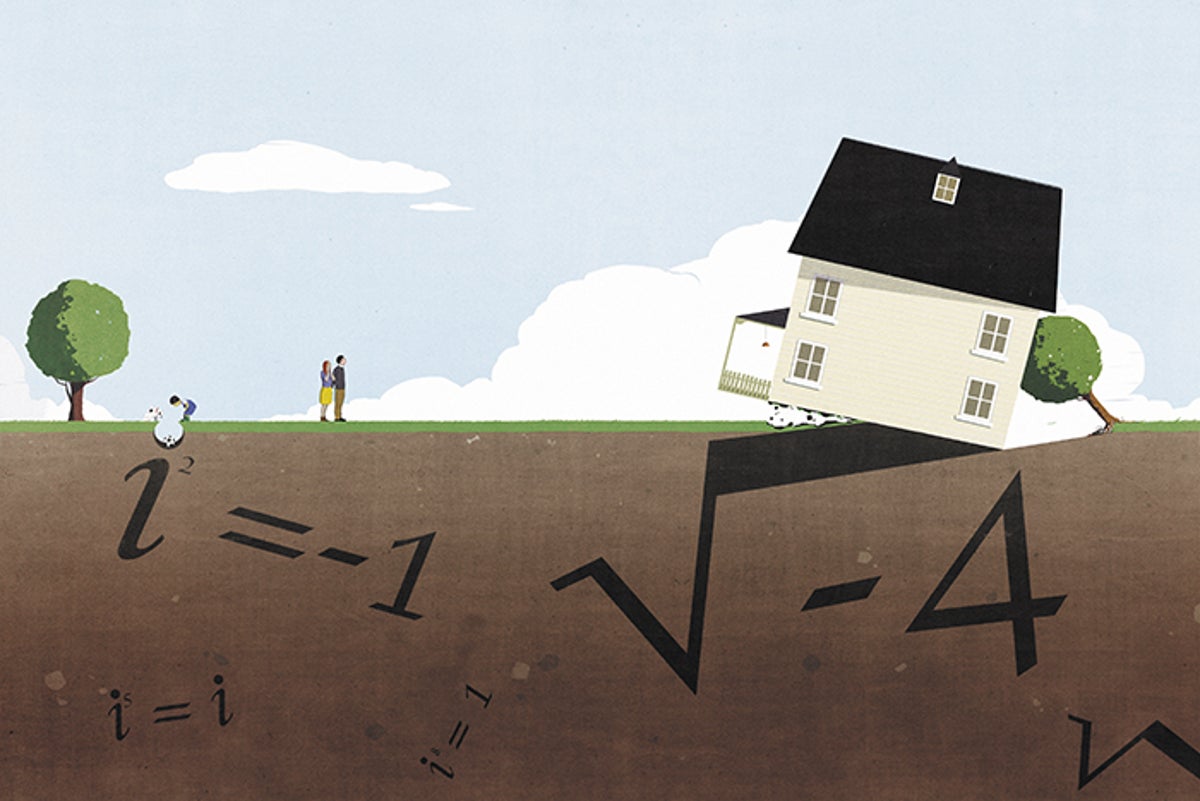
Quantum Physics Falls Apart without Imaginary Numbers
Imaginary numbers—the square roots of negative numbers—are an inescapable part of quantum theory, a study shows
Scientific American
101 points · by wrycoder · 3y ago · 157 comments
The intuition I developed with them while studying physics was that, unlike "real" numbers which interact by stacking, complex numbers interact by stacking and rotating. This is bizarre to think about with single numbers in a 1D world, but we don't live in a 1D world. In higher dimensions they rotate and sheer rather than just scale.
And indeed, QM (at least as it was thought to me) would fall apart without complex numbers. Whether a physical theory can be consistent without them is an interesting question, but not because a physical theory with them creates some kind of metaphysical paradox.
I agree, it is interesting, and the answer is yes, a physical theory can be completely consistent while never using complex numbers.
If you don't want to use imaginary numbers, you can avoid them for almost anything by using matrices instead. Use 2x2 matrices instead of complex numbers, and instead of 1, use the identity matrix:
1 0
0 1
Instead of i, use a matrix that corresponds to a 90 degree rotation:
0 -1
1 0
This means that i * i = -1, and so pretty much everything else will just work the same way as it does with complex numbers. Adding, multiplying, calculus, all the same. No need for complex numbers if you don't like them.
I do like complex numbers though. They are just a bit more concise and convenient than using matrices.
Like Quaternions, which add another dimension to our 3 to help solve ambiguities with Euler angles and gimbal lock. Going another dimension up makes the solutions much more elegant.
EDIT: the difference between complex numbers and 2D vectors (as I understand it) is just that you can’t really multiply 2 2D vectors together to get another 2D vector (you need to multiply a scalar times the vector to get a vector), but you CAN multiply two complex numbers together to get another complex number.
To do multiplication with 2 vectors you need to introduce new things like the “inner product” (dot product) to produce another vector (as opposed to “outer product” which produces yet ANOTHER kind of thing, a matrix) whereas with complex numbers you can use regular multiplication without introducing new types of multiplication.
I always liked that one. Gimbal lock comes in because to be of any practical use you gotta have a reference axis from which you start to rotate, which necessarily creates poles with a singularity. Since you gotta have the axis there's no way around it.
So, how to solve that? Easy: stuff the axis outside of 3d space. It doesn't even matter what the axis is, it's just there to stash the singularity away and you can rotate every which way continuously.
The inner product gives you a number and the "cross product" for vectors gives you another vector and is not the same thing as the outer product.
I think it's also not really correct to compare them like this, because complex numbers give you complex structure, whereas vectors don't. Yes, you get another dimension, but also a rich algebra, Cauchy-Riemann equations, etc.
Put another way, complex numbers are a qubit the universe gives you for free.
For example, lets just use the cliffords plus arbitrary phase rotation {X,Y,Z,H,R(theta)}. X,Z and H are all real. Y is real up to an irrelevant global phase (if you really want to implement it anyway, just do X,Z on the target and then flip the ancila with an additional X). All that's left to handle is R(theta). Map R(theta) into a (real) controlled rotation in X (to wit: C-X(theta)). Thus we have a set of gates, universal for quantum computation, using only real numbers.
If you don't believe in arbitrary rotations X(theta) without intermediate imaginary operations, just pretend I used the T gate instead to extend the Cliffords. Either way you can construct a set which is universal for QC with only real numbers.
Why should it work? Simple. In your math, if you replace every i with |i> your equations are still the same. You've just substituted one squiggle on the page for another that works the same way. The Riemann sphere is just like the Bloch sphere. Complex numbers are a qubit the universe gives you for free.
No less useful, but kind of mundane.
Are there other things they fundamentally do, or is everything else rooted in that property? (Or have I just misunderstood them?)
In quantum mechanics, we use complex numbers to describe the behavior of particles. A complex number has two parts: a real part and an imaginary part. The real part represents something we can physically measure, like the position or momentum of a particle. The imaginary part represents something that's a bit harder to grasp - it's related to the probability that the particle will be in a certain state or position.
For example, let's say we're trying to describe the position of an electron in an atom. We can't know for sure where the electron is at any given moment, but we can calculate the probability of finding it in a certain region. The probability is represented by a complex number, with the real part telling us the position and the imaginary part telling us the probability.
Things like Feynman Diagrams model probability distributions of particles and all possible paths they can take from A to B. They allow us to do interesting calculus
That is while at higher levels they allow modelling of things such as probability and state, the way they are fundamentally enabling this is also just the same thing - a shorthand trick that permits fast calculations of rotational characteristics.
I'm not sure that they're able to do anything else. A wave is a particle as I understand it, or rather, they are like views into the same thing. But waves have identical characteristics in terms of what is tracked to enable calculations with them.
Eg there's amplitude phase and frequency. Maybe they all have probabilities or are otherwise dynamic, but that's what there at the base level. The complex plane then just takes the role of enabling easier calculation and tracking of state changes.
A wave is a wave whether it is a sine wave on a scope, a wave of pressure through a solid or gas, a light wave, or the path of a particle when viewed as a wave. Or, I'm misunderstanding and there are actually two, or more types of complex numbers.
The stationary probability distribution of some transition matrix is the eigenvectors, so the stationary "probability distribution" of even very simple matrices (like cycle of 3 values) are complex. It's not as magical as they make it out to be.
My intuition leads me to believe that almost some sort of other dimensional effects are at play, and our feeble math just can't accurately describe it. Perhaps it's just the nature of quantum itself, and no special dimensional consideration is needed. It's been a long time since I studied any math or physics...
You can't and shouldn't try to understand QM from a CM standpoint. If you remember Taylor series expansions, this is like trying to understand `sin(x)` by looking at it's first order Taylor series expansion `x`. Your question about momentum and a potential hill is the same question as "how did the value of sin(x) start decreasing if `x` is linear?" You're using too few terms of the series expansion. The mechanisms of Newton's laws are first order terms of a proper QM solution.
All physical theories are “fundamentally wrong.”
> You can’t
A classical apparatus is part of the QM framework.
Ergo: the commenter doesn’t know what they are talking about.
> The mechanisms of Newton’s laws are first order terms of a proper QM solution.
Quantum mechanical velocity is complicated as well.
Are we talking about different things? Is one of us way off the mark? Or are these two angles of the same phenomenon?
[0] https://www.youtube.com/watch?v=_Sm7SNlNUOI&list=PLOFVFbzrQ4...
The most common explanation is a geometric one, that of the "complex plane", that seems awfully analagous to any old 2D plane. But teachers never seem to explain why you'd have a complex plane in the first place, or when you'd use it instead of a regular plane, and you slowly realize that indeed, nobody's ever using it as a dimensional "plane" at all that's used for geometry or 2D coordinates or anything.
Then you progress into all the complex e^ functions where you basically forget about a plane, and it's just a convenient shorthand for math that would otherwise involve a bunch of trigonometric functions. But again, this never provides any actual intuition... it's just convenience. You could still write everything as sin() and cos() etc.
I finally felt like I understood complex numbers when I asked myself, how do you create a continuous solution to the function y(x) = (-1)^x? Because for x = [1, 2, 3, 4...], y = [-1, 1, -1, 1...]. But you can work out the math such that it necessarily produces a spiral through them. And it's different from the e^ equations because there's no pi involved.
And so rather than thinking of complex numbers as a "plane", it's much better to think of them simply as the inherently spiral motion required to continuously join alternating values. And when I look at how complex numbers are actually used in things with physical correlates -- e.g. signal processing -- the spiral intuition always continues to make sense.
Of course, at the end of the day, it's all the same math. But the idea of a continuous spiral path between otherwise discontinuous real numbers has wound up clicking for me in a way that the metaphors of a 2D plane, or of more generalized arbitrary "rotation", never has. That complex numbers are about spiral oscillation, not about planes.
https://qph.cf2.quoracdn.net/main-qimg-1b9122546ee68a13e259e...
And it connects circles, e/euler's formula, and sin/cos is a visually grokkable way.
y = cos(pi * (x-1)). No complex numbers needed.
Yes, you can make a 3-D spiral / helix by mapping from R to C, but (a) that's only when your domain is R; ignoring when the domain is C.
The spiral doesn't help you with a simple task like solving this: 0 = x^2 +1
A helix is a time-based view of drawing a circle, in the plane.
Your favorite use of complex numbers isn't the only use of complex numbers.
Your spiral motion intuition is really cool and complements the amplitwist model that book introduced me to nicely.
On a random tangent, one of the reasons why I love Common Lisp is that it has functions like CIS[1] in its library. That got me realizing you can literally view SIN and COS as CAR and CDR for what's essentially a cons of non-Complex numbers. I don't claim there's any benefit to doing so, but it's not wrong.
I do not understand at all that stuff about "spiral path between otherwise discontinuous real numbers", but I suspect you may be making things more complicated than they need.
Reading this abstract[1] and this[2] StackOverflow discussion about the topic, it seems the point is rather more along the lines that complex numbers aren't just plain two-dimensional vectors of real numbers. There's an extra constraint involved by requiring that i^2 = -1, which could be written other ways, that ties the two elements of the tuple together. It seems quantum physics requires this constraint in order to describe reality.
Then again, I'm just a programmer.
[1]: https://www.nature.com/articles/s41586-021-04160-4
[2]: https://physics.stackexchange.com/questions/691623/how-does-...
I think you couldn't have put it better. I'm just a physicist, though.
You might be tempted to think of complex numbers as "just" being 2-dimensional real vectors (x, y). Looks pretty similar to how you can plot a complex number a + ib at point (a, b) on a 2D plane. But importantly, division is defined on a field, which is not necessarily true for vectors. For any complex number (except 0), you can find another complex number that multiplies with it to give 1, the multiplicative identity.
You _can_ think of complex numbers as being "made of" real numbers though. a and b above are just real numbers. Complex numbers are the two-dimensional normed division algebra over the reals[1].
[0] https://en.wikipedia.org/wiki/Field_(mathematics) [1] https://ncatlab.org/nlab/show/normed+division+algebra
Complex numbers afaik began as an attempt to solve polynomial equations. They begin from the agreement to invent a number i whose square is -1 so you can solve equations having sqrt(-1) in them.
The jump from sqrt(-1) to plane rotations is to my feeble mind one of the most flabbergastingly unintuitive things in ‘basic’ maths. “A rotation you say? Who ordered that!?”
It explains how standard (complex) quantum theory comes up with the right answers, but how you can also just rewrite the equations as a less-elegant "real" quantum theory that involes no complex numbers, that also comes up with the right answers.
Which makes perfect sense, of course, because all of the rules of complex math are written in terms of real numbers at the end of the day. When CPU's are calculating math operations, it's not like any complex/imaginary bits or bytes are involved.
But then the article describes an experimental setup where the results are somehow only consistent with standard/complex QM, and are inconsistent with real QM.
But it totally neglects to say how or why. The entire premise behind real QM is that the complex stuff can just be rewritten as real. But this article seems to provide zero explanation, analogy, or intuition whatsoever as to why there's a case where this would ever not be possible. At no point does the article define what it even means to not be reducible to real math.
So I can't tell what any of this is supposed to mean at all?
Quantum mechanics is defined by three axioms:
1. States are unit vectors. Vectors whose 2-norm is 1.
2. Operations preserve the 2-norm. They are described by unitary matrices.
3. Systems are combined using the tensor product. If system A has state u and system B has state v, then the combined system (A, B) has state u⊗v. If you apply operation x to system A and operation y to system B, the operation on the combined system is x⊗y.
What this paper proved is that, if you use these axioms but limit yourself to unit vectors and unitary matrices with real entries, you cannot explain some experiments. This is surprising because a complex number can be thought of as just a pair of real numbers. For example, in numpy, you can turn any complex ndarray into a real ndarray by making an ndarray with one additional index of length 2, like this:
    def complex_to_real(complex_ndarray):
        real_ndarray = np.zeroes(shape=(*complex_ndarray.shape, 2), dtype=np.float64)
        real_ndarray[..., 0] = np.real(complex_ndarray)
        real_ndarray[..., 1] = np.imag(complex_ndarray)
        return real_ndarray
The problem is axiom (3), where systems are combined using the tensor product. The issue is that complex_to_real(A ⊗ B) has one more index than A⊗B, but complex_to_real(A)⊗complex_to_real(B) has two additional indices because you gained one real-vs-imaginary index from A and also one from B. The tensor product doesn't understand that these indices should be merged, instead of concatenated. Using complex numbers tweaks the definition of the tensor product so that it does merge these indices. The experiment is basically a way of checking that you contracted those extra indices instead of keeping them both.
So really this result is not about complex numbers vs real numbers. It's about how the states of quantum systems are combined. If you want to use real numbers, you can't use the normal tensor product; you have to use a modified one that understands every system has a special real-vs-imaginary index and that when combining systems you must contract these indices together. Complex numbers just happen to have a tensor product that packages this contract-one-index functionality nicely.
https://academic.oup.com/book/26363
As far as I know (I haven't read the book) he argues for this by logically reconstructing part of Newtonian Mechanics without any numbers (without assuming the Peano axioms) and suggesting that in principle similar things could be done for other theories.
Now it would be very surprising if Quantum mechanics would even require the existence of imaginary numbers, since these seem to be much less basic than natural or real numbers.
Anyway, I agree that popular articles haven't made it clear what the relevant physicists mean with their thesis. And as a non-physicist it is hard to read the original source.
And as imprecise as that sounds, many of the formulas that take complex numbers as inputs multiply them with other complex numbers in such a way that the imaginary side cancels out.
First you have some math that goes along discovering physics. You split vectors, multiply mass by something and it's fine.
Then you have math that helps you with physics. Simple differentials equations that uncover while laws of nature (cooling down speed for instance). This is the golden time for many because you're at this sweet spot where it is exciting but not too hard.
Then comes the travel in desert of abstract things you have no idea about and winner why someone hates you by shoving Abel groups down your throat for no reason.
Finally comes that sight of relief when you can binding do some maths to end up with a real life solution without too much thinking because you have solid tools.
The last part is a bit morally complicated because you have the feeling that you are cheating. Renormalization, I am looking at you.
But then I forgot everything because I left academia and my memories may be faulty.
This is the first time I've heard anyone say that. To me, renormalization is extremely weird, if anything because it's so unrigorous and ad-hoc that I find it hard to believe it even works. Sure, it does the job it's supposed to, and I understand how it does that (for the most part anyway), but that doesn't make it any less weird.
But doing splits and advanced acrobatics to get rid of infinities always felt like a hack (Feynman felt the same do at least I am not alone :))
It's not imprecise. It reproduces experimental results from theory, so it's in fact the most precise approach in existence.
Yeah I'd say that's the most common approach but I think it's misguided. Complex numbers aren't any less physical than any other number. It just turns out that for historical reasons, it makes sense to define observable quantities using self-adjoint operators (which have real eigenvalues, and the latter are used to measure things like energy). But that doesn't mean the rest is not physical. Just because we can't take a picture of an object in the dark, it doesn't mean the object isn't there when the lights are off.
The only thing imprecise about this is "many". Really any formula for an observable of any kind (including probabilities) has to come out to a real number.
Apparently the existence of irrational numbers was a shock to Pythagoreans. There may be also people unhappy with transcendental numbers.
Even from a 21st century perspective, I think that the first "two dimensional number" is always going to freak people out and I can see where it's coming from. Imaginary numbers intrinsically involves leaving numbers that can be used to describe the number of apples you have in your hand, and by the time people get there, they've been pretty darned used to numbers looking like that. Real numbers nominally overshoot that too (you can't really have apples in two hands whose size only differs by 10^(-(10^1000))) but people tend to not have their faces rubbed in this until they get a math degree.
Matrices nominally are such numbers too, but they are often presented as shortcuts rather than numbers in and of themselves.
Of course in the 21st century now we have a zoo of these representations and the community as a whole is comfortable with it.... but for any given person I still think that first number that isn't something that can be a number of meters or apples is a shock.
In fact we only see plus/minus/times/divide before getting into "You'll probably use a computer for that, and you probably don't need to unless you're an engineer" stuff. Does anything ever happen outside of science that we could use imaginary numbers to understand? Are they just fundamentally outside ordinary experience, or do we not see them because we have workarounds that hide them?
It would be interesting to read a SciFi novel where regular people commonly encounter imaginary numbers and other similarly far from everyday life stuff like calculus.
Reason I think this is having listened to Greg Egan's Dichronauts, in which spacetime is ++-- with all the counterintuitive hyperbolic rotations that this implies.
Other ways to get i into common use besides that, probably gives equally counterintuitive results if you don't already know the maths; for example, instead of a maximum debt you can take out based on your ability to repay, you get a region which, for certain interest and repayment rates, is the Mandelbrot set.
Modelling here means predicting what a change would do, for example if I want to make a robot that can balance a stick upright on its hand like you might do with a broom, I use maths related to pendulums to predict the movement of the stick, which require imaginary numbers to show how moving in a certain direction will cause the pendulum to fall (in what direction & how fast). I must emphasise here that I have done these things with real robots, and they do indeed heat/electricity flows/balance as the maths predicts.
Does this imply your brain is doing the same maths, imaginary numbers and all, when you balance a broom on your hand? Is there an alternate mathematical notation that doesn't include such strange unintuitive things? probably, thats for the mathematicians to figure out. But as an engineer, they definately do work.
Some controversy does exist. NJ Wildberger is most famous for not believing in the real numbers.
Similar to "imaginary" numbers, it's curious how influential/distracting the terms are, though.
In three dimensional Geometric Algebra, `i` is defined as the product of three orthogonal unit vectors, `abc`. You have `abc = bca = cab = i` and `acb = cba = bac = -i`. So `i` defines a chirality on the space.
David Hesternes has a paper relating that to QM: https://web.archive.org/web/20120406093531/http://www.montgo...
Stop calling them imaginary.
i^i = 0.20787957635... (Spoiler alert: it's real!)
No, they're not imaginary, and yes they have real-world significance. They represent oscillations in control systems [1]. They're useful for accurately approximating derivatives [2]. I really dislike the term "imaginary" because of how useful they actually are.
[1]: https://web.mit.edu/2.14/www/Handouts/PoleZero.pdf
[2]: https://mdolab.engin.umich.edu/wiki/guide-complex-step-deriv...
Note also that a world with only monotonic linear motion could not possibly have life or thought or any complex behavior. Rotation is required to model any sort of accretion over time. (note that the typical finite case of "particles in a box" bouncing off the walls is, on average, circular motion too.)
See Clifford Algebra for generalization of the complex numbers
I don't see how this is remotely true. You can't even solve the ODE for an undamped mass-spring system without imaginary numbers. More generally, most of our notion of eigenvalues falls apart if we work over the field of reals rather than complex numbers, and once you lose that, you lose most of linear algebra and with it vast swaths of engineering.
Where are imaginary numbers required for the undamped mass-spring system? Because a lot of "complex" equations are using complex e^ simply as an alternative to trigonometric functions (for aesthetics or convenience), where there's nothing inherently imaginary whatsoever. The same as much of signal processing.
I'm less familiar with using complex numbers in linear algebra, but I know that when I studied it in college we never touched them, so I don't understand how we'd lose most of linear algebra?
But I think the point the article is making is that, except for QM, there are no physical instantiations of complex/imaginary values. Rational numbers physically "exist" as a fraction of a distance between two points; real numbers "exist" as actual geometric proportions, and negative numbers "exist" as an opposite direction. But complex/imaginary numbers are just intermediary tools for solving equations (or conveniences to replace trigonometric functions), they don't correspond to anything physical (except, it seems, in QM).
https://ieeexplore.ieee.org/abstract/document/6875117
On the other hand it makes me wonder if there's some deeper truth about the nature of probability representations.
Real number 1 is 1 OR -1 Imaginary number 1 is 1 AND -1
In other words, when you “break apart” i, you get 1 and -1
What they add which your comment discounts is the locality structure of quantum mechanics, i.e. what happens when you combine multiple quantum systems. Specifically if the state of one system lives in A, and the state of another system lives in B then the state of a combined system lives in the tensor product A ⊗ B.
If you do the trick where you replace complex numbers by real matrices what you end up is having the state of the first system living in A = X ⊗ A', and the second is in B = X ⊗ B', where A' and B' are real and the X subsystem is the degree of freedom you're using to "fake" the complex numbers.
Then if you try to combine the two systems you end up with a state that lives in A ⊗ B = (X ⊗ A') ⊗ (X ⊗ B') but what you need in order to get the behavior you want is actually for the combined system to live in X ⊗ (A'⊗ B').
What they do is a bit more complicated because they show that all ways to fake complex numbers using real numbers breaks this way of combining systems, but this is the gist.
When I took undergrad quantum physics, we saw that the Schrödinger equation can be represented without complex numbers. But that's for one particle, and it sounds like you're saying this somehow breaks down when you have multiple systems interacting, due to these tensor products not working as we think they should?
If you drop that assumption about how things compose then you can use something like the real matrix representation where 1 is a 2x2 identity matrix and i is some anti-symmetric 2x2 matrix.
Because if real skew symmetric matrices count, then a harmonic oscillator also inescapably uses imaginary numbers.
>Marco made a curious face, so Toni posed the question: “Can standard quantum theory work without imaginary numbers?”
Why are amplitudes complex?
The page isn’t redirecting properly
An error occurred during a connection to www.scientificamerican.com.
This problem can sometimes be caused by disabling or refusing to accept cookies.To expand: any time you read "...magical complex numbers" just mentally replace "complex" with "negative" and then examine how odd the original text now reads. There's nothing fundamentally different between the concept of negative numbers, and complex numbers.