The real lesson about the end of nuclear in Germany
The end of baseload is coming
jeromeaparis.substack.com
68 points · by Enimesnas · 3y ago · 263 comments
Whereas in France, the new EPR in Flamanville, for all it being talked about as a failed investment, has cost 1/10th of that. With 10x the money and economies of scale, we could have had a crazy nuclear capacity with very strict, modern standards.
Whether France will build nuclear or renewables, the problem is they had to do it 10 years ago.
Your comparison is meaningless, because the 150 billion € investment is not comparable to a single nuclear plant.
And realizing ten times the current building capacity for nuclear plants with the same (or stricter) regulation and standards? That is almost delusionally optimistic.
Which grid-scale solar projects have gone into production on schedule and under budget? Are there any?
Here's what the researchers found for solar (section 3.4):
Thirty-nine solar PV and CSP power plants, representing 2374 MW of installed capacity and $16.5 billion worth of investment, were analyzed. (These are utility-scale infrastructure projects, thus they do not include the familiar rooftop solar collectors on buildings or residential configurations.) These projects as a class actually came in $4.2 million less than budgeted, or $200,000 less than expected per project. These solar systems had the lowest average cost escalation per reference class (1.3 percent), the least time overruns (an average of 2 months ahead of schedule), and the lowest standard deviation for amount of overruns and time overruns. They also had the largest total amount of cost underruns, with the entire class of projects costing $163.9 million less than budgeted, though some of this may be explained by dramatic reductions in cost over the past 4 years. As Table 5 indicates, only 3 facilities had overruns greater than $50 million and only 3 facilities had cost overruns greater than 30%, all of which were CSP facilities rather than large-scale solar PV apparatuses.
Here are a few solar projects that outperformed in recent years:
O'Brien solar farm in Wisconsin, completed in 2021 on time and under budget:
https://www.boldt.com/project/edf-renewables-obrien-solar-fa...
Mount Signal 3 in California, completed in 2018 ahead of schedule:
https://www.solarpowerworldonline.com/2018/12/8minutenergy-c...
Sun Streams 2 in Arizona, completed under budget and ahead of schedule in 2021:
https://www.enr.com/articles/55112-best-project-energy-indus...
Hillston solar farm in Australia, reached full commercial operation in 2022 ahead of schedule:
https://www.solarquotes.com.au/blog/hillston-solar-farm-mb24...
Kuala Ketil solar farm in Malaysia, completed in 2019 ahead of schedule:
https://www.pv-magazine.com/2019/09/12/50-mw-solar-park-come...
[1] https://www.qualenergia.it/sites/default/files/articolo-doc/...
All projects do, including wind and solar.
--- start quote ---
Ernst & Young (EY) has found that an average power and utility megaproject is delivered 35% over budget and two years behind schedule
Of the megaprojects surveyed, 64% were delayed and 57% were over budge. Almost three-quarters of hydropower, water, coal and nuclear infrastructure projects were over budget by 49% on average,
--- end quote ---
https://www.offshorewind.biz/2016/12/02/offshore-wind-projec...
> And realizing ten times the current building capacity for nuclear plants
How much do we need to overbuild wind and solar?
There is no need to "overbuild" wind or solar. There has never been any illusion those sources will produce at 100% capacity all the time. There will eventually be energy storage to level out the peaks, but most countries still have years to build up to the point where this is necessary.
Nuclear has failed to scale, it's a well documented issue. If we want to decarbonize quickly, I cannot imagine how it can make sense to invest a 1/10 for a 1/25 of the production, and then wait decades longer for it. If decarbonization is the goal, projects like Flamanville are already a failure: even if finished it will take decades and decades to make up for the construction time during which it did not produce a single kWh and did not displace a single molecule of co2. Germany was over 50% coal 20 years ago, it would still be at this level if it had gone that route. It can't be the solution now.
This reminds me of the joke "Fusion is 30 years away and always will be".
The reason is that a panel of scientist predicted various timelines of viable fusion between 30 years and infinity years based on effective funding. Ever since the funding for nuclear research was significantly below the level of the infinity years[0].
I suspect nuclear fission followed a similar path in the last decades.
[0] https://astralcodexten.substack.com/p/your-book-review-the-f...
It hasn't, and it's not a "well-documented issue". What's documented is decades of FUD, fear-mongering, underinvestment etc.
> If decarbonization is the goal, projects like Flamanville are already a failure
Why not look at projects like Fuqing Nuclear Power Plant instead?
> will take decades and decades to make up for the construction time
Ho long will it take to overbuild renewables and all the required power storage for them?
E.g. right now, during the day, Germany's renewables are generating:
- wind: 20% of installed capacity
- solar: 34% of installed capacity
- pumped hydro storage: sucking up 8% of total power generation for recharging
> Germany was over 50% coal 20 years ago, it would still be at this level if it had gone that route.
Which route? E.g. France's carbon output from electricity generation is ~56g/kWh. Germany's is ~340g/kWh. Care to guess why?
> Why not look at projects like Fuqing Nuclear Power Plant instead
Because the person I replied to talked about Flamanville... Do you even read what is discussed or just frantically go from one post to the other?
I also posted how long it took to reach 50% renewables - 20 years, during which time the EDF/Areva failed to complete almost all of the projects they were involved with. If Germany had gone that route it would still be pumping out 800g/kWh like Poland does and it would be doing that for the last 20 years. Thank God it didn't make that mistake.
https://www.theguardian.com/news/2017/dec/21/hinkley-point-c...
Would that help though, if drought periods hit Western Europe, like last year, and water levels in the rivers are as low as they were?
* a minority of plants were involved, it was only an issue because it happened on top of other issues (planned maintenances delayed due to covid, corrosion issues)
* the problem isn't actually the drought, it was the heat. The plants could keep operating, but they would have rejected water too hot, in breach of environmental regulations.
Besides, new plants can be built close to the sea instead of rivers to account for that.
I think that's a no-go due to the salt in the water that will corrode pipes etc. Not an expert on that, though, obviously.
All the other points don't sound too good either: Corrosion issues, let's fuck up nature with hot water, not very good at all.
Also nothing stops you from building nuclear plants in other locations
Either way it's true that they let the situation degrade far too much while resting on aging infrastructure; it'll take a bit of time to get back on track whatever the direction is.
In France's case, we had both.
Meanwhile because cost cutting on maintenance backed up wholesale prices next winter are a blowout - far worse than Germany's:
https://www.archyde.com/french-electricity-prices-soar-for-w...
At one point, German subsidies drove ~⅓ of the global solar adoption, ~86% of which occurred outside Germany (6x) - see https://founderspledge.com/stories/changing-landscape#fnref1
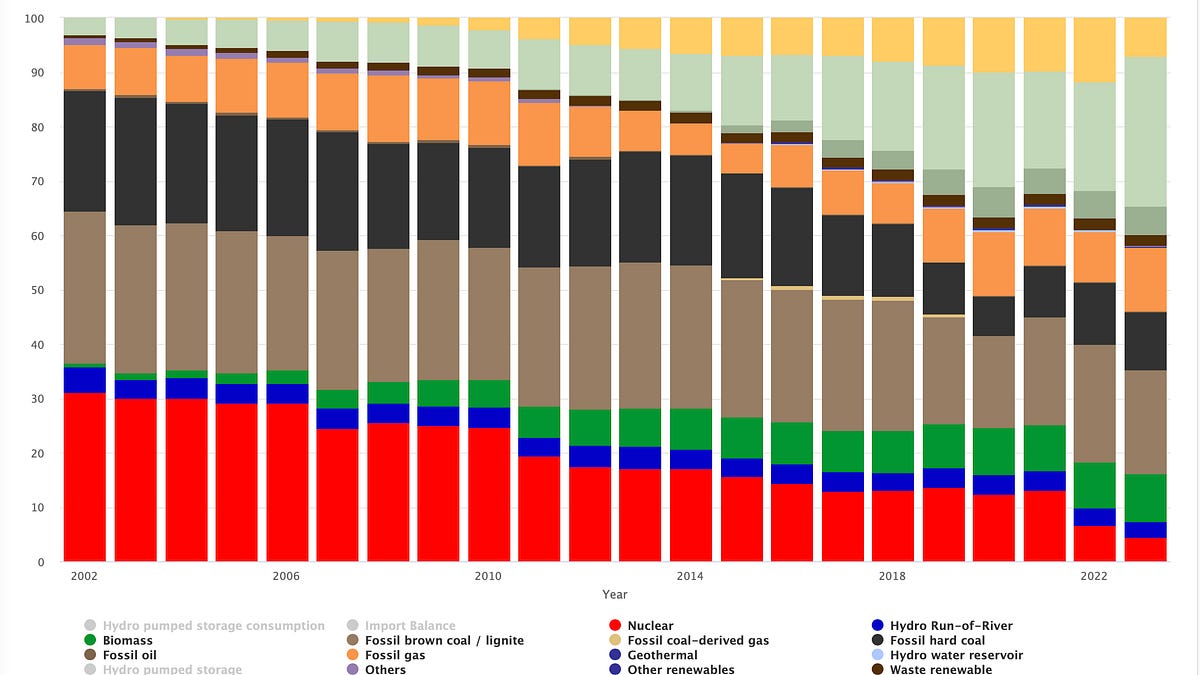
The central argument is that renewables basically replaced nuclear in Germany. But that is not* what happened. Simply put -- the continued operation of coal generation replaced the shut down nuclear, nearly on a one on one basis. These coal plants, all of them, would have been shut down absent the atomausstieg. Today, Germany currently produces about the same amount of power from coal (~160 TWh/y) as its nuclear fleet did before the shutdowns began (~160 TWh/y). Had Germany not shutdown its nuclear fleet it would burn zero coal today -- and would emit ~130 million tons of CO2-eq less greenhouse gases.
While Germany did reduce slightly coal power generation, it did this by dramatically increasing renewable generation and* fossil gas generation. Recall that fossil gas electricity generation has increased massively since the nuclear phase out began -- increasing from by more than a third since the beginning of the phase out. I don't really think anyone would argue that renewables plus fossil gas backup can not replace baseload power -- it can, just not particularly cleanly or cheaply.
The problem is that the German approach -- despite spending over €500 billion on the energiewiende -- did not make a low carbon electrical grid. It made an expensive, dirty grid. In 2022, a kWh of power generated in Germany produced on average 385 grams of greenhouse gas (in CO2-eq) -- 2021 was barely better at 365 g per kWh. Compare that to France, where in 2022 a kWh of power produces 85 g per kWh -- 4.5 times* cleaner. Furthermore, power is dramatically more expensive in Germany -- in 2022, a kWh of power was €0.3279 in Germany vs.€0.2086 in France.
*Furthermore, there are basic errors here. Nuclear power doesn't need pumped hydro -- literally Germany has more pumped hydro than France, despite not having the "Alps" etc
The comparison is also not between France and Germany, but Germany now and Germany 20 years ago. The difference is massive, and the only counter argument can be that France did more with nuclear in the 70s and 80s, which is fine, but it's been the only country in the world that's done that, and France itself has not been able to replicate that. Germany on the other hand kickstarted a non-existing industry, that's been on an exponential growth worldwide in the last decade, and doesn't appear to be stopping. I think this comment in the thread was very insightful and should be read by everyone: https://news.ycombinator.com/item?id=35711724
France's nuclear fleet is designed to use imports and exports to the rest of europe for storage to be economical. Somebody needs the storage.
These are just the same tired lies.
"So yes, Germany has a lot of gas-fired plants, and a lot of coal-fired plants, but they are actually used very little - only when demand (including from France) is very high and renewables supply is very low - which does happen, but not that often anymore."
This will continue to happen for the foreseeable future during the winter months. Solar is almost neglible, and wind obviously has slumps.
To fix this problem, the article brings up the recurring theme of saviour technologies that simply are not there yet: "flexible generation, whether hydro, new forms of storage"
Total consumption for 2021 in Germany: ~500TWhs [1]. That means ~10TWhs per week. At the moment our storage capacity is in the small GWhs ballpark [2]. We would have to increase this thousandfold. I haven't seen this gap adressed with actual projects yet.
[1] https://de.statista.com/statistik/daten/studie/164149/umfrag...
[2] https://www.erneuerbareenergien.de/transformation/speicher/w...
Many people completely ignore how well EU contries are interconnected and how EU is pressuring Germany to become even more well connected to other contries.
So electricity generation in EU should never be considered at country level only.
Today it is windy in Denmark. Wind mills produce 103% of current consumption, solar 33%, bio/coal 17%. Surplus is exported to Norway, Sweden, Nederlands and Germany.
During night time this often switches around and we import from those contries. Most days wind blows in Denmark during day time and not during night time, so we are extra hard hit by up-and-downs in renewable generation.
Tech for long distance transmission of electricity has also improved a lot over the past years but this is often ignored when speaking about renewables.
Transmitting electricity over larger distances remains very expensive, which is why the idea of using the African sun for Europe (e.g. Desertec[1]) has stalled [2].
So at the moment there is not a lot to export, and there is not of excess electricity from sun/wind to store.
The next thing is that, for example, The Netherlands needs a lot of green hydrogen for industry. So quite a bit of new wind turbine installations may go to powering that.
Germany has an other problem, building enough transport capacity within the country.
There is a big difference between transporting electricity all the way from Africa, including the question if it is smart to depend on those country for your electricity needs and transporting electricity between countries that border at the North Sea.
Germany is a big country, so even internally in Germany there is a big difference: right now Stuttgart has 0 m/s while Sylt has 9 m/s.
As we speak there is a war in Europe and - in case you missed it - there is a recurring death dance around a major nuclear plant in Ukraine [1]. How can we ignore the depressing reality that geopolitical strife is not under control?
For as long as the risks from deliberate attacks on energy infrastructure are within the realm of the likely the only sane approach is to ensure that such attacks would have only contained impact.
In other words, the menu of energy transition options we have is not independent from what sort of political world we envisage to prevail.
[1] https://www.theguardian.com/world/2022/aug/26/war-zaporizhzh...
There are very few places in Europe (outside of Norway/Sweden) where such long-term storage (sevel months worth) could be built at a competitive price. Currently, storage is usually counted in minutes to single digit hours, even in the optimistic plans.
So, barring some extreme breakthrough in storage technology, the only way to remove the reliance on fossil fuels, is to have significantly more plannable peak capacity than low season consumption.
In the case of nuclear, the main ways to bring prices down would be to create standardized and predictable regulations with a better thought out balance between the economic and health/safety costs, while also encouraging innovations and economies of scale to drive costs down in most other parts of the economy.
If costs could be reduced to €20-€40/MWh, some overcapacity would be ok.
This is not true
> On top of that, running nuclear reactors on average significantly below maximum output drives the cost up further.
It doesn't
Capable of changing power output at 3-5% of nameplate capacity per minute. https://www.oecd-nea.org/upload/docs/application/pdf/2021-12...
Again: This is a problem no country experienced so far, because even France doesn't have that much capacity.
I don't follow the logic whatsoever.
I don't think the solar argument sounds intuitively wrong to me, I just would like to see the argument fleshed out in some more detail. I have an open mind I've just never heard this argument before.
The amount of wind that's produced is predictable. In NL they do "day ahead pricing". You can get energy contracts based upon those prices. It's pretty easy to predict the amount of solar energy and wind energy a day in advance. It's not random.
They are not, of course.
And I wonder who will take care of peak air conditioning on a summer night?
Maybe it becomes clearer if you look at them, e.g. chart 3 on that page: https://www.cleanenergywire.org/factsheets/germanys-energy-c...
Yes switching off nuclear and doing nothing else would have that effect. But that's not what they did, they pivoted to a renewable heavy grid.
Wind and Solar can be intermittent but the drought is here to stay. A flexible system which reacts to electric availability is needed for the future. Wasting water in huge cooling towers will threaten food security.
Also, there may be areas prone to drought but there's simultaneously plenty of precipitation[2] across Europe; heck – build nuclear power stations along the West coast of Ireland and send the juice across the interconnectors[3][4] to the UK and France
[1] https://en.wikipedia.org/wiki/South%E2%80%93North_Water_Tran...
[2] https://vividmaps.com/precipitation-in-europe/
[3] https://www.soni.ltd.uk/customer-and-industry/interconnectio...
[4] https://www.eirgridgroup.com/the-grid/projects/celtic-interc...
Meanwhile Germany has added 2.65 GW of solar power in Q1/2023 alone: https://www.pv-magazine.de/2023/04/20/photovoltaik-zubau-im-...
So the solar energy gets supplemented with bulldozing villages every year to mine lignite in Garzweiler instead. Yay?
- hit by earthquake at or above upper structural limit. The most powerful earthquake ever recorded in Japan
"maximum ground g-forces of 0.56, 0.52, 0.56 at units 2, 3, and 5 respectively. This exceeded the seismic reactor design tolerances of 0.45, 0.45, and 0.46 g for continued operation, but the seismic values were within the design tolerances at units 1, 4, and 6"
- hit by tsunami exceeding that limit
The largest tsunami wave was 13–14 m (43–46 feet) high and hit approximately 50 minutes after the initial earthquake, overwhelming the plant's ground level, which was 10 m (33 ft) above the sea level
---
This resulted in 1 (one) death directly attributable to the incident
Some physics: raising 1kg of water by 1k takes 4184 J. Evaporating 1kg of water takes 2260 kJ. Notice the k in kJ. That's 500x better.
Regulation has changed, and you can no longer cool down a react by heating river water. You can't raise it more than 4 degrees anymore. And that's taking down about 1% of the reactor's operating time, at a time of the year there's no hard need for energy anyway.
Now, you just change the cooling system. That's a fairly simple, non-risky modification, though a bit costly. And you get more than 100x bang for the buck. For like a drop in the river's capacity that would have evaporated anyway elsewhere (and goes up in the atmosphere to rain down at a much needed time in the summer). But it's gonna be an eyesore, which might have been why they didn't build them like that originally.
No, no they didn't. The shutdown due to "lack of water" (which is also bullshit) affected 0.18% of power generation.
The shutdowns happened due to planned maintenance when French government finally got its head out of its ass long enough to realize that power plants need to be maintained.
"The government expects it can meet future generation needs after the nuclear and plannedncoal phase-outs with additional renewables capacity, energy efficiency measures and increased imports (given an estimated 80 GW to 90 GW of overcapacity regionally) (Eckert, 2019). However, Germany’s switch from a net exporter of electricity to a net importer will also have implications for regional power generation adequacy."
[0] https://iea.blob.core.windows.net/assets/60434f12-7891-4469-...
If anything you're more pointing out how hysterics over nuclear safety ended up endangering lives in practice by promoting the use of more dangerous forms of energy which don't arouse public fears as much since they kill people in an indirect and gradual way with unclear causation. Whereas nuclear kills people directly and suddenly with obvious causation.
Relying on past frequencies for future risk assessment is dangerous, especially when there is this high of a cost. Especially on the organization level of the decision makers: Maybe on average the risk for the global population is acceptable, but if a country like Germany loses part of its territory to a nuclear accident, that would be huge tragedy for the country and its economy. Germany is NOT replacing nuclear with lignite 1:1, much less in the long term. Anyone who says so is lying. And even those plants MAY have more risk, but that risk is hugely more predictable!
Sure nuclear meltdowns making territory unusuable sucks, but the mining does actually present a fair amount of ecological damage itself, and I think there's more metrics than potential territory loss. Notably lignites causes more radiation to enter the atmosphere, but unlike nuclear, this isn't neatly concentrated in one area people can just stay out of, which isn't conducive to people not dying.
I could maybe humour the argument that nuclear waste storage (Even accounting for these being very little of it, there will be very little of it for a very long time) or especially nuclear power plants encouraging nuclear weapons development being fat tail risks, but accidents, no. We're never going to see dramatic nuclear meltdowns even get close to causing the death toll of lignite, it just is way too implausible.
In the end, the high impact risks of nuclear are of extremely low probability, and they compound better than fossi fuels: we have 1 30km-radius exclusion zone and some smaller non-exclusion cleanup efforts for some 1PWh(? can't find the number right now) of energy total. When an event like that happens, the affected population is tiny, and they are able to move out at a moderate one-time cost.
Meanwhile, fossil fuel generation downsides are inescapeable: every plant decreases the quality of life for every person, and we cannot escape it. How many people have died early because of the unescapeable, permanent health damage for each PWh of energy produced? There's no exclusion zone at all, so there's no ability to pay a one time price and be spared the long-term effects.
Which kind of generation has "this high of a cost"? What should be the average damage to the population which we take as a baseline?
How many people do you think have died from nuclear reactor accidents the last century? I ask because they're shockingly few.
In fact more people have died from radiation from coal plants than from nuclear plants.
The safety argument isn't based on numbers, but on fear.
And the reason why there were so few fatalities was because huge chunks of land have been evacuated every time and costly cleanup operations have been undertaken. The risk is not just lives lost, but rather the impact on those countries' economy.
Only if you believe the official numbers about Chernobyl, which are worthless. The Soviet Union and later Russia was not being transparent.
> The safety argument isn't based on numbers, but on fear.
Very well-founded fear, based on how bad nuclear accidents can be, how bad people suck at adhering to safety protocols when there haven't been accidents for a long time, and the possibility of such accidents even being caused intentionally.
Take the worst number you can possibly imagine and then compare it with known numbers for hydropower. I'll take nuclear, thank you very much.
To the best of my knowledge China has had none and South Korea have had none and the Russians (non-Soviets) have had none.
https://world-nuclear.org/information-library/safety-and-sec...
The Fukushima incident was a result of regulations being too weak or ignored and the government not keeping good enough tabs on the operator. I really don't think the Chinese government does a better job. They suck at regulating and enforcing plenty of things they care about.
Because coal plants have been allowed to remain after forced closure of nuclear plants, safety is not the actual reason why nuclear plants are removed in Germany.
You are completely wrong there, Austria is the biggest anti-nuclear zealot in EU, they are the reason why investments into nuclear are not considered green (effectively stifling development of it).
So far everything works well for Germany. Relying on Russian gas meant cheaper power for quite some time. Hard to tell if alternatives would have fared better. Hindsight is always 20/20. Putin's invasion of Ukraine is irrational from any standpoint and not expecting him and his country shooting themselves in their feet that way wasn't illogical.
Fun fact: In the last 20 years France has reduced its nuclear power output by just about the same total amount as Germany.
Source: https://ourworldindata.org/grapher/nuclear-energy-generation...
There's definitely a pattern there.
Right now electricity maps shows that France produces 60% of electricity from nuclear, imports zero from Germany, and exports 6% of generated electricity to UK.
Also right now Germany generates 26% from coal and 9% from gas.
And you have sources on this except opinions and FUD?
"Focus is renewables, not baseload" - that doesn't even make sense, you still need the latter to heat a country through winter (or cool it down during summer, in case of Australia). So I guess on the flat, overcast days they'll burn coal instead, which has its own horrible mix of emissions. Or gas. Bravo, genius.
I'm all for green energy etc, but the focus must be on reducing total emissions. As someone who likes charging their EV from the sun I have experienced how bleak it gets during the Melbournian winter - I'll get 3-4 kWh in a day at worst/too often - maybe up to 8 more normally, compared to closer to 40-50 kWh on my 6.6/5 kWh PV system (rarely less than 30) during summer.
The end of nuclear power has been a thing in Germany for the last 20 years. Changes of the required laws were already done in 2002, Fukushima was just another data point to stick to this plan.
Most reactors were EOL anyway and the energy providers wanted to offload responsibilites (and costs) to the public.
Nuclear power only made up around 6% of the total energy consumption of Germany, so it's not that of a big deal.
What we need in Germany (now and for the last 20 years) is less bureaucracy for setting up solar systems and lots of development for public/private storage solutions.
The future of energy is decentralized.
During the tsunami in 2011 (that led to a minor nuclear incident), my facepalm moment was when I realized that the death toll from the tsunami would be eclipsed 1000-fold by the anti-nuclear fallout. (And the nuclear part would be eclipsed 1,000,000-fold).
Fukushima wasn't a data point. It was a populist FUD talking point.
Of course, from the carbon point of view, switching off nuclear before coal is a bad idea. But there are a few considerations to be made and the original plans were much more reasonable, but not executed.
- a large driver of decommissioning nuclear was about nuclear waste, safety and also costs
- the original agreement from 2002 didn't set an exit date but a total amount of nuclear energy produced. Which would have meant that some reactors would have ran into the late 20ies
- of course, the plan assumed build up of renewables at best speed
What where the deviations from that plan?
- the CDU/CSU+FDP government first prolonged the life time of nuclear, then after Fukushima shortened it beyond the original agreement.
- at the same time the CDU/CSU led governments from that on did not push renewables enough, at some time they actually started curbing the buildup. As a result, there is far less renewables in the mix than there could have been.
So the original plan wasn't that bad and has been screwed up considerably. Now we have to fix the situation but there is only one way ahead: continue with the switch to renewables at best speed.
I think the respective attitudes pro nuclear advocates have to Poland (80% coal->80% coal) and Germany (10%->50% renewables) kind of underscores that nobody is shaming Germany for climate reasons.
Compare it to France which didn't have to decarbonize to begin with. Because of those bad-bad-bad no-good reactors.
Any thread that mentions "energy" and "Germany" here is full of completely full of incorrect facts about Germany energy infrastructure.
edit: thanks commenters, i stand corrected
Wind turbines generate way more power than what is needed to produce them. Loads of wind turbines will be installed in the North Sea by various countries to generate a huge amount of electricity. I really don't get how you'd think that creating a wind turbine requires way more energy than the electricity it'll produce.
> A 2014 study which looked at the same issue found that 2-megawatt wind turbines installed in Northwest USA paid for themselves in 5-6 months.
> A 2010 analysis of fifty separate studies found that the average wind turbine, over the course of its operational life, generated 20 times more energy than it took to produce. This level was “favourable” in comparison to fossil fuels, nuclear and solar power.
And such wind turbines are nowadays tiny. If you look at https://nl.wikipedia.org/wiki/Lijst_van_windmolenparken_in_d... (Dutch) the column "Turbine vermogen" shows the (average?) megawatt (MW) of the windturbines. The ones planned for 2023 are 11 MW. The ones delivered in 2021 are 9.5 MW. There's a planned windpark with 14 MW turbines for delivery in 2026.
I really hope Germany is successful and proves to be the model for the rest of the industrialized nations. But we don't have enough evidence yet to call this a success.
And nuclear power proponents are using plenty of lies. Like the one where the only alternative to nuclear power is coal power.
What you claim to be "reality" and "science" is just a convenient selection of either. It is entirely rational to claim that the risk of nuclear power is not calculable, and to not have enough appetite to carry that risk.
The actual EU strategy hinges on multiple interacting elements. Making more of the demand steerable, to align peak use better with peak production. Overbuilding renewables capacity so it can still provide enough even at lower efficiency. Wind at sea at a never before seen scale (decided this week at the north sea conference) to have a form of base load (there is dunkelflaute but in general wind at sea is reliable at producing a certain amount of base load). And last but not least the EU hydrogen strategy, where a transport and storage network will be built similar to that for natural gas (in fact converting over that infrastructure), that then can be used to respond to demand in a steerable way, and that can be fed through shipping and pipelines from regions where renewables are most cost-effective at producing hydrogen.
Skeptics like to pretend the EU doesn’t have a renewables strategy beyond hope, but if you dig into it they (like in most things the EU does) have actually worked out a detailed and pragmatic strategy.
There is a strategy beyond populism and FUD?
> Overbuilding renewables capacity so it can still provide enough even at lower efficiency.
And the cost of overbuilding is?
> And last but not least the EU hydrogen strategy, where a transport and storage network will be built similar to that for natural gas
Again, some future magical solution with unspecified costs
For renewables? Absolutely huge. We would need 10-20x the nameplate power. Perhaps even more. The only reason renewables "work" at the moment is that all other energy sources work overtime to compensate.
(And the EU's hydrogen strategy is a huge green elephant -- but Timmerman has invested most of his political capital in it so the idea doesn't go away until he does.)
When combined with solar and wind they can all easily compete with nuclear power on cost, they're just more expensive than natural gas for peaking.
Very limited in where you can build it
> grid scale batteries
Don't exist. You severely underestimate the needs of the grid
> syngas
Aka burning furl and calling it carbon neutral. And have they passed the 1MW mark
There was a scientific study that looked this precise question and found 10x as many sites as necessary
>grid scale batteries Don't exist.
Your assertion is trivially disproven with a quick google.
>Aka burning furl and calling it carbon neutral
aka making hydrogen from excess solar/wind, storing it, burning it and turning that into electricity.
it's unfortunately only 50% efficient but that still makes it cheaper than nuclear power.
You've just described renewables.
> So the amount of energy which was previously part of "base load" will be reduced considerably.
There's a minimum of required electricity that you have to provide every day, and you can't escape that.
If there was no baseload you wouldn't care if intermittent power generation went to zero.
Because "Base load is the minimum level of demand on an electrical supply system over 24 h."
Maybe i misunderstand the downvote mechanism on HN. IMO it should be used for inconsiderate, rude, spam etc. but not against an opinion you disagree with.
Everytime I post something against nuclear it gets a huge amount of downvotes. In this case it didn't happen to me, but happens to another user, see comments at the bottom of the tree.
I would say just don't upvote, or better write an argument why you disagree.
Otherwise leads to huge amount of group think because opposing ideas are pushed down instead of debated.
That said, I do at times upvote comments that I strongly disagree with but are nevertheless so well argued that I disagree with them disappearing. I bet I’m not the only one.
There is a lot of the groupthink on HN, and this might be one of the mechanisms suppressing debating certain ideas.
Downvoting definitely surpresses well written contrarian arguments. It often kills the discussion by moving it down.
On a personal note. It's fun to see a comment get a lot of votes, and also fun to see it get a lot of downvotes. But I'm not very emotionally invested into it.
The level of group think and indoctrination is hilarious.
I get downvoting because of the Quran comment. However to apply your comment "something wrong" to an opinion sounds weird.
As for the community: it's clearly divided on this topic. Each side on any divisive topic complains bitterly about the other side and how it supposedly dominates HN. These perceptions are the product of cognitive bias plus ideological passion, and the comments they lead to are mostly flamewar noise. If you'd please avoid that, and stick to either (1) posting substantive, thoughtful, respectful comments or (2) not posting, we'd appreciate it.
Governments remain widely delusional so far and no other government is stepping into their bad decisions.
"Ecologists" weren't the ones who nuked nuclear. Popular opinion did. Impossible accidents happening a couple times too often didn't help.
There's no rational argument that's pro "saving the planet" that can explain that. As in, zero arguments.
That's delusional, plain and simple.