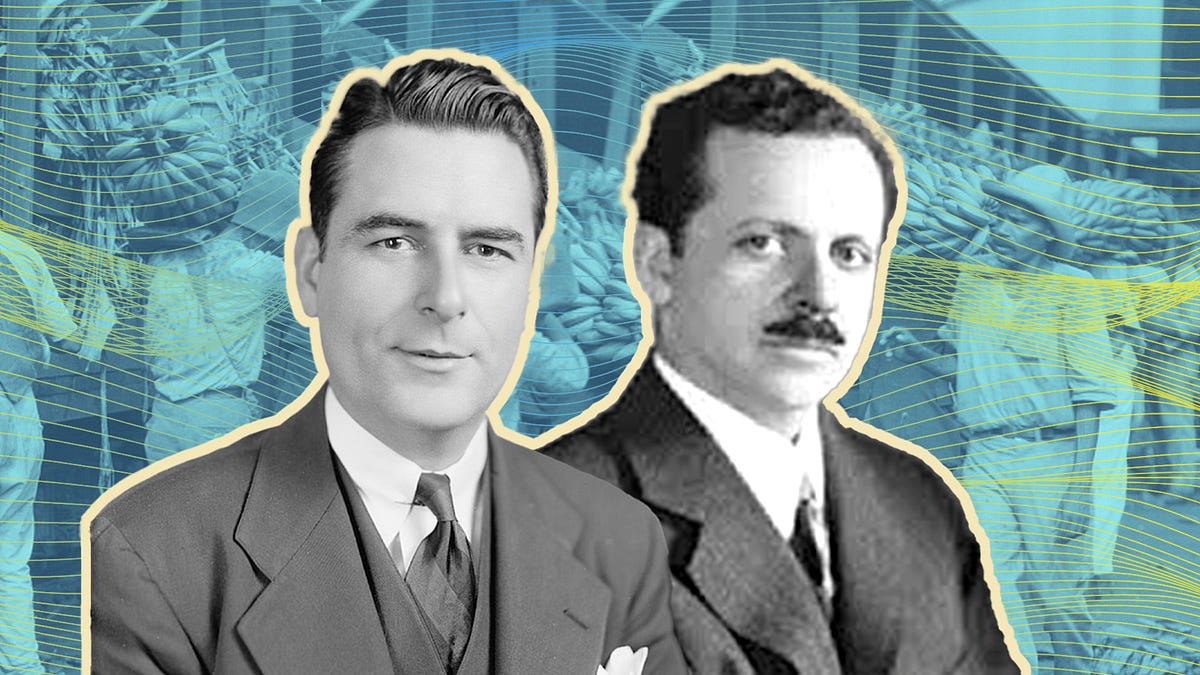
How to Subvert a Democracy, Stage 2: Condition the Masses
In advance of full-blown psychological warfare, seeds of doubt and conspiracy must be planted and watered.
narratively.com
123 points · by rzk · 3y ago · 161 comments
[...] Ideally, Guatemala would back down and start praising United Fruit for being a job creator instead of a foreign plunderer.
Somewhat OT, but one of the feats of propaganda that impresses me the most is how "jobs" were successfully established as an end in itself instead of a means.
As a politician, you can easily run on the platform of "creating jobs" without ever discussing wages.
As an employee, it doesn't matter if the job is wrecking your health, making you neglect your family and pays less than living wage, just having a job on its own is something to be grateful of.
An employer is not needing services that employees provide, no, an employer is creating jobs and then in infinite grace giving them to the employees.
It's crazy, but it works.
> just having a job on its own is something to be grateful of
Graber's book Debt challenged my worldview in many ways. For instance, the bits about the notions of employment. How the norm went from working for oneself to selling one's labor to another. Our predecessors considered employment akin to slavery.
Years later, it still stretches my incredulity. The gig economy is bad, right? I struggle to imagine an entire modern economy, contemporary society where most persons are not wage slaves.
Youngest me was obsessed with getting a good job, having a good career. Old burnt out me is wondering why I worked so hard to be make other people rich. What a waste.
(But at least I got valuable work experience.)
Free Agent Nation [2001] advocated working for one self. But somehow we ended up with gig work.
What happened? Was "free agent" just another self-help con? A pretty good idea subverted? Unrealistic whimsy given our winner-takes-all economy?
I'm for more small businesses. I don't know how we get back to that.
Ideas?
https://www.goodreads.com/book/show/165415.Free_Agent_Nation
These things should be taught in public education but aren't, likely because of ideological indoctrination.
Unbacked debt breaks the guard rails for rational pricing of both products and labor. In the 1770s, it was recognized that the price of labor couldn't go below what it costs to raise 4 children with a spouse, which was necessary to have 1 make it alive to 18.
More jobs increase the wealth of the employed.
More jobs improves the job market for the employees (more demand for their services).
More jobs helps (small and large) business owners (more wealth in the hands of customers).
If there are 10,000 coal mining jobs and 9,000 coal miners, coal mining conditions will improve.
What about slavery? What if there is a spectrum between chattel slavery and owning the means of production? How would you determine where "job" exists on that spectrum?
Slaves still get fed and housed. If the only thing that a job offers is food and housing, how different is that from slavery? How free is a person who can only afford to house and feed themselves?
Then the whole situation spiraled out of hand, because everything was better then socialism. Turns out in the end, it was not.
Blockades used against "rival" empires made drastic measures rationalizable, like for example mass murdering populations to provide for your own population, that could not be fed without oil imports aka fertilizers. This whole madness we today remember, started out rational.
I thought we already went down this road and remembered were it leads.
Boycotts, mandates, laws, and other forms of political pressure manage to put the employer (labeled an exploiter) out of business. Then everyone pats themselves on the back about what a good citizen they are for righting the injustice.
Afterwards, the poor (now unemployed) person goes back to scavenging through an unsanitary garbage pile looking for their next meal.
Most people have heard about Allende/Pinochet, and Regan's illegal war in Nicaragua, but I don't think that many people in the US have heard about this. I certainly hadn't.
This series is excellent, especially in the many references to decassified documents. Agencies denying operations for decades, only to have those operations confirmed after declassification is a repeating pattern.
Seeing how powerful this media based campaign was in the 1950s also sheds some perspective on how overwhelmingly powerful modern fake-video can be in persuading a population.
All rolled up, this really spells a very hard road ahead for democratic government. How are ordinary people supposed to pull back the deception and understandd the truth, in the face of highly-funded media campaigns to deceive them? It becomes less and less possible with every new technical development.
Ok, huffingtonpost.
all ministerial positions are about positioning, not effectiveness.
china has this spelled out in some laws and govt practices. e.g. they assume rural resources will be abused by a central group until they can get a stronger state law presence. but accept it and keep dumping resource till then and then work with those corrupt entities to ease the region absorption into proper state mechanics instead of "fighting corruption" or some other grand but disconnected goal
for and older but more comprehensive view on the article points, there's: Coup d'État: A Practical Handbook
This is HN . . .
IMO that's what has been happening in red states in the US for some time now.
Kids biologically can't discern lies prior to that age unless they've had some form of trauma (from what I've been told), and often accept what's read and written as truth. Few re-evaluate those beliefs later as they become part of their identity.
Its why that Florida education issue was such a hot-button topic. They tried overtly embedding some of that junk into math problems.
Teach kids there are other possibilities and how to think critically and they won't be so quick to accept BS.
Critical thinking by itself isn't really enough in my opinion either. It only impresses how much additional work is needed, on an ongoing basis, to defend yourself. Its often overwhelming, and rarely are things like negotation and credibility taught in a way that kids can understand.
This has been known for decades[1], yet the West has done little to stop it from happening. They engage in the same psyops, but information in the countries of their enemies is much more strictly controlled, so it has much less of an impact.
People aren't sold on debate and discussion, and aren't aligned on goals, and don't have a way to align on goals
This is a very easy intelligence trap to fall into, but it neglects internal bad actors that are doing the same things for profit. That interview is structured to set you up into a subtle us vs. them mentality. If you look at what he says and how you feel when you find out (if you agree, which itself is a subtle lever of influence with consistency [Cialdini]), its hard to argue that he isn't doing exactly what he says they do (creating a demoralized state).
You always have to remember the source, and he is not a good source for this. There are much better sources.
We value freedom of speech, because proper communication enables debate which allows us to come to a fuller understanding of certain issues than in the absence of this.
This understanding often allows us to save lives, whereas those mistakes that would never normally be addressed would result in deaths in a system where this doesn't take place.
That being said, you can never have a debate where the number of real people is less than fake people, and they have some motive to amplify or de-amplify what's being said which is ineffable ahead of time.
Where things have gone wrong is in treating corporations as dual entities. When it suits them they are people, when it suits them best they are a corporation, and in some industries when it suits them they act as arms of government without any of the mandates from the constitution, and are immune from legal repercussions.
I call utter BS on this. You are basically shooting a messenger here (whether said messenger is a baddy is not really relevant). If you had healthy society where fucking lefties and asshole righties were not at each other throats and where poverty, ever progressing lack of education and other social issues were not so rampant political enemies would have no grass to feed on.
The post-Cambridge Analytica cognitive warfare has two goals:
- To elect your candidate
- To prevent any meaningful discussion of political goals and to focus the conversation on whatever wedge issues are needed to win
[1]: https://www.washingtontimes.com/news/2022/sep/19/us-governme...
Yes, unlike the good old day when legacy media (tv/newspapers/radio) served the people and told them the truth, without trying to manipulate the masses.
Social media, however, accelerated that by allowing individual manipulation of vulnerable young people with that messaging by both foreign adversaries and subverted citizens. Boosted by things like economic warfare, where China funds these radical groups and promotes their agendas.
(1) creating political parties, then
(2) claim that its party members represent the people, while
(3) they actually represent its political party, and therefore, of course, prioritize its interests.
In my country, every major oligarchs have its own / is a member of a political party.
So our "Council of People's Representatives" actually works as "Council of Party's Representative" - and therefore work very diligently to fight for the interests of our oligarchs.
And yet no one is upset, not even our "democracy activists" - because they're already conditioned / believe that, political parties are a requirement for a proper democracy.
Nope, they're not - and they're actually the way to subvert democracy, and enabled the oligarchs to create massive profits AND control the people at the same time.
Parties could only be avoided by explicitly outlawing them - and not just by name, but by proscribing specific behaviors which could create de facto parties. Sounds incredibly difficult and would be amazing to watch attempted.
Regarding Europe, I think you are on the right track about the role of political parties in democratic backsliding. While heavy disinformation and propaganda (both domestic and foreign) are certainly involved, there are all sorts of other dynamics involved. Oftentimes, things really start to get awry when a dominant party succeeds in capturing state institutions (including the judiciary) and the media sector. It is also noteworthy that such capturing may occur both through "pure" political actors and corporate powers, the latter often in the form of corrupted oligarchic structures, as you pointed out. Also recessions and economic hardship have played significant roles, as they have always done. People's apathy and disengagement are also a factor. In Europe we also have the further issue of backsliding spilling to the supranational level.
That said, I disagree with your conclusion: even with the dangers, political parties are clearly necessary.
As for the Narratively's focus on "fake news", I think a central question is in which stage of the backsliding these play a role. A hypothesis would be that these are particularly important early on. Later on, the entity that has succeeded in capturing can use the fire-hose strategy at its will.
This tactic of fear, uncertainty and doubt has been addressed by numerous authors in recent decades. Science historian Naomi Oreskes pointed to the deliberate cultivation of uncertainty about climate change by Bill Nierenberg, Fred Seitz, and Fred Singer to slow down and stop regulations on fossil fuel companies.
In 2012, Jay Rosen, journalism professor at NYU, described this cultivation of uncertainty on the right as a process of "reverse verification", with the example of the question, "Was Obama born in the United States?”
Rosen: "Verification is taking something that might be true, and trying to nail it down with facts. In reverse verification, you take something that’s been nailed down and try to introduce doubt about it."
This is the primary way that American democracy is being subverted now, in 2023.
Very interesting to follow on twitter in that he picks apart bad journalism and explains why it doesn't work.
Are you referring to the disinformation campaign that promoted the conspiracy theory that Russia somehow influenced the 2016 presidential elections, or the conspiracy theory itself?
No, it would do exactly the opposite. Short term limits mean you perpetually have a revolving door of inexperienced and naive legislators who are much more prone to a) manipulation by experienced and cut-throat lobbyists and b) grabbing everything they can for their district with no regard for long-term sustainability, because they'll be gone before they can see any consequences.
I'm not picking on you in particular because I see this all over the place, but it really makes me crazy when people default to their gut emotions and desire to punish, and so come up with non-solutions like "shorter term limits!" which actually make the problem so much worse.
I'm sorry you haven't made that case at all. All you have done is listed the costs of the "term limits" side, you haven't listed any of the benefits. A couple off of the top of my head:
1. Seats would be up for effective election more often allowing for democracy to perhaps function more effectively. Perhaps there would be more of a market of ideas instead of cults of personality.
2. Less time for legislators to establish "ties" (corruption) with regulators, business leaders, party leaders, and others in power.
I think it is a thing that feels right to a lot of people, but if you ask "What will term limits achieve, and what are possible unintended consequences of term limits?" I think most proponents of it would have a very hard time coming up with a satisfying answer.
I would prefer age limits before term limits.
I think the real question to ask is: "If corruption were against the law, would people still want term limits?" or "Will term limits reduce corruption?"
I think the answer is no and I think it is obviously no for the latter (revolving door).
All of reaganomics while allowing Fox News to spread lies and propaganda to rile peopel up.
2) The main downside to term limits is that it tends to put more power into the hands of actors who are not subject to elections—professional bureaucrats, lobbyists, interest groups, and party machines, basically. My perception is that those latter three groups, especially, are behind a lot of this kind of thing—if true, term limits would make things worse, not better.
Almost all of the evidence detracting from legislative term limits centers around attempts to allow only 1-2 terms. But there’s very little about medium to longer term restrictions.
1. pay them all FU money so they're not corruptible (I don't care how much. Maybe a trust fund for life.)
2. harshly, legally prohibit them from making any money from ever having been in office (the FU money is a cushion here)
And then . . . why limit their terms? If you have eliminated corruption, at least ostensibly, why limit terms?
This style of writing is so unfriendly to readers. The text could have been 3 times shorter. The first paragraph where he is standing with wavy hair could just be thrown away. It does not continue anyways.
IMHO
As long as the elections are fair, and people do the voting themselves, they do it rationally, judging the information available to them and weighting it according to their beliefs.
If you do not trust them to make a valid choice because they are unable to know what's true and what's not, you are on a path that will logically end with stripping voting rights from such dim masses and installing an enlightened Fuhrer (you) who would lead them to the better future.
https://news.ycombinator.com/newsguidelines.html
We detached this subthread from https://news.ycombinator.com/item?id=35747650.
I might assume that terrorism wasn't the "us versus them" issue that it used to be, so culture wars were something new to galavanize the in-group tribe of voters.
Or maybe contemporary culture wars came about after Obama was elected, the sense that the majority was loosing it's majority to the minorities.
The occupy movement didn't seem to be picked up by either political party, so was it really a threat to anyone in power?
This iteration of the culture wars is an over active response to that threat, which is ironic because the war on terror was a hyper over response itself.
"Winning at psychological warfare isn’t about convincing people to do things they’d never do. It’s about getting them to give up."
What percentage of income taxes do you think the bottom 50% of tax payers pay? What percentage of income taxes do you think the richest 1% pay?
(Answer key: Q1 - 3%, Q2 - 39%)
We tax the rich.
1. Your 3% and 39% actually reflect how much more absolute income the rich generate compared to others. For example, if a rich person has $10 million in income and someone from the bottom 50% person has $100k in income, even a 15% income tax (for example) is $1.5 million and $15k respectively. Given our massive wealth inequality, your 39% income tax number tells us that the top 1% are capturing a massive chunk of the total income generated in the US. A quick quote from a 2021 Forbes article: "billionaires collectively hold two-thirds more wealth than the bottom 50 percent of all households in the United States, according to an analysis by the Institute for Policy Studies." - more wealth generates more absolute income.
2. By focusing solely on income tax, you're ignoring Total Taxes, which for example include sales tax. Low-income Americans face higher payroll tax rates than rich Americans. There are also many more tax-reducing benefits for the poor in our tax code, for example, Long-term capital gains and qualified dividends overwhelmingly accrue to the rich.
Tax analysed in absolute dollar terms is misleading. What should be analysed is the tax's effect on a person's quality of life. A person with a million dollar income paying 50% tax still has 500k to burn. A person paying 30% at 50k a year has 35k left. That 30% means a lot more at the lower end, even though the dollar amount pales in comparison.
I don't follow this framing. You are saying we should look at taxes as "how much money does the government allow someone to have"?
This seems to assume a government has a right to take an arbitrary amount of money from its citizens. Do you believe this?
People on both sides of culture war issues really do care about them. I agree that there are a number of more important issues, but the ordering of political priorities is basically subjective and nobody needs share anyone else's.
That's the goal of every diversion. Sports fans really care about their teams too (in some cases to the point of mass hysteria, or beating other people over them).
>but the ordering of political priorities is basically subjective and nobody needs share anyone else's.
Not so subjective, since conveniently almost everybody ends up sharing the ordering of one of the two sides they are conditioned to chose among.
That's like saying "fashion is subjective" and then seeing 90% of the people wearing the same shit for the season, "mysteriously" the very thing promoted in fashion magazines and celebrity videos and advertised to death 24/7.
Also, whenever you see only a "both sides" then that's the MSM circus.
Which aside from entertainment messaging and your educational curriculum, should be obvious by the fact that its largely the marginal social tier that thinks as you do.
To see the edge of the actual discussion: think about the dissonance of a worldview that simultaneously sees the nation's problems to be inherent in enforced hierarchy as mediated by the government, as you state, and the solution to that problem being the same government's enforcement of taxation.
There's only room for one of those views in anyone's mind. They cannot logically exist simultaneously. The government will never be simultaneously a marauder and a beneficent tax collector. And nothing changes its stripes.
Culture war topics aren't intended to distract from any of the things that you mention. Your list is a litany of topics barely adjacent to the culture war.
The culture war is about legal control of people whose natural habits and views would otherwise preclude it. When control has reached its limit working through the channel of temptation, then the only avenue left is the one that legally forces norms that are so distasteful to the natural senses that they oppress most normal people.
If it is on the same standards (or a higher bar) than that under which someone who was a political ally or uninvolved would be charged, no.
If it is on a basis on which someone differently politically situated with the same degree of evidence of the same kind of crime would otherwise not be charged, than yes.
So the funds were reported as contributed to and expended by his campaign, and the specific payment, including recipient and purpose disclosed on Schedule B-P filed with the FEC and available to the public as required by law?
Or was it falsely characterized differently in Trump’s business records (a crime) to cover up that Trump knowingly failed to make the required campaign disclosures (also a crime) because the whole point of a hush money payment is defeated if you accurately report the payment and its purpose in public disclosures?
If we assume that is true, what should happen?
https://www.youtube.com/watch?v=AW_Bdf_jGaA
It's within a candidate's rights to ask that all his voter's votes get counted.
It was: what should happen if he actually is guilty of what he is accused of?