39 points · by tosh · 3y ago · 50 comments
So I would actually be a bit surprised if the models failed this type of test regardless of whether they have any understanding of theory of mind.
Note that I’m making no claim about how intelligent or understanding of humans or neurotypical these models are. My claim is that it’s very hard to tell given how incredibly knowledgeable the models are.
But these same devices, running the right software and given the right parameters, do something that seems impressively close to intelligence. And I suspect that my brain, with its software somehow removed, would not seem very intelligent.
On the other hand, a human baby will spontaneously generate language and intelligence, and I haven’t heard of a language model doing that. (The experiment has, sadly, been done. https://en.m.wikipedia.org/wiki/Nicaraguan_Sign_Language )
Philosophy often asks questions that are not yet reached by current technology but will be soon enough.
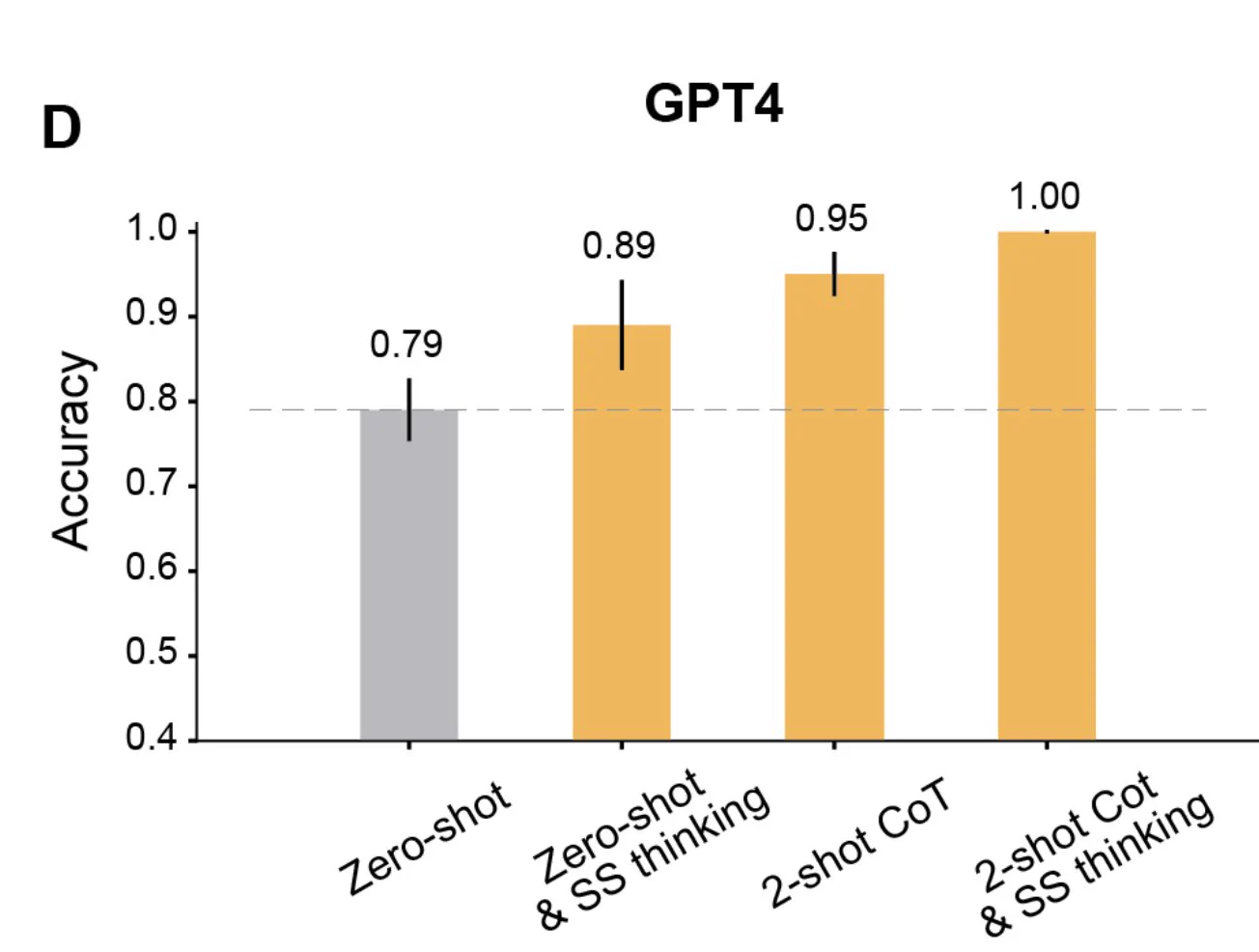
When a model is given insufficient context beyond the question, it may generate responses based on its best guess. This situation can be compared to abruptly waking someone up in the middle of the night and demanding an immediate response to a question.
In contrast, when humans are asked to answer questions in a test setting, they are aware of the larger context and the importance of providing accurate answers.
Especially when you arrive at this imaginary distinction with "It's fake because it has to be fake"
In other words, beyond a certain point it's impossible to tell.
At the same time, it's just as impossible for me to know that another human is sentient, even if we meet face to face.
(So it's pretty much a moot point.)
If thinking/understanding/reasoning/whatever can be fake, it should be testable. It should be a conclusion that can be reached from results not baseless speculation. I mean, what kind of huge difference can't be tested for ?
If you tell me "this is fake gold" then there are numerous ways to distinguish fake gold from it's real counterpart, mostly by testing its physical properties.
If the results and properties from "fake" [insert] and "real" [insert] can't be distinguished then well you've just made up a distinction that doesn't meaningfully exist.
On the contrary, isn't "step by step" reasoning exactly what we tell students to do to become better at solving complicated problems?
"Autocompletion" isn't an adequate explanation when neither the prompt nor the output has ever existed before. Something else is going on... something that obviously has a lot in common with how our own minds work.
If this so-called “fake” thinking is indistinguishable from “real” thinking, is there really a difference?
I have seen many claims that transformer models can't "think" but I have not seen any purposed tangible tests to verify or refute the claim.
The great thing for cognitice scientists /linguists is that we now have a quantitative, precise framework and no longer need to talk in terms of the folk intelligence science of the past.
The fundamental concept behind LLMs is to allow the model to autonomously deduce concepts, rather than explicitly engineering solutions into the system.
The self-reflection part is probably true, but that’s not strictly necessary to understand concepts
> what concepts are
How do you know concepts aren’t just statistics?
However:
> but clearly dont have a model of the world, self, or others because they have not been engineered in
Neither did we.
> The hypothesis that, by scaling the giant clockwork, these things will magically emerge is .. magical and unproven.
Our sapience was and is an emergent phenomenon, (superstition aside) was that magic?
You're essentially requesting the goalpost be moved.
The cognitive tests we rely on (turing test, chinese room etc etc ) are woefully outdated and inadequate for our time
The goalposts will always be moved btw, because our experience of intelligence is subjective and we 'll never have an objective measure of it. At some point we will stop moving them because we ve ran out of ideas. At that point we can say we have a facsimile of our intelligence
Wouldn't that be a table of sentences less than 7 words long?
100^7 = (10^2)^7 = 10^14
EDIT: 0. How many times did it take this test? 1. Where's the code and reproducible results? 2. Okay, give it a completely new test. How about that? 3. Who did it cheat off of?