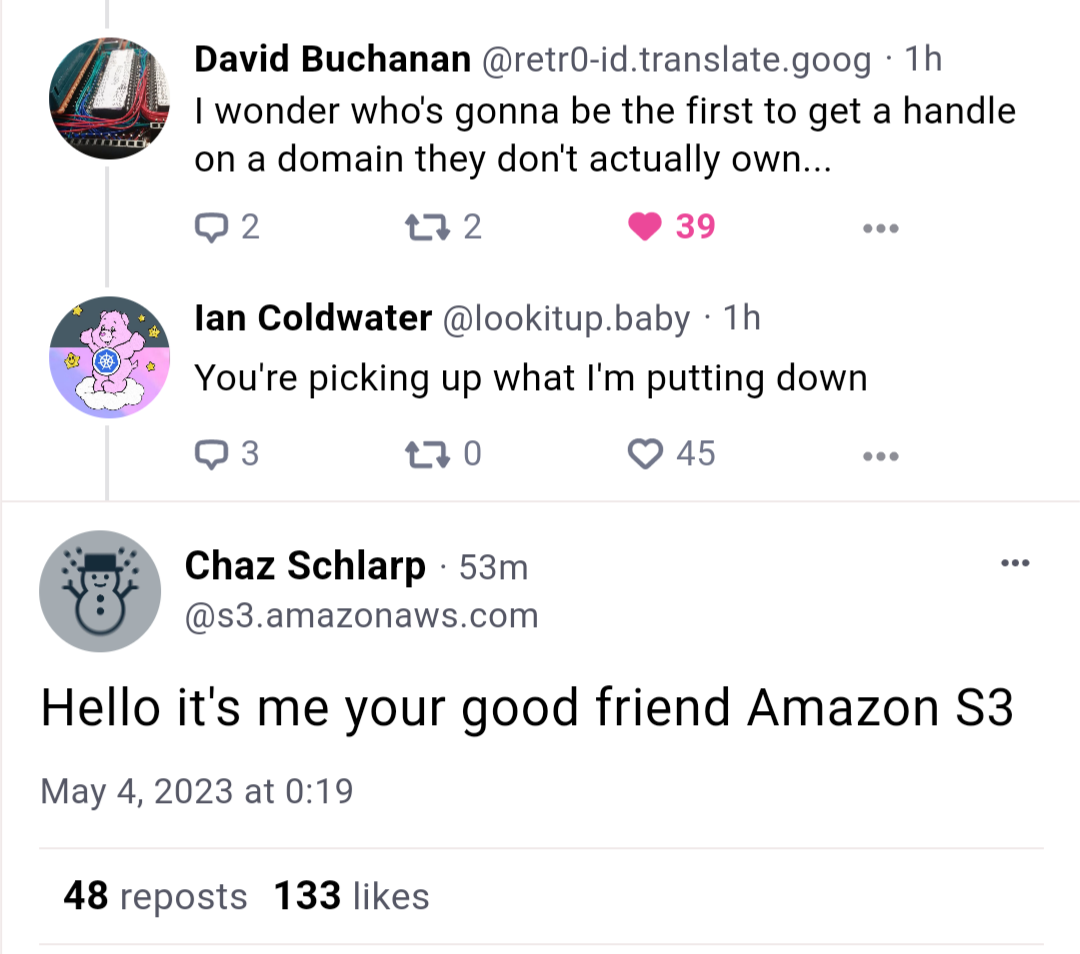
Jonty Wareing (@jonty@chaos.social)
Attached: 1 image It turns out you can simply serve a file from a domain to use it as your bsky handle. So this guy is now S3. All of S3.
chaos.social
595 points · by aendruk · 3y ago · 358 comments
What this is actually about: BlueSky is Jack Dorsey's new Twitter clone, it is eventually intended to be some sort of fediverse thing but it's not there yet and it's not the source of the fediverse gripes here. You can authenticate your BlueSky user as the owner of a given domain or subdomain by placing a certain file with a given content somewhere under that domain/subdomain. However that "somewhere" was just a location one of the devs at BlueSky chose, rather than somewhere relatively standardised, like under the ".well-known" path (which you might recognise from things like OpenID Connect where the configuration doc is located @ example.com/.well-known/openid-configuration). So one user exploited this and became the "owner" of that Amazon S3 domain by setting up a storage account on Amazon S3 and following BlueSky's setup instructions. That is the main story here - some non-Amazon rando is now officially the Amazon S3 guy on Bluesky.
The next part is that someone posted about it on this https://chaos.social Mastodon instance, which got overwhelmed, the owners decided to save their server by electing to return a 429 response for that specific post if users don't belong to chaos.social, and that is why people are upset about Mastodon.
Interesting story, but I'm not interested in Dorsey's version of Twitter 2.0 unless it actually allows you to signup[1] and brings something compelling that Twitter didn't and Mastodon doesn't.
[0] - game with an intricate story that does its damndest to not actually tell you. If you want to know the story you have to piece it together yourself by picking up dozens of items scattered throughout the game and reading all their descriptions. Or you can do what I did - watch a video on YouTube.
[1] - they're doing an open beta and letting a little trickle of users on, who post about it on their Twitter/Mastodon/whatever. Feels a bit deliberate, like they're trying to build anticipation and frankly I detest little manipulative things like that so I'm out
Frankly this cynicism feels unwarranted. Bluesky is not a finished product — it is still being built and, even with the small number of invited users so far, there have been problems that have needed attention. The moderation story is still being developed, the feeds are still being tweaked, the app still has bugs, federation still doesn't work yet. Having some users makes for a valuable feedback loop but the team would rapidly become inundated and burnt out (and the platform would possibly turn into a wild-west hellscape with irreversible reputational damage) if they were to open the floodgates entirely at this stage.
Maybe that's in my head but layering this feeling on top of BlueSky being yet another microblogging service with a few other things that I don't love contributes to my impression of Bluesky being simply "meh". If it becomes the next thing that everyone uses, I'll inevitably have to check it out, I'm not going to be an early adopter though.
It's like all these newfangled webapps don't understand the concept of caching static pages for anonymous users. There is absolutely no reason that something like this should result in more than one request (plus a handful more for static resources) handled entirely by the frontent webserver's in-memory cache for each person linked from other sides. But instead its all dynamic and the page shoots off more API requests before being able to show anything.
I don't think I am equipped to diagnose what the root cause was here. It's even possible that this instance wasn't intended to have viral posts (i.e. high profile posts that get would get shared to many external users) and they didn't want to invest in hardware/services to facilitate this.
The question is whether the server was having issues with a flood of new posts being sent in and stored, or a flood of anonymous users clicking a link and blogging down when the same html was getting rendered over and over.
Knowing Mastodon, I have a bunch of was the latter with the server coming out on all the new data it was trying to store locally
I've not looked into BlueSky's domain based identity thing in any detail so I might be missing a point somewhere, but… If someone can manipulate its special location what would there be to stop the same someone being able to manipulate content under .well-known?
Are we just relying on .well-known having some extra protection (in this case by Amazon having created a bucket called .well-known so no one else could)? If so then .well-known is little safer than any other arbitrary location in this respect (because you are relying on every domain owner who might be spoofed to take an action to protect against this, rather than the protocol failing safe if nothing is done by the domain owner) and perhaps using DNS would be better.
If .well-known had just been invented, that would be true. It's fairly well established at this point, though. For example, if someone can create arbitrary files in .well-known, they are also able to pass http-01 ACME challenges and thus issue TLS certs for your domain (modulo CAA) and MITM you. At this point, allowing users to modify .well-known is about as good an idea as allowing them to receive mail for postmaster@ or accepting incoming packets from 192.168.0.0/16 into your LAN.
Amazon S3 specifically would not be vulnerable because bucket names can’t have dots in them; same for every other service that doesn’t allow those. Neither would services that prefix usernames with ~ or @ or similar, nor services that already use http-01 ACME challenges to get certs thus are already using that path.
I’d be much happier if proving domain control were only done through DNS challenges, but that ship has sailed.
Though MitM that way requires more steps than faking identity this way as you need to somehow get in the middle or redirect traffic towards you.
> I’d be much happier if proving domain control were only done through DNS challenges, but that ship has sailed.
Agreed.
https://mailarchive.ietf.org/arch/msg/apps-discuss/1_a06NU8z...
> 1) I feel that /host-meta is too casual of a name and prone to collisions. It matches /^[\w\-]+$/, which I think is a subset of a fair number of sites' usernames."
...
> i.e. put something ugly and weird in there, like a semicolon, to minimize the chance that it interferes with people's existing URL structure.
Fun bit of history!
* The FediVerse is lots of WWW sites. Some are WWW-hosting companies showing off, with all of the acoutrements of high-end WWW sites, including CloudFlare protection and lots of tweaking of the back end stuff. Others are one-person sites where someone has just set up the vanilla Mastodon/Pleroma/Pixelfed/Friendica/whatever software on a cheap hosted VM somewhere. There are lots of in-betweens. I have an account on two sites, at each of the aforementioned extremes, one with well over 20,000 users and the other with around 40.
* It's really easy to deny service to the one-person sites, and many of the low-end ones.
* Chaos.Social's about page explains that it's a couple of people running a WWW site in their spare time on spare hardware. That's a little misleading, as they've upgraded the hardware a bit. But it's still 2 people, with ~5800 users. For more, start at https://meta.chaos.social/resources .
* There's nothing global in the FediVerse. Nothing gets sent everywhere. Some commenters here can see the post cached by their local WWW sites where they have accounts. But I'm in the opposite situation: None of the places where I have accounts have cached that post, and since the Chaos.Social sysop put the 429 error in place to combat the server overloading, they actually cannot pull that post with just its URL entered directly, although simple tricks like searching for @jonty@Chaos.Social instead and reading the user timeline work just fine.
* There's nothing global in the FediVerse. Using the aforementioned trick, I see a different view of the thread from Mastodon.Scot to what I see from Toot.Wales, and both of those are different to what's seen from other places.
Maybe the FediVerse is just not friendly to the idea of a “global top among thousands of users” rating.
[Edit: already mentioned above, I just misread it.]
I've read somewhere that federation is done via regular HTTP requests which ends up really hogging down servers if someone has a lot of followers.
The official method is to set a TXT record, but apparently their "AT protocol" also lets you confirm a domain by serving `GET your.domainname.com/xrpc/com.atproto.identity.resolveHandle`
and `xrpc` was available as an S3 bucket name :)
https://www.zdnet.com/article/stop-the-lies-the-day-that-mic...
* ActivityPub -> AT Protocol (https://atproto.com/)
* Mastadon -> Bluesky (https://blueskyweb.xyz/)
Right now, federation is not turned on for the Bluesky instance.
There are differences in both, however. I'm not going to speak about my impressions of the Mastadon vs Bluesky teams because frankly, Mastadon never really caught on with me, so they're probably biased. ('they' being my impressions, that is, I just realized that may be ambiguous.)
At the protocol level, I haven't implemented ActivityPub in a decade, so I'm a bit behind developments there personally, but the mental model for AT Protocol is best analogized as git, honestly. Users have a PDS, a personal data server, that is identified by a domain, and signed. The location of the PDS does not have to match the domain, enabling you to do what you see here: a user with a domain as their handle, yet all the PDS data is stored on bluesky's servers. You can make a backup of your data at any time, and move your PDS somewhere else with ease (again, once federation is actually implemented, the path there is straightforward though). This is analogous to how you have a git repository locally, and on GitHub, and you point people at the GitHub, but say you decide you hate GitHub, and move to GitLab: you just upload your git repo there, and you're good. Same thing, except since identity is on your own domain, you don't even need to do a redirect, everything Just Works.
This analogy is also fruitful for understanding current limitations: "delete a post" is kind of like "git revert" currently: that is, it's a logical deletion, not an actual deletion. Enabling that ("git rebase") is currently underway. Private messaging does not yet exist.
Anyway if you want to know more the high-level aspects of the docs are very good. Like shockingly so. https://atproto.com/guides/overview They fall down a bit once you get into the details, but stuff is still changing and the team has 10,000 things to do, so it's understandable.
Key to trick was to have bucket named "xrpc" and store a file there: https://s3.amazonaws.com/xrpc/com.atproto.identity.resolveHa...
There is also another funny thing in the image, the user posting about is sending one from "retr0-id.translate.goog", which is odd. Somehow he has got https://retr0-id.translate.goog/xrpc/com.atproto.identity.re... to redirect to his page, and gotten that handle as well.
I myself have had an account for like a month now, but only started really using it a week ago, because that calculus changed for me, personally.
Like, it's not even possible to truly delete posts at the moment. This all needs to be treated as a playground until things mature.
This isn't even the first "scandal" related to this feature already!!!! There is another hole in what currently exists that allowed someone to temporarily impersonate a Japanese magazine a few weeks back.
Aight, level with me: Is every mastodon server running on a Raspberry Pi?
> We just started serving a http 429 error on the exact url of the post. So everything should go back to normal now.
Mastodon is also quite heavy to host, my single user instance will easily gobble up several gigabytes of memory if you let it. There are more efficient ActivityPub servers but specifically Mastodon seems to be written for running efficiently on huge servers.
I already don't trust mastodon links because 9 times out of 10 they simply don't work. Everyone's tiny hobby server falls over when one post gets big, and obviously not everyone is going to scale their servers to support the load of a viral post that might happen once every 6 months and will be 100x their base load
As a community effort where no one is expecting to get rich it might work.
It's an annoyance, often anecdotal at most. Not the foundation of why a platform cannot ever "work".
One of my blog posts was submitted to HN that had 194 points and 149 comments[1]. All dates are in UTC.
  1 - Unique visitors per day - Including spiders
  Hits       h%  Vis.     v%  Tx. Amount Data
  ------ ------ ----- ------ ----------- ----
   14439  1.49%  1148  1.19%  106.42 MiB 21/Jan/2023
   17043  1.75%  1754  1.81%  184.69 MiB 20/Jan/2023
   33560  3.45%  3267  3.37%  491.32 MiB 19/Jan/2023
   46568  4.79%  5816  6.01%  637.54 MiB 18/Jan/2023
  323797 33.32% 28928 29.88%    4.06 GiB 17/Jan/2023  <- Resubmitted on HN and websites started copy-pasting the article from the big website with the same mistakes, never checking my post which had a note about these mistakes :)
   24330  2.50%  3341  3.45%  360.48 MiB 16/Jan/2023  <- Put in a second-chance pool by a moderator and an article with a lot of mistakes published by some big website
   17074  1.76%  3348  3.46%  243.44 MiB 15/Jan/2023  <- Published on HN
    1041  0.11%   120  0.12%    3.70 MiB 14/Jan/2023
    1666  0.17%   171  0.18%    8.40 MiB 13/Jan/2023  <- Post published
     991  0.10%   123  0.13%  374.78 KiB 12/Jan/2023

  2 - Requested Files (URLs)
  Hits      h%  Vis.     v%  Tx. Amount Mtd      Proto    Data
  ----- ------ ----- ------ ----------- -------- -------- ----
  57604  5.93% 31427 32.46%  260.97 MiB GET      HTTP/2   /en/2023/01/13/msi-insecure-boot/
  31179  3.21% 11263 11.63%  245.20 MiB GET      HTTP/1.1 /en/2023/01/13/msi-insecure-boot/

  11 - Referring Sites (depends on Referer header, not very accurate for reasons)
  Hits       h%  Vis.     v% Tx. Amount Data
  ------ ------ ----- ------ ---------- ----
  446781 45.97% 29686 30.66%   5.95 GiB dawidpotocki.com
   14834  1.53%  9485  9.80%  79.85 MiB news.ycombinator.com
  (news sites with very low hundreds or even under, nobody checks sources)
Maybe you underestimate how many people want to keep up on things but not interact?
I can only see Mastodon centralizing to cope with the load. But a server going down on this load from HN tells us it is no where near ready to handle an insurmountable amount of users or even begin to challenge Twitter which hosts 220M+ users every single day.
https://pagespeed.web.dev/analysis/https-twitter-com-realDon...
Mastodon.social is actually much faster on this particular benchmark. So maybe there is hope.
https://hachyderm.io/@jonty@chaos.social/110307532115312279
EDIT: Ah I guess if you're not logged into a hachyderm.io account, you get forwarded. So probably don't use the above link.
This is mind-blowing. Last I checked, the front page of HN sends tens of requests per second to each link. There are humans who can pack envelopes faster than the typical mastodon server can answer GETs. I'd love to see someone benchmark the top servers for a few seconds to see what it takes to break a reasonable latency SLA.
This is peak Web 5.0 right here.
There was a guy running a site off of a single core 32bit ARM SoC that was able to handle the HN frontpage.
my profile, on the same server, loads fine.
Upon clicking reply fastidiously, i got the hn 429
"Sorry, we're not able to serve your requests this quickly."
Wow.
It's funny the bluesky devs say they implemented "something like webfinger" but left out the only important part of webfinger that protects against these attacks in the first place. Weird oversight and something something don't come up with your own standards
This is not how Mastodon does verification (at least not the main method). Mastodon doesn't just link users -> domain. It can link user -> webpage, for example to link social profiles between sites.
If you have a website with user generated content, and a user can set an arbitrary html attribute (rel="me") in a link pointing back to their profile, they can claim ownership of the page on Mastodon. Likewise, if they can set a link tag in the head element of the page for some reason.
Presumably this is somewhat harder to exploit than a (new, poorly thought out) dependency on a static file under /xrpc, but Mastodon does introduce more authentication footguns for sites than just .well-known! https://docs.joinmastodon.org/user/profile/#verification
Edit: authentication -> verification, since Mastodon distinguishes between the two (see below)
You're thinking of how Mastodon does verified links. You could do something similar, provide a verified link on your profile to a file in an S3 bucket, but there's very utility (or risk) in that.
Mastodon also allows you to be discoverable via a custom domain, using .well-known as parent mentioned https://docs.joinmastodon.org/spec/webfinger/ https://www.hanselman.com/blog/use-your-own-user-domain-for-...
I'm not sure what Bluesky was attempting to do here but what they achieved in practice was allowing a user to claim control of a domain by claiming control of a page. But if you allow user generated content on the home page of your site, there's not a distinction (from a Mastodon user point of view) between the two. It's effectively the same problem if I can "verify" yourdomain.com on Mastodon - and my point is that you can do that without using .well-known.
Maybe I'm old but what are some popular use cases for webfinger? (I'm just learning about it now)
A few things are effectively grandfathered in due to their vintage: /favicon.ico, /sitemap.xml and /robots.txt are the three that occur to me—so if you’re running something vaguely like S3, you’ll want to make sure users can’t create files at the top level of your domain matching at least those names.
But nothing new should use anything other than /.well-known/ for domain-scoped stuff, or else you run into exactly this problem.
I also recall /crossdomain.xml as an important one; allowing users to create an arbitrary file matching that name could allow certain kinds of cross-site attacks against your site.
Webfinger is when you want to multiplex multiple identities on a single domain
E.g. https://example.com/.well-known/webfinger?resource=nick@exam...
Will serve the challenge proving your handle is @nick@example.com
Also the penalty isn't very high here. Someone impersonated a domain on a burgeoning protocol for a short while. So what?
We're talking about folks setting up a custom domain for a personal social media presence. If they can handle nameservers and DNS records, they can handle a folder with a dot in the name.
That's the problem with expecting people to agree with and follow standards.
The hacker news DDOS is real.
Previously: https://news.ycombinator.com/item?id=34691489
It's not beyond the bounds of possibility. Compare https://github.com/mastodon/mastodon/issues/15431 .
The issue with DNS-01 (and HTTP-01 to a lesser extent) as someone else mentioned is that the user friction is really high.
I’ve been working on a solution to this that I’ve been meaning to post to HN and this seems like as good an opportunity as any so here it is: [1]
It’s a method of storing a hashed (and optionally salted) verifiable identifier (think email or mobile) at a subdomain to prove authority for a domain.
And the primary way of identifying yourself is in fact DNS.
> I’ve been working on a solution to this
Your solution is almost identical to the BlueSky one: put a TXT record at _atproto.<domain> that resolves to a DID. The difference is that they mandate the DID spec and you do not. Which is totally fine! Just figured I'd let you know :)
Another key difference is that the _atproto TXT record is discoverable since it’s always at _atproto. Whereas the “verifiable identifier” I use isn’t discoverable because it’s hashed and used as a dns label.
The ultimate goal here would be for these records to be populated by domain registrars upon a domain being registered (with registrant’s permission obviously).
This could create a kind of fast lane for domain verification across providers like Google Ads, Facebook, Office365 and everyone else that requests DNS verification.
The worst thing is that hundreds of providers request domain verification TXTs at the zone apex:
dig target.com TXT
Honestly, that's a feature, not a bug.
http verification proves you temporarily control IP space relative to a viewer. dns verification proves you temporarily control name resolution relative to a viewer.
Both are trivially hacked, multiple ways. By the time someone finds out you did it (if they closely monitor CT logs, which nobody does) you've already had hours, days, weeks to run a MITM on any domain you want. The attack only has to work once, on any of 130+ CAs.
The solution is registrar-level proof. Cert request signed by the private key of the domain owner, sent to the registrar to verify, the registrar signs it if its true, it's sent to the CA who can see the registrar signed it. Now you know for a fact the domain owner asked for the cert. The only possible attack is to steal all three of the owner's private key, the registrar's private key, and a CA's private key.
I have been shouting about this for 10 years, none of the industry incumbents care. The internet is run by morons.
One problem I see is the extra overhead for the registrars. Now they have one more thing to do: verify (sign) certificate requests. That extra work is probably enough to get registrars to push back against such a system.
The registrar would be assuming some of the functions of a CA. This would make it easier for a single entity be both registrar and CA. That would threaten the business model CAs and thus they'd push back against such a system.
If the CA were responsible for getting the registrar's verification for a certificate request then that'd add extra work for CAs, and thus the CAs would push back against it. If the domain owner was responsible for getting the registrar's verification for a certificate before submitting it to a CA, then the domain owners would be against it.
And this is all assuming that people could agree on a common set of protocols or data formats for this new system.
> Both are trivially hacked, multiple ways.
I'm genuinely curious how it is trivial to "control [authoritative] name resolution relative to a viewer".
Or maybe, just maybe, hear me out on this... maybe your proposal is not as smart as you think it is.
For one thing:
> Cert request signed by the private key of the domain owner, sent to the registrar to verify, the registrar signs it if its true
What exactly does the registrar verify, and how?
You're not wrong (ignoring how easy it is to hack DNS), but at the same time it's hard enough to get people to buy their own domain name, nevermind understand the system well enough to add a TXT record.
It's a strategy that's fine to implement when your target audience is server admins. It's a terrible strategy when your target audience is everyday users who you hope own their own domain. Doubly so in a world where owning your own domain is so rare for individuals.
for 99.99% of cases when a domain is pointed at me and I want to serve an SSL certificate for it, I can answer an HTTP-01 challenge. Needing to orchestrate a DNS challenge will always be a more complicated external thing.
HTTP challenge (and TLS-ALPN) are in-band, DNS is out-of-band.
In contrast, HTTP based verification often has built-in support with your webserver (Caddy) or only requires copy-pasting a few lines to your docker compose file.
There are edge cases, but they're also widely exploited so you won't run into them if you follow best practices.
There's nothing preventing you from making the DNS record a CNAME to something under a zone that you're allowed to modify.
This is how one of my setups works; _acme-challenge.someservice.example.net is a CNAME to someservice.acme.example.net, and acme.example.net is served by a bind9 that allows dynamic zone updates based on TSIG-signed DNS update requests over WireGuard.
So the machine that hosts someservice has a DDNS key that signs DNS update requests for someservice.acme.example.net, and bind9 is configured to allow that key to change that record.
But the reason for HTTP is pretty simple - it's extremely easy to implement. You only need to tell your ops to redir a subdomain to your app and you're done, you don't need DNS with API that have narrow enough permission to allow that one team in whole company to generate ACME stuff; most providers ACLs on DNS end at "this client have acesss to that domain via API".
It's about proving /control/. If a domain name is pointed to me (my IP/CNAME) I control it and it is reasonable to allow that person to issue an SSL certificate for a domain (or subdomain) under their control. If you, as the domain owner, want to restrict that, CAA exists as your tool to do so.
I'm sure just because of its age and principals involved it's been heavily influenced by the crypto crowd.
But suddenly, without anything else really stepping in to fill the void, it's the Twitter alternative of the day. Anyway not surprised to find some gotcha's like this all things considered.
It builds off of several specifications that came from the crypto crowd. It does not use a proof of stake or proof of work blockchain, though, so depending on how you use the words "crypto" and "blockchain," it either is or is not those things.
> It builds off of several specifications that came from the crypto crowd. It does not use a proof of stake or proof of work blockchain, though, so depending on how you use the words "crypto" and "blockchain," it either is or is not those things.
From the protocol's FAQ docs itself:
> Is ATP a blockchain?
> No. ATP is a federated protocol. It's not a blockchain nor does it use a blockchain.
https://atproto.com/guides/faq#is-atp-a-blockchain
Architecturally, it's an attempt at improving ActivityPub in terms of account transfers & portability between federated instances, which ActivityPub doesn't inherently support. Mastodon, by comparison, requires one of those steps to be the explicit export into a locally-saved file, rather than communications between the federated instances themselves.
Most of the time, it's a good thing, but in cases like this is where this falls over.
(You can also see this in the other direction parent comment, for what it's worth, "Jack Dorsey's New Twitter" isn't really accurate, as far as I'm concerned. It is more informative overall, though.)
their is who exactly? and why does bsky associate it with the s3 domain if it's just a file in a random bucket?
as others mentioned, not a hard fix.
the flexibility bit us on the butt. people started faking mentions via the APIs and one user figured out he could pack 1000 mentions into one "@everyone" and cause us all to get notified. pretty predictable in hindsight but I dropped the ball there
The ability to serve a file “www.example.com” in no way demonstrates ownership of “example.com”; it demonstrates that you control www.example.com.
If you want to prove ownership of a second level domain you must do it through a record in DNS, or through demonstrating control of something that is publicly known to control the domain such as the administrative contact emails.
This really is a solved problem in the PKI space; they should have borrowed that rather than invent their own.
Unless the UI makes it clear it was verified with "non-primary" methods so users can be cautious, any method of verification is essentially "primary" from the user POV.
edit: bsky.app links to blueskyweb.xyz so I guess so. weird.
https://mastodon.social/@jonty@chaos.social/1103075321453803...
-Post points out mistake in BlueSky's tech kind of comparable to "rolling one's own crypto" in concept (not as dangerous but not the kind of mistake one wouldn't expect that profile of an outfit to make) -Post is inaccessible because it's on mastodon and that specific mastodon instance seems borkd for whatever reason
All after lots of rage about twitter's tech being fragile in the sphere and probably going down any time soon as they fired most of their staff - but it's chugging along fine
Yes, of course bandwidth is a concern, but then again there should be our way to monetize, and that's entirely possible using direct payments which already exist.
A little bit of cashing, CDN, and your phone as the initial file server. Tag a photo or video has shared.
Really it's just an RSS feed and CDN.
1. Bluesky allows you to use a domain as a handle by creating a TXT record on an _atproto subdomain of the domain you wish to use (see https://mxtoolbox.com/SuperTool.aspx?action=txt%3a_atproto.s... for mine)
2. You can also serve up your DID by having the URL "https://<handle>/xprc/com.atproto.identity.resolveHandle" return the DID.
3. AWS buckets have the URL structure http://s3.amazonaws.com/[bucket_name]/
4. register "xrpc" as an S3 bucket, drop a file named "com.atproto.identity.resolveHandle" with the correct JSON in it
5. boom! your username can now be s3.amazonaws.com
Hope that helps.