So, you
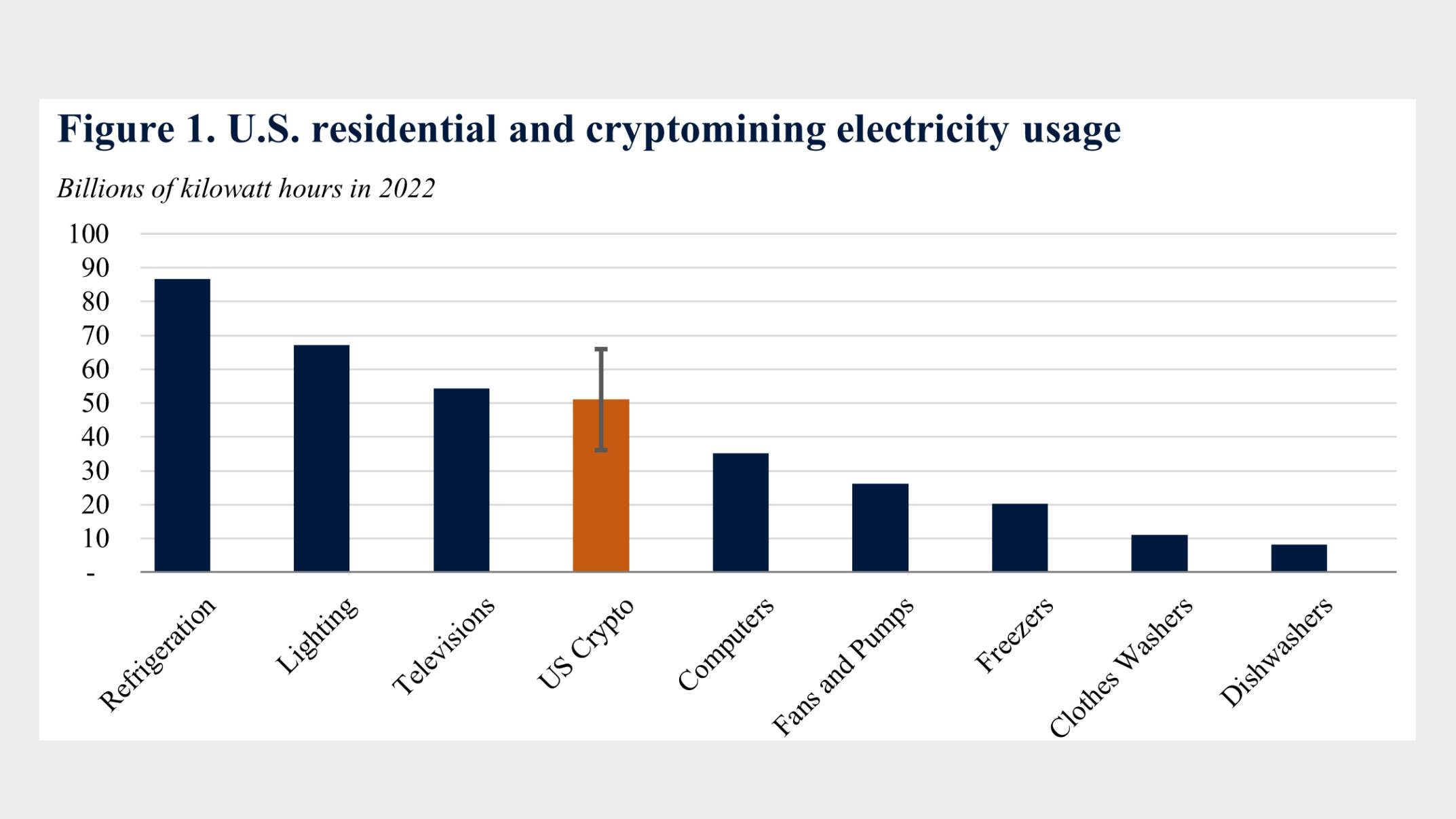
The upper limit could actually put it on par with the energy consumed by all the lighting in the United States. Eep.
PC Gamer
91 points · by geox · 3y ago · 189 comments
This is a scam. It's a self-organizing pyramid scheme. There is no "there" there -- the vitamins really arent a cure for cancer, and your friend telling you to buy a warehouse full is part of a cult of pushers who are desperate that their warehouses of vitamin pills (ie., tokens) doesn't become entirely unsellable.
All the numbers reported by the cryptocoin system are made up: these are manipulated markets with almost no buyers. "Market cap"s are inventions. The amount of actual liquidity in the system is tiny: people are looking for the exists. These exits are mugs called "hodlers", ideally, You, who'll buy their vitamins from them.
Usually, HN comments ought be somewhat more sober -- but I think this is now out of line. Sobriety in this matter is enabling a system of exploitation which should not be entertained by decent people.
Where are you getting this information? Have you experienced issues with liquidity when selling BTC or ETH?
This individual appears to be largely outside the influence of the cartel, at most couple hundred people with a further concentric core of four dozen or so, who control all the liquidity levers and self-reported "usage" and "transaction" metrics in the whole system. These would be the large, long-established and highly publicity-averse miners and the pools they (pretend not to) control, the only group that can afford to burn transaction fees the prop up usage metrics, because they are actually paying a substantial share of those fees to themselves.
Obviously the payout to the people impacted by the gox hack has been perpetually delayed, and there's no guarantee it will happen anytime soon, but certain legal milestones have been reached that will make it quite difficult to delay past this year. When it does happen, we'll see a genuine liquidity event - something north of 120,000 Bitcoins - happen over a very short time, although the trustee has not disclosed how they will manage to do this without completely tanking the market or otherwise introducing slippage that privileges the earliest recipients of the payout over later recipients. This isn't tge same as a in-on-the-game joker like Musk talking about buying and selling a billion dollars in crypto in the past tense, where there is no way to measure his words against the market. The addresses that hold the gox coins are known and monitored.
All crypto news is press releases from crypto companies. All crypto ideas are rehearsed sales pitches with no arguments or evidence. You should assume anything written on crypto which hypes it is a lie. You should investigate the site/author, and -- I'd predict -- you'll find that every single time it links back to people with profound economic incentives to lie to you.
For BTC, you have 400,000 addresses used daily transacting about 300,000 transactions. This is trivial to obtain as a public record. How many of those addresses are associated with only one individual?
If i wanted to simulate millions of users I could do so only with a trivial amount of money. What is a "user"? It's just an address. There are no "users" on the chain.
There are 70mil addresses on BTC, I believe. How fast could an interested party double that? Pretty quick.
These numbers, absent hard-hitting empirical data, should be regarded as fraud. They're made up, either at the level of the press release, or by technical manipulation. Eg., by moving lots of money around a few accounts to manipulate figures.
This is a system which maps, at least provably and publicly, to the entire daily economy of a small town. And it's energy usage is measured in 10^12
Unfortunately as you say it is hard to tell how much genuine usage there is. The only thing I would add is that while crypto is worse, I feel the same concern regarding misaligned incentives in regular finance.
In terms of address count, they're also as I understand intended to be use once[1]. On the other hand there's many people using the same wallet and transacting without ever leaving a exchange and causing a real transaction, though I probably wouldn't consider that as "counting" personally.
> All crypto news is press releases from crypto companies
Again, you could say the same thing about people trying to prop up the capitalist system as they are heavily invested in it and own property, etc..
I could argue that people arguing against crypto are mainly people who are upset that they missed the boat on the biggest price gains. But you could also make that argument about the stock market/capitalism. So it's not a valid point.
The-Ken[c] did a report about how the number of Crypto users in India seems to be over-reported, on two counts - Users have accounts at multiple exchanges (Double Counting) and Users who are in it for the Free Crypto:
> Estimates peak at an overly enthusiastic 100 million crypto owners, as claimed by broker discovery and comparison platform BrokerChooser, but the true number is likely a more conservative 10 to 15 million, according to three industry executives The Ken spoke with.
> “We work with an internal estimate of about 4 to 5 million regular users in India,” said an executive at crypto exchange ZebPay. [...] Notably, the exchange takes into account not just individuals who made trades in the last 30 days, but also app opens while calculating the number of regular users.
> The situation is further exacerbated by exchanges offering joining bonuses and crypto rewards for signing up, like the Rs 100 worth of free bitcoin offered by crypto exchange CoinDCX.
> This lures users into creating an account—irrespective of whether they engage with it in the future or not—and helps the exchange pad up its user numbers.
A better source to consider is the Reserve Bank of India, which has made 2 interesting statements about the number of crypto investors in India.
1. RBI Governor Shaktikanta Das, Nov 2021: "With a reasonable amount of confidence, I can say the number of investors in the crypto market seems to be exaggerated. Adding that most of the buyers of cryptos in those platforms have anyway invested just between Rs 1,000 and Rs 3,000. (12-36USD). [a]
2. RBI Deputy Governor T Rabi Sankar, Feb 2022: "there is no data to justify how many investors have invested in these instruments and what is the amount of investment. Data informally gathered in November seems to indicate that crypto investments by Indians is nowhere near to being significant (although the pace of growth could make it a concern in future). This data showed that four out of five investor accounts held investments of less than ₹10,000 (122USD), with an average holding size of ₹1,566 (20USD). Wealth loss, if at all it is a possibility, is likely to affect only a small fraction of these investors." [b]
I also tried to dig into the original number from Triple-A (Which seems to have gotten a lot of traction because it was quoted in a policy-brief from UN-CTAD[5])
Here's where the number is coming from:
1. Triple-A, Crypto Firm, 2023 Figure[1] is 97.5M / 7.1% of India. The citation for this is their 2022 Report[4] (now deleted).
2. Finder.com, Stats Firm, latest figure is 29% based on a survey of 31k Indians[2]. 29% figure is based on self-selected participants, which are "internet, smartphone and Google AdMob users or Qualtrics research panel participants.".
3. Triple-A, Crypto Firm, 2022 Report[4], claims "over 100 million people, 7.30% of India" and cites HootSuite's Digital 2020 report along with Statista.
4. HootSuite numbers (survey backed), % of Internet Users aged 16 to 64 who own any form of cryptocurrency:
4.1 Digital 2023 - 16.8% [6]. Cites GWI-Q3-2022
4.2 Digital 2022 - 12.6% [7]. Cites GWI-Q3-2021
4.3 Digital 2023 - 7.1% [8] - *this seems to be the figure being used by Triple-A*, which ought to have an upper bound of 2.1% or so (63% of India is aged 15-64, with a 47% internet penetration). Cites GWI=Q3-2019.
HootSuite in turn cites GlobalWebIndex, which is again survey backed, and I couldn't find any clarity about the methodology.
5. Statista, Stats Firm, Paywalled[9]. This is again survey backed: "Which of these financial products and investments do you currently use/own? (multi-pick)". The figures shown here concern respondents who selected the option "Cryptocurrency (e.g. Bitcoin)". I found a citation for their 2020 Figure[10], which puts an upper bound on this at 12% or so.
[a]: https://bfsi.economictimes.indiatimes.com/news/fintech/numbe...
[b]: https://m.rbi.org.in/scripts/BS_ViewBulletin.aspx?Id=20870. Highly recommend reading this, as it tackles exactly the argument here ("so many Indians have already invested in cryptocurrencies and banning cryptocurrencies would lead to a loss of wealth for them. There are three reasons such arguments do not appear justified...")
[c]: https://the-ken.com/tokenised-edition/the-double-counting-fl...
[1]: https://triple-a.io/crypto-ownership-india-2022/
[2]: https://www.finder.com/in/finder-cryptocurrency-adoption-ind...
[3]: https://bitcoinke.io/wp-content/uploads/2021/10/Geography-of...
[5]: https://unctad.org/system/files/official-document/presspb202...
[6]: https://www.slideshare.net/DataReportal/digital-2023-india-f... Slide 48
[7]: https://www.slideshare.net/gangavidya/digital2022indiafebrua... Slide 47
[8]: https://www.slideshare.net/DataReportal/digital-2020-india-j... Slide 35
[9]: https://www.statista.com/statistics/1202468/global-cryptocur...
the Keynote in [b] is definitely an interesting read though it's a bit unfortunate more statistics regarding holding sizes aren't shared.
The perspective expressed of crypto as (reading between the lines) a tool of foreign governments to dollarize EMs is an interesting one. I would be curious if the average person would rather have the individual option of being able to hold other currencies risk and all or if they would prefer to collectively have restrictions for the health of their banking infrastructure as a whole, and how much interest there was in crypto as a means to hold dollars or something else other than rupees, or hoping for extremely high returns in order to then convert back to rupees.
"This could be actual dollarization if stablecoins linked to the US Dollar become widely used, and there is good reason to believe that that they would be popular if permitted."
"Most cryptocurrencies are owned by businesses of AEs; therefore, better adoption of cryptocurrencies would add to their growth and employment. Significantly, it might be of advantage to the AEs if cryptocurrencies replace emerging market (EM) currencies as that would give AEs a better strategic control on the EMEs."
"With one or more private currencies being allowed, there would be parallel currency system(s) in the country. Thus, increased acceptance of cryptocurrencies would result in effective ‘Dollarization’ of our economy."
"They threaten the financial sovereignty of a country and make it susceptible to strategic manipulation by private corporates creating these currencies or Governments that control them."
"Almost all cryptocurrencies are priced in terms of Dollars (or potentially any of the freely convertible currencies). Wider adoption would actually result in wider use of these currencies. So cryptocurrencies are not a threat to convertible currencies as they are to the Rupee, which is not an international currency." (I believe the Rupee has since started to be used for international settlements[1])
[1]https://www.isas.nus.edu.sg/papers/indias-foreign-trade-poli...
In 2022, US mined only 5.4gram of Gold per sec[1]. This is a scam.
Or not. Weighing BTC's utility based on how many transactions it supports per second is as pointless as measuring Gold's utility based on how much of it is mined per second.
[1] https://www.statista.com/statistics/238405/us-gold-productio...
* digital cash
* peer to peer transactions
* digital gold
* censorship resistant transactions
* hard money with fixed monetery policy and capped supply
* highly-decentralized with no single point of failure
Never did it promise to be a high throughput alternative to Visa for buying coffee
Nevertheless the Lightning Network has innovated in the space such that buying a coffee is now trivial using Bitcoin.
I am a crypto “chud” and I believe eventually Bitcoin will become a viable currency and a stable unit of account.
It isn’t that today as it is still a highly volatile asset class with rapidly growing adoption but we are still early.
For now it provides dissidents a viable option that is apolitical and cannot be easily censored.
It offers a hard-money alternative to fiat-money which can be arbitrarily inflated/diluted in value by centralized powers.
It offers a digital asset that is highly liquid, difficult to confiscate, and easy to access for the billions of unbanked throughout the world.
You may not see the use case for Bitcoin but that speaks more to your individual privilege as a citizen of a first world nation than it does for Bitcoin’s usefulness to millions or potentially billions of people around the world.
Lightning supports unlimited transactions per second.
> "Market cap"s are inventions. The amount of actual liquidity in the system is tiny
Is this different than the stock market? Or the banking sector? There are penny stocks, and there are bigger players.
It seems like in finance, sentiment is everything and it's a self-fulfilling prophecy.
> BTC can support c. 7 transactions/sec. Ethereum c. 20
Would you criticize the whole internet because dial-up was slow?
Oh, and regarding the vitamins:
High-dose vitamin C enhances cancer immunotherapy
https://www.science.org/doi/10.1126/scitranslmed.aay8707
It's all about the dose and delivery method, you can't just make blanket statements.
https://www.cancer.gov/research/key-initiatives/ras/ras-cent...
Note how the vitamins aren't sufficient, but they enhance traditional treatments. Seems relevant.
There's a scale from "there are buyers at this market cap" (eg., suprisingly, twitter)... to "there are no buyers at this market cap".
Consider if you and I start a business which sells shares in the business (and nothing else), and we sell 1/1000 shares for $1000 -- that makes our business $1m on paper.
But is there a buyer for that $1m? Well sure, there was for SBF. Until jail, of course -- but many bought his shares in his business which sells shares in his business.
This isnt unique to crypto... crypto is just the latest incarnation whose "productive valuation dial" is close to 0%.
Have you had liquidity issues selling ETH or BTC?
Regarding hodling, again I don't see how this is different than the stock market. You can try to time the market or you can just hold AAPL for 30 years, understanding that any point it could all come crashing down when you're looking away.
In my experience though, every time I have sold ETH (including at the local peak in Jan 2018) it would have always been more profitable to hold it for longer (since I didn't have an immediate use for the cash).
Guess how much Apple stock I can sell right now? Zero. Stock markets are currently closed and Apple cannot be traded. When they are open, I'm looking at a T+2 settlement window. That's not very liquid. One might even call it market manipulation to only open for trading 18% of the time, and of course to shut off trading at any other time on a whim.
Consider an IPO for a company which sells shares, there is no question "at what point does the share price collapse to zero" -- it has a price. The company is worth something: it has profit/loss, assets, etc.
Consider selling all ETH for USD -- the obvious question, to me, is: at what point does the price collapse to zero? 10% of them? 15%? 25.00000001%?
This is an extremely non-linear effect, after 20bn is sold it might just be the next dollar afterwards. Or 50bn. Or 15bn.
I suspect there's about 20-50bn of "real money" in the system, radically double (-double-double) counted by many participants (esp, eg., via tether).
If any coins on any chain were sold off at a high enough rate, perhaps so the total across the entire ecosystem were a trivial 10-20% of ETHs alleged "market cap" -- i think the whole thing goes to zero. At 18.9111123% there'll be no buyers at any price, everyone will realise, and bang goes the whole show.
You can't say that about apple; or any stock whose value derives from owning a business that has *actual assets.
ie., I think the fragility here, of this system and this posted numbers, is radically extreme in percentage terms. Yes, your $1m USD here or there will make no difference.
Ethereum, like Apple, has a dividend. You can stake ETH and earn rewards from the network. Granted, these rewards are accrued in ETH, but they are mostly based on gas fees that users pay the network, which has no dependency on the price of ETH. ETH is bought and sold with dollars so your dividend comes through with a thin layer of abstraction.
However, people don't buy Apple stock for it's asset value or its dividend. They buy it because of the huge TAM of Apple and promise of future growth. Similar to why people buy Ethereum's token.
Let's look at a different stock: DoorDash. They lose money hand over fist every quarter. They have very little assets, and again if you're a common stock holder those shares will be worth $0 when the company is liquidated. However it's still worth a nonzero sum because of speculation and future expectations of growing or turning a profit. Does that makes it a scam? Is their market cap fake because it can collapse to zero say any moment?
What else would you call, say, the NFT phenomenon?
[1] https://www.statista.com/statistics/238405/us-gold-productio...
There’s been so much done (and often right here on HN) to explain how crypto and NFTs are innovative, to link educational resources and list real world examples of legitimate use. As well as to resolve the various ideological controversies. Maybe it’s not quite common knowledge yet, but there’s no excuse in 2023 for being so clueless and, yet, assertive.
They hated mjburgess because He told them the truth.
The amount of actual goods and non-crypto-related actual services purchased with crypto in the last year probably wouldn't fill a high school basketball court.
People who get paid in crypto immediately turn it into real money because the only thing it's used for is building virtual pyramidal constructs.
Fun fact: in 1962, the Atomic Energy Commission projected there would be almost ten times as much available energy in 2060 as there was at the time. Today, I understand we consume just about two times as much. Anyone think we'll get across that finish line thirty years from now with the status quo?
Building nuclear plants because of pointlessly induced demand, however, is ridiculous: we should build nuclear capacity to replace existing capacities that we'd like to phase out. In addition to pointlessly raising the US's energy profile, Bitcoin has also made that aspect of the US's long-term power profile worse than it needs to be[1].
[1]: https://www.theguardian.com/technology/2022/feb/18/bitcoin-m...
Truly we are all much better off.
[1] Standard response, which again isn't relevant to mining: Nuclear is simply way too expensive and by far the #1 reason it's not being built is because no one wants to write the checks to build it when solar is more than an order of magnitude cheaper. Fix that problem first, then start yelling about regulation.
Isn't the value of mining really a function of the higher of both energy and computational availability, and, to my amateur understanding, don't most cryptocurrencies self-adjust their computational difficulty in response to more mining, which the return-value of each new miner less than the one before it? I'd wager that means the combination of time and silicon availability will cap the expansion long before it eats four-fifths of 2060 US' energy generation.
>Nuclear is simply way too expensive and by far the #1 reason it's not being built is because no one wants to write the checks to build it when solar is more than an order of magnitude cheaper. Fix that problem first, then start yelling about regulation.
You don't think there's a possibility the unjustifiable cost might come from the regulation more than the lack of value in displacing almost the entire electricity market?
Please read this, and then do us all a favor and read much more before trying to contribute to this subject's discussion again: https://en.wikipedia.org/wiki/Greenhouse_effect
But if we take the earth's atmosphere with its already existing temperature because of sunlight and greenhouse effect and add additional heat sources it becomes warmer or what do you think happens with the additional energy put into the atmosphere?
What’s your point here?
Cutting the energy bill of the bottom half of the country by an order of magnitude seems to me a self-evident justification, and that's only the first-order effect. Manufactories of producer goods and specialty parts in Germany are shuttering right now because of newly-unmanageable energy cost fluctuations. That puts German workers on the curb, prices consumer goods for all of Germany's sub-median class higher while their wages fall from the labor glut and cratered investor/entrepreneur confidence, and bleeds the ability of producers still above water to maintain a healthy sales base through competitive international products and prices.
With all these people in mind, I've started wondering something about your plea for frugality; what's your delta from the US median compensation, and do you tell it to people in politically-worrying husks like Pennsylvania, Wisconsin, or Ohio after you're done reminding them they really could keep their heart beating without cheap energy if they just try a little harder?
We don’t use 10x the energy because that guess from the 1960s entirely missed the technological revolution that is small, energy efficient computing.
(And other similar advances. The 1960s never anticipated, say, how energy efficient a 787 could be. It was instead the era that thought you might slap a nuclear reactor in an aircraft. https://en.wikipedia.org/wiki/Convair_NB-36H)
It’s not an appeal to frugality. It’s “raw energy usage alone is a goofy metric for a goal to increase”. Do we (including my relatives in the wasteland that is Ohio) need heating? Yep! But we don’t need 10x the energy to do it; my 97% efficient gas furnace replaced a 60% efficient one from the 1980s.
Turning every single light on in my house at once is < 200W. So are all the other items in the list. Running all of them 24/7 is < 5kWh, not that you would ever do that. A single clothes dryer run is 5 kWh. A mid-size heat pump is about 8 kW.
https://news.energysage.com/how-many-watts-does-a-computer-u...
Let's get rid of television.
Gaming and coding.
I thought the stat about how crypto is using nearly as much power as lighting more meaningful and surprising.
Not a single (linked) source is mentioned regarding the energy metric, other than a description that it's a guess with supposedly > 100% margin for error.
Not a word on the energy mix. It draws a direct conclusion between energy consumed and CO2 output as if these are 1:1.
The statement that BTC/ETH contribute nothing of value is surely one many agree with, but not factual. It implies that this author/magazine cares about energy use, which surely they do not. There's 5 million energy sucking ads on the page and it's a magazine that can't wait to tell you about the all-new 3 foot long GPU so that you can play your game at 8K on a 240FPS.
(https://coinmarketcap.com/; Bitcoin and Dogecoin are the only PoW ones IIRC)
Coins like tether cannot continue to exist unless they are allowed to continue.
>It does take a lot of resources to protect a cryptocurrency from attack by corporations and nation states.
What do you think where this resources come from? Corporations and nation states.
It does so at the cost of enormous amounts of pollution. Sure it's non-violent, but it's still disastrously wasteful and after well more than a decade hasn't proven to really be anything more than a way for speculators to get rich off other speculators.
So if I invent a token where I can prove to you that I burned electricity to mint it, will you accept it in return for some of your possessions or your labour?
(If at all.. Prices would drop, reducing some supply but also driving private sector usage up.)
Why would we make an assumption like that? Also, who decides what is illegal?
The entire point of decentralized currency is that it isn't controlled by a national government, and is not subject to any particular country's laws or any corporation's policies.
The benefits go beyond just buying drugs, though. Cryptocurrency helps people to circumvent a wide variety of restrictions - from tariffs, to taxes, to labor laws, governments create all sorts of ridiculous barriers that disrupt the free market and make it difficult for people to do business.
If you're happy with your country's government though and are willing to follow whatever rules they happen to make, then of course it would just be easier to use the national currency. Nobody ever claimed otherwise.
Do you enjoy feeling anger over something, something you or no one in the entire world cannot change?
What on Earth makes you think that?
True, it would be difficult to get every country in the world to get together and ban it simultaneously—but if converting cryptocurrencies to USD and EUR were banned, you just watch how fast they would dry up and blow away.
Banks can't differentiate between consulting fees and buying bitcoin.
Btw I don't have anything to win by telling you this, I'm only bringing information to light.
At Qbix, back in 2018 we were the first ones to implement Monero mining as an option to pay for an Calendars app that was on 50,000 computers, instead of a monthly recurring fee. But we quickly took it out. Back then it blew up and was all over the news, while I was finally taking a week vacation on a cruise with bad internet LOL:
https://www.bbc.com/news/technology-43386918
https://venturebeat.com/security/mac-app-calendar-2-misfires...
https://mashable.com/article/apple-app-mining-cryptocurrency
https://www.newsweek.com/apple-your-mac-mining-cryptocurrenc...
https://www.engadget.com/2018-03-13-apple-calendar-2-crypto-...
https://9to5mac.com/2018/03/13/crypto-mining-calendar-app-io...
The original article was from ArsTechnica, who interviewed me:
https://arstechnica.com/information-technology/2018/03/there...
I told them:
"We have decided to REMOVE the miner in the app. The next version will remove the option to get free features via mining. This is for three reasons:
1) The company which provided us the miner library did not disclose its source code, and it would take too long for them to fix the root cause of the CPU issue.
2) The rollout had a perfect storm of bugs which made it seem like our company
wanted* to mine crypto-currency without people's permission, and that goes against our whole ethos and vision for Qbix.3) My own personal feeling that Proof of Work has a dangerous set of incentives which can lead to electricity waste on a global scale we've never seen before. We don't want to get sucked into this set of incentives, and hopefully our decision to ultimately remove the miner will set some sort of precedent for other apps as well.
Ultimately, even though we technically could have remedied the situation and continued on benefiting from the pretty large income such a miner generates, we took the above as a sign that we should get out of the "mining business" before we get sucked into the Proof of Work morass of incentives."*
Earlier this year "Ordinals Theory" and now the "BRC-20" tokens have been taking off like crazy... https://www.coindesk.com/markets/2023/05/02/first-mover-amer...
In anything that's NOT proof of work, I would be willing to engage and help the ecosystem. But with proof of work, I'm worried that the Bitcoin blockchain having MORE applications is bad for the world. I've spoken to people whose job it is to defend Bitcoin and they had to admit that, if market forces continue, then Bitcoin will start to cause blackouts for people around the world (in some parts, it already has).
Ironically, the Bitcoin maxis probably hate that their beloved blockchain is now going to be overrun with degens bidding up their transaction fees to the moon: https://twitter.com/IntercoinOrg/status/1654355480569839616
Anyway, I am wondering, maybe helping NFTs on Bitcoin and making degens have a mania and crowd out the Bitcoin transactions will actually make Bitcoin LESS attractive to the HODLers? In that case, I'd do it. I wish Bitcoin price would fall and make it uneconomical to mine it, while non-PoW projects like Polygon break free of it and see a lot more adoption.
I wonder if somebody built an automated process for this, or there is still a human element to it.
Turning off the cryptos is sound environmental policy, that energy will be needed for the electrification of transport.
> "Despite its heavy power needs, cryptocurrency mining offers a potentially beneficial and symbiotic relationship between power usage and power generation. Miners can participate in demand response programs, incentives offered by ERCOT to quickly turn off miners’ power during periods of peak demand. When electricity prices are high or supply is straining to meet demand, miners can reduce their energy use. Supply and demand run in tandem, so if a miner stops using electricity, it’s the equivalent of a power plant producing extra electricity that could assist in meeting grid demand and help with grid stability."
> "simple economic theory suggests that increased mining activity could spur additional energy infrastructure. Mining facilities often are located near wind and solar farms that provide access to cheap electricity prices"
Do you disagree with the Comptroller?
But I suppose this pedantic point doesn't matter since HN hates cryptocurrency so much they lose their minds and start hating cryptography just out of spite as well.
https://nichegamer.com/high-end-gaming-pcs-banned-in-six-us-...
The ban from which high-spec PCs were specifically exempt?
https://www.pcgamer.com/high-end-gaming-pcs-are-exempt-from-...
Even more interesting is the comparison to the US dollar which ostensibly is backed by all US Energy consumption less maybe residential consumption which was 2.86e13[2] kwh less residential at ~21% = 2.28e13. Now let's compare the USD energy consumption to bitcoin which was 1.29e11[1] kwh in 2021 which would make Bitcoin ~200x more efficient than the USD in terms of energy required to secure.
[1]: Bitcoin Energy usage 2021 - https://rmi.org/cryptocurrencys-energy-consumption-problem/#....
[2]: US energy usage 2021 - https://www.eia.gov/energyexplained/us-energy-facts/
[3]: US Manufacturing energy usage 2021 - https://www.eia.gov/energyexplained/use-of-energy/industry.p....
If you can find a way to also provide all the goods and services that were provided with that energy while using your energy to mine bitcoin, then I will accept your comparison.
Otherwise this comparison is complete bullshit.
I once toured an automotive plant. The idea that crypto could possibly be 1/100th of just that one plant would have been terrifying. The idea that crypto has reached 1/100th of ALL US manufacturing ...
EDIT: It sounds like automotive plants measure their output in something like thousands of cars per week. Imagine the energy required to move just a single car through a factory. And all of the work that goes into assembling it. And lighting and hvac for the factory. Then multiply it by 10000, then by 50 (~weeks in year), then by total number of automotive factories in US, then do the same for all of the other manufacturing industries in the US. Finally divide all that by 100. Yeah ... I consider myself not to have an environmentalist bone in my body, but I'm suddenly not feeling so well.
The US dollar is backed by a complex of factors, including our willingness to invade or otherwise bring to heel countries that threaten the US dollar. Trying to do math on the "efficiency" of bitcoin versus the US dollar is a category error.
It's also worth noting that most mining power consumption happens where & when energy is cheap. Bitcoin as a whole uses more renewable energy than the US economy by a factor of 2x @ 58.9%[1] vs Total US usage from renewables @ 23%[2]
[1]: https://www.globalxetfs.com/bitcoin-mining-is-set-to-turn-gr....
[2]: https://www.usatoday.com/story/news/2023/03/01/clean-energy-....
You say that like its a good thing.
Bitcoin does indeed use power where it's cheap[1]. The argument that justifies Bitcoin's use of renewables needs to account for Bitcoin's concurrent prolongment of nonreneweables.
[1]: https://www.sierraclub.org/sierra/2022-1-spring/notes-here-t...
The perspective being that crypto is so small because it's 1/100th of manufacturing? Or the perspective being that crypto is so big because it's 1/100th of manufacturing?
The way I see it is that US manufacturing produces a massive amount of highly complicated and sophisticated goods which make a complete nontrivial difference in the quality of life for a massive amount of people.
Whereas (as I see it) crypto does nothing but provide a way for a small number of people to be scammed out of money by a smaller number of people.
At the end of the day, it is impossible to quantify the amount of energy required to keep the USD as the global reserve currency and preserve its value.
The only "fair" comparison, would be to estimate how much energy bitcoin/crypto would consume if it replaced the US dollar. In that scenario, the government would still exist, the military would still exist, most of our existing financial infrastructure would still exist (crypto has done nothing to squash financialization, if anything it encourages it).
In the above scenario, the only thing that would probably disappear is the federal mint. Crypto mining already uses way more energy than that. And crypto mining would almost certainly increase exponentially if it was adopted globally as miners are incentivized to mine right up to the edge of probability, and the value of tokens in the above scenario would increase dramatically (because most tokens are deflationary) thus resulting in a massive surge in mining.
At the end of the day, there is just no way to rationalize away the absurd waste of energy that is crypto mining. They are increasing the cost of energy for everybody and they are increasing global energy demand when we desperately need to be reducing consumption to save the climate. Proof of stake exists, any crypto currency that does not use it should be outlawed in my opinion.
> Crypto uses 1/4th the energy of the most powerful military ever.
See, I read that and suddenly I feel like I need to sign some petitions and call my congress representatives and ask for anti-crypto legislation.
You can't talk about efficiency without talking about the productive output. If I spend 200x as much to get 200x as much value, the efficiency is the same.
The productive output of the USA includes keeping about 330 million people alive with a decently high standard of living. The productive output of bitcoin is enabling speculation, money laundering, and crimes such as ransomware. There is no rational world where the two levels of output are even remotely in the same ballpark.
So let's try to compare them properly.
What is secured by US manufacturing is NOT the USD, but the US economy. Which according to https://en.wikipedia.org/wiki/Financial_position_of_the_Unit... has a net worth of over $120 trillion.
What is secured by bitcoin mining is the existence of bitcoin. Which currently has a market cap of a bit under $600 billion.
This values the US economy at 200x bitcoin. So if the US economy takes 200x the energy, that's THE SAME level of efficiency.
But it gets worse. As others have noted, it is widely believed that bitcoin is a speculative bubble which rounds to "the largest Ponzi scheme in history". To get bitcoin mining to be equal in efficiency to US manufacturing, you have to accept an almost certainly fake valuation for bitcoin at face value. If you don't accept the paper valuation as being real, then bitcoin's efficiency drops dramatically.
This is a profoundly manipulative comment pushing snake oil.
Like now you are saying that securing 1 Bitcoin blockchain is 200x more efficient than securing 1 US economy.
But I expect if you ask, most people, if forced to choose only 1, would select the US economy.
With a scale factor, you could do something like say you would choose 10% more blockchain over whatever the equivalent amount of US economic activity would be.
Can you explain what perspective that adds? I don't see how the two are related.
It's like commenting on an article about U.S. milk production by saying, "To put this into perspective, U.S. orange juice consumption was x."