123 points · by xgdgsc · 3y ago · 133 comments
a(b(c(d))) vs d |> c |> b |> a
but I'm not convinced pipes are better than more verbose code that explains each step:
step1 = c(d)
step2 = b(step1)
result = a(step2)
I've written a lot of tidy R and do understand the specific use cases where it really doesn't make sense to use the more verbose format, but generally find when I'm building complex mathematical models the verbose method is much easier to understand.
In programming the code will be read multiple times and good names will help the future readers. But in data science the calculation will be most likely will not be reused. So efforts to name things will be waste of time.
I suggest that trying to strictly only bind output to a symbol if it will be used in multiple places.
So when I read code and I see some "intermediary" value bound - it tells me immediately "this thing will be used in several spots". Thereby bindings actually start to convey extra information
Anyway, it's just something that's worked for me. In all other scenarios I will use threading/pipeline (maybe Clojure specific). If steps are confusing/complex then you make a local named lambda or add in the extreme case.. comments
> Provides link to R.
Is there an example of this in Julia? I use R now, and every time I give Julia a shot I go back to R because of the insane TTFP. I don't use anything remotely close to big data, and the 90-120s compile times just to replot my small data (using AlgebraOfGraphics.jl in a Pluto notebook) just kill me.
(Yes I know what you mean, but yes you know what I mean!)
In the end, chains are about readability and logical flow; even if you don't like pre-wrapping in more meaningfully named functionals like the example, and accept the slight readability cost of using the occasional in-spot lambda or partial, I feel that this still becomes a lot more readable than "treat this symbol unconventionally in this context as a positional placeholder" hacky syntax stuff.
https://pandas.pydata.org/docs/reference/api/pandas.DataFram...
In R you can pipe a data frame into any function from any package or one you just wrote, so you use %>% for any piping that happens. In pandas, you have special pandas methods that don't need the pipe, but to pipe with any other function, you have to write .pipe.
The comparison is not really between %>% and ., it's between "you just use %>% for everything" and "you use . for a bloated, somewhat arbitrary collection of special pandas methods, and .pipe for everything else".
The ability to pipe shouldn't be tied to whether a function is a method of a class.
According to these benchmarks: https://h2oai.github.io/db-benchmark/, DF.jl is the fastest library for some things, data.table for others, polars for others. Which is fastest depends on the query and whether it takes advantage of the features/properties of each.
For what it's worth, data.table is my favourite to use and I believe it has the nicest ergonomics of the three I spoke about.
In the Julia world the one which optimizes to be fully non-dynamic is TypedTables (https://github.com/JuliaData/TypedTables.jl) where all column types are known at compile time, removing the dynamic dispatch overhead. But in Julia the minor performance gain of using TypedTables vs the major flexibility loss is the reason why you pretty much never hear about it. Probably not even worth mentioning but it's a fun tidbit.
> For what it's worth, data.table is my favourite to use and I believe it has the nicest ergonomics of the three I spoke about.
I would be interested to hear what about the ergonomics of data.table you find useful. if there are some ideas that would be helpful for DataFrames.jl to learn from data.table directly I'd be happy to share it with the devs. Generally when I hear about R people talk about tidyverse. Tidier (https://github.com/TidierOrg/Tidier.jl) is making some big strides in bringing a tidy syntax to Julia and I hear that it has had some rapid adoption and happy users, so there are some ongoing efforts to use the learnings of R API's but I'm not sure if someone is looking directly at the data.table parts.
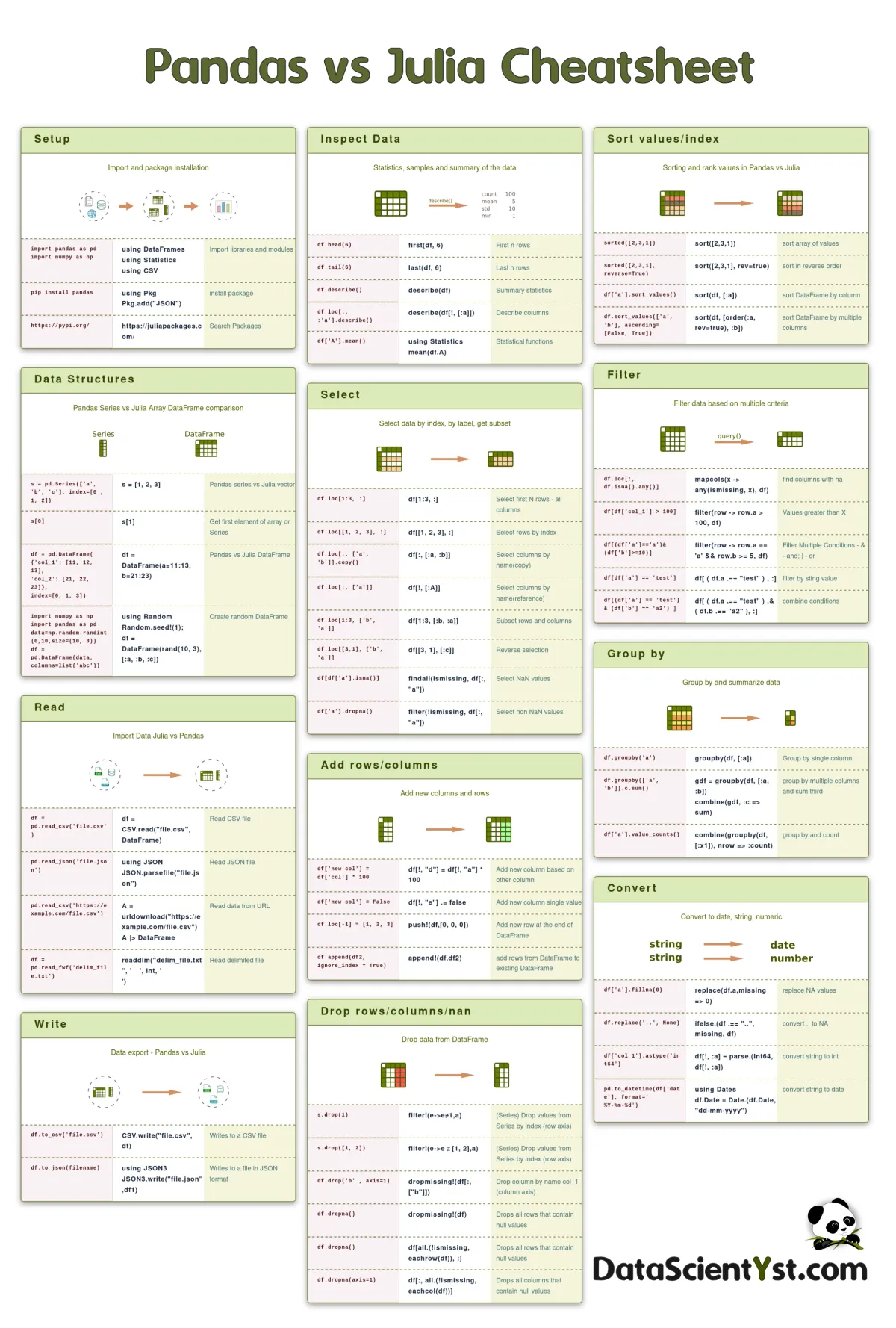
Similarly make sure you research the ecosystem because everything in Julia is very fragmented, IE pandas.loadcsv will require two or more packages in it's Julia equivalent.
Furthermore, Bogumil Kaminski, one of the main developers behind DataFrames, makes sure that the DataFrames tutorials he has created here (https://github.com/bkamins/Julia-DataFrames-Tutorial) are updated on every new release.
No, it isn't. I'm using Pandas, DF.jl, and even polars at work. DF.jl is by far the best/easiest/quickest to use, as its syntax is consistent. Polars is a bit more annoying as its syntax is further along the learning curve that I have gotten yet.
Pandas ... what to say about a library that will happily return a pd.Series in one moment, and a pd.DataFrame in another, for the same function call. This means you need extra code like
if type(ret_thing) = pd.Series: # then do something to coax it back to a df.
lest your actual code break.
This is of course the same language that has API differences that make no sense in, say, re.match vs re.findall vs re.search. I've been burned by all of those.
So, look, we get you hate Julia. That's fine. Go live your python life to its best. But really, stop with the misinformation/FUD. This speaks volumes about you, and tends to make the case precisely the opposite of what you think.
And yes, I use Python, Julia, C++, and many other languages in the $day_job.
At its most basic the obviouses becomes different:
Let's try to get a very simple object: a 3,3 matrix of random booleans in both languages: Julia:
A = rand(Bool,3,3)
Python: No standard support for Matrices. I could really do it a disservsice and comapre the "core language", but that''s obivously stupid so we'll bring in some external libraries to make it easier. Of many ways to skin the cat here's one.. Python
import numpy.numpy as np gen = np.random.default.default_rng() B = gen.choice([True,False],(3,3))
BTW julia has this choice function built into the command as well, so rand(["Which", "Word", "Will", "I", "get?"]) produces exactly what you'd expect.
----
Acutally I can't think of any cases at all off the top of my head. Sorry, I mean my np.somenamespace.another.namespace.sparce head :) I mean just going down the list of things that make code easier in Julia..
* Python requires a third party library for any kind of linear algebra. and matrix multiplication:*
A =[1 4;6 7"; B = [2 ;3]; A*B doesn't work, i.e. you literally even multiply a matrix! This is madness.you'll need yet again a third partly library
Python doesnt have broadcasting. let's apply sin(x) to a matrix a Pythonic(+ required third party libraries) import numpy as np
import math #sigh
x = np.array([1, 2, 3, 4, 5])
f = lambda x: sin(x)
Now in Julia (notice the . after sin) x=1:5 sin.(x)
or more explicity we could write broadcast(sin, x)Even basic string interpolation in Julia is a much nicer "trivial task" than in python alone
No special brackets, just clean "$myvar"
# Reading files is easier
Julia
readlines("my_test.txt")
Pythonopen("my_test.txt").readlines()
What a stupid option in 2? if I call readlines on a filename, 99% of people, 99% of the time, want to read the lines on the file at that path. Why require two function calls?
I really don't understand what you are trying to complain about. Namespaces are nice. Dumping everything into the global namespace sucks.
>Julia
A = rand(Bool,3,3)
Python: No standard support for Matrices. I could really do it a disservsice and comapre the "core language", but that''s obivously stupid so we'll bring in some external libraries to make it easier. Of many ways to skin the cat here's one..>Python
import numpy.numpy as np
gen = np.random.default.default_rng()
B = gen.choice([True,False],(3,3))
I find myself just taking `rand(["Msg1",.....,"MsnN"])` to get a random string often.
And small things like this are why you see people Julia is so nice to write and become so defendant of it.But I agree this should have been reflected in the title of the article.
julia> setprecision(1024)
julia> a=BigFloat(1.0E-300)
1.000000000000000025059091835208759685696146807703705249925342319900466043184051484676302812181950100894962306270278254148910311464998804130812246091606190182719426627934584275510414782787015070222639260603793613924359775094030143866141479125513590882591017341692222921220404918621822029155619541859418525883262e-300
Notice without quotes on the literal you only get ~15 decimal digits of precision because the parser treats the literal as a double and then passes that to the BigFloat variable. julia> a=BigFloat("1.0E-300")
9.999999999999999999999999999999999999999999999999999999999999999999999999999999999999999999999999999999999999999999999999999999999999999999999999999999999999999999999999999999999999999999999999999999999999999999999999999999999999999999999999999999999999999999999999999999999999999999999999999999999999999999988e-301
With quotes we get the full ~308 decimal digits of precision for the configured 1024-bit binary precision.Now we can add it to 1.0 to validate the precision of a calculation and use the @printf macro for C-style formatting to round the output to 308 decimal digits:
julia> b=BigFloat("1.0")
julia> using Printf
julia> @printf("%.308f\n", (a+b))
1.00000000000000000000000000000000000000000000000000000000000000000000000000000000000000000000000000000000000000000000000000000000000000000000000000000000000000000000000000000000000000000000000000000000000000000000000000000000000000000000000000000000000000000000000000000000000000000000000000000000000100000000
I'm not sure why this is the default behavior, it seems like a really easy way for people to screw up their calculations, especially scientists that don't do a lot of programming.Um. You said the answer earlier:
> because the parser treats the literal as a double
BigFloats aren't built in to the syntax of the language (and probably should't be, so you need to escape the parser somehow -- either pass a string to the constructor, or use the @big_str macro to get a non-standard string parsed into a BigFloat.
It makes no sense to an end user that expects an argument you pass to BigFloat to be treated as a BigFloat. As an end-user I would rather have a warning or even error than to have my argument silently treated as a double.
BigFloat(x::AbstractString) is identical to parse. This is provided for convenience since decimal literals are converted to
Float64 when parsed, so BigFloat(2.1) may not yield what you expect.
...
Examples
≡≡≡≡≡≡≡≡≡≡
julia> BigFloat(2.1) # 2.1 here is a Float64
2.100000000000000088817841970012523233890533447265625
However, saying RTFM is not a solution, especially for not-too-frequent parts of the language like BigFloats. It's still a trap many people are going to fall for.The solution here is a good linter though, not adding more work to the already overstressed compiler. It comes back to the issue of Julia needing more mature, easy-to-work-with tooling, that could say "hey, this is technically allowed, but you probably didn't mean this".
And this is not an advantage to the designer exclusively, it is very much an advantage for the end user that the treatment is explicit, consistent and predictable, instead of 'magically' reinterpreting the meaning of literals based on guessing the intent of the user.
Basically, you seem to be saying that when passing x to BigFloat, x should not be treated as the value x, but as some nearby value that might be the one the caller intended (based on some rounding logic perhaps?) Or are you perhaps saying that
x = 1e-300
y = BigFloat(x)
should be different from y = BigFloat(1e-300)
? In other words, completely discarding referential transparency?But this is a language flamewar thing, probably not a constructive comment, sorry.
Pure Julia is faster than pure python, but there are non-pure python tools available in the python ecosystem for a ton of things.
[0] -- https://www.pola.rs/
Yes, I agree, on average polars is a bit faster for many of the simple workflows, but I certainly don't think that's unconditionally true. It's especially less true when you might want to do something out of the ordinary with your series --- in Julia it's trivial to just extract that as a vector and loop over it (fast!). In polars, one would have to make sure their function can be appropriately vectorized.
``` df = DataFrame(CSV(File("name.csv")))
data = JSON(File("name.json")) ```
instead of the usual hodge podge of methods ``` df = CSV.read("file.csv", DataFrame)
data = JSON.parsefile("file.json") ```
For instance, consider someone who has limited access to desktop computers and have to go by with a mobile device. These individuals do exist, and their access is as legitimate as any other.
It's virtually impossible to make a website that is well designed on both desktop and mobile. As long as the affordances of mouse+keyboard and touchscreen are as different as they are, one of the user groups needs will suffer a detrimental compromise.
Julia's DataFrames library is more consistent than Pandas by a mile, but it's still a bit weird.
JuliaDB's IndexedTable and NDTable was a really awesome API design, it's quite a pity that JuliaDB is now unmaintained. :(
mydf = pd.DataFrame({'a' : [1, 2, 3]})
print(duckdb.query("SELECT SUM(a) FROM mydf").to_df())
I can see the appeal, but if you're working in Python, something doesn't sit right with me when having to write out variable names as strings. E.g., if I want to refactor the code, my LSP or parser won't pick up those references.> The SQL table name mydf is interpreted as the local Python variable mydf [...] Not only is this process painless, it is highly efficient.
It might be painless and convenient at first, but I feel like this could get you in trouble down the line. Is there a way to avoid this?