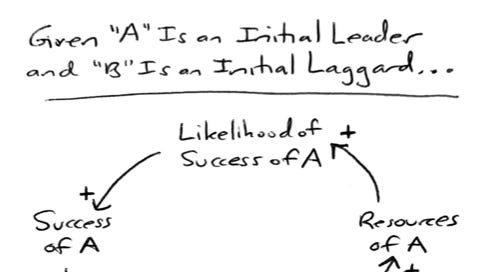
Success to the Successful
The field of system dynamics identifies several archetypes: common patterns that drive behavior in many situations.
riskmusings.substack.com
96 points · by vitabenes · 3y ago · 83 comments
1) It's not an accident that Monopoly looks like this. Monopoly was an intentional demonstration by a Georgist that if everyone starts in the same space with the same capital, eventually one player will own all of the other players. It originally had a second phase (Prosperity) showing that you could change the rules and have things turn out differently.
2) This model has invisible, magical "allocators," but there are material ways by which wealth attracts more wealth. If you're wealthy, you can buy heavily when prices are low and not buy at all (or even sell) when prices are high. You can also buy wholesale at all times, because large purchases/purchasers bring down costs for the seller.
There's no doubt for me that most of the benefit of early success in a industry is that you can wait until new entrants are in a fragile, time-constrained situation, and just buy them. You can also buy from suppliers at a high enough volume that they don't even bother to sell to your smaller scale competitors. You can sell at a loss longer than they can.
None of that is investors making decisions, it's just a natural consequence of wealth.
Meanwhile, a patch of land sold a few years back for £1m. On it, the developer built a block of retirement flats. There are maybe 30 of them. They each sold for north of £500k. The property owner also charges £20k per property per year for "maintenance".
It's simplistic but he's basically printing money. Out of his £15m turnover he had to spend £1m on the land, maybe £1m on building the flats - so £13m clear profit, and an annual of £600k.
So then he goes on and buys the next piece of land for £2m, this time makes a clear £30m, annual of £1.5 etc etc.
So, yeh, success to the successful. Who needs teachers or GPs anyway, right?
Regardless, assume this guy had couple of million pounds — building the flats is a productive use of the capital. We know that because he sold them at a profit. That means buyers valued the output more than the cost of the inputs. That is good.
(I understand that markets are not perfect, and monopolists, monopsonists and rent seekers can make profits without creating value, and I agree that is bad. But the fact that an enterprise is profitable is not a bad thing.)
This is a very naive interpretation. Perhaps (maybe even more likely) the value of the land skyrocketed according to rising demand, regardless of the capital invested in building flats. They could have built single-family homes, or a parking lot, or even nothing at all and still profited handsomely.
Please read up on Georgism, land value tax (LVT) and ground-rents: https://www.strongtowns.org/journal/2020/1/16/the-power-of-t...
You are wrongly framing the builder as the bad guy, and not the homeowners that lobby for SFZ that causes a scarcity of flats which then causes the possibility for abnormal profits. Study the causality and place the blame at the correct place if you want to enact real change instead of just making people angry.
Upvoted you, but I disagree. This is classic survivorship bias. You see the 10% of cases where this works, and you don't see the 90% of cases where the owner goes into crippling debt, can't sell the land, can't sell the condos, or vacancies are at 50%+. There's no such thing as "printing money" in capitalistic markets and it's naïve to think there is. I'm not an efficient market hypothesis guy, but markets tend to be efficient.
There are cases of problematic monopolies (e.g. telecom companies, energy distribution, steel, Google advertising, "too big to fail" banks, etc.) and maybe you could argue those actually do print money, but, imo, that's far and few in between.
The analysis is not looking at the probability of the situation occurring (where survivorship would apply). The formula is applied, where it can be. The observation is pointing out the Success driving success paradigm in action.
I can buy that for average folk, as they often do not have the expertise (nor the wealth to access the expertise) necessary to make better decisions for their business. For those substantially wealthier, it doesn't really make sense but maybe you're privy to more sources here that I would love to dive into.
Btw this is why it's always "big developers" in the first place; they have to be big, because they have to spread out this risk over a large number of ventures, and have easier access to credit. Planning restrictions drives consolidation in the construction/real estate industry because it raises the level of risk above what smaller companies can endure.
That's why it's so maddening to hear nimbys say they're opposed to profiteering big developers, and that loosening of planning regulations would be some kind of handout to them. Precisely the opposite is the case. They're unwitting agents of regulatory capture.
Jeremy Clarkson's farm show is an accidental documentary about this. See here: https://twitter.com/NuclearBeacon/status/1630617164536332303
Some folks like to lament greed or profit, while adamantly refusing policy that makes markets efficient and erodes margins. It is an interesting dynamic.
I think you need to take this from the perspective of what part of the world you are living in.
I'm not sure how we can measure this in quality of life rather than just dollars, but let's consider it this way.
In Australia, Canada, the US, the cost of buying a home has become out of reach for most people. Not even talking about the poorest people, just the average.
Healthcare cost has far outstripped inflation over the last 30 years, and is a greater proportion of the average persons salary. https://www.thebalancemoney.com/causes-of-rising-healthcare-...
Poverty comes with it's own health issues. https://www.aafp.org/about/policies/all/poverty-health.html#....
Salaries have also been stagnant, apparently since the 70s according to this article. https://www.cnbc.com/2022/07/19/heres-how-labor-dynamism-aff...
So, I don't know how you can claim the poor are not getting poorer.
It is interesting to see this play out with NFL football podcasts. This use to be a space of random individuals but then former and even current players started podcasts.
Now the Kelce brothers and Taylor Lewan have podcasts. They don't just have the name recognition with football fans relative to the average person but the subject matter expertise too. They also have a cool factor with who wouldn't prefer to work with a current NFL player about football than you or I? Not to mention 50 million dollar contracts so they have so much more capital to make things work. The average person and Kelce/Lewan can both just have their friends on the podcasts as guests but the NFL players friends are also NFL players that the average person has to do a nearly infinite amount more work to get on.
This process applies to pretty much everything in every domain.
— Matthew 25:29
However, there are other systems where winners-win is more clear-cut. For example, college athlete recruits want to go to programs that are already successful (thereby increasing the likelihood that the team will continue to be successful), or F1 teams that do well in the constructors championship get a sizable payout (which helps them to continue winning).
Organizations may or may not live on. Most businesses have shorter lives than people, but some have lived longer.
Sometimes they change so much that they might as well be a different entity.
> One of the most salient archetypes of our current period is called “success to the successful,” which fairly well describes twenty-first-century capitalism
The implication being this is some new facet of our modern society, and not a part of past ones.
I can’t think of a time period, especially when considering a global scale, when the authors claim of “success to the successful” was not true.
In fact, I would say it is less true than ever before. Note that this isn’t the same as saying it does not apply now. Before the internet what opportunities existed for someone in say, rural Africa, to teach themselves skills to obtain success. Now? Marginal, sure, but absolutely present.
“… we find that large corporations are more and more likely to maintain their dominant positions, while small corporations are less and less likely to become big and profitable.” Link: https://hbr.org/2019/08/the-gap-between-large-and-small-comp...
Here’s economist Austan Goolsbee in The New York Times highlighting growing corporate concentration even pre-pandemic: https://www.nytimes.com/2020/09/30/business/big-companies-ar...
These are success-to-the-successful trends.
Disruptive shocks (like when Google created a truly better search technology and dethroned AltaVista in the late ‘90s, or when the US gov broke up AT&T in 1984) can change those dynamics. That’s how Kodak, despite having lots of resources, lost dominance and eventually failed: they didn’t have the right non-monetary resources (innovative culture and support for change) at a critical time, so disruptive shock toppled them.
Anyway, thanks for reading!
That is a property that has existed for millennia, permitting useless genes that had past success to survive past when they provide strong utility.
And that has nothing to do with capitalism. It is merely a natural effect.
... Gifted & Talented.
Let’s make this concrete and relevant to early 2023: we’ll say A represents a group of companies known as MMANGA (Microsoft, Meta, Apple, Nvidia, Google/Alphabet, Amazon), and B represents a group of all other companies in the US public markets (i.e., a broad-based index minus MMANGA).
People could have said the same in the late 90s, but instead Intel, HP, Oracle, Cisco, IBM, etc. Only Micorsoft has bucked the trend of not fading, unlike the others.
See Communist China before they re-implemented the Gaokao (their college entrance exam), many schools now in California, and once-prominent public schools like Dunbar High in the D.C. area (successful despite the poverty of the area in which it operated-see https://www.creators.com/read/thomas-sowell/10/16/dunbar-hig...).
A lot of people would agree that if someone is 5x smarter and work 5x more than someone else, then making 25x more money could be fair.
My intuitive take is that our system rewards those people with a lot more than x25... this article seems to go in the same direction.
If that is true, is it morally fair? What would be fair? Do we even care about fairness?
("hard work" I can see. That certainly has pedigree - toiling the land to please god, that sort of thing, there's something virtuous about it).
Generally "smart" = born with high intelligence and the right personality traits (I.e. conscientious). I see it mostly as lottery.
It seems a stretch to describe this as "One of the most salient" archetypes. This would only be true if "resources" are "one of the most salient" factors for success. If two companies are almost identical in every other way, then sure resources are a great tie-breaker. But if one company is significantly better than the other in some way, I would expect that company to overcome a resource-deficit. See Google winning search over other earlier and larger search engines. Facebook winning social media over other earlier and larger social networks. OpenAI leading/co-leading the AI race despite being outgunned by so many other companies. AMD surpassing Intel in valuation despite an enormous financial deficit a decade ago.
In fact, an abundance of resources can actually negatively impact success. See the resource curse: https://en.wikipedia.org/wiki/Resource_curse . Highly relevant in big tech companies that are so much slower and bureaucratic compared to startups. Today's world might possibly be the most startup friendly in history - there is far more VC financing available than ever before for any company that can demonstrate any form of competitive advantage in a lucrative market. Financing that provides just enough resources to avoid being handicapped, but not so much that startups are lulled into complacency the way more established companies are.
It's easy to pick one model that seems intuitive, and use it to make sweeping statements about "twenty-first-century capitalism". In the real world there are many different models all operating at the same time, and the one that is most intuitive may not be the most salient.
No. If A is a big enough success, money can get thrown at a bunch of B’s. Resources can INCREASE. Most B’s will be unsuccessful.
Look at Tesla market cap (a measure of resources allocated) vs Toyota and look at how many cars they sell.
Tesla definitely didn’t start out winning, but people saw the potential and started allocating resources away from old car manufacturers.
If this model actually held then no one would have ever bet on them.
If we want to speak in absolutes, entropy cannot be reduced; we will only capture so much energy over time, and I refer you to http://www.thelastquestion.net/
If we get a little zen and allow for the ever-elusive human joy to be the ultimate resource, then I'm not sure we can necessarily say that it's finite. I guess without humans there can be no human joy, but why not machine/post/trans-human joy?
Whoever dies with the most toys wins, right? :)