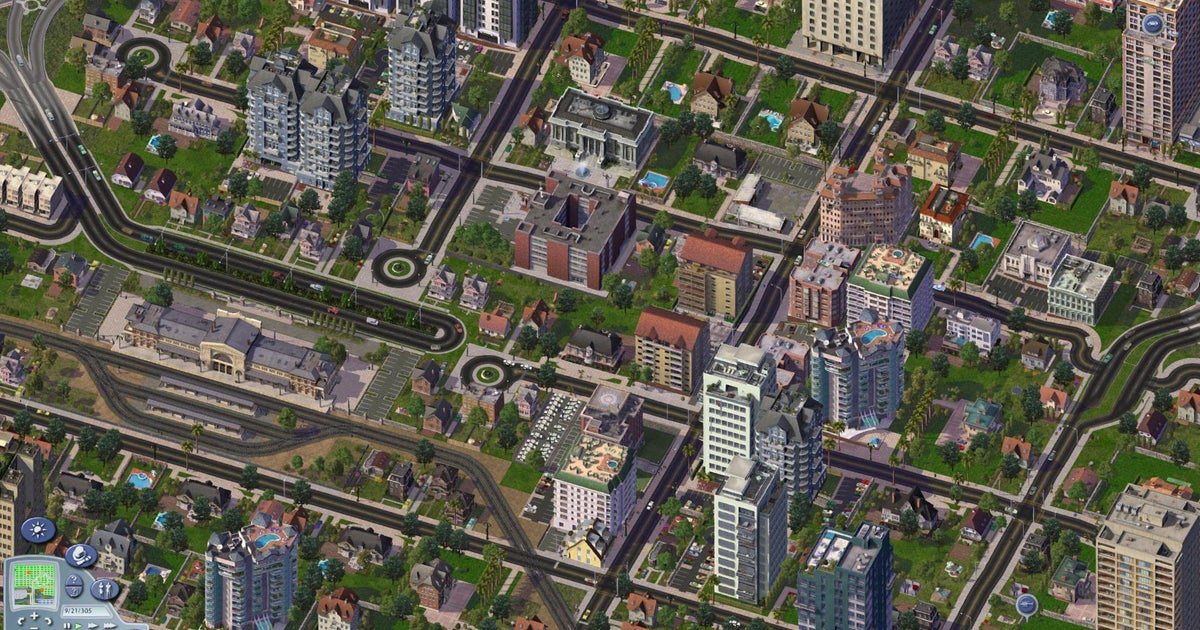
SimCity 4, the greatest citybuilder of all time, was released 20 years ago
SimCity 4, the last great SimCity game and one of the best citybuilders ever made, was released 20 years ago today.
Rock Paper Shotgun
348 points · by jdkee · 3y ago · 251 comments
Back on topic though. My beef with SimCity 4 is that it added a bunch of details that make it less fun, like micromanagement of the funding of individual hospitals and police stations. The added complexity didn’t bring any new profound shifts in thinking or strategy, it just created more busywork for the player.
SimCity 2000 has almost none of that. It’s just a really solid and super fun game. It’s quite balanced (when you resist the temptation to use cheats) without being overly hard. So you can sit back (with a cold beverage of your choice) and enjoy a nice relaxing time playing mayor and seeing your little city develop before your eyes!
Very few games do that today (EU4, a favorite of mine, for example) but the trend now is to confuse the user with graphics while giving really little in term of content.
FWIW, I have a pet theory that WoW took over at that point not because of the MMO concept (which already existed), but because their UX was so smooth. That was the first MMO that "just worked" to understand what you were trying to click. The others at that time would take multiple tries to click an object correctly.
In any case, the success of WoW is what changed the direction of gaming a few years after all those games came out, so I'm agreeing with you that it was an incredible era.
I cannot think of a more revolutionary span of games over 3 years.
Roguelikes
Dwarf Fortress
Factorio
EU4
My theory is that deep gameplay and AAA 3D graphics are mutually exclusive because deep gameplay fundamentally requires "tile grids" of some kind, which don't lend themselves to AAA 3D graphics.
(Diablo 1 and 2 kind of railed against this by taking the approach, "Hey, what if we took a tile-based roguelike and rendered it in isometric 3Dsortof?" At the time, that isometric 3Dsortof was state of the art, I guess.)
I think we'll come full circle with generative ML tooling as games will have to compete in wider areas than just marketing & graphics.
These games were a product of their time and you definitely do have an age based selection bias!
SC3K is similar enough in structure to SC2K that it can actually load SC2K city save files directly; SC3K being a relatively strict superset of SC2K in terms of available elements and their sizes certainly doesn't hinder that backwards-compatibility at all.
The only things that would actively break when you did this were related to maximum terrain steepness for underground elements (metro, water pipes), 90-degree rail connections would sever (at least, graphically), and hydroelectric power generators as they're the only power building not implemented.
The arcologies were also dropped from SC3K, but to be fair those were mostly just designed to be population boosters in SC2K- something that wasn't necessary in SC3K now that the simulator was allowed to keep track of more than 250 buildings (or at least, so the manual and the query tool say).
Graphics hardware at the time wouldn't be able to handle a city builder with the depth and scale of SimCity 2000.
Heck, it wouldn't have been able to handle a 3D version of the original SimCity unless the draw distance was limited to like 300 feet.
For proof, check out SimCopter. I can't imagine trying to play a city builder with those graphics.
You don't have to do that. Leaving the sliders at defaults work just fine. You only need to tweak them if you wanted to micro-optimize spending, which rarely needed given how easy it is to make a profitable city to start with.
The open creation of any layout you could think of was my favorite aspect of the game.
Anyone have a particular recommendation on how to play SC 2000 today on Windows 10?
That said, there are a lot of games where the details of the simulation compound on themselves in interesting ways (Dwarf Fortress, Dominions, DC:Barbarossa, Shadow Empire, Paradox games). I enjoy those sorts of games, more minimalism and abstraction isn't always more fun.
In other words an alternate history of population and human development.
A multi-player Sim Earth.
But to do it right, I'd want it to be the scale of a moderately large nation like the USA. You'd buy plots of land one square mile as you expand. The game world would be seeded with a major highway and railroad system that you could not remove, just add connections to.
I'd want traffic to be simulated in the same depth as Cities: Skylines, and have freight have to move over a thousand miles to reach destinations.
But most importantly, I'd want the entire game world to be seamless. You should be able to pan from one side of the country to the other.
But such an ambitious game would require immense processing power. I don't know how I would scale it.
I am asking, because I think I haven't seen the multiplayer support in any railroad/transport-tycoon game. I remember in Railroad Tycoon 2 and then in Sid Meier's Railroads [0] we could play against NPC. Same as us, NPC is establishing a company and we may buy all his stocks to win.
[0]: https://store.steampowered.com/app/7600/Sid_Meiers_Railroads...
In OpenRTC, each player gets full control over managing the same park from a shared pool of funds. Mayhem may ensure if you set your game to public and don't configure permissions carefully.
In my mind, such an OpenSC2K's multiplayer would work like the latter. Each player managing the same city. Though if they removed game engine restrictions, it would be nifty if each player could manage his own city on one big shared map, similar to OpenRTC.
SimCity 2000, much like Hunter S. Thompson's description of mid-sixties San Francisco, represented a harmonic convergence of factors that established a high-water mark of game design.
It was a time when the energy of a whole generation of computer hardware and game developers came to a head in a round shiny disc, for reasons that were hard to fully grasp at the time and even harder to explain in retrospect.
https://www.youtube.com/watch?v=vUgs2O7Okqc
Just as Thompson describes the sense of being alive in that corner of time and the world, there was a similar sense of knowing that you were part of something special when playing SimCity 2000, a testament to constructive expression and augmented imagination, instead of pre-scripted storytelling and showboating special effects.
It marked a technological zenith, fruitfully applying the latest technology in a way that later versions fell short. It was an inflection point in simulation game design and immersive production values, having reached a point where any further elaboration would only lead to diminishing returns. It struck the ideal balance of complexity by remaining true to the original SimCity Classic, while learning from the oversimplification of SimAnt and the overcomplication of SimEarth.
And just like the high-water mark described by Thompson, the peak of SimCity 2000's game design was a place where the wave finally broke and rolled back. Subsequent versions, despite their technological advancements, could not recapture the magic of that moment. They were like the Las Vegas of today, where with the right kind of eyes, you can almost see the high-water mark of game design that was SimCity 2000.
https://www.youtube.com/watch?v=nsxoZXaYJSk
In a 1996 talk, Will Wright dove into how the designs of SimAnt and SimEarth both influenced SimCity 2000. During a Q&A session, a student asked what he was making next, so he also gave a sneak peek into his current project, Dollhouse, which was later renamed The Sims.
Will Wright - Maxis - Interfacing to Microworlds - 1996-4-26
Video of Will Wright's talk about "Interfacing to Microworlds" presented to Terry Winograd's user interface class at Stanford University, April 26, 1996.
He demonstrates and gives postmortems for SimEarth, SimAnt, and SimCity 2000, then previews an extremely early pre-release prototype version of Dollhouse (which eventually became The Sims), describing how the AI models personalities and behavior, and is distributed throughout extensible plug-in programmable objects in the environment, and he thoughtfully answers many interesting questions from the audience.
This is the lecture described in "Will Wright on Designing User Interfaces to Simulation Games (1996)": A summary of Will Wright’s talk to Terry Winograd’s User Interface Class at Stanford, written in 1996 by Don Hopkins, before they worked together on The Sims at Maxis.
https://donhopkins.medium.com/designing-user-interfaces-to-s...
Use and reproduction: The materials are open for research use and may be used freely for non-commercial purposes with an attribution. For commercial permission requests, please contact the Stanford University Archives (universityarchives@stanford.edu).
Who programmed the original games? Is that unimportant? Did Will Wright program?
Only downside is no mods and the mods give serious quality of life improvements.
The Mac version is published by Aspyr that has rights to the source and to release updates. For example the Mac version is 64bit now. Windows version is 32bit thus heavily limited regarding mods.
I wonder how it affects mods, I might have to dive back in ...
I also note it's on the Mac App Store so that's probably why they're upgrading it.
Still, worth the buy at Steam for $2.
A few great links for you: http://jerrymartinmusic.com/music_demo.php On this demo page website, you can find some original jazz samples not included in SC3k even though they are quite amazing
http://boombamboom.com/ Some website Jerry Martin opened a few years ago where you can download high-quality music from the games he worked on (Sims, Sim City etc)
https://store.steampowered.com/app/1467440/SimCasino_Soundtr... Sim Casino is a way more recent game, and Jerry Martin / Marc Russo came back together to write the OST! It has a lot of feels from SC3k/SC4 music, so you might want to look into it.
You can also find one of their interviews here: https://store.steampowered.com/news/app/1158420/view/4689895...
As you can see I am quite the fan... :-)
Anyway, I miss the isometric grid. Yes, it's less realistic, but it's so pleasing. The thing I'm most annoyed by in modern sim games is placing roads and paths. They never look quite right. It's the same with Rollercoaster Tycoon -> Planet Tycoon.
I'd like to see some new games which embrace a grid.
Regardless, young me decided it would be easier to uninstall the game with "keep saved games" checked and re-install the game every time I wanted to play. And that's precisely what I did, hundreds of times. I'd come home from school, boot up the computer, start the install, go do other things, and then that night play Sim City 4. One day I came home and couldn't find the case the game came with, the case that held the product code. After searching around for a while I couldn't find it, and never did )it likely got tossed cleaning up one day). I figured I might as well try to remember what the key was and typed out: 25MM-TNK4-EH6A-6V6K-KHWN. At this point it's nearing 20 years and it's still living rent free in my head, albeit the last 2 groups may be swapped around... would have to try it to be 100% sure. Not too many months into doing this did I figure out what I was supposed to do with the discs, and then later how much easier it was to play a cracked version of the game in the first place. The rest of my history with the game was trying to fit far too many mods into 512 MB of RAM.
All that history and love for the game aside, I do think either Sim City 4 or Sim City 2000 were the greatest city builders relative to when they came out. On the other hand, I think Cities Skylines is the greatest City Builder of all time as an absolute. The shear scale without having to hop between simulations in a region, the more freeform nature of what you can build, and the additional gameplay systems (like flowing water) all on top of being a more modern game with a more modern interface make it shine. Of course, no two city builders focus on exactly the same gameplay so some may feel differently depending if they e.g. want to care about details like transportation along the way or just want to see the city grow.
Also, given this is HN, if any of the modding folks responsible for things like NAM/SAM/NWM/CAM/etc are around thanks for all the additional free fun those many years ago :).
If I play a game today, I just get straight to it. I don't wander around too much in the open world or try to game the mechanics for some weird bugs or try the same thing over and over again.
Cities Skylines is an excellent city painter; however.
It would be fun to have a game where you have about as much control as a "real" city and mainly what you do is pull levers behind the scenes to get people to do what you want.
SimCity meets Dwarf Fortress, perhaps.
For example, you could add "federal/state requirements" where a new freeway/rail line/whatever would appear on the edge of the map and you have to get it to the other side, making connections as appropriate.
hehe, I tried to do that, but with a walking sim: https://rafsters.itch.io/all-hands
(inspired by a meeting being a retrospective to a meeting about a meeting)
I hope CS2 is more agnostic on transport mode. It would be nice to be able to create genuinely car-free cities in the game.
I’d love to see a city builder game with an extremely powerful policy builder feature. Let me design new rules and see how the city responds. For example, let me implement congestion charges on roads, even if it’s just a text input with its own DSL like you have with minecraft command blocks. Then you could really break out of what the developers designed and start actually doing simulations.
This message brought to you by the "BreadTube[0] but its for cars[1]" gang
[0] A segment of very left-wing, libertarian-leaning YouTubers named after The Conquest of Bread.
[1] AKA Adam Something, Not Just Bikes, and a few other channels
Also curved roads and buildings don't need to be right besides the road, etc.
Sim City 4 is more like a suburbia simulator imo
Emergent paths would be fun, too; if you don't make the sidewalks and paths good enough, people start cutting across empty areas.
The cool thing is you can paint your cities and still play the traffic management game, down to timing the signals at individual intersections.
Jerry Martin, the composer for most of The Sims franchise, is a legend. The music is like vaporwave before vaporwave.
I like Cities: Skylines but am a little turned off at how central the traffic management is to the gameplay. Maybe I just never figured out all the right optimizations, but it feels like after a certain city size you're just spending all your time reworking your roads
It's a little annoying that they chose to be super realistic with realism in some aspects then kind of fuzz the details on others. Hopefully the sequel corrects this.
I'm also struggling with the same issues once I hit a certain size, and I don't want to spend 90% of my time trying to fix traffic issues.
There are four critical ones imo:
- Lifecycle Rebalance Revisited
- Realistic Population 2
- Rebalanced Industries Revisited
- You're Fired
Those alone will make the game considerably more enjoyable to play. If you do a lot of public transport there are additional mods needed to make it work well but I normally stick to roads so it's not a problem for me.
My last few cities really had no traffic problems at all except for one old main road that I really didn't want to redevelop for some reason.
https://store.steampowered.com/app/24780/SimCity_4_Deluxe_Ed...
There were several minigames where you would drive vehicles around in your city. If you drove a train, you would have to get from one point to another in a certain amount of time. Drive fire trucks to a fire to put it out. Stuff like that.
Emergency vehicles had sirens that you could turn on that caused other cars to drive towards the shoulder and stop so you could pass them, which worked great... except at intersections, which caused cars driving at right angles to your path to dart forward and come to a complete stop, blocking the road. Making the siren totally useless, oops!
Sounds like real driver behavior to me.
Still better than Sim City in the long run though. The incredible building flexibility made up for shortfalls in the simulation.
But this article motivated me to play sc4 again.
You can make road-free portions of the city, but you need other mods to handle garbage, etc (basically dumpsters) because without roads you can't get the trucks in.
The latest DLC seems to have some more on that area (roads that ONLY emergency/bus/service vehicles can use).
I have not tested the latest DLC I think. I thought it was about airports only.
I've not played with it much, but I used similar mods that let the paths from the earlier Parklife and Campus DLC do similar tricks.
I couldn't and didn't entirely get rid of roads, but I had 50+ utilizing non-car transportation.
They grabbed this thing which isn't even a thing and turned into some buzz.
I have hope that there is an online massive Sim world where Sims and SimCity players can co-play and create some amazing real-world scenarios.
I agree that SimCity 4 was the peak of the series but there are many hardcore simcity players that claim 3000 was peak SimCity. Just look at Magnasanti city for some proof of the dedication.
[0] I have no clue if any viable launch trajectories from Cape Canaveral support such an emergency landing.
PS. Ok I saw that the problems were related with a buggy DRM system requiring Internet connection on top of that, I was lucky enough to begin playing when that was allowed to opt out.
But yeah, the successors to 4 were undoubtedly a dumpster fire.
Then one day my friend lent me his 512KB ram upgrade and it was a different game :-)
SC4 trended heavily towards unnecessary complexity.
Who knows, maybe that will be a big trend in the near future.
---
[SB: welcome to look in my bio here if curious]
mic drop
Build bus stops. Don’t build subways. Can’t lose.
But SimCity 4 at its time is still quite good.