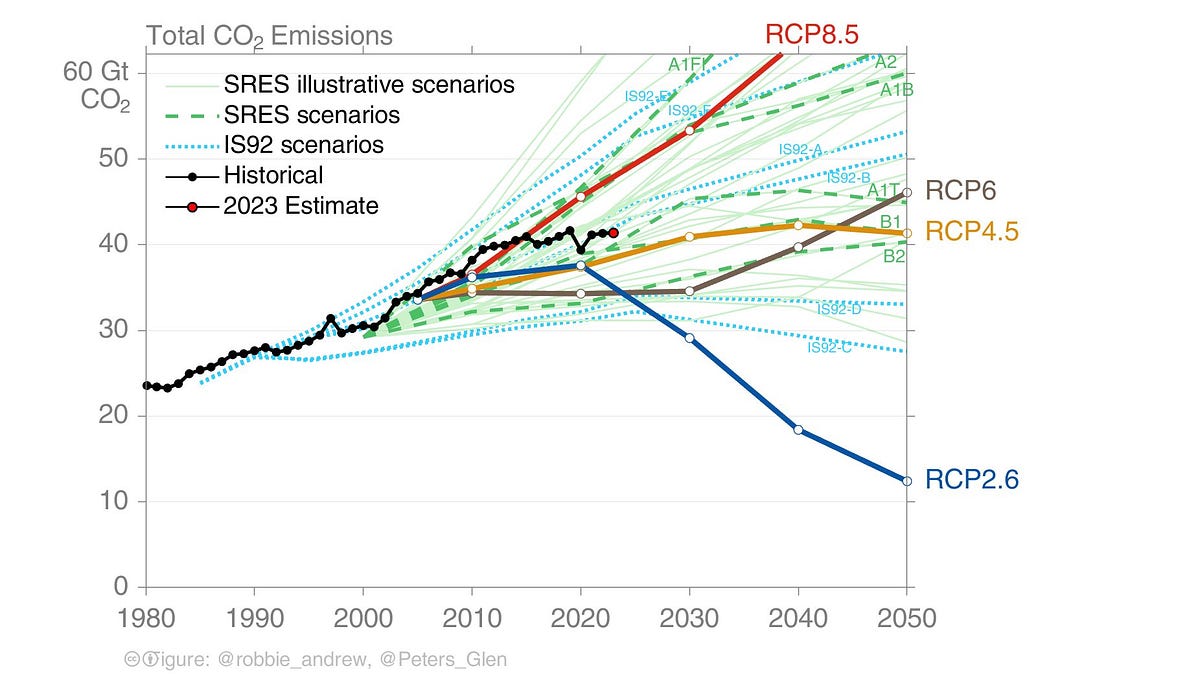
Emissions are no longer following the worst case scenario
So where might we be headed instead?
theclimatebrink.substack.com
242 points · by Brajeshwar · 3y ago · 306 comments
https://climatenexus.org/climate-change-news/rcp-8-5-busines...
RCP 4.5 is really bad as well. In our last project it was kind of the worst case scenario we considered. It means that rich countries will have problems adapting to the changing environment. The changes will happen so fast (20 Years), no new infrastructure can be built to prevent natural disasters (for example dam's). Poor countries have even less possibilities to adapt. For example countries like Kazachstan completely rely for it's water resources in summer on glaciers. In Switzerland we already know that all glaciers will disappear or melt by 80% to 90% in all likely scenarios.
https://ethz.ch/de/news-und-veranstaltungen/eth-news/news/20...
edit: please correct me if i'm wrong, i am a designer that worked in climate visualsation research projects. However my short searches for the outcomes of rcp 8.5 are disastrous and no relief at all that it's now unlikely to come.
Because, like you said, we do need to step up our game. The middle of the road is not good enough. We must resist both the naivety of the techno-optimists as well as the doomist fatalism. Any perspective that leads to inaction is wrong.
The top thing is for people to consider emissions and allow emissions to become part of the decision process. In terms of diet that could be to introduce and consider food outside of the cultural limits, like shell fish and sea weed. A related issue are that a large number (majority?) of Europe and northern American lakes has major issues with eutrophication with mostly fish that people refuse to eat because of culture. Eating those kind of fish would solve two problems at the same time, feeding people and removing uncontrolled overgrowth caused by artificial fertilizers.
Right now it is also cheaper to operate heavy machinery that run on fossil fuels to control plant growth in nature reservation and around power lines, rather than raising animals that would do the same job and create food. Same thing with Lawn mowers. One of the most ecological method to keep grass cut is (real) free range hobby scale chickens. Produce food, cuts grass and keeps pests away.
As with everything else, everything change if people allow emissions to be part of the decision process.
The CO2 emissions from a world full of vegetarians vs a world full of vegans are pretty close to indistinguishable.
If you're talking about "convincing people to go vegan", most people don't like being preached to regardless of the topic, that's not a stigma.
For example, drinking alcohol has its' negatives, but if I'm in the pub with friends and some teetotaler decides to go off on a mission to convert me, my response is going to vary from smiling and nodding to telling them to piss off depending on the mood I'm in that day.
gotta say i see the challenges between animal-free and car-free life as much the same: most people around me generally agree we’d be better off with both these lifestyles, but the issue is practicality. best way to promote veganism around me in the past couple years has literally been to cook vegan meals with friends. if the stigma you’re talking about is “vegan food stinks” or “vegan food’s hard to prepare”, then that’s an easy way to address those two.
Here chat 4:
Piao, S., Liu, Z., Wang, Y. et al. (2020). Plant phenology and global climate change: Current progresses and challenges. Global Change Biology, 26, 1928–1940. https://doi.org/10.1111/gcb.15004 This review paper discusses the impact of global climate change on plant phenology, which includes effects of elevated CO2 levels.
Zhu, Z., Piao, S., Myneni, R. B., Huang, M., Zeng, Z., Canadell, J. G., ... & Zeng, N. (2016). Greening of the Earth and its drivers. Nature Climate Change, 6(8), 791-795. https://doi.org/10.1038/nclimate3004 This article provides evidence for the 'greening' of the Earth over a period of 33 years, attributing roughly 70% of this greening to increased atmospheric CO2.
Smith, P., House, J. I., Bustamante, M., Sobocká, J., Harper, R., Pan, G., ... & Popp, A. (2016). Global change pressures on soils from land use and management. Global Change Biology, 22(3), 1008-1028. https://doi.org/10.1111/gcb.13068 This article discusses the effects of global change pressures on soils, including the impacts of increasing CO2.
Higher CO2 levels are said to have led to a "global greening", in which crop yields have gone up a lot. This is especially true in Africa, so that reduces global hunger and increases wealth. The idea that more CO2 = less life is not as simple as it's made out to be. Climate doomers ignores this type of thing because they are convinced society can't handle complexity, so have to insist that CO2 is always bad even when it's not.
https://fee.org/articles/rejoice-the-earth-is-becoming-green...
An incredibly strong feedback mechanism exists (see article above).
Societal problems, yes. Extinction to the human species? I think that’s extreme hyperbole. What would the mechanism even be, to eradicate all humans, across the globe?
Climate change is real, things will be bad, etc, but the possible end of the species is an incredible claim, that doesn’t follow logic.
What can an individual do to not suffer?
Invest in oxygen masks and a mountain cabin?
Let's say we reduce that 2.43 ppm increment to 1 ppm at some point. Or even to 2.41 ppm. Does that mean we failed? In a way, yes. But was the effort meaningless? No, the 1.43 ppm we didn't put out in the atmosphere really had an impact, and in a similar way, the 0.02 ppm we reduced also had a real impact on actual people. Both would translate to less sealevel rise, less floods, droughts, storms, heatwaves, biodiversity loss, etc. Which means a reduction of death, migration, hunger, suffering, extinction, chaos, economic loss, etc.
I know your question is about adaptation and not mitigation, but we need to get out of the either/or mindset. Every single action we take to reduce our emissions matters. I mean that in a very matter of fact way, not as a call to action. It is just technically incorrect to think it does not matter (though by no means I am implying you specifically think so).
There’s nothing you can do strictly by yourself in my estimation that will help over the long term.
The only way out is through as a team
Why? 1+1=2 2+2=4 3+3=6 And 0.5+0.25=0.75
When two people don't give it 100% you can't get the results you are looking for. Just ask anyone who has been divorced...
You should be asking what an individual can do to not starve to death or die of over heating.
Most answers are: move to a rich, powerful country not in the danger zone
There might not be any. Migration pressure from uninhabitable areas will keep mounting, and some of the countries in the "danger zone" have nukes.
China? Norway? UAE? I feel like they will all fare very differently
Incapable not, but unwilling most certainly - just look at the state of politics across all Western countries and that doesn't even include China and India who're hell-bent on growth.
> What can an individual do to not suffer?
Move to somewhere high up north, these places are going to be those where climate change will at least not cause them to get uninhabitable.
Unwilling and incapable are sort of two sides of the same coin. Our political and economical systems are set up as a greedy (in the CS sense) optimization process.
This makes solving long term global scale problems all but impossible in any case that would entail any sort of short-term inconvenience, and anyone seeking to solve such problems by such means are (by definition) politically and economically irrelevant.
I think in general there's a somewhat unfounded notion that someone is actually in control that's getting harder to defend in the light of what's been several decades of fairly public failures to address obvious problems in society. You to look very hard to find examples of public policy successfully addressing any sort of problem, and even in that case it's questionable whether the problem was actually solved or whether it's just a case of regression to the mean.
I watched a documentary about bread bakers in Afghanistan and there was a whole ecosystem of wheat growers, millers and bakers who were all centered around a river and had been doing the same work for many generations. They are screwed.
Does "suffer" take into account "transitive suffering" from children? (from future generations, our offspring)
i.e. if I'm physically fine but my child is suffering, I suffer too.
Now, for what one can do, there are always two ways: one is, as suggested, to find a better spot for oneself and let the others go to hell for all I care. But what about the children?
other is to become millitant, and force action. Worse outcome for oneself, but potentially a better outcome for the children.
Be independent in all your supplies as much as possible (food, water, basic necessities). Cyclical gardens, Biosphere-2 like systems, etc. Then scale up and do the same with a small community. The bigger the community, more chances to repel an attack of cannibals.
Beyond that you are supposing based upon bad data and conjecture which results in a scenario where worry will kill you.
But let's say the worst happens and you can't live in a city anymore. Can you grow your own food? Can you grow all of it? How many resources does that take near where you live? How about in the mountains near where you live? Now go learn how to do it.
The central thesis is that the climate crisis has already been solved with technology and capitalism. The worst offenders (like Max Roser of Our World in Data https://twitter.com/MaxCRoser) overemphasize success in western countries and hint the problem lies in China and India not doing enough.
A more run of the mill climate optimist claims that the efforts we’ve done so far are enough to avert disaster, and we just need to do more of the same. The YouTube channel Kurzgesagt (https://www.youtube.com/watch?v=LxgMdjyw8uw) is guilty if this form of denialism.
Err, just NO. This is largely due to global trade being flat for the past 10 years [1], this is a good proxy to measure real economic growth. Don't believe GDP as an indicator of real growth, they keep on adding fictitious sources to these numbers. Did you know that rent is part of GDP? And even rent that homeowners would have paid to a landlord had they owned their home? [2]
So basically this is just about the world becoming poorer since the 2008 financial crisis (and covid of course).
Also, "not following the worst case scenario" is not really a reason to rejoice, 4.5 degrees is still absolutely terrible.
Also, funny enough the page they link to as a source for "Global CO2 emissions (both fossil and land use) have been relatively flat" has for title "Analysis: Global CO2 emissions from fossil fuels hit record high in 2022" [3]. So, lols.
I could also add that less emissions growth doesn't mean less carbon accumulates in the atmosphere [4]
[1] https://ourworldindata.org/grapher/merchandise-exports-gdp-c...
[2] https://unherd.com/2018/11/truth-gdp-figures/
[3] https://www.carbonbrief.org/analysis-global-co2-emissions-fr...
People are consuming more international goods and more domestic goods, so trade as a percentage of trade relative to GDP has stagnated, but not volume of trade. Since 2008, maritime trade has increased by 3 billion tons or 37% [1].
> Did you know that rent is part of GDP?
It's also a component of the inflation, so it cancels out. Housing is getting more expensive, but part of it is that we are consuming more of it than we used to. Home sizes have been growing, but household sizes have been falling [2].
[1] https://www.statista.com/statistics/264117/tonnage-of-worldw...
[2] https://www.thezebra.com/resources/home/median-home-size-in-...
I suspect sheer maritime freight tonnage may be a less reliable proxy due to factors like cost of shipping changes, role of air freight, tariff changes, etc. Maybe share all the trade and globalization graphs instead? https://ourworldindata.org/trade-and-globalization
Your second source, hilariously, predates the entire pandemic (which is when home prices really took off). It also says very little to support your point that we're "consuming more" housing because home sizes are growing. The Case-Shiller U.S. National Home Price NSA Index seems to suggest that home prices were rising only modestly until the pandemic. https://www.spglobal.com/spdji/en/indices/indicators/sp-core...
This doesn't seem to match what you'd get by multiplying their figures of inflation-adjusted GDP [1] with their figures of exports as a percentage of GDP [2].
> Case-Shiller U.S. National Home Price NSA
Home prices aren't factored into in either GDP or inflation because they're considered an asset. You're right that the economy has stagnated since the pandemic, especially in America. My point is that it's absurd to suggest that the global economy hasn't grown in the past decade.
[1] https://ourworldindata.org/grapher/world-gdp-over-the-last-t... [2] https://ourworldindata.org/grapher/merchandise-exports-gdp-c...
Gross World Product was about $43t in 2005 and $78t in 2014, so that would suggest international trade has increased from $10t to $18t in 10 years, nearly doubling, inflation adjusted.
You can say that the non-international part of GDP is overestimated, lets say by 40% more in 2014 than in 2005. That would mean that real GWP in 2014 was just 56t, and therefore the 18t international trade would actually be 32% -- a 33% increase in 10 years.
Of course renting is an economic activity that should be reflected in the GDP, and it is as "real" as anything else. To focus solely on international trade feels shortsighted as well. When a doctor sees you and charges you $200, that's going into the GDP but not into any trade balance.
The world is richer since 2008 by almost any metric you can think of, including inflation-adjusted per capita income which is independent of GDP.
How can a smart, presumably educated person not know that rent counts as economic activity?
To say the world is poorer than in 2008 is just utterly preposterous.
Per capita GPD in China went from 3500 to 12500. India 1000 to 2200.
There is half the world. US, Canada and Europe is only 15% of the population but I don't know how the case can be made we are poorer than in 2008 either.
Of course it's "economic activity". But if I sublet to someone that sublets to someone that sublets to someone that lives in an apartment, that's a 4x increase in money flow but there's no production of goods or services at all.
It makes sense to have the cost of building and maintaining homes represented somewhere, but rent is a poor proxy for that.
If my neighbour owns a house (outright) and lives in it, I pay nothing, and no impact on GDP
If I rent from my neighbour for $10k a year, and he rents from me for $10k a year, GDP increases by $20k a year, but nothing has really changed, expect the amount of money paid in taxes.
So that's why you have imputed rent as part of GDP. Fine, I get that.
How about this scenario
I have a kid and look after it, I pay nothing, and no impact on GDP
My neighbour has a kid and looks after it, he pays nothing, and no impact on GDP
I look after my neighbours kid 3 days a week and he looks after mine, in an exchange, no impact on GDP
I look after my neighbours kid 3 days a week and he pays me $300, and he looks after mine 3 days a week and I pay him $300. GDP increases $600 a week, and more money is taken in taxes.
Do we include all unpaid work?
If I (a painter) pay my neighbor (a gardener) to garden my front yard and he pays me to paint his garage, then GDP increases.
If I do the gardening myself, and he does the painting himself, GDP doesn't increase.
How about me looking after my old parent vs me working overtime and paying a care home to do it?
It could be backed by products that nobody wants (wars and such) or it could be at the expense of other quality of life metrics such that the juice is not worth the squeeze.
It's like lifting weights to get huge instead of to get strong or healthy, you can end up some undesirable results.
Watch this. Counting rent is about as sensible as counting financial services.
you raise concerns about the interpretation of GDP and use trade as a more believable replacement - but how about using manufacturing as a more direct replacement? it seems to have continued it's rising trend through the present. [2] rising by 50% in the last 10 years.
this seems to show that growth has not been flat, but has been rising in line with long-term trends.
[1] https://data.worldbank.org/indicator/NE.EXP.GNFS.ZS
[2] https://www.macrotrends.net/countries/WLD/world/manufacturin...
Also, related, check out Nate Hagens work on the Great simplification (he's got a podcast and on youtube). I won't spoil it here but he and his team of scientists have made some very interesting discoveries on future GDP growth.
I think it is more fair to measure temperatures directly, as we already do, and make estimates from there. It's not the CO2 which would harm us (at least not that much), it's the temperature, so we need to base our analysis on the thing that interests us directly. And not on the derivative of the derivative of it (emission rates).
I suspect it doesn't matter how good are our models or how good are humanity's efforts in green tech. Until we are actually removing gasses from the atmosphere permanently, the planet is fucked. Just faster or slower, doesn't really matter.
If I have a cancer, and a lifestyle change would make the difference between whether the cancer kills me in four years or forty… I definitely wouldn’t say “I’m fucked anyway, no point in doing anything unless the cancer can be permanently removed.”
Sure, it's great that we are changing our society globally, it is beneficial for us. If we will ever decide to cool the planet then green energy is must have tech for that, because we can't sequester gas while emitting more of it, it's dumb. But we are talking about a long term estimate now, and that one unfortunately in my uneducated opinion didn't change much. The heating rate didn't change much because of a few Leafs and Teslas on the road, and some northern EU countries actually reducing emissions.
1: Discover some previously unknown method to directly recreate cheap and easy unlimited photosynthesis either electrically or mechanically or
2: Somehow create a fan system that can atomically slice the carbon atoms off of gaseous co2 particles
And the one that we create is ALSO cheap enough to deploy world wide en masse capable of equal or greater CO2 concentration reduction than the number of CO2 producing ICE engines in use and industries put out, it's not going to ever be a miracle fix.
or
3: Hijack a currently existing biological system to do the heavy lifting for us:
I imagine that with government incentive something like a self-regulating robotic rooftop duckweed farms being required for every vehicle owning household, but something like that would first need to be perfected and made available at an affordable price, like $400 or less with minimal maintenance expense which is a HUGE ask considering that duckweed propagation is not a solved part of agricultural science.
I chose Duckweed because it is the fastest growing plant in the world, which can double in mass almost daily under ideal conditions, uses photosynthesis to convert water and carbon dioxide into oxygen and carbohydrates, fats, and proteins, and its dietary requirements are met easily, only needing a small amount of additives to common water and a ready source of carbon dioxide as could be handled by bubbling atmospheric air into the water.
Additionally, duckweed is edible by humans and animals, and if there were unconsumable excess as would be likely given 3 billion home duckweed farms, we could theoretically dry and burn it for carbon negative fuel (as the leftover carbon ash from the burn would count as sequestered carbon).
Alternatively, some genetically modified cyanobacteria could probably do the trick, but with risk of harm should it escape from its confines into the ecosphere.
The problem is, this is not cancer, and all the people who take the "fucked anyway" view are damning the rest of us
> Until we are actually removing gasses from the atmosphere permanently, the planet is fucked.
I happen to agree with this, but realize that's exactly the same metric: it's just negative GHG emissions. We would do the same thing: simulate potential future outcomes given an emission / capture balance that is overall negative, estimate what might happen, and then measure what we're actually doing to see whether we might actually be on that path or not. Once we start removing gasses, it's still useful to track overall emission balance.
http://en.wikipedia.org/wiki/Clathrate_gun_hypothesis
>While it may be important on the millennial timescales, it is no longer considered relevant for the near future climate change: the IPCC Sixth Assessment Report states "It is very unlikely that gas clathrates (mostly methane) in deeper terrestrial permafrost and subsea clathrates will lead to a detectable departure from the emissions trajectory during this century".
https://keelingcurve.ucsd.edu/
You don't even need to be a big wig scientist to test this assumption. Open the graph on the big monitor and put a ruler or anything straight like a piece of paper to the median points corresponding to years 2000-2010. If emissions were "level" in the last decade then we should have 2010-2022 datapoints at most at the same line or even below the line. But in reality we see that the curve is raising up faster, meaning that the rate of emissions increased between years 10-22 compared to years 00-10, which contradicts author's graphs.
1: https://substackcdn.com/image/fetch/f_auto,q_auto:good,fl_pr...
(To anyone a bit confused, the Keeling graph is the cumulative amount of CO2 in the atmosphere, so emissions are the first derivative of this graph.)
Not exactly. There is a net sink of emissions every year into the land & ocean, so d(CO2)/dt = emissions minus the net sinks, roughly. See the graph on CO2 partitioning [0]. A lot of research goes into whether these sinks continue at their current rate of removal.
[0] https://en.wikipedia.org/wiki/Atmospheric_carbon_cycle#Anthr...
Obviously we measure and study both and they both matter so the point is somewhat moot.
The planet will be fine. It will be different, but that's a normal thing in its 4 billion year history.
Whether it will be habitable for humans is a different question. I suspect we'll adapt (like we did for the last ice age), but I'm no expert.
On the bright side, more heat and CO2 means more arable land and better growing environment. Veggies and grazing animals are all I need to get by, food wise.
I can understand how, over a period of years, farms near the equator may become less tenable and land farther from the equator more arable, but, at the scales I've seen (single digit average degrees up over the next 100 years), we should be able to account for that.
Edit: I don't know the Carlin bit you refer to. Link?
So Earth will be fine and life will go on, the only thing that will destroy everything is when the Sun goes om nom nom many billions of years from now as it feasts upon its inner children to become a red giant.
Just looking casually at topo maps and assuming the worst case I've seen (all land and sea ice melts, resulting in sea water rising 250'), the land we'll lose in coastal regions and major river basins is smaller than what we'll gain near the poles. Farming just Antarctica would probably produce enough food to feed the world several times over.
Edit: This isn't to say that worst case scenario wouldn't displace high percentages of the population or that that isn't a major issue; however, it's not an insurmountable obstacle given the gradual nature of the change.
I think the secondary things you describe are almost large scale weather events, not quite climate.
But most fundamentally, the 'primary driver' of temperature change is CO2 and that's that so of course we have to measure it.
And yes, it's far more fuzzy than they let on, which is not good they should be more open about that, or find a way to communicate it more effectively.
No, the planet is not all 'fucked' and CO2 levels will go down as we put less in the air, and of course, if we want to start to decarbonize the atmosphere we can do that as well.
I wish they would use the term 'climate risk' - because risk all about less likely probabilities, than 'specific paths to the future'.
What? You are saying that if your are cooking meat on a skillet and turn the fire down from 3 to 1, or even to 0, then your meat temperature would start actively decreasing below the ambient temperature and freeze on it's own? Because that's what you are saying, literally.
I'm not against measuring emission rates, that's an important metric. I'm against making any far reaching assumptions based ONLY on the emission rates estimates. Because that's like cooking meat inside an opaque black box by measuring torque forces applied to the regulator over time. It loosely corresponds to the result, but the meat would be charred most likely, due to big amount of conversions and estimations. On the other hand measuring meat temperature with a thermometer inserted directly into it would give us a precision result.
Considering that nature provides carbon traps and that the Earth is ultimately in the void of the space, you cooking meat is a kitchen with opened windows and freezing weather outside, and you turn down the climate that was set to full throttle.
You're having trouble with the meaning of word 'literally', but also analogies, and climate.
The earth has various mechanisms for absorbing CO2 over time.
> What does this flattening of emissions and divergence from the high-end scenario mean for the climate going forward? First, its important to emphasize that a flatting of emissions does not mean that global warming will stop or the problem will be solved. The amount of warming the world experiences is a function of our cumulative emissions, and the world will not stop warming until we get emissions all the way to net-zero. Even after we reach net-zero emissions, the world will not cool back down for many millennia to come in the absence of removing more CO2 from the atmosphere than we emit.
> This is the brutal math of climate change, and the reason why its so important to start reducing our emissions quickly. We are already well off track for what would be needed to limit warming to 1.5C without large overshoot (and the need for lots of negative emissions to bring temperatures back down). If we do not start reducing global emissions over the coming decade, plausible scenarios to limit warming to below 2C will move out of reach as well.
In other words, this is heartening progress, but not an excuse for apathy.
Let’s keep bending the curve!
This does not mean that going to zero will be possible with just more of the same.
But yeah, we need a lot more investment in non-fossil-fuel energy production, and we need to be able to move and store electric energy on a much bigger scale than we can now. Fossil fuels for ground transportation needs to stop being a thing. We can do it with existing technology, we've just chosen not to.
US and Europe, maybe. What about China and India?
"China permitted more coal power plants last year [2022] than any time in the last seven years, according to a new report released this week. It's the equivalent of about two new coal power plants per week. The report by energy data organizations Global Energy Monitor and the Centre for Research on Energy and Clean Air finds the country quadrupled the amount of new coal power approvals in 2022 compared to 2021"[0]
[0] https://www.npr.org/2023/03/02/1160441919/china-is-building-...
So, at least morally, they seem to have every right to increase their emissions, and it is up to us, the largest historical polluters, to contract our economies if we are serious about both climate change and moral rights. Why should we expect to live in luxury in the EU while peasants in India live without electricity just because they can't afford a non-coal power plant?
Of course, an even better approach would be for the large historical polluters to contribute funds, manpower and know-how, freely, to build clean power and clean industry in China and other places.
And finally, I am also well aware that this is higy idealistic and none of this has any chance in hell of happening. We'll just keep pointing fingers at China and India (and the USA, speaking as an EU citizen) and avoid too much actual change.
This will change with more wealth though. We must ensure that future energy hunger in India (and Africa) ist not satiated by fossil fuels.
I'm also a little wary that the apparent plateau in the data might not pan out in the longer term. Particularly because of carbon cycle feedback loops that we may not be seeing the worst of yet.
> Ultimately, the progress we have made should encourage us that progress is possible, but the large and growing gap between where we are headed today and what is needed to limit warming to well-below 2C means that we need to double down and light a (carbon-free) fire under policymakers to ratchet up emissions reductions over the next decade. Flattening the curve of global emissions is only the first step in a long road to get it all the way down to zero.
There MUST be more sustainable ways of farming than killing the biosphere.
And more! Destruction of coastal mangroves. Groundwater over-extraction. Pollution of freshwater reservoirs and rivers. Destruction of tropical rainforests and their collections of many possibly useful organisms.
A while ago (2010?) the US Defence National Intelligence Council's report on threats labeled climate change a "force multiplier".
That's all it is, really: the least of the things we're doing wrong, that we will have to fix this century. It makes the real problems a bit worse.
People are going to be really disappointed when we change the car fleet to 100% EV, but somehow things still keep getting worse.
The tone of which suggests the studies are not wide-ranging enough:
    each study has its flaws and limitations, as do all scientific studies, and
    in combination with the North American/European bias where most of studies
    were conducted, this means that it would be a stretch too far to say the
    science currently supports global insect declines: the jury is still out on
insectageddon.The size of the increase each year is much higher now than in 1980s even accounting for the increased CO2 value. So the rate of change has increased.
The bigger and counterintuitive picture is that vast numbers of people do not enjoy the quality of life that is nominally achievable with todays technologies and a more peaceful and better managed world would actually enormously increase emissions unless we find sustainable substitutes for whatever really contributes to quality of life.
We need to snap out of such absurd incentives and false dilemmas. The task is global sustainable prosperity and we are lucky to have a worthy purpose.
It means that somehow, if we care about the environment, we may have to be against economic growth and/or good economic health.
It's not. Local emissions are a thing, too - a new car will have way cleaner exhaust than a 20 year old beater, and an electric vehicle even less. Nitrous oxide is the big issue in urban areas, the less of it is in the air the better for those having to live near high traffic streets.
Maybe because companies do not have interest in it? And this way there is nothing change: just produce the same, but with new type of engine. Even better, because more money is earned. Meanwhile ecology is about putting down the production, but the production blossoms for some reason...
Improving local emissions is good but it doesn’t help with global emissions if you’re still buying a couple tons of metal which will sit idle 95% of the time and will on average haul 1.1 people when in use. There’s also a concern that EVs not only don’t help but actually worsen the health impacts of tire particulates.
They might take away my US passport for saying it but if we want to reduce emissions the solution isn’t spending more. The best options are things like walking, biking, taking transit, and eating less beef.
0 https://www.unep.org/news-and-stories/press-release/covid-19...
"The strongest witness is the vast population of the earth to which we are a burden and she scarcely can provide for our needs; as our demands grow greater, our complaints against Nature's inadequacy are heard by all. The scourges of pestilence, famine, wars and earthquakes have come to be regarded as a blessing to overcrowded nations since they serve to prune away the luxuriant growth of the human race."
We have been beating this same drum for nearly 2000 years, at least. Nothing is new, we're tripping ourselves ad infinitum.
Here is how the earth 'greenhouse effect' really works: https://m.youtube.com/watch?v=oqu5DjzOBF8&pp=ygUlZ3JlZW5ob3V...
This is why Co2 do not have any effect until it reaches the high troposphere. That takes 20 years. The average climate we have right now is caused by emissions from 2003.
I'll repeat that in the comments of every climate article I read by the way, sorry for the repetition. M
Whether the CO2 is pulled from the air or from more concentrated industrial sources, the carbon sequestration industry would need to grow to the size of the fossil fuel industry (in terms of mass moved). But instead of extracting resources and selling them for financial gain, it will be a pure financial loss for an ecological gain. Under capitalism it's as impossible as water flowing uphill.
Not true, under the current EU emissions trading scheme you can actually earn money by selling the certificates for the CO2 you remove. If you check the price of it you can see that well defined markets can actually get the power of capitalism to work in your favour, with the price jumping from $30 to $90 within last year.
Please don't do that. Thank you.
From pages 32 onwards: https://www.lmd.ens.fr/legras/Cours/L3-meteo/radiatifNN.pdf
If we don't have more specific information people can get the incorrect idea that "crisis is averted".
1: https://www.ipcc.ch/site/assets/uploads/2018/05/ipcc_wg_I_19...
We can all get back to normal life then.
I have quickly googled that statement and all I see is pre-02/24/22 data. I am sure the percent has changed significantly from the good old times.
https://www.economist.com/international/2021/04/27/the-wests... archived: https://archive.ph/nFd2h
There is nothing about “military engines” or “military supply routes” or “military explosions” that leads anyone to believe their impact would be any worse than their civilian equivalents, and even if they were, you still have to prove that they are so much worse that even their limited activity compared to the normal economy must be given priority attention.
The burden of proof is on the one making the claim, not everyone else.
When you're done with that search, look up volcano explosions on land and under the sea, and compare them to the explosive power of a missle.
When you have a bleeding cow, you can solve the bleeding issue and keep the cow alive, while completely ignoring the mosquitoes "relentlessly draining" its blood.