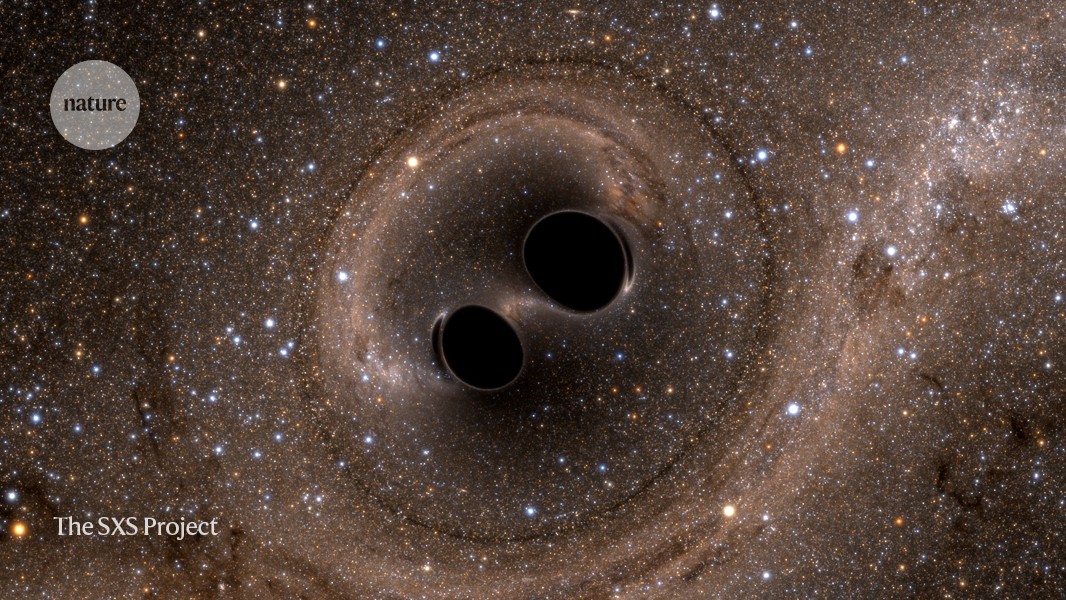
Gravitational-wave detector LIGO is back — and can now spot more colliding black holes than ever
The twin gravitational-wave detectors have started a new observation run after a major upgrade.
nature.com
165 points · by gmays · 3y ago · 99 comments
https://online.ligo.org/grafana/public-dashboards/1a0efabe65...
The improvements should allow the facility to pick up signals from colliding black holes every two to three days, compared with once a week or so during its previous run in 2019–20.
Hear 9 times as far?
[1] https://nautil.us/we-should-count-balance-as-one-of-the-sens...
https://goo.gl/maps/9fLFCVqjumx1LSkXA
As someone who's worked on laboratory ultra-high vacuum systems the ~2m diameter by 4km long arms that are vacuum chambers are quite impressive.
A "fun fact" from the tour was that they had a road grading company construct the underlayer for the support of the arms. They asked the company to set the angle of the grading to equal the negative curvature of the earth as the arms have to be straight in space while a surface that's graded "flat" would end up following the curvature of the earth.
Just a few miles away (and likely everywhere) in the same country there are many people growing in number who insist for some reason that the earth is flat. I am genuinely flummoxed why that's still a thing.
[0] https://www.geo600.org/ , https://en.wikipedia.org/wiki/GEO600
Question though - do gravitational waves diminish significantly as a function of distance or intervening mass?
This should answer any questions!
i find it utterly fascinating that we're able to detect such a minuscule deviation
Nowadays, physics students do the MM experiment in a lab on a benchtop in a day.
what makes it possible to do in a desktop lab course combination of a large number of different innovations. The first is that we know how to make extremely stiff/rigid/strong/flat/thermally stable tables (https://www.thorlabs.com/navigation.cfm?guide_id=41) which can optionally be placed on active vibration-cancelling struts (https://www.thorlabs.com/newgrouppage9.cfm?objectgroup_id=10...). The second is using cage systems for mounting things with everything lined up parallel and centered (https://www.thorlabs.com/navigation.cfm?guide_id=2255). The third is precise kinematic mounts which make real-time angle tuning a lot easier/more reliable (https://www.thorlabs.com/thorproduct.cfm?partnumber=KM100#ad...). The fourth is now we have powerful lasers and LEDs that make generating lots of light all pointing in the right direection easier (https://www.thorlabs.com/thorproduct.cfm?partnumber=CPS532-C...). The fifth is that high quality standardized optical parts (mirrors, lenses, etc) are easily available from a wide range of vendors (https://www.thorlabs.com/newgrouppage9.cfm?objectgroup_id=10...).
There are a number of other innovations in material science. but I'd recommend taking a look at Thorlab's Michelson-Morley educational kit. For $3K you get basically everything you need to carry out the experiment: https://www.thorlabs.com/thorproduct.cfm?partnumber=EDU-MINT... plus a nice manual https://www.thorlabs.com/drawings/5d9e11209b7d4536-820A3379-... that walks you through physical setup and theory behind the experiment (which among other things helped lead to special relativity).
if you want more like this, see https://www.thorlabs.com/newgrouppage9.cfm?objectgroup_id=11... which is a hardware kit that accompanies an actual optical lab class. The course is online: https://www.thorlabs.com/drawings/5d9e11209b7d4536-820A3379-... and gives a fairly straightforward introduction to optics. With this, you can easily build a microscope from components or any number of other nifty optical systems.
Non-optics people (IE, programmers, etc) with enough time and money can learn how to do real-world optical experiments in their garage (this applies to astronomy too). For example after a significant time/money investment, have started building my own microscopes which use real-time object detection to track tardigrades to do behavior analysis (lest anybody feel imposter syndrome, trust me it took a ton of time and money and even then I'm not quite at the level of a good grad student).
It's not my favorite but you can also read https://www.amazon.com/Perfectionists-Precision-Engineers-Cr...
If you want to truly go down the rabbit hole, https://pearl-hifi.com/06_Lit_Archive/15_Mfrs_Publications/M...
Since we came to exist so early in the overall age of universe, there is absolutely no chance we are the only sentient civ across hundreds of billions x hundreds of billions/trillions x nr of planets realm.
Super focused super dense ray of very hard gamma rays/cosmic rays should do any trick required for anything made out of matter. Or just swipe left with a black hole or two.
Or do grav waves really pass ~trough~ black holes?
If you hold Faith in the axiom "the universe was initialized homogeneously and propagated untampered thereafter", perhaps.
Plenty of axioms for which "there is absolutely no chance we are not the only sentient civ across..." is just as true though. And everything in between.
If you've set up a close-orbiting neutron star binary and you're in a military frame of mind, one thing you could do is accelerate missiles to a good fraction of lightspeed. (Same principle as the gravity assists used by planetary probes like Voyager.) The tides would limit the practical size of the missile, though I haven't tried to compute this limit.
(I don't consider this comment to be aiding the interstellar enemy, it's too obvious.)
Now the tricky part is probably to build a neutrino / gravitational wave / whatever source that is intense enough to be useful as a weapon without just evaporating everything in a supernova scale explosion before...
(edit - spelling)
[0] https://www.zooniverse.org/projects/zooniverse/gravity-spy
https://en.wikipedia.org/wiki/Michelson%E2%80%93Morley_exper...
The gravitational waves travel also at the speed of light. They will reach first the point of the Earth that is closest to the event first. And then travel and reach the oposite point like 40ms later. The Earth is almost almost almost transparent, so the signal reaches all the Earth, but with a different small delay.
Gravitational waves are usually studied in the context of linearized gravity <https://en.wikipedia.org/wiki/Linearized_gravity> rather than the full theory of General Relativity.
Essentially one fixes some background metric that does not have the dynamical aspects of the inspiralling binary. Those dynamical aspects are then applied as perturbations of the background metric. When one then slices the 4-dimensional static background into 3 spacelike dimensions along some timeline, the departures from the background (the perturbations) then propagate like massless waves.
Masslessness (and no refraction, birefringence, etc.) is why the wave propagates at "c".
Light propagates as massless waves too, which is why the speed of light is "c". The constant is geometrical in origin (it's because our spacetime is 4-dimensional, with one dimension of time: gory details at <https://en.wikipedia.org/wiki/Causal_structure>, particularly the "Curves" subsection of the Introduction), although "c" was discovered by studying the speed of light.
Linearized gravity is a good approximation but not fully general. It breaks down in extremes of compactness, and so one resorts to numerical relativity (on supercomputers) for understanding the final parts of inspirals of merging black hole and neutron star binaries (both species are compact, and in the final inspiral each binary partner orbits within the "compactnes-really-matters" region of the other).
I guess you are correct and with small amplitudes the apparent speed is equal to the speed of light. For big amplitudes, I'm not sure.