Japan will try to beam solar power from space by 2025 - Engadget
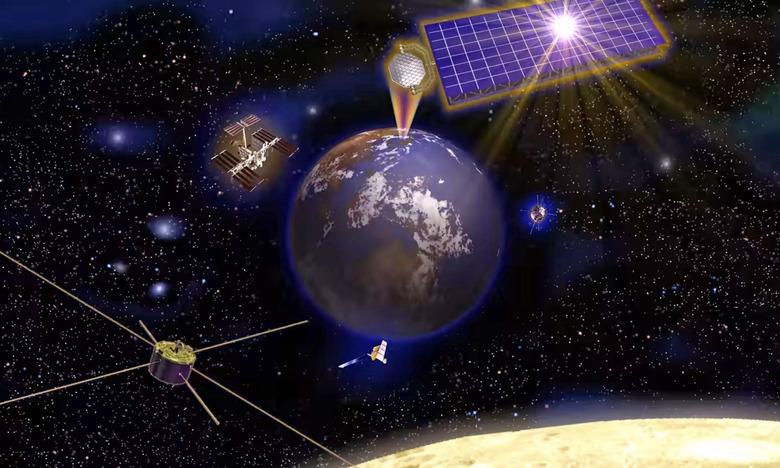
A Japanese public-private partnership will attempt to put orbital solar arrays in space later this decade.
Engadget
66 points · by signa11 · 3y ago · 94 comments
Launching stuff into orbit is expensive in cash and emissions.
They tried building on mountain faces but shoddy construction by yakuza linked companies lead to landslides[0] and many dead people a couple of years ago.
For the record, I live in a remote mountainous (snowy) region and have panels generating 10kw on my roof. It generates really well 8 months out of the year. 2 months of snow and another couple of months for the rainy season and I’m still generating more than I use in a year. If the govt is willing to reintroduce subsidies and raise the fees in tariffs, a lot more people would be willing to install them.
But you really depend on the grid for energy storage it seems. There is no technology available to consumers that can load shift and/or store energy for 2 months.
In practice, this means you waste your excess electricity (or perhaps, sell it to the grid so that someone else can use it), but then still rely upon Natural Gas peakers for those other two months.
> If the govt is willing to reintroduce subsidies and raise the fees in tariffs, a lot more people would be willing to install them.
More solar in this scenario means that everyone involved runs out of electricity in those 2 months.
A degree of the grid can be solar, but not everybody. We should get as many people on solar as is reasonable, but energy storage (especially on the scale of months) simply is science fiction.
Back in the real world, there will be 2 months+ of fossil fuels to support the lifestyle you've chosen. It's better than 12 months of fossil fuels, but we aren't at a technological level where we can ignore the natural gas plants quite yet.
But we can mitigate their use.
Nuclear, hydroelectric, etc. Lots of places do not get a majority of their electricity from fossil fuels. Washington (and Canada) use a ton of hydro power. https://www.eia.gov/state/?sid=WA
It's cheaper to tear down the microwave receiver and put up solar panels and batteries than it is to send solar panels to space to beam power back to the microwave receiver. You'd have to beam 1000x the power that solar panels receive to justify the cost of sending things to space, but at that point you're lifting 100x more panels to space to get the 10x bonus, and lifing / installing them in space at 10,000x the cost or worse... Plus they have to be magical perfect installations that never fail and work perfectly.
Again cheaper to put that money into more batteries and panels..
All the variables are moving in the direction to benefit orbital solar, and will continue to go that way. It's not so much a matter of whether it's cheaper in space, than when it is cheaper in space. And it won't be long now.
The installation cost for space is so much more than the installation cost for earth. Even at 10x the cost, which is orders of magnitude off, what do we have?
We have a system in space at 10 the cost that needs a solar array sized receiving plant (double the cost) and has transmission losses (increase size of space and ground installations to offset).
It would have to be nearly the same cost or cheaper to install in space than on a field in, say, Kansas. Its a ludicrous proposition.
Anyway, this guy said it better: https://caseyhandmer.wordpress.com/2019/08/20/space-based-so...
Something like this was tried by Russia: Znamya ( https://en.wikipedia.org/wiki/Znamya_(satellite) )
Presumably, they believe there will be advances in technology such as space based construction techniques or mining asteroids for resources that will make it a viable option.
Mining the asteroids is an activity where payback periods are measured in decades, plural. Space is big. Rockets are slow, and so are orbits.
Could even be safer if their system for beaming electricity has the potential to be compressed to a point where it turns it into a lightning gun.
That is not gonna last if they want to continue decarbonizing.
They are averse to nuclear, they are an island, and they don't have a great relationship with most of their neighbours from whom they could import electricity directly. So instead they have crazy things like this and hydrogen.
The hope is that space based manufacturing will eventually make this technology viable more widely.
Solar panels lose efficiency when hot. The best locations are sunny but cool, like Germany. Not deserts
Assuming they're not shading Earth, robbing someone else of sun. Are they? Is Mr Burns' solar blackout machine becoming a thing?
If the energy reaches the surface, and is absorbed there, it will eventually become heat as we use it. At that point, we've added heat to a system we're actively trying to cool.
Of course the elect city eventually turns into heat too...
You could beam energy up to a station in the orbit which would then redirect it to the place where energy is needed. You could then get "easily" energy from solar farms in Sahara, for example.
They're either very weather dependent, ecologically intensive or time dependent.
This solves a lot of this by moving the actual capture above us, into geostationary orbit where there's still plenty of space and by using microwaves (rather than traditional light) you can avoid clouds.
It's a benefit because it's energy that doesn't require releasing carbon to aquire and make use of.
Well, I guess progress is progress. If you don't try, you won't know. You keep going until you get it.
However here is an idea, what about using this for, i don't know, powering habitats etc on the Moon?
Edit: https://en.wikipedia.org/wiki/Microwave_transmission#/media/...
So I guess the goal would be to pick one of the high points on that graph that also wouldn't wreck havoc with telecommunications.
Hinkley Point C is currently estimated at £32.7 billion for 3.26 GW.
https://www.bbc.co.uk/news/uk-england-somerset-61519609
So with currently available technology price is the same as nuclear even assuming that $7b overruns
https://www.esa.int/Enabling_Support/Space_Engineering_Techn...
We do not know, it might cause cancer.
Citation needed. I'd especially like to see the calculation against the launch costs and the expected lifetimes of solar cells.
No. No I'm not going to dignify this with a 'citation'.
Betting on solar is a silly idea. Its just a way for oil companies to keep shipping baseload
https://en.wikipedia.org/wiki/Passive_daytime_radiative_cool...