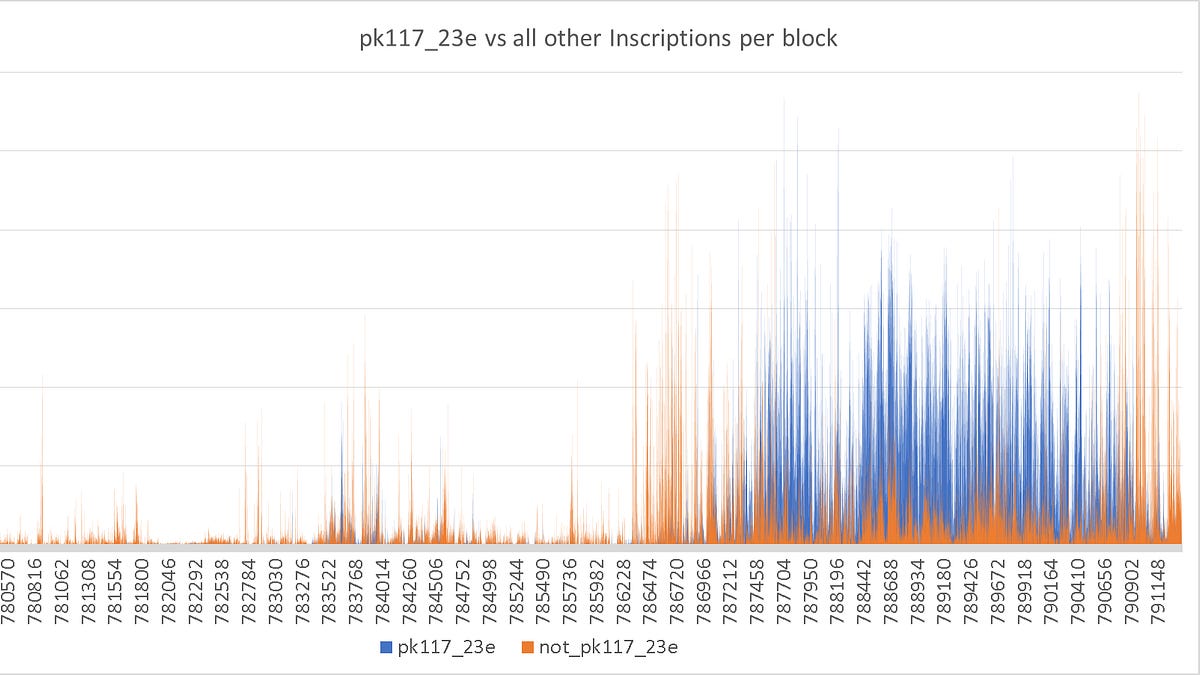
Most Bitcoin Inscriptions belong to a single person or entity
TLDR We have analyzed all Ordinal Inscriptions created since Bitcoin block 779832, which marks the introduction of the BRC-20 standard.
block21m.substack.com
159 points · by cft · 3y ago · 215 comments
Explanation thread: https://twitter.com/mononautical/status/1663383996561072129?...
It just goes to show that most of the comments here are entirely clueless about the whole ordeal and don't wait for the facts to come out and jump with any nonsense takes. It turns out it is just a new service that has gotten traction attracting some BTC volume in the recent uptick in Bitcoin ordinals. That is it.
All can be found and traced for anyone to see in the blockchain.
As someone who hasn't kept up with Bitcoin for the past few years, can someone share their conclusion?
The only reason most Bitcoin users care is that they pushed up fees for everyone else (there is limited block space, so miners take the highest bids). Such few pressure is expected to be the norm eventually, and has happened before, but there's been a prolonged period (years) of low fees so it was a bit of a surprise to many.
Imagine if your Visa card became hundreds of times more expensive to use during the Christmas shopping period.
And application-level solutions like Cash App.
Or rather, such fee pressure is required to be the norm eventually for bitcoin to remain secure when block subsidies become insignificant (halving every 4 years, 1024x less in 4 decades).
https://rusty-lightning.medium.com/the-three-economic-eras-o... for more detail that you probably want...
Those that aren't are probably created by other people intending to immediately sell them to a single entity: https://www.reddit.com/r/ethereum/comments/13e3di3/can_someo...
That's it. That all the conclusions to be had here.
The whole thing is a big nothing.
Idiots duped to pay for this stuff raised the floor for price of blockchain space from artificially low (due to still low adoption) to a more reasonable one (reflecting the value of global replicated censorship-resistant database). It doesn't change much in a great scheme of things. Some Bitcoin users are annoyed that Bitcoin transactions aren't nearly free as they used to, but it was always just a matter of time.
oh yeah, haven't we all had ones of those days where we get excited about something and spend thirty million dollars on transaction fees? :)
(I don't disagree with the rest, but I am chuckling a bit at people wrapping themselves into pretzels trying to find ways to see it as potentially earnestly motivated...)
Probably the reason for leaving the conclusions to the reader is conspiratorial. Since one single wallet is responsible for most ordinals, some people might believe it is a government actor trying to stop Bitcoin from becoming useful as peer to peer cash. Of course this is ridiculous as in fact the original premise is wrong as memecoin and nft entertainment products represent a greater threat to state power than peer to peer cash - as they represent popular sovereign property that a lot of people want.
Most of the memecoins seem to just be money raising vehicles to bolster exchange profits
BTC was supposed to be liquid as a market for compute by posing and solving challenges to give it an intrinsic value — and the people who gimped it for “Digital (Fools) Gold” are now complaining about scammers misusing the technology?
Well, at least I get to start my day with a laugh.
The only person who has ever reduced scripts functionality is Satoshi.
But the conartist pretending to be Satoshi has been paying people to claim otherwise. It's easily falsified.
> BTC was supposed to be liquid as a market for compute by posing and solving challenges to give it an intrinsic value
Citation needed. That doesn't even make sense: You can't give the Bitcoin currency itself "intrinsic value" just because people use it to buy or sell some kind of good or another.
The article and the parent comment are about Ordinals. Your comment appears to be an opinion about Bitcoin the asset and/or network itself.
> However, we notice that by spending only 0.005% of the total Bitcoin supply on transaction fees, a single entity can significantly impact the entire Blockchain regime.
> The total transaction fees spent by this entity to dominate the Inscriptions are estimated to be 1056 BTC as of May 25, 2023... We leave the conclusions to the reader.
I don't really understand what conclusion we are supposed to draw.
> However, we notice that by spending only 0.005% of the total Bitcoin supply on transaction fees, a single entity can significantly impact the entire Blockchain regime. This illustrates that if a whale or a governmental actor, possessing hundreds of thousands of Bitcoins, decides to spam the blockchain, they could impede its usability for normal payments.
Maybe this?
Interesting that someone was prepared to spend 1056 BTC on this. 1056 BTC is ~US$30M (edit: I had $3M before) at the current time.
Fixed it.
Yes, at the spot market you can usually move $30 million in a single trade with only a small slippage. Bitcoin is more liquid than most stocks.
Current exchange rate is around $27,774 USD, so more like $29,329,344.
An ordinal minter trying to sell their ordinals to make money: no.
A government or an influential entity who wants to "prove" Bitcoin is unreliable (for whatever reason): yes.
There seems to be much cheaper ways to magnify negative public sentiment on crypto though.
It is not a feature like GP mentions. It is a fun hack that's being taken too seriously.
From what I understand, ordinals can have very limited logic, if any at all.
NFTs can be though as "smart cards" and ordinals like numbered post stamps, just as an analogy.
On-chain will always have more value compared to inferior ways on L2, similar to how Ethereum L1 NFTs are more valuable than ones created on L2s.
> This vulnerability may partly be due to the discount for witness vBytes in SegWit,
That's erroneous thinking resulting from a false and confused description that uses the word "discount". An attacker's objective is to deny access to capacity to other participants by outbidding them for available capacity.
It doesn't matter what units the capacity is in or how its measured, all that matters is how much they're willing to spend each and every block to outbid the other participants. The fact that prunable witness data doesn't use up as much of the capacity limit as other data is completely irrelevant to the attackers power.
If, on the other hand, the attack were "we're using up the users disk space and it's cheaper to do it with transactions that have way more than typical witness bytes" that would be another story. But since the witness data is completely prunable it's not a suitable attack on storage to begin with, which is why it counts less against the capacity limit.
> relaxed witness size restrictions in the P2TR (Pay to Taproot) transactions scheme
I think that's also confused. Beyond the overall limit on the block there are no consensus limits. There have been standardness limits which limit what nodes are willing to relay and mine out of the box, but they're not imposed in consensus. My understanding is that recent ordinals floods have involved transactions over the standardness size limits, so at least those are being added with the cooperation of miners (tens of millions of dollars in fees apparently buys a lot of cooperation) so standardness rules are irrelevant, only consensus rules matter. So I think it's doubtful that standardness rules would help, and given the years of relentless harassment of bitcoin developers over other standardness rules like the 40 byte op_return limit I doubt anyone would bother trying even if they thought it might help.
I think people fall into this kind of misunderstand because they fail to think through where transaction fees come from-- they're not specified by the protocol. They're a result of market forces acting between demand and capacity limits so there isn't a way to use up capacity at lower marginal cost since the cost arises directly from capacity.
Or to be more clear: no way at issue here. I believe the authors of the taproot specs intentionally designed it to not need any other limits than the overall block weight specifically because having additional limits creates an avenue for attackers to use capacity at lower cost. An example is the old 20,000 sigops limitation in pre-segwit transactions: An attacker could create small transactions that burned up the separate sigops limit without using much weight, and since the sigops limit is normally not even close to limiting the miners txn selection would irrationally accept attack transactions that displaced more honest transactions than should have been implied by their fees.
I believe that attack vector is closed by the mining algorithm using an ad-hoc solution of the mining transaction scaling a transactions share of the sigops total to the weight limit and using it as the transaction weight in selection. This, in theory, results in an incentive incompatible transaction selection (so a miner following it would eventually be bankrupt against miners that didn't) but thats a non-issue in practice because only attack transactions trigger the maximum operation and when the attack doesn't work there is no incentive to create the attack transactions. But that kind of ad-hoc fix was only really viable because the sigops limit was high enough to never matter for real transactions.
Perhaps more relevantly, on the subject of attacking through denial of service-- the attacker is free to structure their transactions however they like... they only need to burn up capacity. In any case, outbidding isn't normally an attack that creates much concern because it's phenomenally expensive and the expense is ongoing: the to block the next best transaction X the attacker has to spend more that it in fees in each block its blocked from... while the defender only needs to get their transaction in once.
The fact that adding random limits can't actually stop a spam attack (at most it just forces the attacker to shape their transactions in a less distinguishable way) was the first thing people pointed out on the mailing list when this latest generation of spam attacks was brought up.
Beyond that, data isn't knowledge. That there is a lot of data doesn't mean you actually know much of value.
> Beyond that, data isn't knowledge. That there is a lot of data doesn't mean you actually know much of value.
The blockchain doesn't just have 'data', it has the 'information' that has the recorded transactions useful enough for those who want to trace the actions that happened on the ledger; fraudulent, faked, or not. This is exactly why tools like Chainalysis exist.
I think the minting event was good sign for bitcoin.
But one person having a bunch of inscriptions that they paid dearly for? Inconsequential.
These same developers block attempts to increase the block size in Bitcoin, which would allow more throughput and transaction capacity.
The increased demand for Bitcoin transactions from BRC-20 combined with the limited block size caused transaction fees to skyrocket, making Bitcoin too expensive (again) to be used for normal retail use.
The article points out that 80% of these giant "BRC-20" transactions were coming from a single individual/entity in control of one private key. Effectively one individual caused the backlog in Bitcoin with sky high transaction fees.
> in in support of "BRC-20" tokens, which is Bitcoin's feature reduced version of Ethereum's ERC-20 token
It appears that BRC-20 is primarily affiliated with Calvin Ayre, the person backing "Bitcoin SV" and the conman pretending to be the creator of Bitcoin -- the three main entities connected to it are all funded by Ayre and they've been bragging pretty loudly about their disruption of Bitcoin ( https://nitter.it/B2029org/status/1655611301412982784 ). I've heard speculation that the attacks are either a marketing pitch for "Bitcoin SV" (e.g. create congestion on Bitcoin then pivot to the unauditable centralized BSV blockchain, which always has room cause it's easy to scale centralized systems) or an effort to get Bitcoin community members to propose protocol changes to block the flood in order to substantiate the allegations in either of the Ayre-affiliated 6 billion dollar or hundreds-of-billions-of-dollars lawsuits.
I'm not aware of any previous active Bitcoin developer that had anything to do with BRC-20 tokens, if you know of any I'm sure the bitcoin community would be very interested in learning of it.
> changes recently that allow much larger transactions,
Unless you are referring to increasing the capacity of blocks back in 2017, no change to the consensus rules that allowed larger transactions has happened. You can easily verify this for yourself by starting up an older copy of Bitcoin and observe that it accepts everything fine.
In any case, this "BRC-20" crap is mostly only embedding 89 bytes of data ( https://twitter.com/jratcliff/status/1655669410206457865#m )-- it doesn't need any larger transactions. It happens to stuff it into the most recent transaction type, but there is no reason that it couldn't put 89 bytes of data into pretty much any other kind of transaction.
I think the false claim that BRC-20 was made possible by recent changes is mixture of confusion and an intentional deceptive cooperation cracking move, intended to direct even more harassment at project contributors but it's just not true.
The Taproot upgrade made the witness data discount from Segwit available to be used by inscriptions. This is what led to the explosion in BRC-20 transactions that are clogging up the mempool. According to this research, it's all coming from a single entity.
Not so, the very first sentence of your post was a flagrant untruth.
> Bitcoin's developers made changes recently that allow much larger transactions, with blocks up to 4MB in size on the Bitcoin blockchain in support of "BRC-20" tokens,
Okay, go ahead link to this "recent change" in support of "BRC-20" tokens. -- gonna be pretty hard in light of the fact that BRC-20 activity appears to be primarily (perhaps exclusively) by parties connected to the multiple billion dollars in lawsuits against bitcoin developers, and the fact that old versions of bitcoin are just as happy with the same transactions and the limits on transaction size are the same at least since 2017 or earlier.
> what led to the explosion in BRC-20 transactions
The BRC-20 transactions are just embedding 89 bytes of data (see link). They're a spam attack of a sort which has always been possible and is nearly impossible to block, I'm not aware of any basis under which you can argue anything "led to" it other than an attacker being willing to spend millions of dollars a day to DOS attack the the network.
This is completely false. 4MB blocks are possible since segwit in 2017 and BRC-20 has nothing to do with bitcoin, it’s just some third party protocol that assigns meaning to random data stored in the blockchain.
You can append random crap to your transaction and store it in the blockchain if you pay the fee, nothing has changed. The limit is still 4MB every 10 minutes.
nullc breaks it down here: https://news.ycombinator.com/item?id=36119707