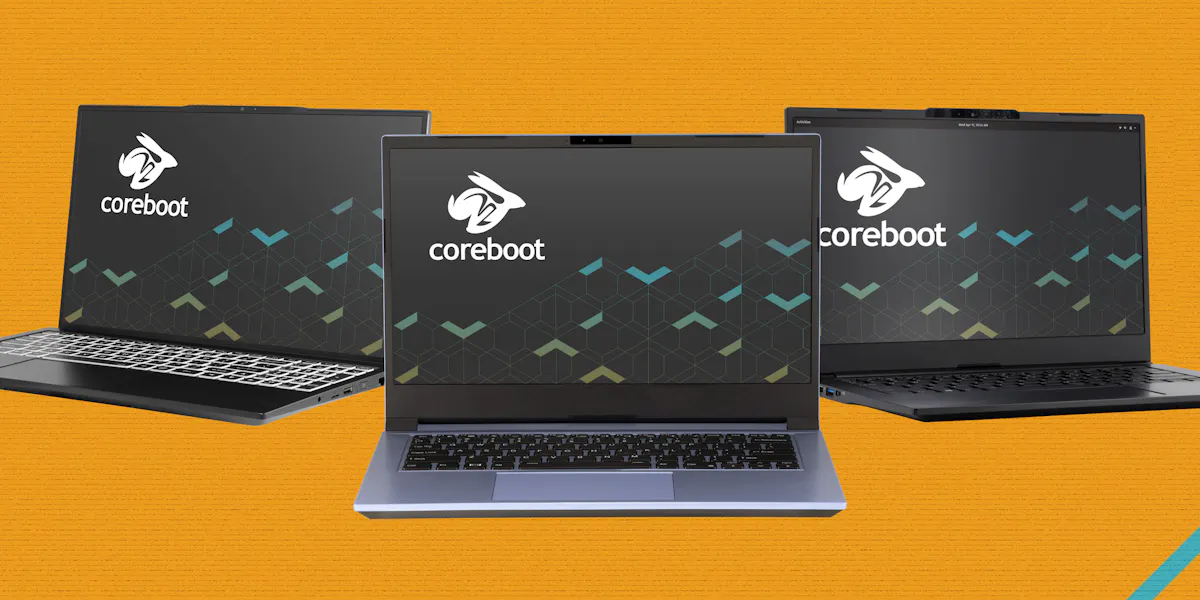
Major Updates for System76 Open Firmware!
Read about the latest performance boosts, disabling Intel ME, Windows 11 support, and more!
System76 Blog
278 points · by airhangerf15 · 3y ago · 98 comments
See comment by bri3d below for details. It appears they're just sending a command to the ME politely asking it to stop doing things, maybe. Of course, this happens long after the ME has already done a great deal of work bringing up the system.
Of the three options for ME scope reduction, none are good and none actually "disable" the ME, but it seems like they've chosen the least effective/audited option of the three. I should add that if you don't trust the ME not to be owned, there's not really any reason to trust that it will honour a polite request to stop doing anything sent to it, and you can't trust it not to have compromised the boot process anyway, making this rather pointless.
> One of the fields, called "reserve_hap", drew our attention because there was a comment next to it: "High Assurance Platform (HAP) enable".
> Googling did not take long. The second search result said that the name belongs to a trusted platform program linked to the U.S. National Security Agency (NSA)
https://web.archive.org/web/20170829010653/https://blog.ptse...
Answer: order them to tape out N units without the spyware for only you. A new photomask isn't all that expensive.
On certain performance cars, it's actually a three stage system. On my Audi RS 5, there's the same thing as you describe. And then if I push, and hold, TCS for five seconds, it goes fully off (for race days and such).
Rather, this was about fixing a buffer management bug in Coreboot which prevented S3 sleep from working with secure boot enabled (basically, coreboot would clobber itself with the TPM log on wake). This bug required System76 to switch to S0ix suspend and in turn, the ME to be re-enabled (as the ME manages some peripherals in S0ix sleep).
I didn't know this - so it's possible to turn off Intel ME? The idea of a full copy of Minix with TCPIP running on my machine is scary. Can someone else turn it back on?
* By patching the ME firmware itself - see the me_cleaner project, and methods documented here: https://puri.sm/posts/deep-dive-into-intel-me-disablement/ . This is Pretty Reliable; the runtime code has been deleted from flash.
* By setting a bit in the flash configuration, assumed to be added for the US High Assurance program: https://github.com/corna/me_cleaner/wiki/HAP-AltMeDisable-bi... , https://www.ptsecurity.com/ww-en/analytics/disabling-intel-m... . This is Mostly Reliable; the mechanism has been fairly aggressively reverse engineered and was added for a program with strict requirements.
* By sending an HECI command that says "hey ME, turn off your runtime" https://review.coreboot.org/c/coreboot/+/52800 . This is Somewhat Reliable; the method is well understood and seems to work but I'm not sure someone has done a deep dive audit into whether it could be re-enabled somehow.
Well...
- I don't think the ME knows how to talk to non Intel NICs (install a Realtek or Broadcom based NIC).
Some searching I just did regarding "AMT" (remote management feature that uses the ME) says it needs an Intel NIC.
And, some searching I just did regarding vPro (not 100% sure what this is exactly) says vPro uses the onboard network adapter.
- So I don't think the ME will look for a NIC on the PCIe bus at all, but not 100% sure.
- I'm fairly sure AMT/vPro/the ME doesn't know how to talk to anything other than stuff on the PCIe bus (use a USB NIC)
- The NIC the ME would use has a MAC like any other NIC. Should be information available from the firmware. Just block it at the router.
Kinda tangential but I wonder, as successful as they've been in their niche (I presume, based on how prolific the branding is) I wonder if they would be better positioned to make a Linux phone where the others have fallen flat? I loved my PinePhone but as a novelty mini-AIO PC more than a phone. I doubt they'd want to step onto that minefield, but I wouldn't be able to help but get excited if such a project ever materialized.
- They wanted $90 for a replacement laptop power supply cable
- They wanted money to replace screws that that fell off and were clicking around in the body of the machine
- They took the exact same model/design (from CLIO) of machine in the same release year and changed the interface for the LCD screen mid-stream, so a newly ordered screen for machine would not connect because they changed the ribbon cable type and told me to kick rocks
The machines had extremely flimsy cases and the fan fins often broke...
I loved running linux on them for the value for the guts you got on their machines, but their support fucking sucked. I abandoned them a few years ago.
I still have one of their machines here - and its firmware failed and its unsuable.
> They took the exact same model/design (from CLIO) of machine in the same release year and changed the interface for the LCD screen mid-stream, so a newly ordered screen for machine would not connect because they changed the ribbon cable type and told me to kick rocks
I don't understand what happened here. Did you buy clevo (clio?) parts and expect it to be compatible with what they shipped you?
> I abandoned them a few years ago
What do you recommend instead?
NO. the OEM for the first sets of S76 laptops were a spec buy from S76 to Clio?Clivo? - taiwanese laptop mfr who makes spec built kit....
The problem was that S76 wanted strong guts, but a lower price point to lure Linux Savvy buyer... and the machines they had built, while the guts were strong - the casing was weak and the build quality poor... (this is why Apple makes their machines out of Aluminum rather than plastic. Which is great one many levels, but there are also cons with using aluminum in anything...)
-
>"What do I recommend"
Currently on a flagship HP Omen Gaming machine - but still this exhibits hardware problems - this machine is ~$3,000 and I am on my third one with the previous two having mainboard failures of different causes...
But HPE Executive support is probably the best computer support I have received barring COMPAQ (whom HPE acquired in the late '90s... - COMPAQ support was legendary)
so - I am still paying for awesome guts - but even these Omen laptops still have a shitty case design...
They have a top aluminum panel for the KB - but the under panel is a flimsy plastic BS - and they still use undersized screws which are prone to fall out...
But the mainboard design is pretty bad ass.
Dual SSD slots - good venting (even though the machine has problems on any sof surface (like a blanket or a bed) because the venting is bottom fans venting air up, but when stiffled by a blanket/bed/pillow - it makes the machine overheat...
And W11 is not help in that area - power mgmt in W11 is atrocious from a subjective perspective - but if you want powerful gut and dont care about the above - then an HP Omen gaming machine with great graphics and proc and an AI capable GPU (although I havent used that much yet) is bad ass - couple that with USB powered external monitors and you have a three-screen awesome machine that is light and fits in any backpack.
but the legacy of apple is really the aluminum chassis...
But strong guts are more important to me for compute/$
So is all the bootleg crazy hardware produced and sold in Shenzhen basically running the same firmware/driver blobs used in the West?
Is there really nobody who has access to specs for even out-of-date shitty cameras, wifi modules, and old gpus?
To bad the whole Nokia N900 thing didn't work.
In some ways I guess I don't care since I'm on a pixel 4a 5g just for the headphone jack. But I also only paid about 150 or 200 for it.
I posted some pictures of it and pictures of the Intel tool confirming it can't connect with ME when disabled:
I've left its title, even though people are disputing it, since the comments are mostly about that.
Quote: "As part of our efforts to build out the RISC-V ecosystem, SiFive has partnered with Intel to develop the HiFive Pro P550 Development System (previously code-named Horse Creek). During his keynote, Patrick was joined on stage by Intel Foundry Services’ Bob Brennan to share a first look at this high performance platform that features a quad-core SiFive Performance™ P550 processor and is implemented in the Intel 4 technology platform. The board will enable a new generation of RISC-V software, continuing the tradition of SiFive HiFive boards that have helped drive the growth of the RISC-V ecosystem. The board will be commercially available in the summer of 2023."
And we are not talking about TFTP, but DHCP and NTP (not to mention even more problematic HTTP[S]) which clearly does not belong at BIOS and should not be at UEFI level.
Meanwhile, mothetboards having ARM, RISC and PowerPC continues to gain support.
1. A trackpoint similar to what Thinkpads have and the ability to disable the touchpad.
2. No Nvidia GPU, but full opensource GPU. I think that is already an option for some models. This is so I could use OpenBSD with it.
But if I every get a new laptop, I will look directly at System 76.
Jeremy's post seems to going pretty strongly at that.
it is optional to run an additional OS code from the main Intel CPU to gain access to Intel ME.
Intel ME's basic function is to display your monitor over network, monitor some hardware temp sensors, and reset the motherboard while your main Intel CPU is running or suspended (or even powered down).
since we cannot verify that Intel ME is only doing just that specific listening of network packet, because we do not have access to their source code (much less rebuild our own copy of Intel ME binaries); we cannot assume any modicum of correctness of Intel ME CPU operation (which has full unfettered access to all of your CPU memory) nor determine the level of maliciousness ... of your Intel ME.
it is "caveat emptor" from a computer security POV.
No, that's AMT, which is an optional feature not enabled on the majority of devices with an ME. On an average system it's much more likely that the ME is being used for PTT (Intel's implementation of a TPM running on the ME, avoiding the cost of an additional TPM chip), a protected video path for DRMed video (the encrypted video is passed to the ME, which decrypts it and draws it to the screen without the decrypted content ever being visible to the host CPU) and various other low-level platform integration things.
You don't need source code to verify the behaviour of a binary. The vulnerabilities that have been identified in ME code didn't depend on researchers having source code. Can we be certain that the ME isn't doing something malicious? No. But nor could we be certain even if we had the source code (maybe the microarchitecture was modified so that a specific sequences of instructions would cause the next cmp operation to invert , for example). Nobody's found any evidence of malice, and not really any more incompetence than you'd expect.
Not even a died-hard cybersecurity reverse engineer would ever say, “you don’t need source code to verify the behaviour of a binary”, but it would make life easier to verify seldom-used or unused code for non-maliciousness.
Occasionally the open source security industry uncovers yet another 0day in the endless stream of zero days then Intel and all the OEMs release a patch to fix the bug and add three more 0days to Intel ME.
Very very few IT teams want AMT. It is a total scam. If we had a functioning government, Intel ME in its current from would never be allowed to be sold in USA.
I agree, only that I think it’s reverse. It would seem that American companies like Intel and AMD can be far more easily controlled with both force and cash by American government, not by foreign governments.
Do you even have a shred of evidence for this claim?
>yet another 0day in the endless stream of zero days
There is not an endless stream of zero days in the ME. None of these are relevant to most people's security model. Even for those with an excessive security model attacks you probably already consider your machine compromised if tan attacker has physical access to it.
I have been responsible for keeping small fleets of laptops patched and I actually read the relevant CVEs Intel puts out, which if you bothered to do you would find that yes over the years there has been an endless stream of fatal 0days
I assume you are talking about INTEL-SA-00075. To quote "This vulnerability does not exist on Intel-based consumer PCs with consumer firmware." This vulnerability was responsibly disclosed to Intel and there was a security update made that patched it along with mitigation instructions in case your motherboard manufacturer did not create an update.
Security bugs and security updates are just a matter of reality. Anyone managing a fleet of computers needs to make sure that the whole fleet is getting security updates for any software that is running on it. This isn't a problem exclusive to the Intel ME. If this was instead was implemented as an OS driver it would still be a critical vulnerability that would need to be patched.
>over the years there has been an endless stream of fatal 0days
I believe INTEL-SA-00075 is the only ME related vulnerability that was rated as critical. I am not seeing all of these fatal 0 days that you are talking about.