235 points · by Octabrain · 3y ago · 221 comments
I didn’t think they illustrated what it felt like to have secret police looking over your shoulder. If you weren’t in trouble with the state or an upper class westerner I don’t think there was a huge difference in lifestyle between East and West Europe for most people until the late 60’s / early 70’s
Remember state housing was common in Britain as well. E.g 80% of the population of Glasgow lived in state owned housing until the 1980’s.
[O] E.g. look at 1960’s London in the film ‘The Ipcress File’.
Most Russian regions excluding the region around Moscow is above 0.800 but below 0.850 at the macro level (microlevel Caucasian Oblasts and Far Eastern Oblasts are around 0.750-0.800 but not too bad).
By most standards, at a developmental level Russia is definetly developed, but then again it is roughly comparable to Turkiye or Thailand developmentally, so it is by most standards 15-20 years behind living standards in Western Europe, but none of this is too surprising tbh.
If we're being honest, it is a country in the Middle Income Trap. It almost became a developed country (the gains before the Ukraine War began in 2014 were amazing and broke into the Developed category), but a decade of economic development was lost after the post-Crimea sanctions and the subsequent war from 2014-Present.
Then again, a country like Russia has significantly narrowed the gap from a quality of life standpoint, but conversely, this also makes countries like Russia much more susceptible to a brain drain a la Poland or Czechia.
Repeat that for other western countries.
I had a chance to visit oil and gas production town in Siberia slightly north of Northern Polar circle not long ago after USSR collapse. I have to say the work and life conditions there were quite good, I spare you of long anecdote comparing Yugorsk with then contemporary Moscow.
You don't have to go back to the 50's. You can see buildings like that in any european capital today. Moscow from the 50's looks very in line with most european capitals by the way.
>I didn’t think they illustrated what it felt like to have secret police looking over your shoulder. If you weren’t in trouble with the state or an upper class westerner I don’t think there was a huge difference in lifestyle between East and West Europe for most people until the late 60’s / early 70’s
Sometimes I have the impression that Hollywood movies gave people a permanent wrong perception about what it really means to live in a dictatorship with a secret police. For the urban middle/upper class it didn't mean much except if you were involved in politics. That was the case in Latin America at least.
I guess the biggest losers in the Soviet Union were the poor farmers and the industry workers who were forced to work, but you will barely hear about their drama because people don't really identify with them. It's much easier to sell police states from the past as low tech minority report scenarios for an urban middle class even if that was not really the case.
The farmers did not. They worked incredible hours, for little pay[1], and had very few options for leaving for a better life in the city.
Access to non-staple consumer goods was, of course, very uneven. The party gets first crack at it, and if anything's left, there's a dograce to pick up the scraps.
[1] Gosh, that part sounds just like being a farmhand today. Weird how farming is universally a shitty job.
yes, people have a very strange image of the soviet union somehow. the 90s have been the worse period by far in the ex-soviet union. before the system was in crisis, but sort of worked for most. and in the 50s, 60s was working fairly well. 70s decline, 80s crisis.
Only if you ignore the gulag period.
It is very unlikely that any of those cars was owned by an individual.
Most likely all cars were state-owned and they were used by various important-enough officials. During that time in USSR, many of those who made efforts to ascend through the hierarchy of the Communist Party hoped to reach a position high enough to be provided with a Pobeda car. Even if the cars were claimed to be "property of all the people of the USSR" those who received them as an official car frequently did not hesitate to use them for their personal interests. It was one of the main perks of such positions.
Only a couple of decades later, after a few more car factories for cheap cars, like "Lada", started production, cars owned by individuals became common in the USSR.
This was not the case in the Soviet Union, certainly not under Stalin. The secret police was not only a means of subjugation but a means of extraction - if you had a house, a job, an apartment, or even a wife, that someone in the system wanted, you would be accused, tried, and repressed.
18 million people were sent to gulags. 1.6 million died.
I doubt they were all "involved in politics" beyond expressing an opinion Stalin didn't allow.
Please, be aware that Solzhenitsin admitted that he lied about millions sent to Gulag on purpose. Documents from archives do not support that numbers.
The educated middle/high class in Moscow was probably quite critic of Stalin's policies and nothing would happen to them as long as they were not loud enough with their criticism.
It's not too late to go back to this utopia!
https://www.reddogplumbing.com.au/plumbing-non-existent-russ...
And they still choose to spend all of their money and prestige on a war of aggression against Ukraine.
Sounds like nonsense and also does not seem to relate to the rest of the article.
Whatever real problems Russia might have, toilet access is not one of them.
https://euroweeklynews.com/2022/12/06/russian-soldiers-looti...
Through history sometimes you'd find the extremely well-off people in London, other times they'd not be caught near the place, it seems.
For what it's worth, the difference was huge.
At the consumer, daily-grind kind of level the whole country was basically living just above the poverty level. Very few struggled, but the quality of things was shit as was their availability. Those who lived well and had access to the luxuries were still barely on par with the middle Western class. The only way up the ladder was through the party line, which required faking belief in the bright communist future in order to advance. It also restricted what you could and couldn't say, even if the truth was blatantly obvious. Everyone knew that everyone was faking it and that left a profound imprint on generations of people. It wasn't 1984 exactly, but it wasn't that far off either.
https://www.youtube.com/watch?v=K7CWajaOx4E
> Everyone knew that everyone was faking it
I think that's what ultimately did them in - the fundamental dishonesty in the system as everyone told lies about their productivity. And this happened all the way up the reporting line, so any amount that was claimed above the plan got magnified. By the time the numbers arrived at Gosplan, Soviet farmers were the most productive in the world (despite widespread hunger).
Professor of Economic History, Robert C. Allen, concludes in his study without the 1917 revolution is directly responsible for rapid growth.
* https://citeseerx.ist.psu.edu/viewdoc/download?doi=10.1.1.50...
Study demonstrating the steady increase in quality of life during the Soviet period (including under Stalin). Includes the fact that Soviet life expectancy grew faster than any other nation recorded at the time:
* https://www.jstor.org/stable/2672986?seq=1
A large study using world bank data analyzing the quality of life in Capitalist vs Socialist countries and finds overwhelmingly at similar levels of development with socialism bringing better quality of life:
* https://www.ncbi.nlm.nih.gov/pmc/articles/PMC1646771/pdf/amj...
This study compared capitalist and socialist countries in measures of the physical quality of life (PQL), taking into account the level of economic development.
If this study really has that result then it collides pretty hard with the experience of people who actually lived there (like me having grown up in Eastern Germany).
TBF, East Germany did have a pretty good health care system, which in turn may lead to a life expectancy similar to other countries at the time, but at the same time the level of environmental pollution was (literally) breathtaking.
And for 'real-socialist' standards, East Germany was still pretty well off, but at best comparable with poor capitalist European countries like Portugal or Greece.
Also, you simply cannot trust any public data about socialist countries from that time, because those numbers are almost certainly sugarcoated and had little to do with reality (that might at least partly explain how those studies above come to those 'unbelievable' results).
Lol, no, it's not "completely false".
There are academic papers and there are realities of life under the Soviet rule. Life was substantially shittier than on the West and you didn't need a slide ruler and statistical analysis to see that.
It doesn't mean that it wasn't improving, but the focus of the state was, as others already said, on the industrial development rather than on consumer goods and services, leading to various curious facts such as the lack of mass-produced toilet paper until late 1960s. PQL that.
Think about what kind of spiritual dammage you are doing upon yourself with the lies you are trying to convince yourself and others of. That damage can be irrevocable.
Look at that film in general. It's brilliant.
Just think how long it took to recover from the 2008 crisis and then multiply that by 10.
So if you focus for example on the color red you find it is used extensively in political signaling context (not totally surprising given the location and era :-), to differentiate gender clothing and, in one instance, a religious building.
I think it’s more that Victorian fashions (and later) favoured those drab colours. Compare to eg medieval dress which was colourful (though limited by dyes) or the way old (catholic) churches were decorated.
You can see the brightly coloured roofs from Red square for example. It was just taken on an overcast day with a 70+ year old camera. I think part of the drabness is limited by the technology, in the same way that Turner’s paintings are less colourful than those by Van Gogh.
Another thing is the soot in the cities making everything generally dirty and perhaps also causing people to prefer darker outer layers.
People generally like color in some measure and it obviously serves as sending a more intense signal. But in various contexts other factors may prevail (e.g maximizing the market for eventual sale)
The interesting question is when does color get used more extensively (above average) and why.
If anything it's the communists that turned everyone into a gray mass, mostly because you had a very limited number of items of clothing that the state manufactured and you could buy, and the state decided on the color, and second because standing out in any way was at best frowned upon, and at worst dangerous, especially during stalin's times.
Soviet Russia totally did have a propaganda sector. And they sure used bright color, though limited by what colors were available.
Usage of bright color is culturally dependent, and also geographically dependent when it comes to sourcing dye.
For example west African counties have always used bright colors in fabric due to culture.
The argument is that marketing has made cities more intensely colored. Its not a value judgement (maybe calm natural colors are better for the soul).
It is also not a universal rule, there are places here and there that have a tradition of painting, e.g., house exteriors in intense colors (these days they are invariably tourist attractions - precisely because they are exceptions).
> For example west African counties have always used bright colors in fabric due to culture
Red appears in these photos in clothing context so not sure what this (dis)proves. Sourcing dyes for clothing has been a global trade mainstay from the earliest days of human civilization.
How about the clothing choices. I see a lot of grey. Do you think that’s an unconscious choice due to lack of marketing for bright clothes?
The red in clothing does stand out, but as other posters and the article say: red was closely associated with the communist party so using it is a political statement of solidarity, not a free fashion choice.
Marketing may have an effect on making western cities more catching than they otherwise would be, but communist era Russia isn’t a good example of what that would look like. Due to other constraints (e.g. government control of factories and design industry) people were not really given free expression. This is an economic factor forcing an aesthetic. Similarly, if you live next to a quarry, you’ll have a lot of polished marble buildings in your town. This isn’t because you love white marble, but because it’s far cheaper than trees to you.
https://3.bp.blogspot.com/-86xo22o6jeE/WN5Rye49UvI/AAAAAAACn...
https://4.bp.blogspot.com/-cc6ZoLe139M/WN5RzS1AhCI/AAAAAAACn...
Woman doing such manual labor would have been highly unusual in Western countries at the time (and still are). They probably were assigned these jobs by the system.
Also curious: Selling ice cream in winter?
https://3.bp.blogspot.com/-JgJPVcAaAwo/WN5R7tuIlLI/AAAAAAACo...
In the 2000s saw very similar sights in Bulgaria - gender roles seem far less fixed than you might imagine if you only watch TV or films.
In the 90s, Portugal's HDI was comparable to Poland and a number of other Eastern European states and still is to this day.
Salazar's dictatorship did a severe number on Portugal's development.
And ime, housewife type experiences definetly skew towards those who can afford a household on a single income - especially looking at countries c. 2010-2023 with similar developmental indicators as Portugal and Eastern Europe in the 90s.
It's only in a few countries where there's a large gender difference for outside labourers, ironically it seems to be inversely proportional to how much it's talked about in a given society.
In Italy ice cream is sold in winter too in all Gelateria.
The good thing about winter ice cream is that it is better, it doesn't melt that fast and artisans tend to do it with more care and quality while in summer there's an offset for quantity.
https://en.wikipedia.org/wiki/Soviet_famine_of_1930%E2%80%93...
That said, certainly in Thailand commercial driving is still very, very male dominated, and job ads will explicitly insist on men; I’d estimate less than 1/100 motorsai drivers I’ve seen were female, and 90% of those were “Tom”[0].
0: Kinda like F2M trans but also it’s own thing: https://en.m.wikipedia.org/wiki/Gender_identities_in_Thailan...
Female motosai (motorbike taxis) more than 1%. Really only a thing in Bangkok, where organized gangs run the motosai according to territory. Definitely mostly men doing that, and food/parcel delivery. I would guess that results from Thai women finishing school and attending university at a higher rate than Thai men, which leads to better jobs. Motosai sit close to the bottom of Thai jobs in prestige, pay, and education requirements.
https://careersmart.org.uk/occupations/equality/which-jobs-d... and plenty of other sources if you search for it. Which is kind of interesting because most searches result in the "gender pay gap" stuff, yet they kind of answer their own question with the stats.
I think there are a couple of outlying issues even these days: 1: "boys clubs" some men trying to get women to not work in certain industries (although sometimes just men working together is perceived as a boys club, in the tech industry I've seen male friendship/camaraderie killed because it's seen as "boys club-y" even though anyone's free to join) 2: women may or may not choose to work in certain industries, even if it's 100% possible for them to do so 3: societal pressure (from both men and women) on women (and men) to fill certain roles/be perceived certain ways in society.
> Strange ideas about gender roles are coloring your perception of what is normal.
It's rather that your perception is off. See for example
https://external-preview.redd.it/RqUXzaQhvPVuJ3Qw6-7hHfsCinn...
Edit: Of course it could have been very common in the Sowjet Union at the time.
AWLA (Australian Women’s Land Army) was formerly disbanded 31 December 1945 but women stayed on as farm workers in some number for a good few years following.
https://www.awm.gov.au/articles/encyclopedia/homefront/land_...
I live in a tropical country, and it's quite common to drink hot tea in the heat of summer, to help one cool down.
Perhaps the opposite effect works in the cold regions of the world.
"Science and Life" reprinted some article on a comparison between a sandwich and an ice cream for the useful energy output in a cold environment. Guess you missed it. *grin*
I can vouch for the veracity of that claim. Some members of my family drink hot coffee to cool down. (I drink frosted diet coke)
https://www.smithsonianmag.com/science-nature/a-hot-drink-on...
Today a pile of trash is 50% plastic and will linger around for centuries
Today, we separate them, but in the not so distant past (our family's house in West Virginia, not excepted, didn't get telephone or electricity until the 1970s), you just dug a new outhouse when it got full.
When I asked if that meant the rare bottles he dealt in had been fished out of former toilets, the antique dealer just gave me an amused smile.
Plastic degrades to microplastics and goes into the water cycle and the air, where we breathe it in and drink it. There is suspicion that microplastics could contribute to cancer, autism, obesity, and gender dysphoria. Partly directly, partly because some of the chemicals in plastics resemble hormones, changing prenatal hormone levels, affecting the development of kids as they grow up.
This stuff is hard to study academically, as microplastics is everywhere nowadays. Particularly in household dust due to textiles made out of synthetic fibers.
https://diafilmy.su/3646-nyu-york.html
https://diafilmy.su/3665-nyu-york-2.html
(amusingly enough, I'm pretty sure the first picture of the first part is on the other side of the north american continent from New York, but I didn't notice any other obvious howlers)
Surely it should say his "espionage was detected" if he's a spy as per the title?
Although the article does not suggest he is a spy. Perhaps the title should be changed his deportation might have been a sore spot and it seems unfair to label him definitively a spy if it's not so certain.
> Spy Or Artist? / Part Four / The timing and location of Martin Manhoff's work suggest spy. The artistic images he left behind suggest something else. ...
> There is no direct evidence that Manhoff was a spy during his time in the U.S.S.R. His military records contain no indication that espionage was a formal part of his duties. After the Soviet newspaper Trud alleged that the Americans had been taking note of various infrastructure while traveling the Trans-Siberian Railway, U.S. authorities declined to comment. And to this day U.S. intelligence agencies refuse to discuss the issue.
Article: dry, empty, trite, derivative. Was it written by an AI? I suspect it was.
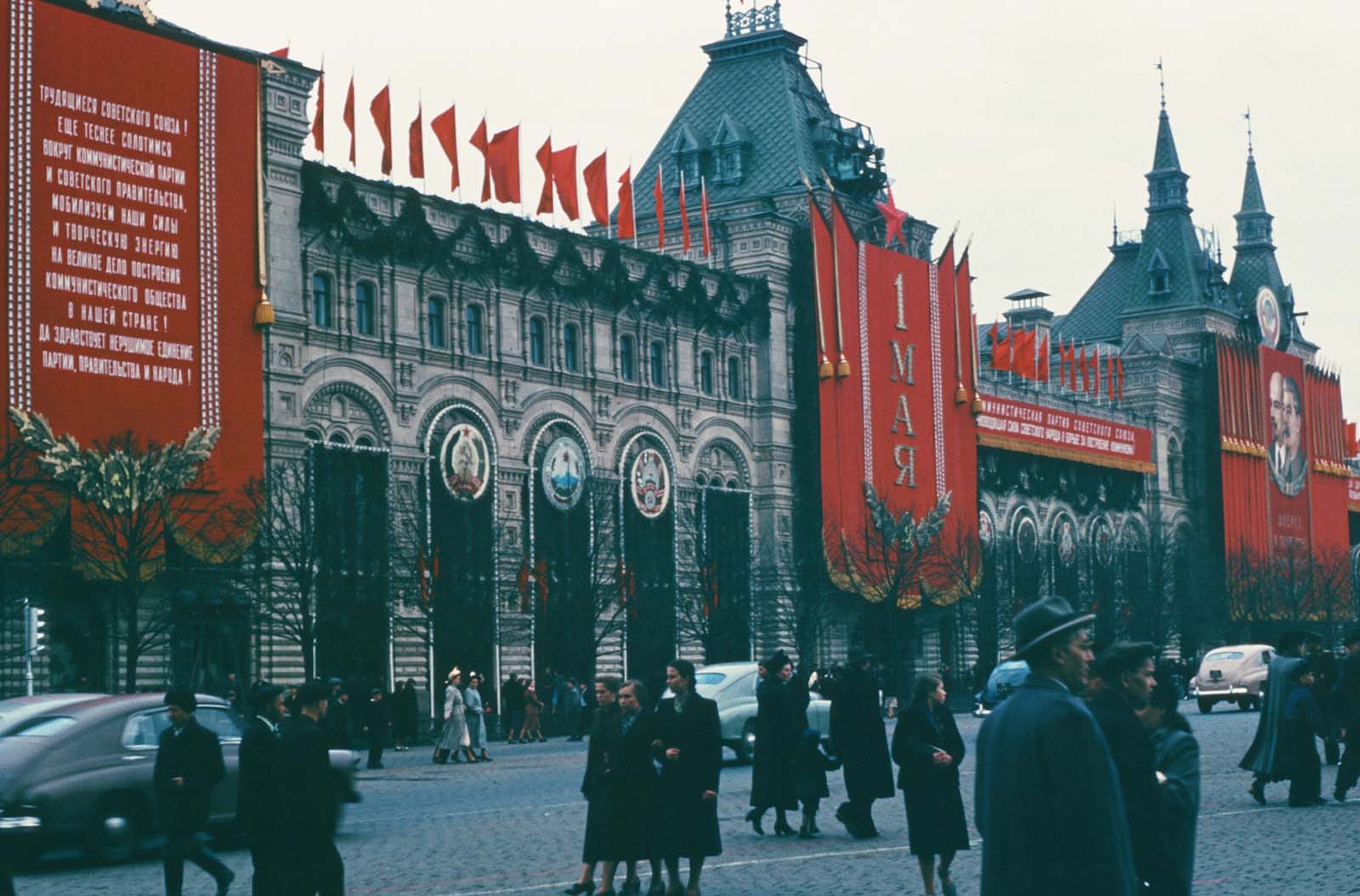
https://3.bp.blogspot.com/-OPV-iBDM_es/WN5R0JXjX1I/AAAAAAACn...
Workers of the Soviet Union! Let us unite even more closely around the Communist Party and the Soviet government, mobilizing our forces and creative energy for the great task of building a communist society in our country. Long live the unbreakable unity of the party, the government, and the people!
"Workers of the Soviet Union! Let us consolidate ourselves even more around the Communist Party and the Soviet Government, mobilize our forces and our creative energy for the great work of building a Communist society in our country! Long live the unbreakable union between Party, Government, and People!"
Manhoff archive: https://manhoffarchive.org/
This juxtaposition of BBC reporting on DPRK overlaid on the british queen funeral procession[0] brilliantly demonstrates the kind of bias I'm talking about, and how it's more often than not a form of projection of one own issues on others.
A few examples of the bias I'm talking about and how it can as easily be applied to "liberal" societies:
One notable event chronicled in Manhoff’s diary is his participation in the May Day parade of 1953. He vividly describes the grandiosity of the event, with its elaborate displays of military might and the orchestrated enthusiasm of the Soviet people.
It becomes evident that the parade was a carefully choreographed spectacle, designed to showcase the Soviet Union’s ideology and power to the world.
Literally any parade involves a "choreographed spectacle" as it's always about showcasing power to the world.
Despite the pervasive atmosphere of control and suspicion, Manhoff’s diary also reveals moments of genuine connection and warmth between him and the Soviet citizens.
This pervasive atmosphere is nowhere to be seen in the pictures, but of course they had to remind you that these are the ebil commies. The pictures alone look too human otherwise.
The secret police played a crucial role in maintaining the conformity necessary for the survival of the socialist regime.
Easily reversed: The NSA and FBI played a crucial role in maintaining the conformity necessary for the survival of the capitalist regime.
Understanding life in the Soviet Union during this era requires delving into the intricacies of the state-controlled society, the hardships faced by ordinary citizens, and the pervasive ideology that permeated every aspect of life.
Easily reversed: Understanding life in the USA during this era requires delving into the intricacies of the capital-controlled society, the hardships faced by ordinary citizens, and the pervasive ideology that permeated every aspect of life.
Look what a "carefully choreographed spectacle" that is.
.0: https://stream24.ilsole24ore.com/video/italia/2-giugno-migli...
My mother was an avid polish communist born and raised in communist Poland and there isn't a communist country that she didn't travel from east Germany to Uzbekistan and Yugoslavia.
Yes, as you point out, people living in the Soviet Union were just normal people with their everyday problems: the boss, the colleagues, groceries, buying some new tech (e.g. radio), family, health, etc.
I think it is very false to depict secret police as having such a huge role in everyday's Russia life. What was slightly different in Soviet Russia compared to other countries members of the Warsaw Pact is that there was more control on movement.
She and my father too recollect how going to some village 80 miles from Moscow had them stopped and controlled for documents and purpose of their trip like 4 times.
That tended to fade the further you went and increase around major cities like Moscow.
I wouldn't really say secret police had such a huge role in day by day, but the "police state" of control did. Other things that were quite heavily controlled were phone calls. People had all kinds of secret codes when communicating with people abroad because everyone assumed someone was listening and recording.
But I really cannot stress how average Ivan didn't really care or felt all of that control nor cared unless he did something heavily (politically) risky.
I often ask my family that lived in the Warsaw Pact countries, either in Russia, mostly Poland and Ukraine if they didn't feel there was a lack of freedom, etc, and they all said they didn't care nor think about it at all. They were thinking where to go to vacation, what to prepare for lunch or sporting activities, etc.
It should also be noted that all of those countries never experienced a much "different" state of affairs. My grandmother was born in Nazi Germany, her mother under the Haubsburg's Austrian empire, her husband was born in Prussia. And they all were born in a 30 miles radius. There was always a ruler, repression and control.
If anything, for those people, communist regimes brought the most freedom and best standard of lives they ever even dreamed of. It only got in the late 70s and early 80s that the system started tracking, people weren't blind and could see that people in western countries had it much better and kept growing while communist countries capped in their economic and social evolution. New generations didn't even remember the Tsarist or Prussian times, they looked at America, at West Germany at France and thought the situation was bad.
You could have just asked any survivor of these times.
As yourself: would you write a similar comment about Nazi Germany? May be you would consider it insensitive to the millions of its victims? Well, your comment about USSR is insensitive exactly for the same reasons.
I was born in that country, many members of my family have had to survive through it, and many didn't — just as many others have been killed by the Nazis. And westerners who, out of mistrust to their government, begin to whitewash Soviet union make my blood boil. You're as bad as holocaust deniers.
This is spot on, if anything, the 'grandiose' May-parade photos remind me of 1930's Nazi Germany (and back then - before Germany invaded Poland - there was a similar fascination in some corners of western society with this sort of aesthetics).
This looks normal. What typical American spin.
You don't say?
I visited St. Patrick's day parade in SF and it was definitely choreographed. It's not like people just walked as they see fit. If it isn't it's not a parade.
The "parade in front of the former U.S. Embassy building on Manezhnaya ploshchad, Moscow" would be from the old embassy, but could still be after Stalin's death.
There's also "18 Novinsky bulvar under construction in Moscow" and http://wikimapia.org/12359967/Novinsky-bulvar-18 says it was constructed in 1953.
FWIW, Manhoff was in Russia when Stalin died. "From a balcony with a view to the Kremlin, Major Manhoff shot the only known independent footage of Stalin’s funeral." "U.S. Army Major Martin Manhoff had been in Moscow for more than a year when on March 5, 1953, after several days of ominous reports in the Communist Party mouthpiece Pravda, Josef Stalin died." - https://www.rferl.org/a/manhoff-archive-part-one-stalins-fun...
Many of the Radio Free Europe/Radio Liberty images are the same as those on Rare Historical Photos. That's because at the bottom of the Rare Historical Photos page you'll read "Photo credit: Courtesy of Douglas Smith, via Radio Free Europe/Radio Liberty / Martin Manhoff’s Archive / Bored Panda / Pinterest".
So if you want more old pictures of Moscow, and video, see the RFE/RL link too. Then go to part 3 and see places outside of Moscow - after Stalin's death, travel was easier.
such as?
(interestingly "Agitpunkt" sounds like a German loanword)
[1] https://www.merriam-webster.com/dictionary/agitpunkt
[2] https://en.wiktionary.org/wiki/%D0%BF%D1%83%D0%BD%D0%BA%D1%8...
Edit: Forgot Engels, another German.