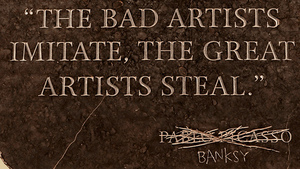
If Android is a "stolen product," then so was the iPhone
Steve Jobs reportedly called Android a "stolen product." If he was right, then …
Ars Technica
180 points · by tambourine_man · 14y ago · 131 comments
It seems to me that he wasn't calling it stolen because it was a similar product - other comments of his indicate that he was was well aware that the technology would be cloned.
He was calling it stolen because he felt the time-to-market advantage had been stolen by an insider who breached his trust. I think this is what drove his animosity.
Android is obviously deeply influenced by the iPhone. The iPhone is obviously influenced by a whole load of other products (though not to quite the same extent).
What makes it 'stealing' is whether the influence was underhand or not.
We don't know whether Eric Schmidt did use inside information in breach of trust, but if he did then Jobs' position seems a lot more supportable.
Pre-iPhone, Android's demo phones looked like a BlackBerry clone: http://en.wikipedia.org/wiki/File:Android_mobile_phone_platf...
The "entire package" of Android included a huge number of features that the iPhone did not, many of which later got incorporated into iOS.
> Pre-iPhone, Android's demo phones looked like a BlackBerry clone
As I understand it they had full screen touch-based prototypes as well. They were experimenting with everything. Of course, what actually emerged into production was iPhone-like because by then the market had moved in that direction.
wrong.
</sarcasm>
Sorry, for all that I wasn't personally a fan, I remember how amazing the O2 XDA (and its its immediate relatives) were at the time and I have to stick up for them (and HTC, of course).
Like design of any architecture, a consumer product is always a package of many components. Knowing what component to keep and what not to and tuning each to best please the user and work together are the art and the kind of innovation that is the most difficult to find.
And you know people are copying/stealing just by looking at it:
- http://www.flickr.com/photos/tjetjep/4100430224/ - http://micgadget.com/8168/shanzhai-sydney-opera-house/
http://www.osnews.com/story/25264/Did_Android_Really_Look_Li...
iPhone was announced January 2007 and released June 2007. That's hardly pre-iPhone.
This article is heartily missing the point.
Android is basically a stolen product. It's a direct successor and competitor to the iPhone, and the direction of Android in it's current form has been and is extremely influenced by what Apple has been doing.
Sure, the iPhone is a bunch of "stolen" technologies and ideas, but Apple brought them together to make something great in a way that had never been done before. What Apple did took vision, discipline, and execution. That is what Apple brought to the table, and that is what innovation is.
Nobody was making products that resembled the iPhone before Apple, but now everyone is trying.
We don't need to get all emotional about this. This doesn't have anything to do with the quality of the products, it's just the history about how this stuff came about. You are still free to like Android or WebOS or iOS or whatever you want. It's fine. Just recognize innovation for what it is.
That's blatantly false. Every smartphone I owned going back to 2003 resembled the iPhone. Smartphones of the day either resembled the iPhone or they resembled the blackberry but both designs were out there in number. After the iPhone was released almost everyone dropped their blackberry-like designs (except for RIM).
Apple's innovation was the capacitive multi-touch screen and finger-friendly interface. I'm not even sure that's a revolution just an evolution of existing designs.
Ah, here we are: http://en.wikipedia.org/wiki/File:Sony-CLIE-PEG-NZ90.jpg
The iPhone is a fine product. The ground it broke was making people want a PDA, not actually inventing the PDA.
http://www.gsmarena.com/palm_treo_180-623.php
Palm OS looks a lot like iOS when you factor in the era's technology.
Which phones?
This is pretty close to the one I owned around 2002: http://img.tomshardware.com/us/2002/04/04/comparison_of_six_...
Do you have specific smartphones in mind? The only ones of that era I'm more than passingly familiar with are the Palm phones, and they were nothing at all like the iPhone.
http://files.myopera.com/Yorch/blog/p800.jpg
Palm smartphones were the minority (in terms of total number of models).
Which is exactly why it resembled none of the smartphones that preceded it. That innovation was a monumental game changer.
The Nokia 770 from 2005/11 and the N800 which was released (2007/01) around the same time that Jobs was announcing the development of the iPhone. (These were Internet tablets with the hints of the telephony stack already included. Eventually the N900 phone did come out, too little too late unfortunately.)
Android has much more in common with Maemo than Apple iOS.
(And at the time, the 770 had a pretty amazing screen and user interface compared to most other mobile devices. If only Nokia had known that capacitive touchscreens existed and started porting the Hildon UI to multi touch in 2005..)
Aspects of Android were inspired by the iPhone. The iPhone itself was inspired by the Blackberry, Palm and Windows Mobile series of devices before it.
There really is no such thing as "stolen" when it comes to knowledge. Everything is built upon other things, emerging from the context where they are conceived. It is utterly impossible to not "steal" when you create because your creations are a direct response to the environment in which you create them, which by necessity is a result of creations that came before.
Apple "advocates" always said: apple invented the gui, apple invented mp3 players, apple makes the fastest PC, apple's not the "big brother" company, etc. etc. Every claim usually turns out false. The Rep for "reality distortion field" has firm basis in trugth.
We can't always take Apple's claims at face value. This article just exposed, once again, another pro-Apple fallacy: that they own mini-tablet-phones and everyone stole the idea from them.
nonsense.
Apple made the GUI, MP3 players, etc. usable for the general public.
Apple "advocates", including some in this very thread, do routinely dismiss as unimportant, sucky, etc. every pre-Apple contribution in some of these categories (especially smartphones and tablets). I generally think they're trying to emphasize the importance and originality of Apple's contribution, but I can see how someone else might interpret that as saying "Apple invented X".
This video describes very well how inventions get created and then evolve for the benefit of everyone:
Palm was making touchscreen smartphones before iPhone.
Years before the iPhone I was carrying around an iPaq. Now it isn't quite the same, most notably because the original device didn't even function as a phone. Yet I would argue that the phone part of smartphone is by far the least important part (and the only reason it is so prevalent is that carrier subsidization allows people to stomach $700 iPhones). Really these things are ultra-portable computers and the phone thing is ancillary.
The iPaq wasn't multitouch. But here's the thing -- Apple bought that multitouch sensor. They didn't invent it. They didn't specify it. They didn't even initiate its creation. Their software used it brilliantly, but by the common narrative you'd think they had invented it.
Capacitive touchscreens evolved. Embedded processors evolved. GPUs evolved. Wireless technologies evolved. Batteries evolved. Makers like RIM pushed much of that evolution.
Apple stepped in at the perfect confluence of technologies and made the iPaq v2.0. Better in every way -- largely owing to those hardware improvements, all of which came from outside Apple -- but did it really invent an industry?
It's actually a bit sad how little credit RIM gets, given that they were the ones who pushed a lot of the innovation in mobile that made the iPhone possible. A distributed messaging, application platform, camera, etc...everyone just focuses on the damn keyboard as if it defines the platform.
Already I'm seeing many ascribing the iPad as inventing the tablet, forgetting so many products that came before (both real, such as Archos, and conceptual like the Crunchpad). Apple executes amazingly well, but their creations are seldom as out of left field as people imagine. They say that the victors write history, but it is sad if we're blinded into confusing commercial success with innovation.
Do you think that was only because those devices lacked a capacitive touchscreen? If so, then why did every other company have to scratch their mobile platform after the iPhone came along? Why didn't Microsoft make Metro in 2006, after all, the techology was available (I tried a Panasonic Toughbook with a capacitive display way before that).
I agree that others should be credited for their inventions. Both RIM and others like Nokia helped pushed the technology forward, but they did so very gradually. It took an outsider to disrupt the industry (luckily, Apple had killed off the Newton, or they probably woudn't have had the incentive to do so).
Besides everything being touch based, which was really disruptive, I believe a real disruption in the iPhone was that it included a full browser and not the mobile crap that existed back then, apps were good, but it was something that existed in other smartphones although without the centralized distribution medium, but they did exist.
Now some people are saying that Apple reign will not last just because smartphone prices will follow the same path that feature phones prices walked in the last 10 years, they will become much cheaper than now, I do not know about Apple remaining the leader or not but I do believe that smartphone prices will be really cheap in 2020, even for developing nations.
EDIT: typo and correction in the last paragraph.
For those right choices Apple has yielded incredible riches: Profits never before seen, quarter after quarter. They're a half-a-trillion dollar company.
All I argue about is this revisionist history that acts, essentially, like Apple is entitled to everything. That they borrowed nothing and created everything. It seems like I'm arguing against a strawman there, but it is too common of an opinion. It is an argument that is based upon taking the smallest trivia of Apple's implementation and making it the most profound, important thing ever, while everything else doesn't matter.
And isn't the iPaq v1.0 just the Newton v2.0?
I think the real meat of the argument is "iPhone synthesized all those individual pieces into something coherent and incredible.". It's kind of like how the Macintosh and Lisa took the ideas from PARC, perfected them, and turned them into a real product. I think the stink is being made that Android is copying that aspect of the iPhone, instead of just a piece or two.
Maybe that's not what's actually being argued, but that's what I think should be argued at least.
This doesn't seem like a meme we should seek to perpetuate.
No, they're not, at least not in software. Nobody reads software patents, for two reasons. First, the majority are either non-novel or written in a way that they are not useful to others. Second, by reading patents you increase the damages in a possible infringement suit since at that point you knowingly infringed.
Bringing this back to technology with an example: Palm synthesized the smart phone and color LCD screen in ~2004. I'm pretty glad all smartphones have color screens today.
But sometimes, to better see the whole picture, we need to take a step back from the drawing board. We, as engineers, like to think that every great revolution in consumer behavior is due to a technological invention fundamental to the shift. But if you pay attention you'll notice that Apple's biggest innovation wasn't technological. The area they excel the most is marketing. They built a coherent experience from the device interface design, to the propaganda on TV ads that was powerful enough to convince consumers to buy their products.
Steve Jobs was a genius. But if you believe he was a genius engineer who you should try to mimic, then you'll end up making poor technical decisions. He was a genius marketer who excelled at convincing consumers his products are worth it. That's what we should take from all this. That's we should learn from Apple's growth. Marketing matters.
We all stand in the shoulders of someone else.
Isn't that what the current legal battle over slide to unlock is over? I'll be the first to agree that the iPhone put all the pieces together, but it seems like every other week there's a new lawsuit over some iPhone or Android feature that is more of a common sense thing and probably shouldn't have been granted a patent.
Bill Buxton is currently a Research Scientist at MSR and he more than knows what he's talking about.
From 1997:
(http://groups.google.com/group/comp.dcom.telecom/msg/f62a1ff...)
It's how progress happens. Too bad people are so quick to blame others with "stealing" when this happens.
http://obamapacman.com/2010/03/myth-copyright-theft-apple-st...
Other people here are talking about "vision" and "innovation" and while these are certainly things Apple had in abundance, the bottom line is that Samsung's lack of vision is not what Apple is complaining about. It's all about risk: Apple took a risk, they pioneered a whole metaphor of a smartphone made of a giant touchscreen and little packaged apps. They had to convince a whole legion of consumers that their highly simplified interface was the elegant solution they needed, and that takes a lot of money and a lot of risk. Now Apple wants their day in the sun to last as long as possible, they want as much of the payoff from the risks they took as possible, and they feel entitled to a degree of exclusivity.
Has Apple been fair to those companies by their own standard?
Would that not constitute prior art in one of the patents Apple asserted against Android recently? I am only vaguely aware of the finer details so I'm probably mistaken on some point.
Other prior art would be Ward Cunningham's WikiWikiWeb (1994/1995) for turning CamelCase into links and, my personal favorite, Netscape Navigator 2.0b1, for "Live URLs" (that recognized URLs and email addresses in mail and news text and made them clickable).
I've been following this off and on, and AFAICT, HTC didn't bring up any of these piece of prior art, which makes me seriously question the quality of their prior art searches.
No wonder Apple has never sued Palm, or now HP who owns all the IP. Palm had half the iPhone probably patented lol.
Meanwhile all phones since the iPhone look a heck of a lot like it.
They get to the point themselves:
Indeed, what made the iPhone such a great product was precisely that Apple drew together a number of innovations already developed separately—touchscreen phones, capacitive touchscreens, sophisticated multitouch user interfaces—and combined them in a product greater than the sum of its parts.
And then Android just imitated that precise sum of parts (full touchscreen, swipe gestures, on-screen keyboard, apps, desktop-class browser, accelerometer, great graphics...). Android looked nothing like it is today before the iPhone OS.