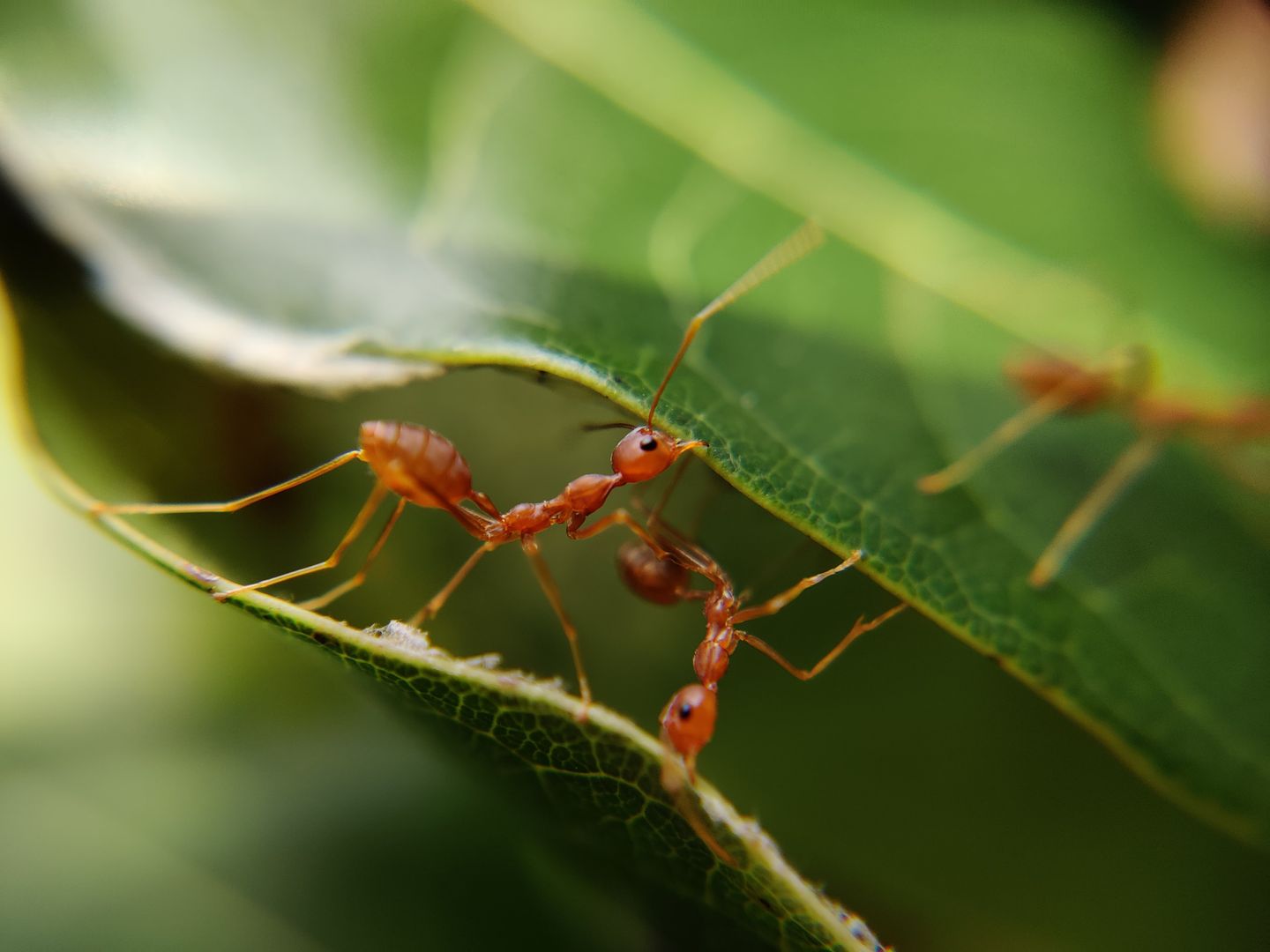
We don’t trade with ants
When discussing advanced AI, sometimes the following exchanges happens: “Perhaps advanced AI won’t kill us. Perhaps it will trade with us” “We don’t trade with ants” I think it’s interesting to get clear on exactly why we don’t trade with ants, and whether it is relevant to the AI situation. When a person says “we don’t trade with ants”, I think the implicit explanation is that humans are so big, powerful and smart compared to ants that we don’t need to trade with them because they have nothing of value and if they did we could just take it; anything they can do we can do better, and we can just walk all over them. Why negotiate when you can steal? I think this is broadly wrong, and that it is also an interesting case of the classic cognitive error of imagining that trade is about swapping fixed-value objects, rather than creating new value from a confluence of one’s needs and the other’s affordances. It’s only in the imaginary zero-sum world that you can generally replace trade with stealing the other party’s stuff, if the other party is weak enough. Ants, with their skills, could do a lot that we would plausibly find worth paying for. Some ideas: Cleaning things that are hard for humans to reach (crevices, buildup in pipes, outsides of tall buildings) Chasing away other insects, including in agriculture Surveillance and spying Building, sculpting, moving, and mending things in hard to reach places and at small scales (e.g. dig tunnels, deliver adhesives to cracks) Getting out of our houses before we are driven to expend effort killing them, and similarly for all the other places ants conflict with humans (stinging, eating crops, ..) (For an extended list, see ‘Appendix: potentially valuable things things ants can do’) We can’t take almost any of this by force, we can at best kill them and take their dirt and the minuscule mouthfuls of our foods they were eating. Could we pay them for all this? A single ant eats about 2mg per day according to a random website, so you could support a colony of a million ants with 2kg of food per day. Supposing they accepted pay in sugar, or something similarly expensive, 2kg costs around $3. Perhaps you would need to pay them more than subsistence to attract them away from foraging freely, since apparently food-gathering ants usually collect more than they eat, to support others in their colony. So let’s guess $5. My guess is that a million ants could do well over $5 of the above labors in a day. For instance, a colony of meat ants takes ‘weeks’ to remove the meat from an entire carcass of an animal. Supposing somewhat conservatively that this is three weeks, and the animal is a 1.5kg bandicoot, the colony is moving 70g/day. Guesstimating the mass of crumbs falling on the floor of a small cafeteria in a day, I imagine that it’s less than that produced by tearing up a single bread roll and spreading it around, which the internet says is about 50g. So my guess is that an ant colony could clean the floor of a small cafeteria for around $5/day, which I imagine is cheaper than human sweeping (this site says ‘light cleaning’ costs around $35/h on average in the US). And this is one of the tasks where the ants have least advantages over humans. Cleaning the outside of skyscrapers or the inside of pipes is presumably much harder for humans than cleaning a cafeteria floor, and I expect is fairly similar for ants. So at a basic level, it seems like there should be potential for trade with ants - they can do a lot of things that we want done, and could live well at the prices we would pay for those tasks being done. So why don’t we trade with ants? I claim that we don’t trade with ants because we can’t communicate with them. We can’t tell them what we’d like them to do, and can’t have them recognize that we would pay them if they did it. Which might be more than the language barrier. There might be a conceptual poverty. There might also be a lack of the memory and consistent identity that allows an ant to uphold commitments it made with me five minutes ago. To get basic trade going, you might not need much of these things though. If we could only communicate that their all leaving our house immediately would prompt us to put a plate of honey in the garden for them and/or not slaughter them, then we would already be gaining from trade. So it looks like the the AI-human relationship is importantly disanalogous to the human-ant relationship, because the big reason we don’t trade with ants will not apply to AI systems potentially trading with us: we can’t communicate with ants, AI can communicate with us. (You might think ‘but the AI will be so far above us that it will think of itself as unable to communicate with us, in the same way that we can’t with the ants - we will be unable to conceive of most of its concepts’. It seems unlikely to me that one needs anything like the full palette of concepts available to the smarter creature to make productive trade. With ants, ‘go over there and we won’t kill you’ would do a lot, and it doesn’t involve concepts at the foggy pinnacle of human meaning-construction. The issue with ants is that we can’t communicate almost at all.) But also: ants can actually do heaps of things we can’t, whereas (arguably) at some point that won’t be true for us relative to AI systems. (When we get human-level AI, will that AI also be ant level? Or will AI want to trade with ants for longer than it wants to trade with us? It can probably better figure out how to talk to ants.) However just because at some point AI systems will probably do everything humans do, doesn’t mean that this will happen on any particular timeline, e.g. the same one on which AI becomes ‘very powerful’. If the situation turns out similar to us and ants, we might expect that we continue to have a bunch of niche uses for a while. In sum, for AI systems to be to humans as we are to ants, would be for us to be able to do many tasks better than AI, and for the AI systems to be willing to pay us grandly for them, but for them to be unable to tell us this, or even to warn us to get out of the way. Is this what AI will be like? No. AI will be able to communicate with us, though at some point we will be less useful to AI systems than ants could be to us if they could communicate. But, you might argue, being totally unable to communicate makes one useless, even if one has skills that could be good if accessible through communication. So being unable to communicate is just a kind of being useless, and how we treat ants is an apt case study in treatment of powerless and useless creatures, even if the uselessness has an unusual cause. This seems sort of right, but a) being unable to communicate probably makes a creature more absolutely useless than if it just lacks skills, because even an unskilled creature is sometimes in a position to add value e.g. by moving out of the way instead of having to be killed, b) the corner-ness of the case of ant uselessness might make general intuitive implications carry over poorly to other cases, c) the fact that the ant situation can definitely not apply to us relative to AIs seems interesting, and d) it just kind of worries me that when people are thinking about this analogy with ants, they are imagining it all wrong in the details, even if the conclusion should be the same. Also, there’s a thought that AI being as much more powerful than us as we are than ants implies a uselessness that makes extermination almost guaranteed. But ants, while extremely powerless, are only useless to us by an accident of signaling systems. And we know that problem won’t apply in the case of AI. Perhaps we should not expect to so easily become useless to AI systems, even supposing they take all power from humans. Appendix: potentially valuable things things ants can do Clean, especially small loose particles or detachable substances, especially in cases that are very hard for humans to reach (e.g. floors, crevices, sticky jars in the kitchen, buildup from pipes while water is off, the outsides of tall buildings) Chase away other insects Pest control in agriculture (they have already been used for this since about 400AD) Surveillance and spying Investigating hard to reach situations, underground or in walls for instance - e.g. see whether a pipe is leaking, or whether the foundation of a house is rotting, or whether there is smoke inside a wall Surveil buildings for smoke Defend areas from invaders, e.g. buildings, cars (some plants have coordinated with ants in this way) Sculpting/moving things at a very small scale Building house-size structures with intricate detailing. Digging tunnels (e.g. instead of digging up your garden to lay a pipe, maybe ants could dig the hole, then a flexible pipe could be pushed through it) Being used in medication (this already happens, but might happen better if we could communicate with them) Participating in war (attack, guerilla attack, sabotage, intelligence) Mending things at a small scale, e.g. delivering adhesive material to a crack in a pipe while the water is off Surveillance of scents (including which direction a scent is coming from), e.g. drugs, explosives, diseases, people, microbes Tending other small, useful organisms (‘Leafcutter ants (Atta and Acromyrmex) feed exclusively on a fungus that grows only within their colonies. They continually collect leaves which are taken to the colony, cut into tiny pieces and placed in fungal gardens.’Wikipedia: ‘Leaf cutter ants are sensitive enough to adapt to the fungi’s reaction to different plant material, apparently detecting chemical signals from the fungus. If a particular type of leaf is toxic to the fungus, the colony will no longer collect it…The fungi used by the higher attine ants no longer produce spores. These ants fully domesticated their fungal partner 15 million years ago, a process that took 30 million years to complete.[9] Their fungi produce nutritious and swollen hyphal tips (gongylidia) that grow in bundles called staphylae, to specifically feed the ants.’ ‘The ants in turn keep predators away from the aphids and will move them from one feeding location to another. When migrating to a new area, many colonies will take the aphids with them, to ensure a continued supply of honeydew.’ Wikipedia:’Myrmecophilous (ant-loving) caterpillars of the butterfly family Lycaenidae (e.g., blues, coppers, or hairstreaks) are herded by the ants, led to feeding areas in the daytime, and brought inside the ants’ nest at night. The caterpillars have a gland which secretes honeydew when the ants massage them.’’) Measuring hard to access distances (they measure distance as they walk with an internal pedometer) Killing plants (lemon ants make ‘devil’s gardens’ by killing all plants other than ‘lemon ant trees’ in an area) Producing and delivering nitrogen to plants (‘Isotopic labelling studies suggest that plants also obtain nitrogen from the ants.’ - Wikipedia) Get out of our houses before we are driven to expend effort killing them, and similarly for all the other places ants conflict with humans (stinging, eating crops, ..)
world spirit sock puppet