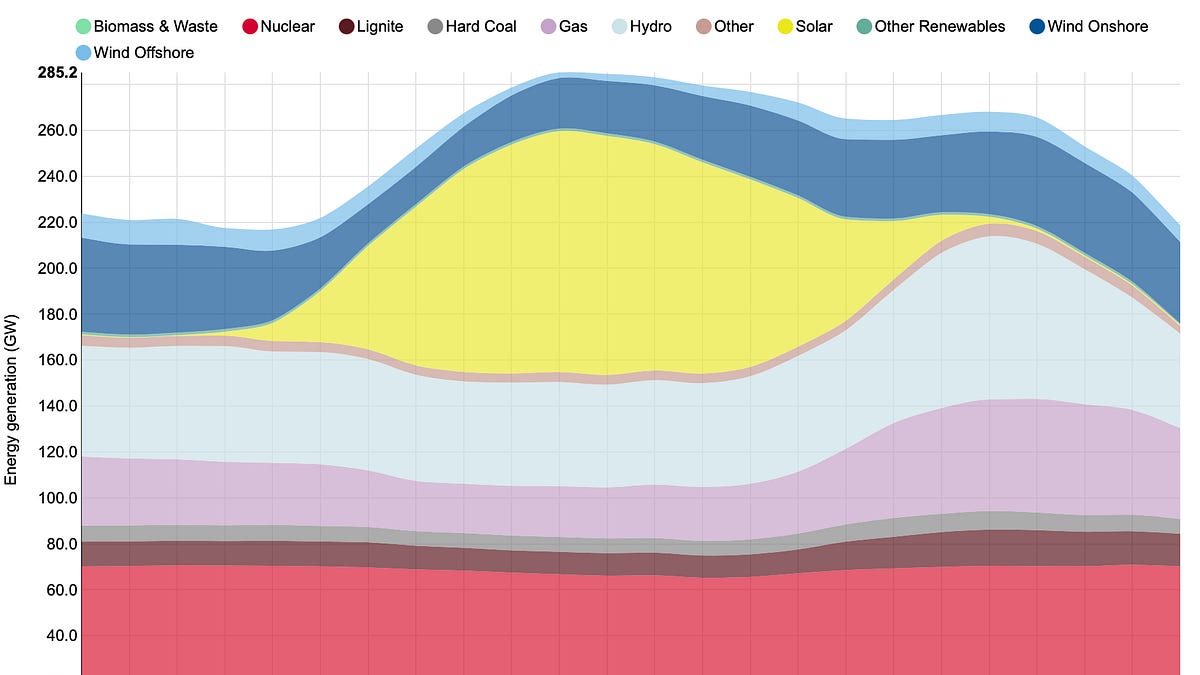
The duck in the room - the end of baseload
There's simply no space left for new (or even, soon, old) nuclear
jeromeaparis.substack.com
38 points · by guerby · 3y ago · 117 comments
Or more specifically, why couldn't you convert any baseload plant into a "flexible supply" plant by adding storage?
You can interpret the post in two ways: Either, solar capacity will grow to such an extent that eventually it will be enough to cover all demand: Meaning, during summer days, there will be enough supply to cover the immediate demand and fill up storage enough to cover all evenings, nights and winter days. If that were the case then there wouldn't be the need for any power sources except solar and storage and we'd have basically solved energy. Hooray!
However, that seems pretty unrealistic. The second interpretation of the article is that solar will grow (and will be able to contribute to storage to some extent) but will not be able to fully cover the dark hours - hence the duck curve. For those times, other energy sources are still needed.
However, if there is still a need for other energy sources, then why couldn't baseload plants cover that need? Yes, it's only for a few hours per day (in summer), but then the baseload plant is needed the rest of the time to fill up storage - as solar, by initial assumption, would not be sufficient to do that.
Cost. New built nuclear costs $0.12 - 0.2/kWh [1], already completely uncompetitive. Now add storage on top of that.
There are ideas with for example salt based heat storage, but they all boil down to added cost on something uncompetitive if it ran at 100% all year around.
[1]: https://www.lazard.com/research-insights/levelized-cost-of-e...
I’m more interested in learning where all the storage that’s going to be needed to decarbonize is going to come from.
According to Woodmac’s most recent grid storage update, there was only 13.4 GWh of grid storage in the US 2022.
Projected growth for the next five years is 10-17 GWh per year with a declining growth trend.
Paid-off nuclear plants are in the same range as new built renewables in cost. They don't magically appear out of thin air though, someone has to pay to build them.
Imagine we turn of all fossil generators tomorrow, forever. Solar panels will still be cheap, but instantaneous energy price in California will tend towards infinity every night, making solar-based generation an extremely expensive solution. That expense is not captured in Lazard's numbers.
Neither do they capture the cost of transmission lines and storage necessary to eliminate blackouts in that scenario. People talk a lot about the time it takes to build nuclear, but transmission lines aren't much faster, and unlike reactors they don't generate on their own.
They have a whole section when they compare renewables with battery storage against other "near firm" options.
So if for example 66% of the time solar+wind+hydro+misc provides enough and nuclear is not needed, nuclear kWh will be triple the price (estimated with historical load factors).
Already at play in Finland a few weeks after the nuclear power plant has been turned on it had to scale back its production to "not loose money":
https://oilprice.com/Alternative-Energy/Nuclear-Power/Finnis...
What will happen in a decade with more and more solar and wind?
Baseload as an abstract concept still makes perfect sense.
It is exactly equivalent to a flat reduction in demand. Which is something that would be worth paying for.
How much it is worth is the big question. I'd suggest it is worth less than the costs of burning coal or gas as baseload and that therefore those should be used only when necessary and be on standby the rest of the time.
I'd also suggest building new nuclear makes little sense as there's little chance of it being economically worthwhile.
But, current nuclear that's not got other problems isn't any big drama to integrate with increasing renewables. And I don't think we're quite at the point yet where new build renewables are cheaper than nuclear running costs. If anything it just gets you faster to the point where you have a daily bump of excess solar that can be matched with batteries (grid support or in vehicles).
Final shout-out for east-west orientated static solar, which can be used to make the solar curve a bit more of a square wave. They produce less but at times of day when it'll be worth more, once the standard peak is saturated.
But the concept of a specific type of power plant that specializes in satisfying the baseload is going away.
The idea that you provide the baseload with dirt cheap but inflexible nuclear and supplement the peaks with expensive but flexible things like coal made perfect sense, while nuclear was cheap.
Now nuclear isn't the cheapest thing around anymore. Which means that while solar is available the economically rational decision is to buy solar.
And this hurts the profitability of nuclear enormously. Now it can't run 24/7, because during the day it has competition. And since nuclear is almost all capital costs, any time it's not providing power is time it's not paying off those enormous loans. And renewables being very variable results in an environment nuclear isn't very well suited for either.
You are emphasizing one factor/capability: (economic) efficiency. That may not be the only factor worth considering. One such other factor could be reliability, and it may be worth paying more to gain that factor/capability.
Or would you also say: "Well, the load can be handled by a single server (or router), so a second (active-active or active-passive) system isn't worth paying for to get HA."?
Meaning, I don't care whether the power I'm getting got made by a power plant that can keep going 24/7, or sometimes gets supplemented by a battery, or there's some constant delicate balancing act going on between 5000 distributed sources.
So as a consumer I don't really care that nuclear is stable and solar isn't, the output of the grid is all that matters.
(France's big nuclear build out was extremely socialist planned economy, only later privatized as EDF)
Why aren't sun-tracking solar panels in use at scale? Economically infeasible I assume, but is that because of increased hardware costs, increased maintentance costs, or just because they won't add much extra output?
Economically infeasible because of decreased hardware costs. Panels are so cheap compared to tracking systems.
(Quick envelope calculation: Amazon offered me a 400w panel for £200. Amortize that to about 6h of effective daytime use, that's 21600 seconds or 8kWh/day. 25 year warranty lifetime; derate that by, say, 20% to allow for degradation. 20 years is about 7300 days. That's about 58,400kWh. UK electric costs are all over the place at the moment, but at £0.30 that means .. you're buying £17,520 of electricity for £200.)
NOT INCLUDING BALANCE OF SYSTEM COSTS, solar panels are really cheap.
This doesn't invalidate your point though - even if you're one order of magnitude off, your £200 solar panel will buy you about ten times its price worth of electricity.
Not that I disagree with the conclusion, but you’d get no where near 8KWh a day from a 400W panel.
The energy market systems are somewhat distorting perceptions of power in general and some reliability planners are worried that as older dispatchable generation goes offline for good, rotating blackouts may be in the future for many high demand areas.
BTW, agreed on E- and W- facing PV widening generation and thus being more useful.
Japan’s vast hydro storage was actually built to solve the issue of too much nuclear baseload generation at night (to be discharged during the day). Later as Japan added a lot of Photovoltaic after Fukushima, the same hydro storage was doubly useful
is good for seeing details for each country (or part of country). I'm not affiliated to the site.
There is a lot of different duck patters. For some countries Wind Power has the same duck pattern as solar, for others it's more even.
It is also interesting to see how much electricity is imported/exported during the day to other countries. West European countries are definitely not isolated islands.
Everyone here currently adds local solar panels (which dropped 50% in the last year). Battery packs being no option 4 years ago are now offered for 1kwh household solar panels and dropped in price too (but not 50% yet). We will get one next year to move generated energy into consumption times in the evening (we have no car).
(This is all private consumption of course not industrial power usage)
Venezuela's terribly administered grid shut down power to its aluminium industry. This cannot survive without power to keep the smelters warm; two hours was enough to destroy the industry. https://www.alcircle.com/news/blackout-in-venezuela-brings-d...
It is an argument hinging on cost. The cost for new built renewables are in the range of what existing paid off nuclear and fossil plants cost in operations and maintenance.
Try building new ones in that environment.
Use that to play with the numbers at different locations.
Well, if you ignore reliability.
To decarbonize without rolling blackouts you need nuclear or storage.
The problem is that renewables and nuclear are economically incompatible, like the article goes into depths about. Renewables easily win this battle as the cost for new built renewables are in the same range as operations and maintenance for paid off nuclear plants.
For nuclear this inflexibility comes from pure economics. It is economic suicide to build a new plant and operate it at 100%, now try operating it at less than 50% on average.
Generally, the research available see no issues building 100% renewable grids, so I do not know why you keep hampering on about it being impossible?
The grid the author is imagining would not survive more than an hour.
The impact of that is that high UK natgas and power prices resulted in renewables with "negative subsidy" paying money back to the taxpayer. https://www.current-news.co.uk/cfds-set-to-pay-back-10-5bn-a...
(Heck, I myself am part of this: I'm paid a 15p subsidy for electricity generated by my panels. This was a good deal when electricity was 10p. Electricity is now 30p.)
Renewables and storage can provide the aux services needed, and already are on many grids.
Which grids? I wasn't aware of grids powered entirely by renewables with grid scale storage as the backup, that would be pretty cool if true.
The initial use case for small batteries on grids are providing the grid stability, frequency control, (synthetic) inertia and other important operational factors that the original comment thinks are being ignored.
> Unfortunately this is article fails to talk about grid stability, frequency control, inertia, and other important operational factors that keep transmission grids running.
This 'value stacking', which the immediate parent called 'aux services' makes them much more valuable to the grid than just their delivery of power would suggest.
Though we're now approaching a point in the mass deployment where the batteries have flooded that market on many grids and there's only actual energy storage left for them to do (and maybe avoid some transmission bottlenecks).
I still feel that these articles massively underestimate the amount of energy required in the future, when all fossils (eg. air travel, transportation, industry) will migrate to fully electric. Unless we want to pave every surface with solar, baseload will still be needed...
The point is that excess energy from solar especially is essentially free, while excess energy from nuclear or other traditional baseload generators is very far from free.
> I still feel that these articles massively underestimate the amount of energy required in the future
That's certainly an aspect. Here in Norway it increasingly looks like we'll end up with a lack of electricity by 2030 or so[1]. However production is just one aspect, another problem is distribution. Even if we tap into all that wind up north in Norway, for example, most of the consumption is in the south, and there's a huge lack of transmission capacity between the north and south today, with no current plans of building more.
[1]: A big factor here is if we want to use our precious "clean" hydro to electrify the oil platforms or not. They need a lot of energy to operate.
Perhaps a much less comfortable question for Norway is when to retire them entirely and leave the oil under the sea.
Maybe Norway need to build the Shetland interconnector as well as the 1400MW one that's just opened? Shetland is where all the never-built tidal schemes are always planned for.
Oh absolutely. About as easy as stopping a heroin addiction though, I expect. Not only the direct income from them, but about 10% of the non-govt workforce is directly tied to the oil extraction or in supporting roles.
Hydrogen generation does not have a flexible power demand, because as you the electrolysis ramps up and down efficiently goes to zero.
And while I'm wishing, showing it for each season would be nice too.
It would clear up a lot of unnecessary drama caused mostly by poor information design.
edit, Wikipedia does okay with it's two graphics:
First, you reduce the need for extra power cables but in exchange you now need internet cables going to all the solar panels.
Second, for any capital good you need to take into account the utilization rate during its lifetime. Imagine you have a server costing 10k with an expected lifespan of 5 years. This means it needs to earn about 2k per year. Depending on how much power it uses, it may well be that 50% utilization with only cheap electricity is still less profitable than 100% utilization with cheap electricity 50% of the time and expensive electricity 50% of the time.
Third, physical servers need maintenance every once in a while. It will be mcuh cheaper to organize that if all the servers are in a few central locations than if they are spread out. (this was originally one of the main selling points of electricity in the first place! You could finally build your factory where the people and the resources were, rather than having to go where the power was)
Finally there are other options to consider which solve the same problem at potentially a lower cost, like building out the grid and introducing more demand response in the industrial base.
[0] https://www.earth.org.uk/note-on-site-technicals-46.html#202...
With that said, don't you want steady, consistent usage selling a server? I'd guess for exactly the same reason as a power plant, nobody wants to own a server that cranks up 2 or 3 hours a day... unless they absolutely HAVE to, to provide their service.
The problem is, of course, that at the prices needed for that most consumers will no longer be interested in buying my computing services or power.
That doesn't really make a lot of sense. Servers are too expensive to keep off except in "times of excess".
That being said, it's a long established practice to co-locate data centers with cheap power.
since dc cooling has become very efficient
also since 99% people are wake up during day time, actually you'd not have "excess" capacity, you'd have more stuff running
If we stopped trying to live to an entirely artificial rigid timetable (with some ineffectual fiddling at the edges with daylight saving time) that ignores seasons, weather, etc, solar would be an even better fit to demand.
It is not great for latitudes north of 45 (much of Europe) where energy needs due to heating increase at night and in winter when solar is not running at capacity…
Price goes to zero at highest solar production within the day, ergo nuclear will suffer from this. Counterpoint: if electricity is sold at spot price, wouldn't it be solar mostly affected by this? If at its best hours price is zero or negative, this means mostly zero profits for solar certainly. Meanwhile nuclear still has nights to get some of the investment back?
The awkward thing is: mostly nuclear works. France is doing ok, thank you, has best CO2-impact, with flexible production tech though. But renewables suffer from the presence of nuclear.
While mostly renewables suffer from very high storage and flexibility requirements. The author mostly handwaves those away: "I have no doubt that entrepreneurs will find zillions of ways to use energy available". Sure free energy is nice, but that's a problem for solar investors surely (or the taxpayer).
But in the end what do we want? Renewables? Or the expectation that renewables reduce CO2? Zero-CO2 can be done with flexible nuclear.
----
More on the prices:
* Short term market design (matching demand and production on spot): prices for solar and wind collapses when production is highest
* Long term market design (contracts for production at specified times): solar and wind can't predict their production, prices are lower than predictable sources.
This means you cannot free-market renewables unless with massive subsidies, or with artificially created market rules (like the current 'merit order' in the EU, which stifles coal and gas but nuclear too in an unfair manner)
There is no merit order in the EU, it is simply marginal price. The marginal cost for an added kWh of solar is zero, for wind it is about zero, only an extra hour of wear, for gas it is quite expensive, nuclear power plants might need to pay for someone to take the energy because they can not ramp fast enough.
Is this generally true?
The local Wikipedia says nuclear ramps up or down at 5%/min. This is faster than any other method of generation.
When prices recently went negative, it was on the news that they ramped down production at the nuclear power plants.
How is paying extra to ramp at 5%/min once a day "faster than" being able to switch off in seconds and back on in a minute like a wind turbine, or turn on and off in milliseconds as many times as you like like a PV inverter or even stopping starting in minutes like a reciprocating or OCGT peaker or ramping 0-100% in minutes repeatedly like hydro?
Your thinking appears to align pretty much with the messages of this podcast (not only this episode). In case you don't know it already, you may well find it interesting, never mind the esoteric sounding name:
https://thegreatsimplification.libsyn.com/electric-vehicles-...
Degrowth aka massive reduction of consumption of basically everything would be the only solution, but it's not going to happen.
The sad part is that all the irrational optimism from the renewable energy proponents/lobby is a significant contributor to preventing more people from realizing this. Which in turn will mostly prevent politics from trying to enact the necessary policies.
Here's an actual link to the interesting episode: https://www.thegreatsimplification.com/episode/rr01-berman-m...
Like say, if you want to reduce consumption, that's technology too. LED lighting is pretty new, but far more efficient than incandescent.
https://support.apple.com/en-us/HT213323
https://news.xbox.com/en-us/2023/01/11/xbox-carbon-aware-con...
https://www.youtube.com/watch?v=Zbzwu7AExZM
"Finland’s Electricity Prices Fall Below Zero"
I only had time to watch half of it.
The other two were far more realistic with the guy in the center particularly calling out the most egregious nonsense from the man on the right as not being connected to reality.
No, they will just earn their maintanence price in the peak demand.
[1] https://en.wikipedia.org/wiki/Too_cheap_to_meter