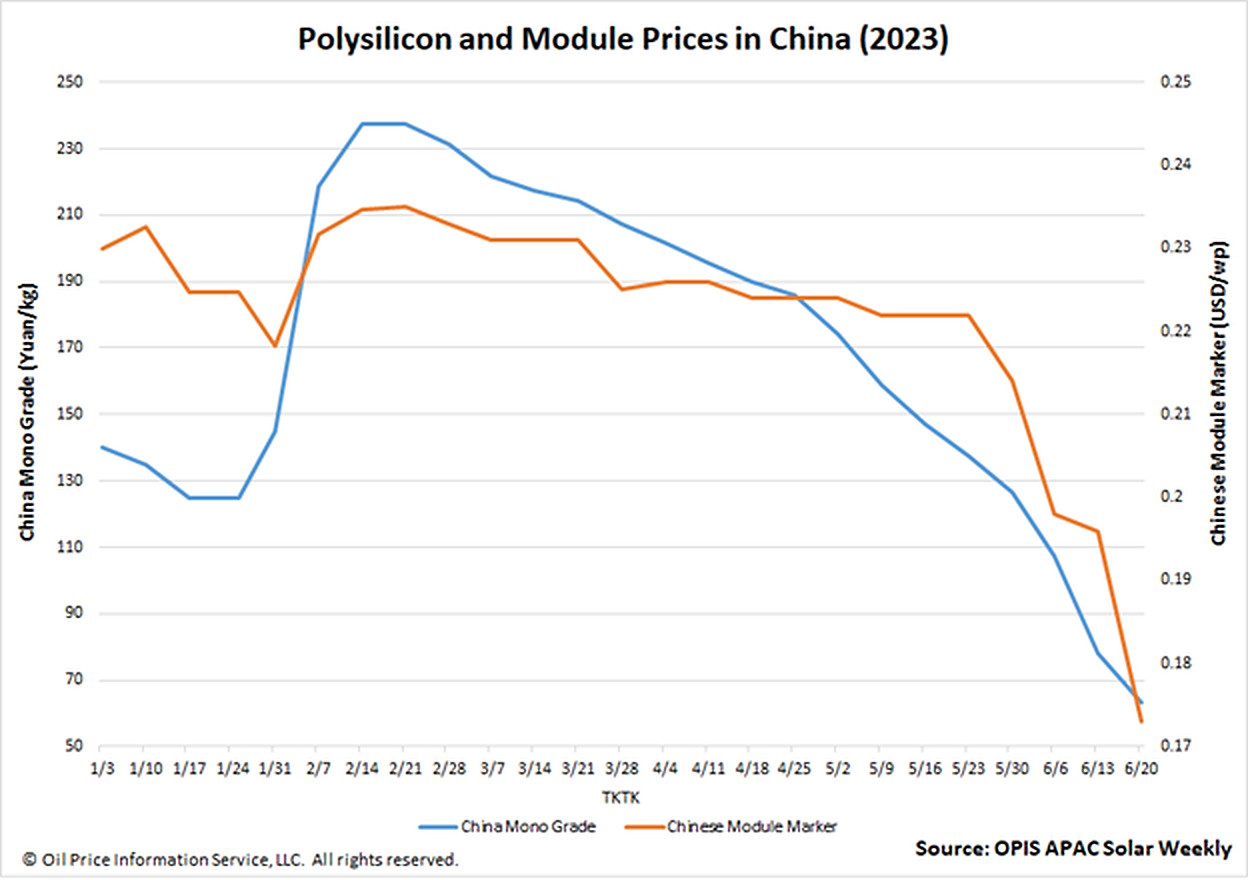
China solar module prices keep diving - pv magazine Global
In a new weekly update for pv magazine, OPIS, a Dow Jones company, provides a quick look at the main price trends in the global PV industry.
pv magazine Global
174 points · by flipbrad · 3y ago · 206 comments
In practice, inverters probably also need partial redesign for a high loading ratio. Higher ILRs in large solar farms has appeared to contribute to faster inverter failures in recent years.
I'd also love for appliances to entirely adopt DC.
- Homes should run on batteries.
- Batteries should be trickle charged from the grid with a cheap rectifier.
The big problem is that everyone has AC sockets, and it isn't worth the trouble to switch. It is going to be huge expense to buy new appliances for potential small efficiency gain. The in-wall voltage is going to mean that need adapters for other DC uses.
A better approach is to have a standard for DC power between AC side, batteries, and solar panels. Then have a single big inverter between AC and DC. It also makes possible to have DC-only in places like cabins that aren't connected to the grid.
Finally, many houses and apartments can't add batteries or solar panel. Not everyone has space like a basement. Like there is efficiency advantage like with utility solar, it might make sense to put batteries in substations where can use containers.
Hell sneak some data in and you have smart control of all these connected usb-c cabled devices too. Make for game changing smart home rollout.
Gimme lamps, lights, speakers, fans, window motors, TVs all on usb-c power plus data pls.
That seems like a bad trade-off to me. Batteries live 5 years? Inverters live 20+.
Inverters are also cheaper than batteries. I'm not seeing any advantage to your idea.
Also safety is harder on DC. For one the relays must be made much larger to withstand the nasty arcing. Arc extinguishing is much harder too.
Efficiency is a toss up. On one hand, rectifiers are very efficient and you could get by with one rectifier instead of many. On the other, they're not 100% efficient and the voltages are much lower -> more copper.
Reliability wont be as good. Rectifiers go all the time (think PC's CPU), there's no comparable failure component in the AC home.
Overall the idea has merit, mainly because the most home loads are DC nowadays anyway. But your AC, washer, fridge, garage opener, pool pump, furnace blower, refrigerator, dryer and dishwasher will not be pleased.
Maybe carbon capture, if that's a thing yet?
They're capturing carbon to turn into a useful product (fossil fuels) though.
One could also make hot water for their own DHW use or charge their electric car.
It doesn't work so well in the north east, but if weather is only bad for a few days, you might need much less backup or generator power. Batteries and generator power tends to be much less than adding excess solar.
I have 12kW of panels, and a 10kW inverter. I get a nice 10kW flat-line for a few hours each day through summer, and a better-than-it-would-otherwise-be return through winter (though never reaching max).
They expect a number of panels to be connected in series, but you can have as many of those batches in parallel as you want.
Inverters already allow a substantial amount of undersizing, e.g. I'm using a 10 kW Fronius inverter with 14.5 kW of panels installed. This does lead to the plateau you are looking after so if that is something you want, go for it In my case the 10 kW inverter just happened to be the biggest one available in this series (GEN24 Symo, a 3-phase hybrid inverter using high-voltage batteries (which I have yet to install, waiting for prices to come down and my 5 year sell-back contract to expire)). I would have been fine with a "thin hill" instead of the wide plateau we get now since that hill would stand on top of the plateau, maximising production.
> As the cumulative installed capacity increased, the price of solar declined exponentially. Solar technology is a prime example. For more than four decades, the price of solar panels declined by 20% with each doubling of global cumulative capacity.
https://www.pv-magazine.com/2018/04/14/the-weekend-read-chin...
> "When potential expansions from other mono ingot and wafer makers are factored in, this points to a tectonic shift in the supply of monocrystalline silicon which threatens to reconfigure the entire upstream solar landscape and potentially push monocrystalline silicon solar into a dominant market position in much shorter timeframe than previously anticipated."
Inverter: Cost of materials, assembly, and QA. You want good stuff for the amount of current passing through.
Cabling: Cabling is mostly materials in cost. Conductive metals are expensive.
Metal Mounting: It's heavy, and requires lots of raw material and expensive equipment to create it.
Where do you get these things?
I have a 50x100 shop with a metal roof I'd like to cover at least one half of, someday.
So many other priorities here though :-(
There's definitely 1% of land there that's almost desolate and lifeless.
The backpacks with built in panels are still expensive because I'm guessing it's hard to find customers who want to be in direct sunlight long enough to get significant charge, while carrying a backpack.
https://www.multpl.com/us-median-income/table/by-year
Regardless of whether wages match inflation completely or how long they take to do so, the fact is that if solar panels cost the same in dollars as they did 10 years ago, the average person's wage buys more of them.
You could counter-argue that other things gone up by so much that despite this, people have less money to spare for solar panels. But given that solar panels are competing with some of those things, importantly fossil fuels, it's still important to be clear that they are getting cheaper - as the trend continues a solar panel pays for itself more and more quickly.
I got 3.7Kw panels, 5Kw inverter and 10Kw battery - only our stove is not on the PV circuit - water heater is already solar based (not PV) and it has been brought some measure of sanity back to our lives.
The worst outages was 6 hours daily.
Should have done this a long time ago but it is now helped by banks tailoring financing packages for such installs.
Any ideas on a portable solar panel that could power those during the summer? Portable because I rent and can’t fix anything down, it doesn’t have to fit in a backpack or anything like that.
That being said, there’s a lot of options nowadays which is exciting! For instance, you could have a 200W port panel and a 1kWh battery system from eco flow that should run both with room to spare. Anker has a new system meant for patios but it’s only for Europe.
If you want to run a line into your house you can get by with one, or just get a panel with a usbc pd output.
Just 75W.
For almost all people they are only appropriate when you are off-grid.
Personally I'm interested in a DIY mod to add solar panels directly to the back of a laptop screen. It probably wouldn't be able to actually charge unless the machine is in sleep mode (which also would have the lid closed which would help), but it would extend the battery - if the machine averages 10W and the panel gives 1W, that's an extra 10% runtime for free, and better if it sleeps in the middle (which works, because I'm unlikely to use a laptop continuously for 10 hours).
Or environmentally sustainable?
A solar panel has life-span of 25-30 years, will you be utilizing that? or are you just creating more waste?
If you wanted to protect the environment, it's probably better to find a wind-farm project or solar farm project to invest in.
It's really easy to think that adding solar panels everywhere is a good idea; but you might just be making e-waste.
(The range at the local big appliance retailer is about 35W for the cheapest models to 10W for the most expensive.)
https://www.macrotrends.net/2575/us-dollar-yuan-exchange-rat...
China PPI is in Yuan, but sales prices of panels are mostly in Dollars.
Practically this was possible by pegging the currency which lowers the purchasing power of all their citizens.
[1] https://data.worldbank.org/indicator/NY.GDP.MKTP.PP.CD?locat...
It's a good metric for a rough comparison/transformation, but has relatively weak prediction power. That said, the same holds for any economic metric used in isolation (eg. HDI, GDP, GDP Per Capita, GDP Growth Rate, GDP PPP Per Capita, Debt Rate, Median Income, etc.)
All metrics need to used together to gain a holistic view on economic development. It's the equivalent of driving and only concentrating on the odometer at the expense of the fuel gauge, speedometer, and tachometer.
to that end, what metrics would you use instead to compare purchasing power?
[1] https://data.worldbank.org/indicator/NY.GDP.PCAP.PP.KD?locat...
The US is at 80k, Germany is at 66k, Canada is at 60k, South Korea is at 56k, Romania is at 41k. China is at 23k.
If Germany or South Korea can't reach the US, China getting there seems incredibly hard.
Though if China reaches Romania's level (funny when presented this way :-) ), the nominal total GDP of China will probably be 1.5 - 2x the US one, just by virtue of them having 5x the number of people compared the US.
It's the natural progression of anything in this universe. Even people.
Your rate of physical growth between the ages of 2 and 22 was enormous. Your rate of physical growth between the ages of 22 and 42 was likely minimal. (Unless you grew, um, laterally.)
A 22 year old should not be comparing himself to a 2 year old and lamenting that he can't match the 2 year old's growth rate.
Plunging Solar Stocks Fly in Face of Booming Panel Demand https://www.bloomberg.com/news/articles/2023-06-20/solar-sto...
U.S. solar installations to fall 23% this year due to China goods ban -report https://www.reuters.com/business/energy/us-solar-installatio...
Plus, Walmart has pretty terrible payment terms. Suppliers hand over the product, and maybe Walmart pays them for it in a year.
Walmart is too large to ignore, but too cut-throat to survive exclusively on.
But Walmart isn't the only company like this. The entire domestic auto industry operates like this (supplier costs are known to the fraction of a cent, and manufactures know exactly what margin to give in order to keep them around, but just barely), as is Apple.
How cheap are we expecting things to be?
This is reinforced by 50% in price cuts in real estate listings in tier 1 cities, 10X increase in real estate inventory this year, and 90% physical retail decline
China’s Latest Source of Unrest: Unpaid ‘Zero Covid’ Workers https://www.nytimes.com/2023/01/16/world/asia/china-covid-pr...
China's Industrial profits in the January-March period declined 21.4% from a year earlier https://www.bloomberg.com/news/articles/2023-04-27/china-s-i...
(and no, we're not secret communists or whatever - we're just trying to have an internet forum that doesn't suck in predictable ways)
We detached this subthread from https://news.ycombinator.com/item?id=36451477.
Also, the bearish 2-3% growth rate estimation was derived independently of the PRC government - it was reached by both Blackstone and the IMF.
None of this is to say there isn't an economic malaise/recession in the PRC circa 2023, but honestly it's playing out the same way a similar growth slowdown happened in Mexico, Türkiye, South Korea, Thailand, and Brazil in the 2000s when those countries hit similar economic metrics to China in the early 2020s.
You can't have either the US or China in a great depression without it taking everyone down with them. If china is in a great depression, then so is the rest of the world. If china is in a great depression, apple stock would have cratered as would most indices around the world. Go read about the 1929 stock crash. Money front runs economic depressions. Meaning wall street will let us know.
The anti-china nonsense hasn't changed since the early 2000s with gordon chang. China was supposed to collapse decades ago according to the anti-china "experts". Today it's the like of peter zeihan and youtube grifters like serpentza, et al. Same old nonsense - economic collapse, falun gong genocide, organ harvesting, environmental devastation, end of "da ccp". All of that turned out to be outright lies in the 2000s.
My advice is stop watching silly youtube videos by silly grifters and silly news from silly media organizations. Watch the money. If one day, the dow or s&p drops 10% ( even with circuit breakers ), then we may have something. If it continues to drop and stay down, then we may have something. Can't believe the amount of nonsense people believe when it comes to china. Especially when it's the same old debunked nonsense.
At this point I don't know whether people like gordon chang or peter zeihan work for "da USA" or "da CCP". Cause their outlandish bullshit always end up being wrong and making china look good in the end.
If you want to shake your fists about fossil fuel emissions this is by far not the appropriate direction to aim them IMO.
That being said panels still produce multiples of their embedded energy throughout their lifetime, so it's still worth it.
It's their construction industry which is incredibly wasteful and isn't a result of outsourcing.
For an example of why focusing on one segment does not give you a full picture, china is the world leader in solar, hydro, and wind energy production.
they also use less fossil fuel energy per capita than the united states.
for a more accurate comparison of how clean their power is compared to the united states, i would say a better metric would be that they are 26% renewable while the US is 17% renewable.
https://www.researchgate.net/publication/335083312_Why_do_we...
Also, that paper had this statement:
> For example, every step in the production of solar PV power systems requires an input of fossil fuels
which is false. None of the steps in making PV require fossil fuels.
That paper appears to not have been published in any peer reviewed journal. Also the claim that wood chips have to come from clearcutting of rain forests is hilarious. Where did you get this bullshit?