55 points · by sizzle · 3y ago · 111 comments
In EV's, more and more issues will be fixed by reconfiguring/patching software.
I would guess that over time, car software will get more and more locked down - even today, real cryptography is typically used to stop you flashing new firmware onto your ECU. Those checks are only going to get tighter. There are no opensource ECU's.
Therefore, I don't see the dealer going anywhere. But they might get rid of the workshop and replace it with desks of people able to hit buttons on a computer...
With something like a Prius, you have such wide adoption that everyone knows how to work on them. When you have something like a Tesla, let alone a lesser known EV, independent shops can burn a dozen hours just getting up to speed on the car. And they literally may not be able to get the part, either because of some rights/IP/vendor lock in or because the part just stopped being made.
In some ways, the cars made from 1980 to 2010 are the easiest to service. You've got a lot of simple engine designs. Well understood, high parts availability. Not a lot of screens or software that isn't 100% critical for car functionality. I don't think you are going to see too many cars made today that are still running in 10-20 years honestly. Even with the greater increase in overall reliability for electric cars, the failures are often catastrophic or nearly so because everything is so integrated. It's like a MacBook Pro—almost any failure is going to run you at least 1/3rd the value of the machine.
I have some bias based on my age, but I feel like the most reliable cars were the well built vehicles in the late 90s, early 2000s. Hondas, Toyotas, the Crown Vic, and various other Ford trucks. The "simple" V6/V8 BMWs and Mercedes from this era were also incredibly well/over engineered. I don't see anyone making EVs today even attempting to do something like that anymore.
Tesla doesn't have dealers, but they've been the vanguard of bringing Apple-style "serialized for your safety[1]" parts to the automotive market. Almost every part is paired or calibrated to the ECU and the car won't start or won't run well without their proprietary software and signing key involved. And since Musk embarrassed the rest of the car industry into making EVs, they're copying everything about Tesla, including the bad bits[2]. As a result, repair-hostile design is ubiquitous in EVs.
Actually, I've heard it might be back-contaminating ICE cars, too - you might just never buy a new vehicle ever again at this rate.
[0] Japanese urban legend / slang term for "thing in an electronic device designed to break when the warranty ends"
[1] against unauthorized repair shops
[2] Most established firms tend to be vertically disintegrated channel traders - i.e. they buy other people's components, put it together, and sell it on as a finished product. Any major product change is a process of herding cats, dogs, and guinea pigs all to the same spot and hoping they don't harm each other in the process. This results in an extremely conservative design discipline. For example:
- GM tried selling electric vehicles in the 90s and shitcanned them because dealers weren't going to sell them.
- PC vendors weren't going to bother selling laptops with SSDs in them until people started switching to Apple because "it's so fast because it boots in like 5 seconds."
Of course, once a Tesla or an Apple changes market expectations, then it's easy to copy them, because they've already de-risked the project.
Everything else has been an easy DIY, meaning a corner/independent mechanic could have done it just as easily.
Dealerships do lose the oil change up-sell loop, but my gut feeling is they can make up the cost with big margins on high-voltage repairs. Check out the workshop service manuals for some existing EVs today -- its staggering how much more complex a battery cell replacement is compared to say, an ICE engine swap. Dealer prices on these two procedures are priced accordingly, with procedures that involve HV components regularly costing more than the depreciated value of the EV itself! The Toyota Prius seems to be the first and last model with any kind of easy repair kept in mind for high-voltage components on cars.
how much maintenance does a honda ice car really require? Most of them run flawlessly for years and years, almost without opening the hood at all.
I wonder how the numbers break down?
I once helped someone with a flat tire in a Model S who had zip ties dangling from every door handle. The "present mechanism" had failed in every door, look it up, it's a known problem of wire fatigue caused by the present mechanism's repetitive movement breaking the door handle.
Imagine owning a Model X at 150,000 miles. I watched kids have to crawl under the rear "gullwing" door of a fresh one last month. It refused to open beyond a small gap, despite there being no obstructions. Impatient parent in the driver's seat just shouted in frustration for them to crawl in after throwing his hands up at the steering wheel.
Trash needs lots of maintenance to keep on the road... those things are like Homer Simpson mobiles.
Two decades ago I had a 2004 subaru that needed nothing first years.
Then We got a 2015 Toyota rav 4 and every maintenance there was some up sell. Change a filter check the brakes resurface rotors change the atf or differential oil etc. We actually got into a dispute with dealer after third consecutive $300brakes maintenance.
Thought maybe that was lemon car or bad dealer but now we have a honda odyssey and same thing. My bill last week was $900 for a car that nothing was wrong with, just "regular maintenance".
Due to our schedules my wife usually takes the car in ; I can see the bill is inflated in terms of labour and parts but I already know they'll tell me that's the book value.
So for today's ice cars, they do get a lot of revenue from regular maintenance and may even be more profitable for them than actual fixes.
I wonder about Ev - do they not have brakes, Cv joints, bearings, differentials (I know there's no transmission), et cetera?
Bulbs, tires, alignment, washer fluid, cabin filters, and brake pads remain.
But the entire system of the vehicle, and the way we use vehicles, and the way those form factors affect society and people's lives are very, very complex. So basically, the shift in technology is going to enable changes and improvements in all of those ways.
Also, look at what Tesla, Lucid, and even Volkswagen have been able to achieve in terms of innovations just to date. Tesla has found ways to let electric motors spin faster, drive vehicles more efficiently, get built cheaper, and without rare earths. Lucid has Tesla beat in terms of comparable capacity in smaller packaging. Even Volkswagen has impressed Munroe and associates with some of their design around motors.
I'd bet you can find people mistakenly saying, "there isn't much to improve," in internal combustion engines over their long history. Even now, this isn't correct. I suspect 21st century innovation in vehicles is just beginning!
Which is to say, if the drivetrain gets simpler, the rest of the car will become more complex. Some of that could be good, like more/better heat pumps, but some of it will be complecting other parts of the car.
But that's no different from combustion cars. What matters is that the motor (by far the most complex part of a combustion car) is now a simple part in an electric car. The rest stays about the same in terms of complexity. So the overall complexity has gone down!
Say a combustion car had 100 complexity units, of which the motor has 50, the rest has also 50.
For a electric vehicle the complexity of the motor is say, 5 units. The rest is the same. So the overall complexity is 55.
You may ask why electric cars are so much more expensive when they are less complex. The obvious answer is that the batteries are expensive.
This might mean that they are eliminating positions, but are possibly filling new ones with the laid off employees where appropriate.
"Workers" to me implies assembly line workers, whereas the actual layoffs are mostly engineers. I have never really heard anyone call engineers, "Workers"...
https://nypost.com/2023/01/20/google-parent-alphabet-to-lay-...
> Microsoft laid off another 689 workers from its Seattle-area offices Monday
https://www.seattletimes.com/business/microsoft-cuts-another...
> Meta to Lay Off Another 10,000 Workers
https://www.nytimes.com/2023/03/14/technology/meta-facebook-...
https://en.wikipedia.org/wiki/Cannibalization_(marketing)?wp...
What does Toyota see that we’re missing?
I ask this as someone who just bought an ICE vehicle, but only because there were no electric vehicles in my market segment.
Renewable sources of electricity would seem to be solar, wind, hydro, geothermal, biomass, and nuclear. According to https://www.reuters.com/business/energy/japan-can-achieve-90... 24% of their energy is renewable today and they're planning on significantly boosting nuclear.
76% of their energy comes from gas and oil from other countries. Toyota and other Japanese manufacturers seemed to focus on their domestic market, meaning hybrids or ICE vehicles instead of EVs. Electric vehicles are becoming drastically more popular in the US and Europe.
Toyota talks about how the battery requirements of 1 EV could be used for a dozen hybrids. And they're right. But it's also besides the point.
https://en.wikipedia.org/wiki/Solar_power_in_Japan https://en.wikipedia.org/wiki/Wind_power_in_Japan
From a practical perspective, I can store 100+ miles of range in a $30 plastic container that I can store in the yard. If there's an extended power outage and I have an EV - I have to wait for the grid to come back up in order to drive my EV. Backup home batteries are still very expensive. Even at half their current prices they're prohibitive (compared to say an emergency gas generator).
Will these problems be solved? Probably, just not in the next few years. My wife just got a new car and we chose an ICE. I will probably replace my 2016 ICE vehicle in the next 5-10 years and I think I'll wind up with another ICE.
Will still be cheaper then gas. Total cost of living will still be less.
> Nor, will it need an expensive battery to be replaced.
Overall live-cycle cost are already higher.
And many batteries can go for a very, very long time. Even if you reach the 80% mark, they can often continue after that. Many EV batters survive the car and then go on to do other stuff for a long time. And those were first generation packs.
> I can store 100+ miles of range in a $30 plastic container that I can store in the yard
Something 99% of people have never done.
Be careful to not think inside a bubble. There are a LOT of cars on the road that are over 20 years old. ICE cars being bought today are going to be on the road 20+ years from now. It's going to be a long time before the majority of cars sold are electric, and even longer before most cars on the road are.
In that time, electric companies have plenty of time to ramp of electrical production.
Also, it's worth mentioning that the time most people will be charging is in the evening, when electricity usage is declining anyways. With time-of-use pricing, we could heavily incentivize charging to only occur in the dead of night when electricity usage is minimal.
The grid can handle it (Unless you're in Texas).
> Worse, costs for all electricity (home, industry, etc) will go up as demand surges.
Most people charging at home are using a 220 volt, 40-amp circuit, and charging at 32 amps. That's 7 kW. Most EV users will only need to charge for 0-3 hours/day. Overall, it doesn't represent a very large increase in electricity usage. Back when I was driving 300 miles/week, my car charging was only ~15% of my electric bill.
> My ICE vehicle won't lose range like an EV's will over time. Nor, will it need an expensive battery to be replaced.
Unless you bought one of those shitty first-gen Leafs with the sub-90-mile battery that didn't have cooling, battery degradation isn't a concern. Yes, it happens, but it's VERY slow. About 15% after 150,000 miles. If I've gone that far, I'm more likely to be interested in buying a new car than replacing just the battery.
Besides, isn't it common for ICE vehicles to lose fuel economy over time as some parts wear out?
> [...power outage...]
Yeah, there's a fair point about being able to store "range" in a can. But...meh. Not worried about it. In the over 20 years I've been driving, it's only been an issue once, and it was because I was stupid.
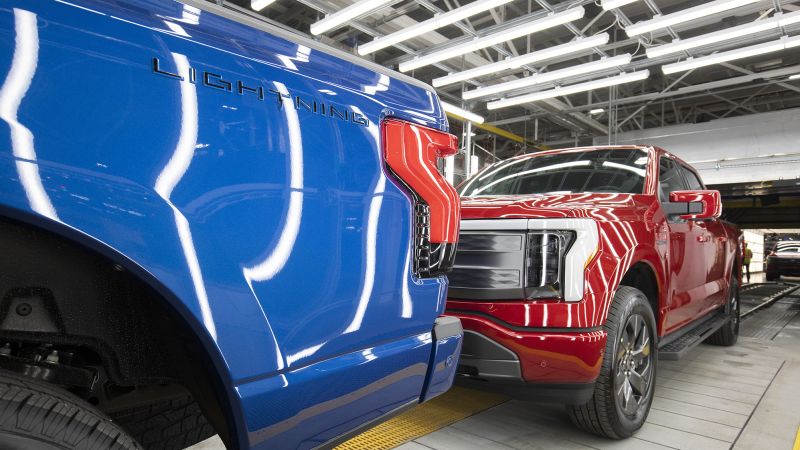
A huge ICE vehicle construction infrastructure that they don't want to throw away.
The idea that auto maker employees can't adapt to building EV's is pretty absurd. Interesting that upper management/execs are not being tossed out as well. You would assume they would be the group with the most outdated knowledge in a changing market. I know this did happen with Toyota, but you don't hear much with the likes of Ford. They seem as backwards as ever when it comes to selling cars.
TLDR Efficient, nimble innovators can kick the can, laggard incumbents cannot.
As the below article notes, it’s a balance and pushing risk around.
https://www.detroitnews.com/story/business/autos/ford/2020/0...