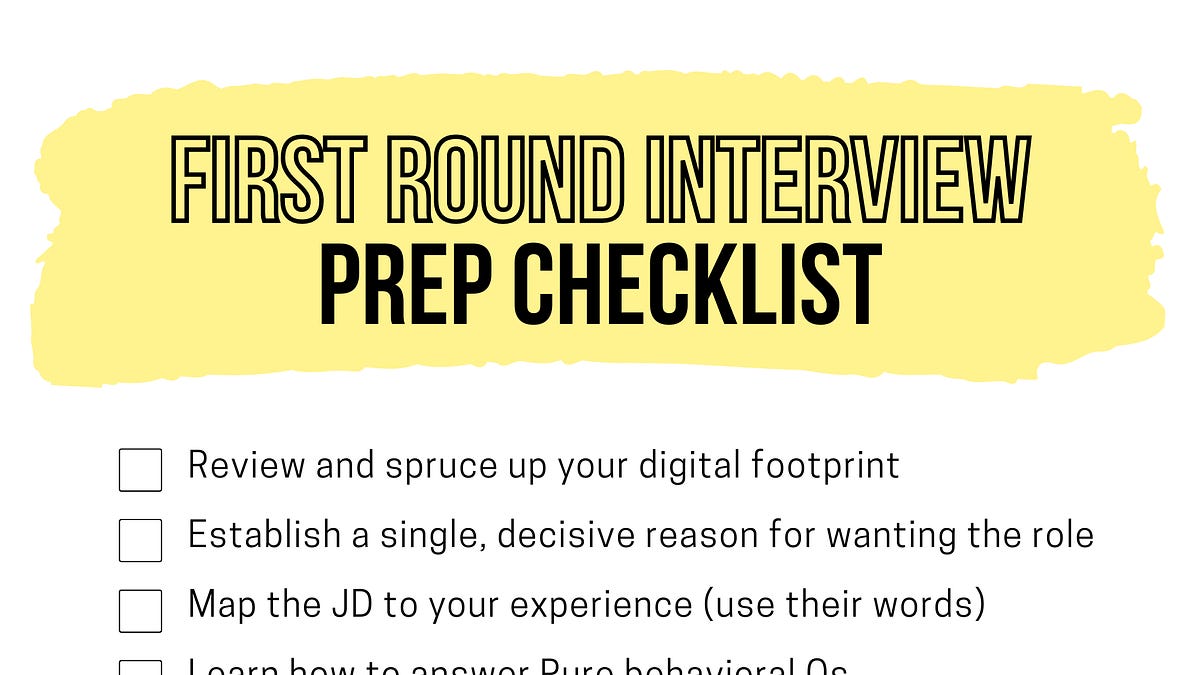
How to pass any first-round interview (even in a terrible talent market)
Learn how to get that strong yes without burning yourself out with interview prep
lennysnewsletter.com
195 points · by jger15 · 3y ago · 215 comments
I've performed hundreds of FAANG interviews, and I categorize this firmly in the "interview astrology" side. In my company we don't use questions asked by the candidate to determine the outcome (at least not for software engineers), and often we don't even record them. It sounds good to "impress your interviewer with your questions" but we are mindful about biases that might favour some candidates e.g. those with particularly good storytelling skills.
My advice would be to not overthink it. Just ask the questions that are genuinely important to you, and don't try to focus on impressing your interviewer.
But early-stage companies are looking for folks who have an interest and understanding in the task at hand. For many hiring managers at these companies, expertise – or at least interest – in the problem space is noteworthy. On the hard-skill side, it can suggest that you may be able to help see around corners with your product team, identifying and solving issues during planning or on the fly. On the soft-skill side, it can suggest that you’re bringing positive energy and motivation to the still-nascent team.
In the end, it’s still a matter of knowing your audience and reading the room. It may be a waste of time in some places, and may be the difference-maker in others.
Folks at 200+ and especially FAANG companies are mostly interchangeable. The interviewer is mostly derisking chance of a dud and comparing a 86%er vs 87%er. A few exceptions like at the rarer million dollar comp level. For everyone else, especially non-insiders... Cookie cutter comparisons it is, and whatever edge.
Startups are very much making a more existential bet. For our openings, I'm equally looking for ownership, interest in our customers/mission/long-term, and other bits that have little to with a whiteboard. On a HN Hiring thread from yesterday, you'd be surprised how many emails I got that were 'here is my stale CV from 5-10 years ago' and little about why they're excited to do hard things with us. Likewise, if someone is on a second round with us and hasn't bothered to use our free tier, that also tells us a lot about their (dis)interest in doing for what is, for everyone else on our team, career-defining creations.
I took a career pivot from web forms /rails to AAA playstation games. I played the game after they flew me to Seattle and gave me an offer. It involved buying a PlayStation 3 and their previous game. And that's an obviously cool job. Bought it right after I landed home and played it the next morning. Accepted the offer a few hours later.
This is on a completely different planet from my experience as a candidate and as an interviewer.
It looks like you're doing interesting work, and it might be great to work for you. But that's true of a lot of other companies. You're asking for a level of interest and dedication to your company that is completely unwarranted at this stage. For all I know you're about to ghost me. I suspect a major effect of your approach is that you select people who are better BS artists and have fewer employment options.
Now that you've said it on HN... soon, most of the applicants you get using your free tier by second round will be doing so because that'll be added as a standard part of the generic tech jobs interviewing ritual for people who just go through the motions (along with memorizing Leetcode, and practicing good-sounding lies to behavioral questions).
I was about to write a moderately snarky comment and went to your profile to check which Java banking middleware or Rails-based Uber-for-dogs your startup is building for applicants to be excited about... but looking at the description your company seems quite interesting! Sorry to hear that you've got flooded with generic low-effort application from disinterested people. I guess in current job market some people just desperately knocking on all doors hoping to get any job at all.
This makes sense. After a first round, if I'm still interested in a company, I want to dig in and find out everything I can to see if they're a likely fit and signing up for a free tier (if there is one) is absolutely a no brainer. And it's usually is a great way to form some meaningful questions to ask in the next round of interviews if I AM interested.
As an interviewee, I refuse to put any effort into gaming the system and hoping to come across as a better candidate. I treat these sessions as me interviewing them. And yes, this means that a lot of times my questions will come across as banal. But you can get some decent signal on red flags by asking several potential peers to describe their day, challenges that they're facing, and that sort of thing.
That reminds me of this part of the article: "You can use mirroring in your interview process. How? Use their language when describing your experiences."
I consider mirroring to be a form of gaming the system, or at least something that can backfire. Having heard many interviewees parrot back terminology they didn't really understand, I'm sensitive to when somebody is trying to dazzle me with BS. I'd much rather hear an interviewee use much simpler, even non-technical verbiage, when describing things than try to use the words they think I want to hear.
This is something missing from all the "interview coaching" advise and very few people seem to understand.
Suppose there is an actual technique that allows you to get a job you otherwise would not get. Say, hypothetically, you used it to become an astronaut. Do you think you perform well as an astronaut even though the selection process would have culled you? I'd imagine you get kicked out anyways so all you gained is a line in a resume. The same advise also insists that having a whole bunch of 0.5-1 year "gigs" in your work history is normal, but is it really? Do people really believe hiring managers don't see the pattern? Does anyone really think that people go: "Oh, we should hire this person, he worked in all of FAANG, one year in each, must be very good!"?
People are terrible judges of character and interviewing is every bit the shit show dating is.
Yes, and it's not even remotely close. It shouldn't really be surprising, "code up an algorithm that some genius needed half a lifetime to develop, but from scratch, in 45 minutes, on a whiteboard, while being watched, with the job on the line" has nothing whatsoever to do with what you'd do at the actual job. So why would the interview be a predictor of job performance?
Anyway, neither of those things is binary, if you ask me, I would really advise into getting some amount of preparation; but if it too useful, it's actually a red flag.
I don’t think I ever made a decision where the questions factored in at all; most of the time there’s more than enough material in the actual interview to cover a decision being made.
E.g. design a document storage system
Asking about requirements can help provide evidence you're aware of tradeoffs, various concepts, etc. and separate yourself from other candidates. Not surface level "what QPS do we need to support?" type questions, but beyond that.
Otherwise, yes, I agree, questions are not recorded and don't matter (unless there's a serious red flag like someone asking if they can avoid working with $GROUP_THEY_DONT_LIKE which raises HR type concerns)
And no, not really. My job is to assess their technical skills, not how well they ask me about my work life balance while in a relatively high stress environment.
An apt symmetry, as typically the questions a candidate gets asked during an interview also have no overlap to the questions they would get asked as part of the real job.
If I am interviewing at a company I certainly want to know that I am not going to be working at a dumpster fire. I want to know how you internally resolve conflicts relating to code reviews for example, so I know that you uphold standards and dont just allow things to get progressively worse as time goes on due to systematic indifference. Now you could be lying to me but that's why I ask more than one question. Certainly to me it feels like if a candidate is asking these kinds of questions during an interview process then that candidate also cares about those things, which depending on whether you are running a java sweatshop or an organized and productive development company seems like it would have some importance.
When I'm actually working at a place, I don't need to ask those questions. I already know the answer.
I would be worried if someone nevet asked about the thing they were going to be working on, asked why certain design decisions were made, or asked how it gets developed.
after all that, I feel the candidate deserves at least 5-10 minutes at the end to ask their own honest questions without having to worry about what they're signaling.
if not how do you decide to allocate them?
Questions really distinguish you from other candidates more than answers because the fact that they're unprompted means they tell me more about where you focus your attention than do the answers to my questions.
> My advice would be to not overthink it. Just ask the questions that are genuinely important to you, and don't try to focus on impressing your interviewer.
With all of that said, I still 100% agree with this. The ideal result is that you ask me questions about things that are important to you and that I find those questions compelling - then we've probably got a good match.
But do make sure you have some thoughtful, researched questions. Those are always better than "what's the best thing about working here?" regardless of topic.
As an interviewee there is nothing you can do that will universally be read as a positive across all interviewers. There are so many contradictory rules among interviewers that you might as well not bother gaming the system and do what you want to do. Let the chips fall as they may.
As an interviewer, no filter you put in place will give you a perfect read on what it's intended to test. For instance I know I have my quirks in terms of things that'll turn me off of a candidate based on resume alone. But I also recognize that many candidates are coached to do it this way in the first place. So I need to be conscious of this and try to not interpret these things as "shitty candidate"
100%. This is what makes me roll my eyes in all of these threads. Do enough interviews and you'll see people regularly dismissed for the most pretty and inane reasons. Hell, just the other day in one of these threads you had someone saying that they rejected a candidate because they said "bro" too much. No amount of interview prep, "They Hate This One Weird Trick" blogs, or hiring astrology will beat the fact that there are humans sitting on the other side of the table. And humans are weird and finicky
Getting a new job is a big deal - either you're about to quit somewhere and presumably you're looking because you care about finding a new employer that's better on some axis than your current job, or you're out of work and desperate to take anything, which is fine as well, but if you don't want to just admit that, you should probably have some idea of what to say otherwise.
And then you are left with "polite questions", fillers.
I assume that does not include scenarios where the large company interview claims they can't answer questions about a specific job until much later after a "team matching" step.
I agree with this, except in one sense that I think lends to the point of the blog post.
The questions you ask can drive perception of how you might act as an employee. On more than one occasion I have asked a question about X at an interview and then had a subsequent conversation with a recruiter where they ask "is [something related to X] a concern for you?"
I've not ever had one discontinue me due to it but it shows what's coming up in conversation at the interview debriefs.
If I already know the answer I have to consciously remember to still ask questions at the end....
No worse interview feeling of suddenly thinking of all the questions you _should_ have asked after youve left the meeting...
I put my cards on the table to show that I've done my homework and establish what I know already, then elicit more information. If there's nothing more to be said, then fine, but at least an interviewer who cares what I ask will know what I'm curious about even if I already happen to have an answer. And if I'm wrong, then it gives them an opportunity to correct the record. Or it gives them an opening to provide additional nuance.
hundreds??
So that's at least 200. Assuming you interview for the 5 FAANG in parallel, and you have, let's say 5 rounds per application (and you do reach the 5th). You would have done the whole process 8 times. Assuming they let you apply only once per year, that means you have interviewed at the very least every year for the last 8y. okay.
That doesn't match any interview processes I've been involved with. If you are running an interview process for ICs (which this article clearly targets), you should put the highest signal questions first.
That usually means a somewhat easy coding question. If people fail that, then you can immediately eliminate them from the pipeline. If they fail a hard coding question, you usually need more signal, which means more wasted time.
If your culture fit / behavioral question is good at weeding out candidates, then there's probably something seriously wrong with your hiring practices. Sociology studies show that those questions are more correlated to drinking the same brand of alcohol or playing the same sports than they are to job performance.
Other studies show that diversity significantly increases team performance, so filtering people on whether you'd like to hang out with them during the weekend is fraught with technical peril.
While I agree with you, what do you make of the claim in the article (that I've seen elsewhere) that behavioural questions are x% more predictive of job performance than technical questions?
I had a candidate that didn't believe they were allowed to make decisions, just carry out edicts of "the leaders" even if terrible idea. They didn't believe they should ask questions to clarify or help structure the request. This person has worked at a higherarchial bank then a rule by fiat game studio.
There's no way I could have used this person at our company. Didn't matter their tech chops. They would have been a disaster. In this case behavioral would have caught them.
Instead I asked a tech question which they failed hard and started blaming the recruiter on for not knowing this was a tech position. I tried pivoting to behavioral and it went downhill from there.
I had to try and save the interview by talking about games war stories for 45 minutes taking us over by 30 minutes. It was not great.
But if I had caught it with behavioral I would still had to ask the tech question for fairness. So I'm not sure what would have helped.
However, we had a very high, quantified technical bar, and the recruiters were extremely good at selecting candidates that had demonstrated success elsewhere (top of class, winning coding competitions, managed teams, shipped stuff, worked with trusted engineers / researchers outside the company, etc, etc.)
The result was the strongest team I've ever worked with. We ended up having to let go about 1-3% of new hires, sometimes due to technical skills, sometimes due to lack of motivation / team fit.
More behavioral questions might have filtered out half of the people that didn't work out. However, we also ended up with some socially awkward, uber-nerd types with performance that was way above that of the stereotypical 10x engineer outliers. (They weren't awkward in a hostile work environment way -- those were not tolerated, and were usually filtered out via interviews! Instead it was more things like not being great at getting credit for their work, or at reading social cue's like "I'm busy", or "I have no idea what branch of discrete warp manifold <-> flux capacitor interconnection techniques you're talking about, but I see you're going to keep talking for 10 minutes")
So, if you're at a giant company with a low bar where organizational stuff matters more than technical contribution (like, say FAANG, where hiring targets are in the 1000-10,000's, not 10-100's), then behavioral questions make sense. (No offense to FAANG, but different stuff matters in larger companies.)
If you're at a smaller place where all-by-all communication still works, then I'd suggest keeping an extremely high technical bar, mostly ignoring the behavioral stuff, and then figuring out how to make sure you retain technologists that are not ladder climbers as the organization grows.
I've had a ton of trouble finding good research on this.
Studies have shown.
Ah yes, “studies”, no doubt by “experts”. Think about how ridiculous this claim is in the context of a software engineering team. What mechanism is supposed to be at work?
(With one exception - gender differences, that’s perfectly plausible).
But that’s got nothing to do with individual teams (unless they’re huge) which are far too small to exhibit population-level statistical behaviour. I see this claim repeated often but the sources always end up being these flimsy studies of company-wide public company reporting correlated with market performance.
Where I'm at:
* I don't really know what other people mean by "conflict", so I probably go for examples that are more charged than is necessary.
* When I hear "conflict", my head goes towards relationships with people who were widely problematic within the business (i.e I wasn't the only one who had difficulty with them), and more often than not, they eventually got fired or manage out -- so the conflict often resolved itself based on external factors.
* Minor disagreements, ie differing opinions on how to approach a problem, aren't conflicts in my mind. Because they had no long-term emotional impact on me, I don't tend to remember these well enough to spin a story or discuss particular conflict-navigation techniques or outcomes.
* I have one example where a CEO got an employee to do something unethical (and possibly illegal, not sure), and I challenged them on it. But this was kind of a no-win situation for me, I said my piece, he heard me, the particular instance was stopped, but I'm told he's still doing similar things today (I'm no longer at the company).
I have a story I use now. It involved a coworker with whom I had an oil vs water relationship for a couple of years. In retrospect I could have gone about it all a lot better than I did in the moment, although that was true for both of us. I don't have the perfect "And then I solved everything" punchline to my story, they were eventually let go. But, my journey during it all was critical to my own development. And that started me down a leadership path, changing the course of my career. So I talk about my lessons learned, things I wish I'd have done differently in retrospect, etc. I'm not painting a perfect picture of myself, but I do display introspection, personal development, willingness to take different approaches to resolve an issue, etc.
I do feel like too many of my examples (for this whole class of questions) are times I could've handled better (though I didn't handle them catastrophically by any means), that ultimately shaped how I think about such things going forwards (after a fair amount of introspection)). But I often seem to lack the examples of a subsequent situation where I put that into practice (pandemic meant I basically took a holding-pattern role for a couple of years).
One would think that introspection, recognition of ones own mistakes and being receptive to feedback would be a massive pro; but lately that hasn't been my experience when interviewing.
I've even been told that my lack of a good answer to this question was the only negative mark on one of the interviews for a job that I eventually was hired for.
My honest answer is that I don't generally have conflicts at work. I get along with people and generally handle disagreements easily. I haven't worked in an environment that was rife with conflicts, maybe I'm just lucky or maybe my definition of conflict is different than others.
I explained I was new to the group, had no special understanding of the code they changed or the tests that failed and wasn't about to deviate from SDLC principles when there wasn't a compelling need. In my view committing an untested change was what caused the trouble in the first place and I had no confidence that the fix they wanted me to commit would make things better. I suggested that they simply revert their change and come back to it later when they had time.
This only made the other person more irritated. They raised their voice and continued to demand I do what they suggested and I continued to politely explain that while I was willing to help them work through the problem, review their code, examine the data or follow any appropriately documented procedure, I wasn't willing to violate proper engineering principles this way. Their shouting started attracting some unwanted attention and they decided to just pack up and leave. Later that evening another engineer reverted their change and everything was fine again.
My manager asked me how I felt about the incident the next day. I said that although their behavior was irritating, I didn't hold it against them. Even the best of people make mistakes when desperate or rushed. Their mind just wasn't in the right place at that time. They really just needed to get away for a bit. What matters is that we move on, try our best to treat each other with respect and remember that we're all part of the same team.
When I ask a question like this I mean a disagreement, and I’d imagine that’s what most interviewers mean too. So I recommend you continue to search for a situation you can recall in detail.
If the answer is that they’re looking for interpersonal conflict, you should use a situation where you took effort to work past it with the person for the good of the mission/company. Your last story could work if framed that way but it lacks a moment where you found a way to move forward with this person.
Or just make one up. Ask silly questions, get silly answers.
All these interview questions just boil down to "can you carry on a coherent conversation and do you project a pleasant and social disposition" or even more simply stated, that you "are likable."
I don't care what your technical abilities are, if you are weird or fidgity or sweaty or can't make eye contact you are going to have a lot more difficulty getting hired. At least in the places I've worked. Work on your personality and your abilty to hold a conversation. The details don't really matter.
Is it better to learn something from the conflict yourself or is it better to help someone else learn something? Come up with different versions and A/B test them to see what kind of reaction you get.
Isn’t this what everyone does in interviews? If not, why not? It’s a storytelling game to get a job offer, not a deposition. I interview a lot of people and hope they’re telling me stories that are partially untrue.
I’m literally someone who took an inch off my height on my dating app profiles because I have slightly bad posture and didn’t want to misrepresent myself.
So you disagreed over something technical, like architecture. You show they you can handle conflict by not taking it personally, but involving other people on the team, and regardless of whether or not the outcome is in your favor, you thrash it out once and then stick to it.
- the scope of the question is usually "how do you reconcile your worldview, desires, and best interest with someone else's". When answering, I tend to first clarify to the interview that "conflict" is a word that has intense connotations for me, and then ask "Are you asking about a time I had to negotiate with a person that was coming from a different point of view or background, or about how I handled an emotionally charged situation?" (As a manager, it is more common that I do get asked about emotionally charged situations, which also take skills to defuse, just different ones.)
- At least for me, I often think of non-emotionally-charged disagreements as negotiations; there are absolutely negotiation skills to be used to resolve disagreements efficiently and effectively, and if you can't think of any, it may be something for you to practice. Do you often get what you want? When you do, is it mutually beneficial? How does that course of action happen?
- Sometimes you can sidestep the question and showcase better conflict resolution skills by thinking of a time you arbitraged a conflict between two other parties. Describe how you dealt with each party. Did you feel you were unbiased? If you were initially more on the side of one party, how did you set that aside to listen to the other person?
- Don't mention abuses of power (by you or the other party) in a conflict resolution question. Also don't mention conflicts that are primarily personal - the origin of the disagreement should be about work, not tone, physical threats, intimate history, etc.
- If you do have a story about building a working relationship with a known problematic person, so that your work with that person yielded good results and you didn't fall into the trap of a bad personal relationship with them, you can mention what you did to get there. E.g. "X was widely known for his temper and would often yell during code reviews. Although this caused problems with all his teams, and he doesn't work there anymore today, I always got civil, useful code reviews from X by sending him my points in writing in advance, and expressing that I valued his feedback which was why I wanted a trace of it."
In a technical interview, learn to recognize when the interviewer is trying to help you, and take notice immediately when they do. If they say, “Do you really need to use a float here?”, nine times out of ten what they really mean is, “Stop trying to use a float here.”
As an interviewer, it’s really unpleasant to be trying to throw a candidate a life preserver and have them keep shooing it away.
(Sometimes “Do you really need” questions are a trap and the interviewer is testing your confidence, but in those cases it’s usually said with a completely different tone.)
My other tip is for the squishy personality test interview: come into it smiling, and keep that up for no reason. The interviewer will usually start doing it too, and that leads their brain to think, “I’m smiling, so I must like this person.”
It is so frustrating when I word a question very specifically and the candidate doesn't answer it. Most commonly it's a question like "tell me about a time when you encountered a bug in production, how you discovered it and the steps to resolve it". And instead of answering the question, they tell me about what they _would_ do, if they _had_ found a bug. Or worse, they step me through some process that their company uses. I'm looking for personal experience, not what you read on a blog post once.
I also am mindful at the start of all of my interviews to tell the candidate I am not trying to trick them, I'm just trying to learn where they're at. So if I ask you for an experience you haven't had, that's totally fine - no one has done everything, we're just looking for the boundaries.
When you say "tell me about a time when" you are really saying "Tell me a prepared story about when".
In this case the person didn't have a prepared answer for that question so they went with a generic answer to show to you that they knew what they were doing.
They could have found & fixed hundreds of bugs in production over their career, but trying to recall an example that will make a good story during an interview is hard and risky.
The good news is they will prepare a story for the next interview at a different company.
Of course they do, it's only natural and smart. They hear your standard formulaic behavioral question and cut to the chase instead of being sheep.
If you want real answers, hold real, natural conversations. Don't read items off a checklist.
> Don't read items off a checklist.
I've gone through periods of interviewing 3+ candidates a week for months at a time. It's just not reasonable to expect me to have a unique and interesting conversation with everyone. There are things I need to get into.
Ugh, I've had this so many times and it's the worst. Often those candidates will pull that move multiple times in the same interview, too. Sometimes this is also paired with a level of oversharing that makes me think "wow, I sure wouldn't want a member of _my_ team going off and blabbing this much about _our_ projects when they start looking for their next job".
I still value them in principle, but it seems to be a skill that many interviewers haven't developed to the point where they're a net positive.
I'm not sure of a good way to re-target someone in that situation. I have let a candidate just go down that line before because they were making swift progress on it, and I gave them pretty good marks at the end for an incomplete solution that I was pretty sure they could have worked out eventually, but for other people it's much harder. I totally sympathize with the disruption of an interviewer essentially telling you "not like that" when you're frantically trying to come up with a quick and workable solution, but at the same time, you're probably not going to make yourself look good if you're putting together an increasingly obviously unviable solution by bolting on more and more logic as you find holes.
Another way to think about it is that these interview processes often have a ~ 1% acceptance rate, and the softball questions typically filter 80-90% of candidates.
So, yeah, it sucks for a qualified candidate if they fail half their interviews, but they'll end up getting a job somewhere. That's much better for them than working at a company where 99% of the engineers can't perform basic coding tasks or explain how products in their industry segment are designed.
Ah, the secretary problem: https://en.m.wikipedia.org/wiki/Secretary_problem
What does the average skill level in the pool converge to over time?
(This might be too hard for a whiteboard problem.)
A written engineering competency test (basically, an industry-standard set of whiteboard questions) sounds good, but, having hired credentialed-but-incompetent engineers from other fields, I can definitely say it helps a lot less than you'd think.
The first call is always about seeing if you even know that there’s a good amount of acting going on from both sides. You play your part and you’ll get to the technical interviews. People have a lower threshold for acting as you progress in the interviews and you can say more things that clearly aren’t good to say. (I.e. anything that demonstrates you don’t tolerate bullshit)
No one is complaining about this round of interviewing because it’s not a real issue or obstacle for anyone.
When I read "fired", I don't immediately think of "forgot a WHERE clause when deleting from a production database table". That happens, but I don't think I've actually seen anyone fired for it.
I think of it more like "you just gradually found you couldn't do the job, didn't meet performance standards, etc". In that case, the usually bland stuff about how the position wasn't a good fit but this one is seems to me like the way to go.
And "CV" suggests to me a non-American or an American academic - whereas some people in this thread may be in the SF bay area (although I'm not).
If you were hiring someone, think about what you would want, and what you want to know. Anything negative in someone's past, you do not really care about it, you just care they are past it and it won't have negative future consequences.
Avoiding the negative aspects of your past is not a matter of deception, but of proving that you are emotionally ready to move on.
On a written job application, which in my experience comes at the end after they think they want you, be honest, but read it like a lawyer and make sure you don't disclose anything that you don't have to.
Interesting and very well put.
What people who advocate the "fuck it, just lie" approach is that lying (about things one doesn't really need to lie about) can be more harmful to the person telling the lie than to its recipients.
I’ve continued to get new jobs and ones that were better than previous.
All these cases are technically the company's fault, not the candidate's, but they do often come out right after the screening call.
Since answering honestly is aparently a deal-breaker in your book.
Lying is part of the theater that is our current employer-employee relationship. Everyone knows this
But in regard to, you know, important stuff, such as matters of one's employment record -- you know they have ways of checking up on what you say, and that any company worth working for does exactly that -- right?
For me, the problem is that 95% doesn't reply to their application form or email box, so that's where I'd optimise for time spent.
Sometimes I get recruiter calls and interviews stemming from that I'd not classify as serious, like I might do 20-30 minutes beforehand to figure out what this company does and whether/how it fits into my life, but if I'm not actually looking then I'm not going to spend hours preparing my presentation. Seems to still work to get an offer, though; they seem biased towards those they initiated contact with
Interviewing has gotten out of hand...
No wait, that's not what they're talking about. They mean extra prep specifically done for that specific interview.
I don't mean lying about qualifications, or lying about jobs you've had in the past. But, I feel no compunction about answering a question like "tell me about a time when you had a conflict with a colleague" by making up a scenario that could plausibly have happened and hypothesizing about what you might do in it. The reality is that no two such scenarios are ever exactly the same, so a real anecdote would not be helpful, even if you happen to have a good one in mind (which I never do). Next time, the people involved (including you) are going to be different, with different personalities, a different set of problems and pressures and constraints . Forget it, there's very low predictive power in a question like that, even if the interviewer were qualified to analyze you. So, just tell them what they want to hear, and prove you speak the dumb language of corporate interviews.
Is this unethical? Maybe, but only to the extent that such questions are meaningful filters (which I believe they aren't). And it is surely no more unethical than answering a question like "why do you want to work for Company X?" by saying "I am inspired by the mission and the fascinating problems you're solving" rather than "the salary is higher than my current job, and I think it will make a good stepping stone to an even bigger salary at another company in a few years", which is what we would say if genuine honesty were what that particular discourse was trying to get at.
I resorted to this because on my LinkedIn interview, the behavioral interviewer kept pressing me when I told him that the situation never came up (I can't remember exactly what it was, I think if I was ever asked to work on something that I disagreed with) and it dinged me on my evaluation. So from them on, I would make up white lies to satisfy my interviewers. I also make sure to note what I say on my interview notes so I keep my stories straight.
Interviews want a certain "type" of answer, so if you don't give it to them, more often than not they will ding you. The same goes for Leetcode questions, if you get the answer wrong, you will get passed over, but if you get the answer "too quick", then you will get passed over because you were "too prepared", so better to just pretend to struggle and come up with the answer.
And in particular a lot of people seem to think it's impossible to lie and not get caught out, which... all I can say to that is I don't see how anyone who has lived as a human among other humans could possibly think that.
It's far better to just prepare an answer based on something that's actually happened to you, so if you have to explain further, there's something actually there.
- Have marketable skills and experience
- Market and communicate these effectively
- Take many interviews because too many are arbitrary and some are terrible places you don't want to work
- Aim to be fit, in good health and spirits, and presentable
- Be honest
In general, everything works out because the synchronicity of individuals and organizations is a self-selecting phenomenon.
Unless you’re interviewing to be a personal trainer, this doesn’t really have any relevancy.
Like yes, be presentable, don’t be a slob. But you don’t have to be “fit” or “in good health” to land a job.
And being fit (not to be confused with a hulking mountain of muscle) and in good health is a large part of looks.
As long as you look presentable, your skills outweigh looks by magnitudes.
Below is a story about how insisting that a fitness instructor look physically fit is unreasonable and sometimes illegal.
The icing on the cake is that her day job is said to have been in tech, in SF.
`` Jennifer Portnick, a 240-pound San Francisco aerobics instructor rejected by Jazzercise because of her size, has reached an agreement under which the firm will drop its requirement that instructors look fit.
After weeks of mediation with the San Francisco Human Rights Commission, Jazzercise Inc., the world's biggest dance-fitness organization, agreed to change company policy.
The case, which drew international attention, was the first to be settled under San Francisco's "fat and short" law, an ordinance barring discrimination on the basis of weight and height.
"I'm absolutely thrilled with this outcome," said Portnick, 38, a computer systems training manager who works out six days a week and has sufficient stamina to lead back-to-back aerobics classes.
"I'm lucky to live in San Francisco, where there's a law to protect people like me." ''
https://www.sfgate.com/news/article/EXERCISING-HER-RIGHT-TO-...
Do you have a scientific study that proves any of this without a doubt or are you just pushing your own biases and societal norms onto candidates?
Most of the places that just laid off are also mandating work from office, and are having a very hard time with attrition and hiring.
This is a perfect time to go to a company without those problems, since they'll be hiring much better than average these days, and, with any luck, their major corporation competitors are going to see their roadmaps implode.
First round to me is typically a “bozo filter” - screen out individuals who are clearly unqualified or who are an obvious bad fit.
Any decent dev should get past round 1 without significant prep.
1) You are applying to a role you don't meet the minimum requirements for.
2) Didn't take the time to research about the company, salary and benefits, the product/service and the team you'll be working with.
3) Unrealistic expectations about compensation and benefits, which you should have researched above.
The rest is just having a casual conversation with another human being, so if you have communication skills that's another issue you need to resolve.
Really if there's a mismatch in salary expectations then it's not that you failed, it's that the company failed to effectively communicate this information and wasted your time on an introductory call.
Bad: “this is a developer for the lookinglass team”
Good: “this is a developer for the team that builds monitoring tool”
A lot of people don't even realize they're doing this. In particular, people who have spent a significant portion of their career in one company (junior devs, long timers). They're used to thinking of these terms as everyday knowledge.
Every time I’ve been asked about a conflict I’ve had and how I resolved it, I die a little bit inside.
- The task at hand was to recall (or, for that matter, invent) a situation involving a conflict at work, and convince the interviewer that I handled it with aplomb.
- And so, I proceeded to recalling a situation involving a conflict, explained the Situation to the interviewer in detail, outlined the Tasks I was responsible for, conveyed the Actions I took, and related the Result of my actions.
- Result: I died a little bit inside, but the interviewer was very impressed and offered me a job on the spot.
I never know which way these are meant to go
What's wrong with "I made sure nobody got a pay cut"?
Totally useless guide.