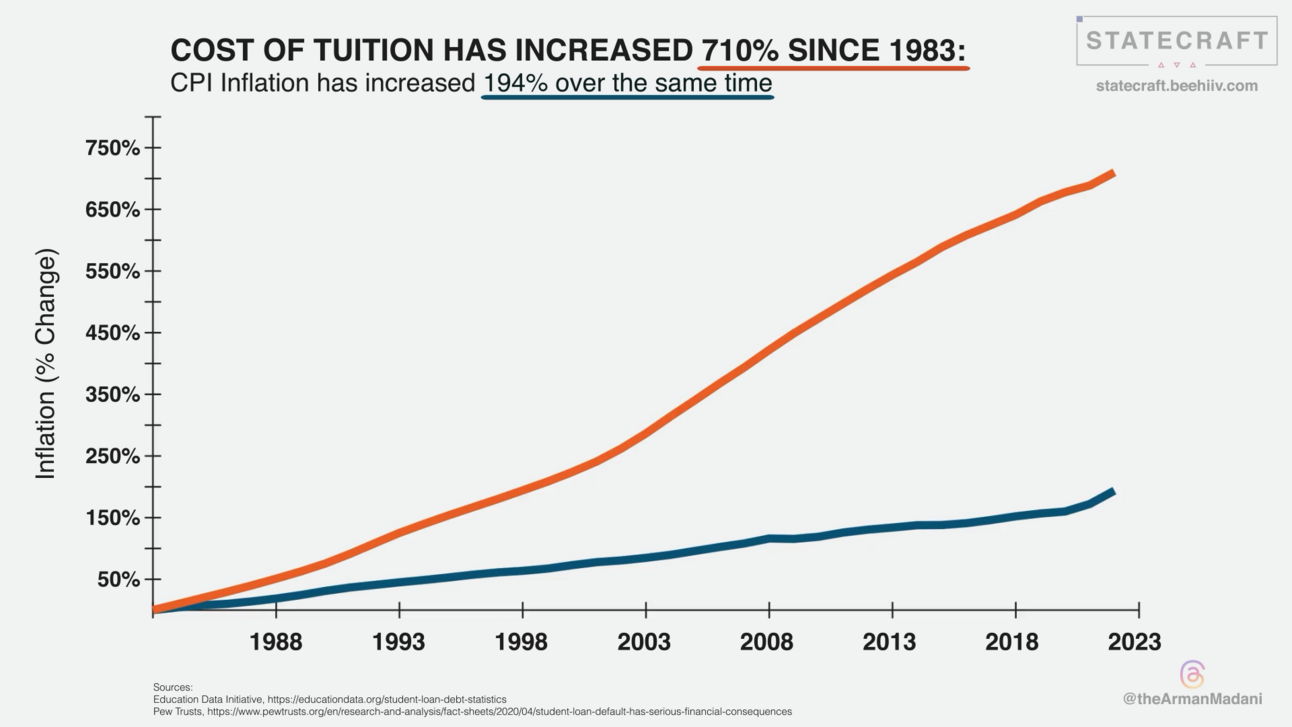
The Student Debt Crisis, Explained.
We weren't ready for a 710% increase in college tuitions from 1983 to 2023. The debt is now 1.78 trillion dollars, with 93% of that held by the government.
STATECRAFT
720 points · by armanhq · 3y ago · 744 comments
It is frustrating to hear the discourse over the inappropriate students that are taking on too much debt, all the while ignoring the lenders that are taking on too much risk. At least, they would be taking on too much risk, if they hadn't captured the market so effectively.
It is really strange that government does not constrain tuitions of the colleges participating in the loan program. Currently, Universities have no incentives to control costs in any way.
(This message brought to you by people-with-thing-to-sell.)
What I have never understood is why career counselors aren't advising students against the downside of getting into so much debt so early in life. Going to your dream school is nice but not if you have to pay for it the rest of your life. My counselor was all about applying to the best schools with little talk about costs.
Why aren't student's suing the counselors for malpractice?
Most universities are the supporters of the existing government structure, so it seems to be a mutually beneficial relationship.
The lenders are taking no risks since these loans cannot be discharged through bankruptcy. There are also very large late fees and penalties that can triple (or more) the amount owed.
I went to school from 87-91. I could already see the problem starting. I was hoping this bubble would burst before my own children went to school. Two of three have gone to public schools so far, and we've paid through the nose for it. We are pushing our third towards some sort of trade school.
- https://studentaid.gov/manage-loans/forgiveness-cancellation...
- https://www.consumerfinance.gov/about-us/blog/busting-myths-...
There's inherent risk to everything, everywhere. Making the loans undischargable in bankruptcy doesn't negate the risk of non-repayment; it just hides it. Until, eventually, all the band-aids fall off, reality bares its ugly head, and we all wish we hadn't-a done that. Yet, in thirty years we'll forget about it and do it all over again, in some new, crazy, way.
I went to a major private university, and several years after I graduated they raised the tuition 24% in one shot. When asked why, they basically answered, "Everyone else did it."
It's time to revoke universities' tax exemptions when they pull shit like this, or are rolling in massive endowments, windfalls from sports programs, whatever. The regression of education in the USA at all levels marks the continuing decline of our society. We've gone back to book-burning in some areas. Now college is unreachable or a crushing burden. WTF.
The lenders? Risk? 93% of all student loan debt is owned by the US Government. What risk?
How is it everybody pretends it's the Big Evil Bankers making all the money on this racket? It's equivalent to the false narrative about private prisons driving the high US incarceration rate (when in fact it was over 95% government prisons across the decades that the rate was skyrocketing).
It's a government replacement funding system for the entitlement programs that are bleeding out. They had to find a new funding source as entitlements dipped red, so they're strapping young people with massive debt (forever rising interest payments) they can't discharge and that derives from magic fiat dollars the US Government 'prints' at will.
This is another case of the government abusing the population.
Anti abortion laws? Government.
Anti gay marriage laws? Government.
Anti trans laws? Government.
Segregation laws? Government.
The war on drugs? Government.
The war on terrorism? Government.
Foreign adventurism wars? Government.
Vast illegal domestic espionage? Government.
Non-existent social security 'lock box' (not filled with $10+ trillion like it should be; should be the world's largest sovereign wealth fund)? Government theft.
How many examples do you all need?
That is, no amount of lending is ever risk free. To pretend that you can hedge all risk out of a loan is the problem. It doesn't matter who issues it. It doesn't matter why they issued it.
So, to put the question back to you, why would you feel there is no risk in lending to students to go to college?
But as you point out, the lenders are not taking on risk. The only ones who are silly in the deal are the students.
The system is really messed up. But when it comes to your individual student making that deal, it's often a dumb idea.
It's designed by the US Government to bring in massive, on-going funding to help fill in the red ink in the entitlement programs now that those are no longer funding sources to steal from (entitlements used to produce persistent surplus funding the politicians used to steal from for decades). That's why they'll never allow it to be dischargeable. Their margin on the loans is de facto 100%: it's all magic printed dollars or otherwise taxpayer dollars (makes no difference to them).
7% interest on a loan in a year with 3% inflation (the real cost of having money that year) that is guaranteed to be repaid seems like evidence of corruption to me. But maybe I think too simplistically.
AFAIK virtually every financial institution has been pulled from student loans.
The U.S. government is now the only major lender.
But then, how do you secretly replace the billions in bribes to your friends in the universities?
This was among a debate where people were asking for more federal and state funding.
Its crazy to see this point become so mainstream. I suppose it was inevitable if it was the truth.
"We want everyone to have a chance at school, but public schools are government indoctrination so we'll just make sure people are in un-releasable debt to private companies."
"We don't want to see people dying in the streets, but universal health care is "socialist", so we're create these convoluted insurance systems, but still require hospitals to provide free ER care (that has to be covered by everyone else in the end)."
"We're afraid of immigrants, but our agricultural industry is dependent on their cheap labor, so we'll make legal immigration difficult, and keep pretending that we're going to restrict illegal immigration, but never actually do anything effective to curb it."
(I also want to add that mentalities like this are not at all exclusive to the US - you can find similar inconsistencies in every countries self-image, the US just seems to have them in more fundamental issues that other countries made a decision on long ago)
https://studentaid.gov/understand-aid/types/loans/subsidized...
You can only borrow $31k over 4 years. That isn't a lot at all.
People can get unsubsidized loans that still come with the same constraints around inability to discharge in bankruptcy for vastly more money.
It’s essentially all unsecured student loans (i.e. effectively the entire student loan market) that have this risk free model for lenders.
It would all be completely toxic trash otherwise that no lender would issue. A student with no assets, no income, and no credit history to preserve has no downside to just declare bankruptcy after school and get $200k or whatever essentially for free.
But PLUS loans themselves have no cap, so the amount of potential federal impact on potential costs for this population—which, as you note, is most undergraduate students—is infinite, not $31K over four years.
And that is the principal. With a short limit on how much of that can be subsidized, meaning the rest is accruing interest from day 1. Such that they amount you would owe will be laughably higher than even that number after your school. And that is assuming you don't have to then delay repayment for financial hardships.
But the government has "protected" all loans - private education loans are also unable to be discharged by bankruptcy, for example.
But grants, you say! We can avoid loans. Not so fast. If your parents made a certain amount, they are fully expected to pay a certain amount for their now adult children to go to college. To qualify for any aid, you need your parents’ income, demanding that A middle class family may still be fully expected to pay multi-thousands of dollars. The student must then take out loans to pay for the rest, which might be the full amount.
This is certified, nonsensical, bullshit. No credit system in history has been given the grace to royally fuck over generations of students, saddling them with loans that cannot be discharged, whose amount is effectively dictated by the institution that is charging tuition. This is a scam at the highest level, sanctioned by the federal government, and perpetuated by every adult figure in the students’ life.
Systems where there is competition, but where efforts are made to make the service providers not really have big advantages for cutting costs, will get you bad outcomes. It's just unfortunate that avoiding needing healthcare, or going into many careers without paying for the very expensive college degree, is such a big gamble.
A fully public system would be very different. An unsubsidized market system would also be very different. Either one would be dramatically cheaper than what we have, which gives us the worst incentives of both worlds.
[0] https://educationdata.org/average-cost-of-private-school
Please correct me if I've made some mistake, but plugging those numbers in shows that the annualized real increase in price is 0.5% per year over 20 years. Looks like doing the same thing for public 4 year college over the same timespan results in an annual real increase in 2.1%
Edit: it looks like there is an error on this page. The bar chart the numbers are much higher. Anecdotally, private high school is always more expensive than private elementary. That is what the bar chart shows but not the bullets.
Btw private school looks quite affordable. I used to think my neighbor was rich, they were, but for only $20k/yr you can send 2 kids to private school? That is cheaper than daycare.
If you're paying $20k for private school, and there's a free option (public school) - you obviously have a healthy amount of disposable income.
So we need to resolve that issue as well if we're to stop federally backed loans. There's more things at play as well and the convoluted mess is the real reason we haven't solved the problem. Realistically, this is probably true about most of the larger issues we face. I'm concerned that over simplifying the problem statement results in an over simplification of the solution and it just causes us to argue (which can be supported by evidence) or take ineffective/theatrical action rather than actually resolving the problem (meeting the intended goals (plural)).
We can keep having this conversation over and over, but it has happened for well over a decade now and no real progress has been made. We gotta start looking at the actual complexity of the situation as first order modeling isn't good enough.
IMHO, easy access to credit is one of the best things about the American economy, and hiring MBAs to manage things that aren't for profit corporations, one of its worst aspects.
Not-for-profit businesses are still businesses; they need to take in as much as they spend, whether it's through fees for service (e.g. tuition) or donations. Colleges and universities in the US spend a lot of time begging alumni to donate money.
And yes, there is education and training specific to running a not-for-profit _business_, and many GOOD leaders have MBAs. I have watched a lot of them fail because the folks at the top did not manage money well.
One of the most crucial components of operating a 501c3 is the financial statements reporting requirements[1]. From an accounting perspective, the organization cannot keep retained earnings (owner’s equity) balance at year end since there are no owners. Rather than having retained earnings, 501c3s deal with net assets, which no person can have ownership of.
The crucial thing here is that the business does not retain profits at the end of the accounting period. However, it can earn what we would call profit in a non-501c3 scenario and then use that money for business activities, paying employee wages, investing, etc. Accordingly, a 501c3 can take in more than it needs to spend. It just has to properly handle that excess money to meet the accounting standards.
See the Wikimedia Foundation’s financial statements[2] for a great example. They spend a minuscule amount of their net assets on actual business expenses. They spend quite a bit on wages, travel and conferences, and various other things that are arguably unnecessary to serve their core mission. However, they follow all of the accounting guidelines and are therefore granted reasonable assurance that they are fairly representing their financials according to KPMG.
Back to the initial topic, it’s now clearer to see why and how a university such as Harvard can be a 501c3 and bring in exorbitant amounts of “profit” that probably do not better serve their core mission as an education center. However, it’s all about following rules and how you spin it. Harvard isn’t begging alumni for donations because they need it. They had $61B in net assets at year end[3]. I think it’s completely fair to argue that Harvard doesn’t need that much money while they deliberately stay at their current size. In fact, I would argue one step further that they have so much money on hand, they shouldn’t even be charging tuition. Their $59B investment portfolio makes up the bulk of their net assets. From a book perspective, they are essentially an investment fund with a university attached.
Looking at a public university, the University of Texas ended the year with a $66B net position[4]. They paid their football coach over $5[5] from their massive pool of assets and are still paying their former head football coach tens of millions of dollars.
I would be interested in hearing if there are universities in Europe that operate like this. Quickly looking up the aggregated statement of financial activities for all Oxford colleges[6], I see that they had a 63M£ expenditure (loss) but carried forward 1.35B£ to end the year with positive funds carried forward of 1.36B£ (after a prior year funds adjustment). That’s incomparable to Harvard. As a CPA (who is not an expert on UK tax law), Oxford’s financial statement appears much more inline with the spirit of what I imagine a non-profit university should be. Harvard and the University of Texas look like two of the most successful companies in America to me.
[0] https://www.irs.gov/charities-non-profits/charitable-organiz...
[1] https://www.fasb.org/document/blob?fileName=ASU_2016-14.pdf
[2] https://upload.wikimedia.org/wikipedia/foundation/2/26/Wikim...
[3] https://finance.harvard.edu/files/fad/files/fy22_harvard_fin...
[4] https://www.utsystem.edu/sites/default/files/documents/repor...
[5] https://www.texastribune.org/2021/02/22/steve-sarkisian-sala...
[6] http://d307gmaoxpdmsg.cloudfront.net/collegeaccounts2122/agg...
I feel you also need to argue: "18 year olds don't realize they are being ripped off", or "college is actually worth that much". It's probably a different answer for different students.
Most other developed nations manage to send every smart kid to college for ten thousand dollars per kid or less. Once again, it is only the US that thinks it is a special butterfly that can't somehow manage to give kids college. Sure, most European colleges don't spend one billion tax dollars on a football stadium, but that is also a good thing.
And no, those sports complexes largely DON'T pay their own way. A significant amount of college sports don't make much money, and don't give it back to the campus as a whole, and that's WITH literal free labor of NCAA athletes.
Does this mean ability to read, write, and do arithmetic? Does this mean the ability to speak and read Latin with an understanding of the classics and the Bible? The ability to fix a car and build an engine? Program a computer?
One could argue that a university does very little to make a populace more educated, since they can already read, write and do basic math (or should be able to) to get into school. Is taking psychology making one better educated? Maybe? Maybe not.
And yes, college sports on the whole does pay for itself. Those stadiums are built by donated money, and revenue from ticket sales. Yes taken in isolation there are a lot of sports that don't make money, but they are subsidized by those that do (chiefly football and basketball). Sports stadiums are not the reason tuition has inflated by 700%. They are two separate pools of money. If you got rid of sports entirely it would not affect the finances of the academic side of the university at all.
One half is easy access to loans, the other half is student debt relief programs.
Between the two, colleges know they can charge absurd prices and pocket the money.
It's awful, and I wish someone was doing something to stop this. It cannot go like this forever.
...which student debt relief programs?
Afaik there are no widely used student debt relief programs.
Its only half the problem because you'll still see inflated housing as well but at least its something.
https://www.nytimes.com/1987/02/18/opinion/our-greedy-colleg...
Here is something interesting:
- Do your first two years at community college. A lot of states have zero tuition costs for community college credits. I think in all 50 states its the absolute cheapest way to do get your first two years done
- Enterprising students may realize that if you're married, FAFSA (which is used to compute both federal and state aid) will use your married income and not your parents. Most students make little to money while in school. This automatically games the algorithm in your favor. Tricky to manage socially.
If you have a kid who doesn't really know if they want to, say, be an engineer, then a 2+2 plan that they realize they aren't cut out for during the cheap years probably is a huge price save. But for the kid with the tools to succeed in school, a passion for a field that pays well, and the opportunity to get into a 4 year, they should absolutely just go for it off the bat.
The other problem with the 2+2 is that you're sacrificing 2 years of one of the biggest advantages of going to competitive universities: meeting other students who could get into competitive universities. I met most of my friends I made in college in the first 2 weeks, freshman year. It's probably the single easiest time in anyone's life to make new friends and acquaintances. And those friends, beyond being invaluable to me for social and romantic reasons, also have benefited me financially: one friend's dad got me an internship, which I was able to leverage into my first job. I got my second job by no small part thanks to the recommendation of another friend who already worked there. Looking back in time, the ROI on the bottle of vodka I brought to the dorm nextdoor move-in weekend is likely in the ~10,000,000% range.
Transfer students get a greatly diminished version of that opportunity. By their upper-division levels, most students are spending a lot more time on school work, and much less time randomly meeting their dorm-hall mates. It's still possible to meet people, and my high-school friends who did the transfer route did meet some people, but there's a much greater than 50% loss in networking opportunity.
I’ve heard of other FAFSA games as well - last I heard the parents’ cars and primary residence were excluded from the FAFSA expected contribution calculation so middle class folks with a fat savings account might decide to buy new cars or pay off the mortgage or do something similar to make the cash “disappear”. Deferred compensation plans are used along the same lines for income. The fact that such games are viable is a shame but probably unavoidable unless we have government foot the bill for college.
The FAFSA is such a load of horseshit I don't even know where to begin with it.
I can’t think of an easier way for e.g. China to win the 21st century. American undergrad enrollment is already down. As the world gets more technical, that is not a good sign.
When an entire generation of Americans are priced out of higher education, who is going to develop the technologies of tomorrow? Should we assume foreign students will always want to come to our schools and stay to work in our companies? It’s not sustainable.
Right before I graduated, my school decided to build a new football stadium, because they decided using the city's stadium wasn't attractive enough for students. They promised tuition wouldn't be used to pay for it, and it wasn't. We just got something like $500 added to student "fees" instead.
I have no sympathy for universities and colleges in the US, only for the students who were duped into thinking they didn't have another choice.
Either the US will figure it out like every other developed nation has seemed to do, or there will be grave geopolitical consequences. Whether the US political/economic machine can figure it out is a question that only time can answer.
"Too many piglets, not enough tits" -AL
That's a very dangerous road.
Governments are not some benevolent creature which always acts in the best interests of the People. As a practical matter, governments are usually incompetent and corrupt (usually in that order), and try to get the masses to further the interests of the politicians, the bureaucrats and the donor class.
I want an educated populace. For that reason, I want government as far away from it as possible.
1) Increased demand.
2) Increased what the market could bear.
The result is Economic 101. There are no surprises here.
p.s. Note: Roughly the same applies to mortgages. The idea that more affordable mortgages (i.e., 30 yr) was going to make homes more affordable, is comical at best. With a relatively fixed supply, increasing demand is only going to have one effect on price. And the solution? The 40 yr or 50 yr mortgage.
Round and round we go.
Everyone says that, but I've not seen much actual evidence.
I tried to find evidence, by looking for tuitions of various major universities over time and seeing if there was any clear difference in the tuition growth rates before Federal loans and after.
I know the data is available. Most schools list tuition in their catalog, and have their old catalogs in their library, but it wasn't turning up in. Google searches.
I was only able to find historical data for Stanford, giving tuition by decade, and one big state school whose name I don't remember. Here's a graph of log10(Stanford_tution) over time [1]. I don't have a copy of the graph for the other school but recall it was similar. It looks like it has been growing about the same for a century.
I also remember comparing tuition rate increases to inflation, and found that tuition has grown pretty consistently at roughly 2x inflation both before and after Federal backed loans.
Easy access to loans may create large amounts of debt, but increased tuition fees are mostly -- though I admit my research isn't exhaustive -- a function of an effective decrease in governmental funding per student.
Australia effectively has price controls on both health and tertiary education. It isn’t perfect but it is hardly terrible.
I know the US pharmaceutical industry hates it - the Australian government uses its monopsony power to limit drug prices and hence drug company profits - and is forever lobbying the US government to use trade negotiations to pressure to undermine it (but hasn’t yet succeeded)
Universities can charge as much as they want - but if they want students to have full eligibility for government student loans and government tuition subsidies, there is a maximum they can charge. Students want that full eligibility, so for the majority of places they stick to the maximum
Reality is that there are so many other factors that it’s probably better to have some sort of price control as a form of regulation, instead of only focusing on supply/demand levers.
I’m not an economist so I’m happy to be proven wrong, but the stance of “x,y and z policies need to be implemented so supply/demand is changed to mitigate these issues”, but the reality is that politicians and the business landscape doesn’t incentivize such changes. For example, colleges aren’t incentivized to keep the cost low, housing construction isn’t incentivized because NIMBYs control what can be built where, etc.
So when someone says “well the economists don’t agree on that”, it really rubs me the wrong way.
The primary reason price ceilings are criticized by "both sides" is because the shifting Overton window has resulted in both the Republican and Democratic parties having quite neoliberal views. In an international context the two sides of the aisle can be described as "right" and "far-right".
Prices will collapse to what people are willing to pay in real time, or save up for.
There needs to be a middle ground where we support poor but promising students in a way that doesn't inflate prices. I don't know what that solution is.
Proper thing is for the government to stop issuing the loans, and instead do need-based grants plus establish cost and quality controls for institutions that wish to be grant eligible, while prioritizing federal institutional funding other than direct student aid for institutions that, whether througj grant eligibility or their own pricing and in-house aid programs, or both, meet set financial accessibility standards.
There’s a growth in admin [0] that I think is the proliferation of the most bullshit of bullshit jobs. It’s weird that I think the issue is much worse by basically funding all these admin positions that pay more than actual instructors and researchers yet I’m not sure what they really do.
I’d like to see universities advertise low admin:student and admin:instructor as measured of quality.
[0] https://yaledailynews.com/blog/2021/11/10/reluctance-on-the-...
https://oir.yale.edu/data-browser/faculty-staff/faculty/facu...
Universities are not just educational institutions. You can't just compare students numbers to employee numbers without also examining what the university does.
>Jesus went into the temple courtyard and threw out everyone who was buying and selling there. He overturned the moneychangers’ tables and the chairs of those who sold pigeons. He told them, “Scripture says, ‘My house will be called a house of prayer,’ but you’re turning it into a gathering place for thieves!”
- Matthew 21:12-13
>If you lend money to my people—to any poor person among you—never act like a moneylender. Charge no interest.
- Exodus 22:25
KJV used the word "usurer", but it's the same idea.
The Medici bank gained lots of their money from foreign exchange speculation issuing a sort of option for buying foreign currencies at a specific date (this would probably be a lot harder to do today), you could also charge late fees with the social understanding that paying a loan back on time is really bad for your credit score. I guess a modern conglomerate might make money by putting certain terms in effect: You want to build a house but need some money to do so? I will lend you the money if you contract my contractors to build your house. A university could lend you the money but keep charging extortionate tuitions as long as the cost for the education service is unregulated.
Fees are one option. If you agree to a 2 year loan of 100$ as long as they pay you back 110$ that’s acceptable, the difference being if it takes them 3 years you still only get 110$. Obviously this runs into problems with inflation and people skipping payments etc, but it’s one socially “fair” way to handle loans between friends and family.
Almost impossible to imagine given the current state of the economy where every possible thing you can imagine has been commodified.
It is where the whole "Jews are greedy bankers" stereotype comes from: during the Middle Ages Jews were allowed to charge interest to non-Jews, so they were essentially the only people who could act as bankers for Christians. Combine that with a large dose of racism keeping them out of a lot of other jobs, and you end up with a lot of Jewish bankers.
This is the exact problem. Whoever makes the loan has an incentive for eternally increasing prices.
1. State govs have reduced funds to all public colleges. 2. Fed gov has refused to increase grants such as Pell on inflation basis.
And that is way before the other forces of price increases and demand increases.
Remove this "free money guarantee" and watch how market corrects itself. When students can file for bankruptcy and/or the debt is not guaranteed by Govt, lenders would now use the same criteria they use to issue credit cards to 18 year olds. Hint: It's tough to get your 1st credit card if you have no credit history in the US and most lenders will not even entertain that idea. Some will do if you put in a collateral like $500 of actual cash deposit to guard against the default risk.
When lenders stop lending or get strict, colleges will have to consider how quickly and by how much they keep raising costs.
Is that true these days? At my university 20 years ago, the credit card companies would bribe 18-year-old freshmen to sign up for their cards.
The conventional wisdom at the time was that (a) we were college students and were therefore more likely to have earnings in the near future to cover those small credit limits, and (b) we were college students and were therefore more likely to have parents to bail us out if we got in trouble with the credit card, and (c) there's no better time to snag a lifetime customer than at the very beginning of their adult lives.
The reason student loans aren’t dischargeable in bankruptcy is because it’s basically literally impossible to collect on them, you can’t repo a college education
The students working in the mail-room of my dorm were ... less than meticulous about sorting. My bills occasionally went to the wrong box, leaving insufficient time for me feel safe that my payment would arrive on time. When this happened with Discover, I just called customer service and they said they'd waive the late-fee since I called in advance. It happened once with Citi, I called and they said I would have to do an electronic payment with a $10 service charge. paid the bill and immediately canceled the Citi card.
Guess which (of Discover and Citi) I'm a lifetime customer of, and which one I will never sign up for again.
P.S.
After re-reading the above, it strikes me how much of a "period piece" the comment is. The bill arrived in the mail, I had to mail in payment, and I spoke with a person on the phone when I called the credit card company.
That was a “student card,” so optimized for people who don’t have a credit history. After having that for a while I was able to leverage it into standard rewards cards.
I'm still FB friends with the girl that gave me a free t-shirt for signing up. LOL.
My parents didn’t co-sign, though I did use their incomes for the “household income,” which I don’t believe was a lie.
This was about 5 years ago.
When I transferred to a 4-year, I once again filled out the FAFSA and was eligible for an interest-free loan which covered the difference between tuition and my Pell Grant.
People from low or mid-income families have access to scholarships and funding. Kids from ideal backgrounds don’t take out loans.
If you’re saying schools get a blank check via grants and scholarships, then I’m not seeing how that fixes the issue.
This problem feels super similar to the Us health care system. Those with blank checks for pre-negotiated prices (have health insurance), pay low healthcare costs, and those without pay insane prices. Overall everyone is paying insane prices.
Can you explain your reasoning more?
If the government is going to step in and provide direct funding, it will almost certainly only apply towards community colleges followed by local state schools.
What is "merit" for access to education?
While I agree, I can't imagine what it would be like for the first generation of students under such change. The reason they are government backed is to make college a possibility to begin with.
First ones in line would probably get massively screwed, no?
No, College education will become cheaper, mechanically. Right now, it's the government that is highly distorting the education market with that loan system under pretense of allowing everybody to get an education.
They won't go after your estate for the balance.
So schools and lenders are acting as if it’s true.
There needs to be some formal patronage of the arts, but I have no idea how to pursue that.
Agree with everything you say, except for this.
Allowing student loans to be discharged in bankruptcy will result in millions of students pulling that lever as soon as they graduate. They, of course, get to keep their degrees and use them to make money their entire lives.
If you file for bankruptcy and, for example, want to keep your car (which has a loan), you have to reaffirm that debt and continue paying. Same with your home, etc.
Student loans provide you with a valuable life-long asset. Allowing discharge simply isn't right and is economically destructive. How about I BK, discharge my mortgage and keep my house forever? Same thing.
I agree 100%, government has to get the hell out of the student loan business. Universities and students need to be forced into a situation where risk is assessed and loans are issued --or not-- accordingly. The university has to have risk. And students have to be held to their commitments.
The other problem the current system causes is what I call "course padding". Most degrees in the US have a year (or slightly more) of coursework unrelated to the field of study. In the case of STEM degrees, students spend a year or more on non-STEM courses.
This is detrimental on many fronts.
First, the time to graduation rate for undergrad is 33% longer than it would be without this irrelevant coursework. No employer cares about this stuff for STEM degrees. Some might differ wit this. OK. Let the free market decide then. If Google wants engineers who have taken three semesters of Underwater Basket Weaving History, the free market will drive students to take those courses as enhancements to the required curriculum. They should NOT be conditions for graduation at all.
This would reduce a typical engineering degree from four years to three.
Second, these non-major courses add 33% to the cost of a typical STEM degree. Whatever a year costs at a school (including housing, etc.), that's what they add to the student loan. That could mean $30K to $70K. This is horrific, unnecessary and counterproductive. If the student wants to take these courses because they add value and become additive to their career, they can make that decision --not be forced by government into it.
If government wasn't in this business, bullshit degrees and bullshit unnecessary courses would cost a ton less and some would completely evaporate from our universities. A few weeks ago I was watching a show where this guy helps people deal with debt. This poor fellow had over $250K in student debt for a degree that might not even make him $50K a year. The only way that happens is in a distorted market, one that is distorted by government in favor of what usually ends-up being political agendas disguised as good intentions.
The other element of this equation is our failures in K-12 education. Again, government (and union) meddling has caused much of this.
Our 18 year old's graduate high school devoid of marketable skills. They are useless to most businesses without training and, generalizing, are ignorant about most things that matter as they transition into adulthood.
For example, they have no understanding of money and finances and no skills to help them make sound decisions. So, someone throws a $200K loan at them for a degree on Basket Weaving and they take the ride, not understanding they are going to make just above minimum wage and have signed-on to financial hell for the rest of their lives.
That is a failure in pre-college education. And a serious one at that.
Not everyone has to go to college. Our K-12 path fails that population as well. The average US high school graduate requires training to stack boxes on shelves and make coffee. That sure sounds like a formula for societal success, doesn't it?
At the end of the day, the problem might very well be that education, in the US, has become a political punching bag. One could come-up with dozens of scenarios to understand why we seem to insist on destroying our nation by not doing a good job educating our kids. All of them would seem insane to even suggest. And yet, here we are, it's 2023 and our kids rank below third-world-nation levels almost across the board.
This is insane. What are we doing?
expecting academia to be a job training program, reprimanding higher level general eduction as "33%" waste, trying to address the symptom (high loans) instead of the disease (why are they high) and pretending that cutting required courseloads wouldn't also reciprocate to higher tuition costs like every single time financial aid services like FAFSA increase, repeatedly posting out-of-touch "basket weaving" examples instead of allegedly any single other degree path with "bullshit degrees", having your only argument to discharging loans be that you can't repossess knowledge like you can cars, pretending this is an issue about students not holding "commitments" instead of addressing targeted bilking of a vulnerable group of people, trying to set up a cringe libertarian stance about government stepping in to "force" you to take courses and "distortions" from "political agendas" and anti-union sentiments completely irrelevant to any other issues anyone is talking about, creating huge fake scenarios of being hundreds of thousands in debt for fake degrees and passing this off as an even slightly applicable scenario to others, ... etc
> Our 18 year old's graduate high school devoid of marketable skills
it's really unfortunate for them that they had dead weight watching over them for 18 years, waiting for them to fail and to then immediately turn blame on someone else. it's not unknowable what they're being taught. the problem more and more seems to be that people like you have a voice in the world that someone might be fooled into believing is valid.
Wow.
It sounds like North Korea Would be fantastic for you. You never have to hear from anyone with any opinion outside the officially approved. You’d fit right in. Highly recommended.
What happened in the days before student loans become exempt from bankruptcy?
That might as well be another century. My guess is not many loans discharged by BK. I would also guess loan amounts were not insane, as they are today. I would further guess the no-discharge rule had to have origin in excessive defaults. Nothing happens in a vacuum.
When I was looking for colleges in the 80s, the most expensive private schools were on the order of $20K all in. Those same schools are on the order of $85K all in, which is an increase of "only" (hah) 450%.
However, my alma mater (SUNY Buffalo) has increased in-state tuition 830% ($1300 to 10.8K). When I went to school there, minimum wage was $3.35/hr. That means that I could work 10 weeks at 40hr/week and pay for my tuition. That's the main reason I graduated without student loan debt. The NYS min. wage is $15/hr, so a student today would have to work 18 weeks to pay for their tuition.
We need to increase state funding for higher education.
It's one university, so I don't know if it applies to the others, but drops in state support is often excluded from these conversations.
While tuition at private institutions have also gone up, so has the amount of financial aid (scholarships) that they've made available:
https://www.brookings.edu/articles/college-prices-arent-skyr...
The result is that the net price hasn't increased all that much for the average student.
As of July 2023, the average rent for a 1-bedroom apartment in SUNY College Purchase, NY is $2,696. This is a 12% increase compared to the previous year. https://www.zumper.com/rent-research/near-suny-college-purch...
What does feel bad is turning qualified students away, like one school I know used to do.[1] Every year they would pick a GPA cutoff to admit more engineering students to the upper level classes you need to graduate, not based on evidence of students failing but on faculty headcount. It's a total bait and switch, and thankfully it seems they ended the practice right before the pandemic.
And it's tricky, we run teaching universities because we think there's some benefit to students being taught by practicing researchers. But the reality is that, especially in STEM, research funding is what matters more than tuition funding. Which in essence means in order to admit more students we need more research labs and buildings, because the 3/3 teaching load of a tenure track faculty member will not yield competitive wages.
[1]: https://today.oregonstate.edu/news/osu-college-engineering-c...
It's really screwy that a great many universities have essentially said there can be no long-term work situation for teachers if they aren't also researchers.
https://www.nytimes.com/1982/12/28/science/california-weighs...
Apparently University of California used to be free.
What a damaging thought for him to put out there.
Increased costs at public universities are driven largely by lack of state funding. This is also in part because the number of students attending public universities has gone up tremendously but state funding hasn't kept up.
https://www.brookings.edu/articles/college-prices-arent-skyr...
Since you could earn about $1500 working each summer, your maximum shortfall was $1500 per year (assuming no loans or grants), or $6000 per bachelor degree. At the CPI's 194% inflation, today that would equate to less than $12k of debt.
I'd also like to know how much nonacademic college costs like R&B have inflated -- when provided by the rapacious university system. They should have followed the CPI. But I'd lay strong odds they haven't.
https://en.wikipedia.org/wiki/Baumol_effect (See also section on education https://en.wikipedia.org/wiki/Baumol_effect#Education)
Basically as scalable goods and services get cheaper, non-scalable goods and services become relatively more expensive. In terms of hospital services and college tuition, this is a much more intuitive explanation than government regulation, although I'm open to more informed opinions.
In a graph in that wikipedia article, we see that from 1998-2018, average hourly earnings increased by less than 100%, but tuition increased by more than 150%. If wages for university staff (who aren't becoming more productive) are rising to match wages for those who _are_ becoming more productive, why should tuition costs rise significantly faster than the rise in other wages?
https://en.wikipedia.org/wiki/Baumol_effect#/media/File:Pric...
Further, one statement in the education section sounds right to me:
> The economists Gary Rhoades and Joanna Frye went further in a 2015 study and argued that the Baumol effect could not explain rising tuition costs at all, as "relative academic labor costs have gone down as tuition has gone up".
And we know there's a trend towards shifting teaching responsibilities from tenure-track faculty to cheaper adjuncts. And from anecdata, I get the impression that in the humanities especially, salaries _are_ quite low and raises are currently below inflation.
And my understanding is also that the trend at many schools is towards larger classes e.g. when UC Berkeley increased the freshman class size by a third, there was not an across-the-board increase for departments to hire a proportional increase in faculty and staff, nor did existing faculty and staff get a raise ... so the same people are asked to just teach larger classes (does that count as a productivity increase?), and students just get less interaction with their professors.
Now look at the board of trustees of your local University, and play spot the construction firms...
https://www.lesswrong.com/posts/FCMfToFnRXhsfpfQB/book-revie...
Then there's a lot more old people with a lot of complicated cases, which require a lot of person-hours.
And we still don't really have turnkey solutions. Sure, we have nice vaccines, but they are not 99.99%, there still are complications, there still are ridiculous inefficiencies (why do we still don't have combined yearly multivalent boosters for influenza+covid+others)?
Education also suffers from this overcomplication, but it's mostly because of credentialism. It's perfectly possible to watch lectures at home, complete coursework at home, and then go to some place fill out a test, and then do oral and practical exams. Grading can standardized (high-school exam is already done this way here in Hungary, there's a PDF booklet issued to teachers conducting the exam; and profs and TAs already do the same basically verbally).
I always thought the issue was in admin body count. However, just picking the largest universities in Germany and US on wikipedia we see:
Ludwig Maximilian University of Munich Academic staff: 5,565 Administrative staff: 8,208 Students: 51,606
Michigan State University Academic staff: 5,703 Administrative staff: 7,365 Students: 49,809
Those look pretty comparable, so what is going on?
Stanford University, for example: Academic staff: 2,279; Administrative staff: 15,314, Students: 17,246 - that's basically 1:1
A less prestigious private university like University of Southern California: Academic staff: 4,706; Administrative staff: 16,614; Students: 49,318 - that's about 1:2.5
You have to really break down the administrative staff number (if that's what's of concern here) to see what people are doing to make an informed argument (not saying you are making an uninformed argument or anything like that).
-edit-
For a while I was in on the administrative staff thing and I certainly think there is bloat and just flat out incompetence at many universities in this area, but I also think it's a bit of a red herring to avoid other issues like funding reductions, etc.
The way student loans are structured is the cause.
Year over year they get at least 5% pay increases with US tax dollars. Not to mention, they get private pay increases by weaponizing the ACGME to keep residency slots low.
Residency does not need to be paid. Outside of the Medical industry, people pay for their college. For some reason Physicians make tax payers pay for their education and a decent salary.
Residency is more like on-the-job training (a hospital still makes money when a resident sees and treats you). It just takes longer to train a physician because there are human lives at stake.
Yes, teaching fellows and others in academia are often taken advantage of and work for free, but that doesn’t mean physicians are evil for getting paid during residency.
Residency is not college, residents are practicing physicians that are providing considerable value to society and in many cases they are paid appallingly little for the amount that they work.
Hopefully states experimenting with universal higher education legislation makes some improvement possible: https://apnews.com/article/minnesota-legislature-college-tui... ("Minnesota lawmakers reach deal for free college tuition")
Note for this article that private colleges have the highest drop out rate, and Minnesota's plan excludes such institutions:
> Qualifying students would have to attend a two- or four-year school in either the University of Minnesota or Minnesota State systems, or a tribal college. Private college tuition would not be covered.
> From 2008 through 2009, enrollment in private for-profit colleges rose disproportionately compared to private non-profit and public colleges. Private for-profit colleges have extraordinarily high rates of default, near 16% of borrowers default within 3 years.
The rest of your point stands though.
Funding directly by setting a price cap, and paying vendors that amount for services rendered? Seems to work for almost every other developed country in the world.
With the monetary savings of #2, it could even give every medical student a fully free ride.
(Mind you, I know "largest" doesn't mean most expensive usually - indeed the most expensive TV was "only" 65" but was still <$2k.)
Capitalism has certainly worked really well for this one specific consumer good.
There obviously is a different arrangement when you have companies like TCL putting in Google TV.
"When dad was your age, TVs cost a heck of a lot of money, had terrible resolution, took several grown men to carry, and were almost as deep as they were tall"
"Last year I carried home a larger TV with 40x the number of pixels by myself, and paid for it with one day's work"
https://www.opensecrets.org/federal-lobbying/top-spenders?cy...
The medical cartels need to be destroyed.
I think some major force is needed to counter-act the runaway price growth without cutting off borrowing for students from low-income families. I think university prices should be capped by law at the inflation rate.
Think rent control for tuition.
The only thing economists from every politic view can agree is horrible?
In general there is a an oversupply of higher education capacity due to demographic downturn and a decline in enrollments since 2010. Smaller colleges have been closing because they cannot attract enough students.
You can argue that those people will learn skilled trades or online but university has always been and will continue to play an important role in economic output in the US. When only those in the highest tax bracket can afford college it exacerbates instability and undermines the economy.
Universities used to be separate systems, and you could opt out of one and into another, and most people wouldn’t even go to one at all. But now they are basically all parts of one whole (within the US, at least) and everyone is going and the universities are all failing in the same way.
It could be financial, but I think it’s because of the academic track and social status.
There’s a consensus that college is good and will turn you into a professional leader with a nice job title that reflects elite values (which happen to be a certain kind of liberal but it’s more about social status than politics philosophy). But it turns out the world only needs so many Environmental Justice Media Liaisons, so the universities are just making up these job titles to absorb their own graduates.
Of course, that doesn’t work well financially, so they pay them nothing for as long as possible and then close to nothing after that, and crank up the tuition promising the next batch the same deal.
The students put up with it because it’s hard to evaluate the numbers that they can actually expect from such a ridiculous job, and because it sounds like a cool (or at least acceptable) job title to announce at parties. The fact that a plumber makes three times as much is not worth acknowledging.
My claim is that buyers (parents+children) of college degrees are maybe not behaving rationally with respect to cost.
High-cost schools position themselves as offering a "better" outcome or opportunity to students. I'm really conflicted about this viewpoint. I have two children in high school with one a rising senior. So my family is discussing colleges and college costs somewhat regularly. We have visited a small number of state schools and a small number of smaller private universities and colleges. The smaller schools do a VERY good job of selling extra opportunities easily available to students. My experience is that opportunities can be found by a motivated college student at any institution but the small private schools seem to make it almost hard for a student to NOT be involved in meaningful outside-of-the-classroom options.
Generally, go for the one with the lower student:teacher ratio. My anecdote:
I and a friend both went to low ranked undergrad universities (state schools). Mine, however, had a low student:teacher ratio per class. Comparing notes with him, the main benefit was that professors actually cared about teaching. The number of students wasn't high enough to be a burden. They didn't repeat the same HW and exams every semester. The number of office hours per week per professor was 3-9 hours. They could be that generous because there simply weren't enough students to use up those hours.
We also didn't have TAs teaching any course.
(Also went to a top ranked university for grad school - very few professors cared about teaching).
I also then went to a well-known and ranked R1 university for grad school. I didn't enjoy it very much but also didn't match well with an advisor out of the gate. That colored my experience significantly and in hindsight was really mostly my fault.
Oddly enough, I returned to this school and work a somewhat hybrid staff/research software engineer job and have been here for more than a decade. Go figure.
We are questioning if it is even an average investment, especially the truly high-cost and selective private schools where tuition sits at $80,000+ contrasted with $30,000 at our state's well-known and respected flagship university. The extra $200,000 in costs is breathtaking to consider.
I'm a product of the California Community College system and a lot of my teachers were teaching both in the UC and Cal State systems at the same time. I am happy with the quality of education I received.
Another way to get free college is to just join the national guard program they have. A few friends did this as well. You do bootcamp which sucks, and like one weekend a month playing army in the woods during drill which I’m told also often sucks. But in the end you get free school and some pay. If you are used to doing hard work like manual labor, a weekend a month is not a bad deal. You can even land a job after through this experience and your degree e.g. in cybersecurity.
There are options, obviously not as good as affording it outright but there are things you can do that aren’t going out of state on a huge loan, so I’m surprised why so many people opt to take routes that put them in the same exact place by their mid 20s but with a massive debt over their heads versus these seemingly less glamorous routes. Maybe the marketing of “leaving the parents nest” is just that good?
The biggest issue in my opinion would be all of the people who have tons of student loan debt but didn't exactly graduate. You have the worst of both worlds
I'd like to see universities be able to register for a share of tax revenue from their students post-graduation.
For example "This course costs 5% extra income tax for 20 years".
Then, you pay nothing for the course, but after you graduate you pay a 5% higher tax rate, and that extra money goes to the university. The IRS would administer the scheme since they already have to do all the math anyway for every taxpayer.
This gives the university a strong incentive to make sure their students are productive. They'll help push students into studying finance rather than 'soccer studies'.
Obviously the university needs money now, not in 20 years, but private lenders can help cover that gap (and then the lender also has an incentive to make sure the university is doing a good job educating students).
There is still value in providing philosophy courses and music and art and all the other things that don't lead directly to high paying jobs.
So the philosophy department will still be earning - just less.
They could also charge a higher percentage of future income to make up for the loss of earnings.
Ultimately, I think it's a market non-optimal way if you're the university since student loans allow you to decouple pricing entirely and completely derisk the student.
Then it's presumably not a CS degree...?
While it is technically the student paying, in reality the money is going (indirectly) from the federal reserve to the universities.
Everyone loves free government money...
The fact the student may never pay off those loans (and hence the government foots the bill) is the cherry on top.
They could just give money direct to universities - but then it's hard to ensure they're getting good value for money.
But by giving it to students to in turn give to universities they get better value for money.
One day someone has to pay for that - and the students paying it back via loan repayments isn't awfully different to citizens paying it back via taxes. But with the student route everyone is more invested in getting good value for money. And non-university users (who tend to be the poorest) don't end up paying. Win win.
We're at a point where going into college for non-STEM degree can (and likely will be) one of the biggest mistakes of your life.
(and don't confuse the issue with current debt relief bill. The current bill has not been in effect since 1983, it is trying to give relief for this situation, not causing it).
It is NOT free to the student who is definitely affected. They are in debt and now crippled. But the university got it's money.
If you want to blame the government. Why is it the governments fault that Universities are now behaving like scammers and charging more for less and leaving the 'customer' stuck.
----
Lets say I go to a used car salesman, and they want to cheat me.
Lets say (before 1983) I would pay 2000$ for the car, but I'm scammed and out 2000$. I lost 2000$
Lets say figuratively now it is (2020), and I can't afford the car, so a rich uncle co-signs, and give me 30,000$.
I still get cheated, but now I'm out more money, AND now I'm in debt to my uncle (who lets say wants some 'payment' I feel uncomfortable performing).
The used car salesman is a cheat either way, for lesser money or more money, and either way they got my money.
And I'm in debt and blowing my uncle until it is paid off.
In the end, I (the student) am stuck. Is it my uncles fault? Is it the crooked salesman? Maybe my uncle didn't know the salesman was a cheat either (but like a bank, does want something in return)? Should I know the salesman was a cheat? Maybe I'm young and just starting out in life and not sure about the warning signs? Should we allow the young and in-experienced to be exploited?
Private high school costs have also gone up astronomically and there are no federal loans for them.
[0] https://educationdata.org/average-cost-of-private-school
In 2003, the average private highschool tuition was $8,412 (Snyder, Dillow, & Hoffman, 2008), or $14,079 (in today's dollars).
Please correct me if I've made some mistake, but plugging those numbers in shows that the annualized real increase in price is 0.5% per year over 20 years.
Government (taxpayers) underwrite unlimited amounts to uninformed buyers paying informed sellers.
I am a seller (college boss), and I can boost my own income, and I know I have no competitive pressure to keep prices down, so why not increase the college budget and spending, hence justifying tuition increases.
1. A large increase in demand for College. I could imagine this may be, in part, due to more accessible student loans. But it appears that many factors have come into play, and the main one is the perception that you cannot get a liveable wage in this country without a college degree.
2. Less funding from state governments
3. Increased spending in administration and student services unrelated to education.
Here are the sources I've read through so far. https://www.bankrate.com/loans/student-loans/why-is-college-... https://manhattan.institute/article/a-new-approach-for-curbi...
Common sense is the rallying cry of people who cannot backup their claim by other means.
You are boosting your income by exploiting students through usury.
Lets say there is no government, then where was the 'competitive' pressure? How does government loans take away competition? Did they close schools to eliminate the competition?
https://www.google.com/search?q=what+percent+of+student+loan...
92% Federal student loans make up the vast majority of American education debt—about 92% of all outstanding student loans is federal debt. The federal student loan portfolio currently totals more than $1.6 trillion, owed by about 43 million borrowers.
I think it's then pretty fair game for a forum comment to then suggest there's a causal relationship between "an entity that can print the currency that denominates the debt is backing the debt" and "this drives the price of the thing up due to easier access to funding for it".
To prove that claim, you'd need to actually demonstrate some sort of causal relationship and have data to back it up
For example, you could make the argument that:
1. Demand is the primary cause of tuition increases
2. Government backed student loans are the primary cause for the increase in demand
I believe that 1 is almost certainly the main cause of tuition cost increases. What I haven't seen any evidence for is 2. If it's true, show me the evidence. I'm open to it.
From what this article states and the research I've done, the main driver of demand is not cheap government loans. It's the labor market. The best jobs in this country require a college degree. That is what is probably driving demand, the desire to earn a liveable wage. Not the fact that you can get a cheap loan.
The claim: > Main cause: Government-backed student loans.
I've read the article. It discusses student loans and how they've skyrocketed, but never makes the claim that their availability is the cause. Instead, it argues a change in America's "labor profile" is to blame for the rise in demand (which, in turn, leads to higher tuition):
> Rising enrollment is also associated with a changing US labor profile; for example, manufacturing jobs were eclipsed by “business and professional services” jobs as well as healthcare, education, and retail jobs.
Going further, the author suggests we need to forgive/cancel the student loans:
> These loans should be forgiven/cancelled
To me, this implies the author does not believe federal student loans are to blame.
"In 2000, 44.4% of all undergraduates received grant aid, whereas in 2016, that number increased to 63.1%."
College prices are about as real as hospital prices. Sure, some outliers literally pay that much, but the vast majority receive a discounted price for various reasons. When you factor in those discounts, the cost inflation is 2.5x instead of 17x as the article suggests. It's more than a forgettable idiosyncrasy. It's "how it works" and if the author of the article doesn't mention it, they're either so ignorant as to not be worth reading or they're being dishonest.
I thought it was important to give that context.
American higher Ed is often about prestige and branding. The pricing strategy is similar to luxury goods.
2. https://www.pushkin.fm/podcasts/revisionist-history/a-good-c...
- Get loans and go to school, or I (your family, society, the job market) will punish you.
- Do not get loans, or I (the economy, lenders, your credit score) will punish you.
- You must got to higher education and get a degree, but only if you want to. ("college isn't for everybody", except all we ever say is a HS education is a dead end).
- With a blaming tertiary of "You should have already know that and realized what an issue large student debt was before taking the loans. Why are you trying to act like such a victim?"
And I admit, I've fallen into this previously of "how did they borrow so much money?" Except its this same issue of "we put you in a bad situation, and then blame you for not escaping earlier."
Growing tuitions are a predictable consequence of the federal government subsidizing higher education systems that they don't control (unlike state funding of state universities). The feds should impose price controls on any institution that receives federal funding (including from federal student loans): https://prospect.org/education/case-for-higher-education-pri.... Otherwise, costs will predictably skyrocket.
[0] https://deanclancy.com/a-list-of-colleges-that-dont-take-fed...
That is enough to refund $500,000 to every student they've had for the past 50 years.
Why are universities hoarding so much money?
https://www.highereddive.com/news/how-20-largest-college-end...
Why are universities hiring so many administrators in relation to professors and students?
https://www.usnews.com/education/articles/one-culprit-in-ris...
Academia in the US has become a business, and the business is being run by the secretaries.
See: https://www2.ed.gov/policy/highered/reg/hearulemaking/2011/c...
Lifetime net earnings increase for progressively higher levels of education, resulting in overall GDP growth and a wealthier society better able to pay for public goods and the social welfare of all. The vast majority of college students who attend a 2 or 4 year in-state program will net a significant increase in lifetime earnings and the amount they pay for that degree, even assuming they maximized their federal loans, will be dwarfed by their lifetime earnings increase.
Even for those folks getting masters degrees to the tune of hundreds of thousands of dollars, the Department of Education finds that the lifetime net earnings increase by nearly $1.5 million over a high school education, and yes, actually, around $300k over a Bachelor's degree.
My guess is that the adjusted wages haven't risen much over time, or at least nowhere near as steeply as the associated education costs have.
Since 1980, that has gone up a lot. This method is
Last time I ran numbers, it was one of the best investments one could make; better return than historical stocks, real estate, or just about any similar volatility asset class.
You also might want to figure in lifetime expected unemoloyment- there's usually a decent gap between college degreed unemployment rates vs non-degreed rates.
And the gains given to skilled vs unskilled are only increasing.
I used loans to pay for my education, and one effect that has from an individual level is that it really changes your appetite for risk during the payoff. From a macro level it’s probably nice to have indebted young people motivated to work; however, I’m sure it produces a lot fewer entrepreneurs willing to gamble on a great idea.
I understand financial planning, but I'm having a hard time wrapping my head around how to think about college. Does anyone have insight beyond "Don't pay a tuition amount that's out of line with likely earnings"?
Textbook Publishers
University Tuition
It's a triangle scheme where one feeds the other and it's all fueled by non-dischargeable government loans.
Student Loans are the hill to die on. As someone who isn't eligible for Military Service, I don't get supplemental housing, free healthcare, free college education, hiring preferences, small business loan preferences, nor a lifetime of "OH THANK YOU FOR YOUR SERVICE!!", and that's if you aren't one of MILLIONS of Veterans gaming the VA disability system.
The military decided asthmatics and ADHD kids will forever be second class citizens because we can't join the drunken sexfest that is modern military service; which has essentially become a daycare for 18-24 year-olds.
It's absolutely unconstitutional for the military to relegate individuals to specific spectrums of society given how they were born. I'm not gay so I guess that doesn't matter. But, who cares? If the Constitution mattered we wouldn't be where we are today.
Wait, what did I miss?
Here, in case you missed this too:
https://www.npr.org/sections/alltechconsidered/2014/11/19/36...
Georgia Tech and others have shown this is possible (see their 13 MS degree programs in engineering). Certainly by enlisting the growing set of tools used for remote professional collaboration, it should be possible to cover a wide variety of subjects, especially if the staff is also remote (and not overpriced).
Compared to the $240K of almost all private colleges in the US, a viable alternative that costs only $20k should quickly reset the cost of advanced education to be a LOT more reasonable.
In addition, a cheap remote-only college system be a great resource for many people who want to take college courses but live nowhere near a full-time school, or who need retraining as they change careers or advance professionally.
Really, this solution is long overdue.
- Western Governors University (WGU)
- Open University (OU)
Both online; both relatively cheap.
N.B. Georgia Tech’s online masters programs are professional masters and not research/thesis masters — so unless you are getting paid by someone else to get them, they are almost certainly a waste of money (and there is negative selection pressure during hiring for people with these sorts of degrees).
Professional masters are often compared to a BS curriculum, which is in no way a disability to hiring or advancement since most people in engineering don't have research degrees nor need them to thrive.
In fact, the presence of a research thesis in lieu of taking a couple more courses in useful subjects would be more of a waste in the real world than the reverse, IMHO.
This is a great point.
https://research.collegeboard.org/media/pdf/trends-in-colleg...
The OP also barely acknowledges the huge reductions in state funding for higher ed. In the 60s California paid 100% of educational costs for students. It's now down below 40%. Tuition has gone up to close the gap. https://fivethirtyeight.com/features/fancy-dorms-arent-the-m...
> Long-term, controlling the underlying cost of higher ed itself is an imperative.
Nothing in the OPs analysis supports any increase in the underlying cost of higher ed. While there may be some, it's well well below the nameplate tuition increases. Here's the best data I have on expenditures by college on a per Full-Student basis, and they are nowhere near what the OP is claming: https://nces.ed.gov/programs/digest/d20/tables/dt20_334.10.a...
Lastly, while the argument for some student debt relief is a good one, and his points are well made, the correct policy is Biden's, a universal reduction in debt in the $20-30k range. This gives all students some relief, but doesn't give a regressive windfall relief to doctors, lawyers and other professional students with good career prospects and six-figure debt.
However there's another way to look at it: over the summer I would earn over $10K so roughly covered my tuition. Admittedly that was at the high end of summer job compensation due to the AI boom, but gives you a rough idea of where that tuition fee fit. I finished school with no debt.
These days I doubt anyone is getting $50K for a summer job.
Enter Citadel: https://fortune.com/2023/06/28/wall-street-citadel-summer-in...
It's possible some grad students in AI are getting that kind of money these days. I was talking about my undergrad.
Average annual tuition in Canada in 2006: CAD $4,400. 2023: CAD $6,834. So I could see it also being in the ballpark of 710% since 1983 as well.
https://www.statista.com/statistics/542989/canadian-undergra...
People are going in to get a degree with a job, meanwhile there's a whole bunch of administrators and people that think universities should be for rounding out your knowledge so you're required to pay thousands more for courses not needed for your degree. If we really wanted to, I am sure we could condense a bachelors down to 1-2 years with 2-3 years of practical learning in the field.
Reprinting a new edition every year with minimal changes but a nice $50 price increase (on top of the book already costing several hundred) is a nice way to do that.
Sick bastards, the lot of them.
> Between 2006-07 and 2019-20, COA [cost of attendance] increased by around 27% at both types of institutions, but declined by 7-8% in the few years after that. The recent decline occurred because colleges posted similar nominal COA increases as in the past, but inflation was higher. Overall, COA increased by almost 20% over those 16 years at both types of institutions.
> But average net prices rose at a considerably more modest pace. Between 2006-07 and 2019-20, average net price increased by 13% and 7% at public and private four-year institutions, respectively. Those increases reversed in the post-COVID years. Overall, average net prices are largely unchanged, adjusted for inflation, compared to 2006-07.
https://www.brookings.edu/articles/college-prices-arent-skyr...
in the past 15 years in particular, the big story of college pricing is that it has become more progressive, i.e. more expensive for those with higher incomes.
"List Price" is meaningless at university.
Student: How much does it cost to attend your school?
University: How much do you have?
The base cost is some ridiculously high value and can be brought down with grants/scholarships/loans, which are needs based.
For example, if we allowed student loans to be a bankruptable form of debt, then over time, certain schools and majors would be unable to get loans, which then could have a series of economic responses such as universities increase tuition for ROI positive majors to support ROI negative majors or some departments might close or we might see consolidation of universities specializing in certain types of education.
If we didn't set up 529 plans years ago loans would be our only option to pay for the quarter of a million dollars required for both of them. If they were in private colleges, the combined outlay would be well over half a million dollars.
FWIW we did look at Canadian schools which may be affordable to Canadians, but not to international students ... mid 40s pre-Covid when my oldest was applying.
Any other industry has all kinds of regulations and consumer protections they have to comply with.
A university is allowed to sell degrees to unsophisticated buyers, and if the degree is worthless, they are not on the hook. Who else can do that?
Universities never experience recessions or any other kind of contraction, so they never have to shed dead weight. The administrator to student/faculty ratio is way out of whack.
Student loans should be guaranteed by the university, not by the government. If the university has enough confidence in admitting a person and conferring a degree, they should stand behind it.
They do a lot of catering to student egos too to get them in the door - "ooh, you're so special and wonderful, we're going to help you make it with our programs", knowing full well that most of the degrees were garbage.
People react to incentives. Systems react to incentives. America has been ignoring this for 50 years.
710% rise in education costs is American exceptionalism and greed.
If the federal govt stopped backing loans and let the market play out, the prices would come down.
If they removed employment sponsored healthcare loophole, and allowed a transparent pricing (like the one you get from your car mechanic before they fix your car), prices would come down.
There’s nothing magically different in health insurance vs car insurance.
I’m gonna get downvoted for this. Democrats have a good heart, but when they start giving away money, it’s not well thought out on how supply will react to increased demand.
PPP loans were a huge clusterfuck of giving out free money.
Now they’ve blown the debt ceiling.
The goal should be to lower prices, not to doll out more free money.
Inflation in house prices is nuts.
So you’ve got young people who can’t afford to own their home, ridden in education debt they may not be able to pay, not having kids since they can’t afford em.
Doesn’t look like a bright economic future.
I remember getting lunch freshman year and one day, the signs in the student union cafeteria were printed on poster board and the next they were flat screen TVs. When I asked the on duty manager why, they just said "because it's more eco friendly."
My entire world view shifted in that moment.
This is how lemon laws work with cars.
Today, that tuition is $28k. But the dollar has also appreciated so real cost in local currency is now 2,268,000 - an appreciation of 467%.
The only way this will stop is if the universities are forced to take on the risk of the debt.
I think the way we calculate inflation is kinda weird.
Suppose it kind of makes sense, since the rich control the country, and they are the ones directly benefitting from the asset price inflation.
Also fascinating is the increased room and board (square area requirement per student) due to the lack of experience sharing rooms in the family as family sizes have collapsed to sub replacement levels.
If those tuition/fee dollars dry up, then that money isn't out there floating around to chase after with poor decisions.
However, all the previous poor decisions were still made, and they're still paying for all the extra buildings and gardens and resort spa dorms thinking they'd have time to pay them off. Not to mention the absurd increases in (non-faculty) staff levels... those people might be looking at unemployment.
But, and this is the most important point: allowing bankruptcy is never a bail out. It's the acceptance of reality. Yeh, "loan forgiveness" is sort of screwed up, but why has bankruptcy been denied these people? Why is education debt such an important kind of lending that we must make an exception for it and allow the lender to do what we allow no other lenders to do?
Well, because we don't technically allow debtors prison. It is an unsecured loan which are not really that common.
A supply-side solution to education would be to create more spaces in quality higher education and to make those places cheap or free by government subsidy, often with price controls on the receiving institution. This is largely how most of the developed world works.
A demand-side solution is to make something more accessible, which has the net effect of increasing demand. This almost always raises prices. It's no surprise that money backed by the government has increased prices. It's inevitable. Demand for high-quality college places still exceeds supply so those colleges can (and do) respond by increasing costs. Sometimes that extra money benefits the students through better facilities (eg a new library, better and/or more dorms, etc). Often however it's lost in subsidizing college sports, which most colleges lose money on, and inflating administrative costs. Division 1 football coaches make millions a year for a supposedly amateur (that's what one of the As in NCAA stands for) competition. That extra money makes those programs more expensive to run too through the same means.
We see the same problem in housing. Nearly all legislative efforts are demand-side (eg programs to help first homebuyers) where what we need is simply to increase housing supply by building more units, making more current units available or both. But that runs afoul of vested interests where our homes have become retirement accounts.
It's worth noting that many elite colleges are sitting on eye-watering endowments that could easily be used to pay for tuition but they largely don't do that (outside of a few programs for students from poorer backgrounds).
Pretty much all of this is by design. Post-WW2 there was a concerted campaign to charge for things that were once cheap or free including health care and education. This is nothing more than economic bondage, the developed world's equivalent of Pakistani brick kilns. A person saddled with debt is a compliant worker who will show up to work and not complain or fight for better working conditions. That's literally the point.
It's why the prison population is used as cheap labor. It's why most states like illegal immigration. It's why states are enacting child labor laws. My point is that all of this, including spiralling student debt, is a systemic problem.
Education should be free.
What is the "best" thing for parents to do?
For "best", I'm interested in two things: making the system less broken, and the kiddos being ok as adults.
The entire point of an education is to make you a good worker/citizen. That's it. People completely lose sight of this and think that the point of an education is to get a degree.
Therefore we end up with legions of kids trying to "get a degree" as opposed to "become a good worker/citizen".
I've worked with dozens of self taught programmers, designers, operators, etc. Look at how much more information is available via the web now vs what was available in 1983.
However, for people that did not pursue that route, it is also true that many employers require a college degree for many jobs. Some 19-year-olds may "pattern match" well enough to get some hiring managers to grant exceptions. But these are exceptions and by definition not good general advice.
> Not all answers lie in institutional credentials.
Also consider that the truth of this may depend on the specifics of a job-seeker's phenotype. YMMV.
https://scaleatucla.weebly.com/uploads/2/9/9/2/29923337/4935...
stanford has more administrators than undergrads now.
administrator growth is like a cancer
What would be the impact? What are the drivers that could enable youth to participate in sports run/administered by a 3rd party as well as attend college?
The thought that public universities should “run like private businesses” is a disease of neoliberalism. They largely succeeded in running like businesses, but it’s all the wrong metrics. public goods should not be profit centers for state or federal government budgets.
Take away state funding, make it a business objective to capture students, add a abstraction of student loans and direct federal funding, and of course tuition increases.
rising tuition is bad, but if schools had retained the monopoly on education they had before it would be fatal instead of annoying.
internet and cheap laptops ftw.
Let me give an example that can illustrate this: a typical mobile plan from Verizon in US costs $45/month and gives you 15 Gb of traffic. At the same time in Russia one can get 30 Gb for $9/month. Are expenses for maintaining a cell network 5 times higher in US? Unlikely. It is just customers in US are richer and are ok to pay more for the same service.
I don't know how this effect is called, but couldn't the same thing happen to education, land or housing costs? These are obviously things that everyone needs desperately so the seller will squeeze the maximum they can, and the price is unrelated to how much the lecturer earns or how much the bricks cost. The house will cost you almost all your life's earnings no matter where you live.
Yes, mobile providers market is not a free market, as there are small number of companies both in US and in Russia. But the price they charge customers is different in these countries despite they use similar equipment which probably has the same cost. So the difference in prices can be explained by what people in different countries consider "cheap" and "expensive". The provider charges as much as possible, but less than a customer would consider "too expensive".
And the same thing is about housing prices, they do not really correlate with expenses to build them. It takes the same amount of money to build an apartment in Moscow and in a small city in Siberia, but the price for the buyer will be very different.
The fact that student loans are backed by the government would in fact undermine this as a good example of a free market.
This sounds a lot like 2008 housing crash, among others.
no they don't, as mean as this may sound. The data shows that college grads earn way ore than non-grads, even after accounting for inflation and loans. people who fial to finish or fail to attend college do way worse. Thanks to an abundance of aid, scholarships, and other discounts, hardly anyone is paying these inflated tuition prices in full.