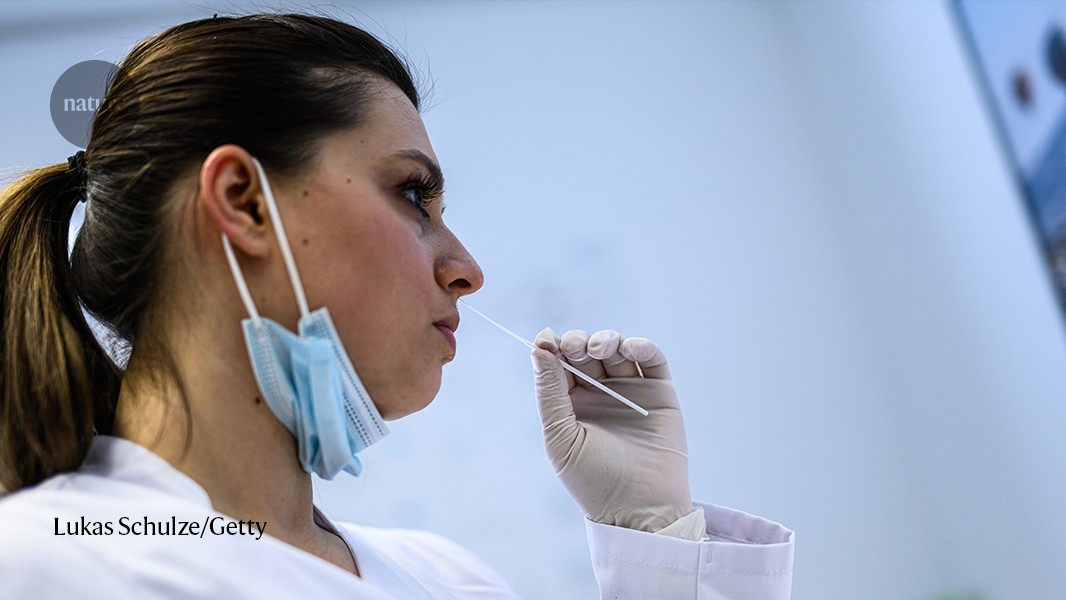
Rapid COVID tests miss 90% of asymptomatic cases
But if the tests work much better when taken three times over the course of several days.
nature.com
247 points · by bookofjoe · 3y ago · 227 comments
Back in the early days of Covid-19 people didn't typically begin displaying symptoms visible without an x-ray until they'd nearly reach their peak viral load. More recently people tend to start displaying symptoms earlier. This is probably due to the adaptive immune system learning about covid through immunization or prior infection, but could also be something related to Omicron variants becoming dominant.
But in any event, it takes a while to get the results back from a test more sensitive than a rapid test. If you take a rapid test and send off a sample for PCR every hour then you'll collect a positive PCR sample long before you collect a positive rapid antigen sample. But you might very well get the results from the rapid test first since viral loads tend to increase rapidly in the early stages and can cross the ~4 orders of magnitude in the time it takes to turn around a PCR test.
EDIT: Actually, I should say and those peak viral loads I quoted are from 2020 when I was paying the most attention to this stuff and have likely changed with mass vaccination/prior infection and Omicron.
A majority, if not all, of the rapid tests I have used explicitly caution against taking one in the absence of symptoms, as it is expected to yield negligible results.
That might explain why governments adopt a blanket rapid test approach irrespective of the potential for false positives (even given the potential, as the article alludes to, for false negatives).
Then how do you explain this:
> However, repeating the test 3 times, 48 hours apart, led to detection of infections in 75% of asymptomatic participants.
Let’s ignore the time aspect, and assume that the test has only a 35% chance of returning positive for an infected but asymptomatic patient.
Repeat that test 3 times, and the chances of at least one returning positive jumps to 73%.
(That’s why there are two tests in most rapid test boxes. You’re supposed to test twice, 24 hours apart, to improve the chances of a positive result if you are indeed infected.)
Because who cares if you're asymptomatic but your viral load is low and you're unlikely to infect others? If lack of viral load is the reason that the test is a false negative but that's also correlated with low likelihood that you can infect others, then this understanding is not useful. The test still did it's job for what people needed it for.
The full article does not seem to be publicly accessible, so I'm not sure if my comment is already covered.
IIRC ~75% of PCR positive samples couldn't have any virus cultured from them at all. Viral culturing isn't easy, but PCR tests can trigger on destroyed virus, so it's not a surprise that you can't get replicating virus out of many such samples especially at CT>40.
But even if you can grow virus, that doesn't mean someone is infectious. To determine that the ground truth is contact tracing and followup. But this showed that many people who were clearly sick with COVID never infected people they were in close contact with. Even within the home, most cases did not transmit, I think. I got direct experience of this when my wife got COVID and was sick for a couple of weeks, I was then quarantined by the government at home but never got sick. How this could happen was never officially explained.
This reveals one of the core scientific problems with the epidemiological simulations that were driving policy: they assumed infection is a one-way event i.e. 100% pre-existing susceptibility. I infect you, because I'm sick, you never were when we get close together we roll a dice and if it comes up 3-6 then you get infected too. This isn't how it works in reality. People's immune systems differ significantly and some are just stronger than others. To be infected I have to be infected but you have to be susceptible. The COVID models basically ignored this and assumed a homogenous population. When adjusted to reflect a more realistic heterogeneous population herd immunity thresholds went down a lot:
https://www.medrxiv.org/content/10.1101/2020.04.27.20081893v...
This research wasn't merely unnoticed, it was actively suppressed. Journals refused to publish it because, "Given the implications for public health, it is appropriate to hold claims around the herd immunity threshold to a very high evidence bar, as these would be interpreted to justify relaxation of interventions, potentially placing people at risk."
When you're in the heart of an epidemic that's going to kill millions, you err on the side of caution. Quarantining you at home, for example, makes sense when you're dealing with a deadly disease and you don't know enough to know you're not contagious.
Again, thanks for the info, but "lessons learned" should generally be left to the people who will have to deal with the next pandemic, especially since (I'm betting) they won't express their lessons learned as confidently as you are.
There is far more to life than the prevention of exactly one very specific respiratory illness. If you leave it to only the “experts” the only lessons you’ll get will be so narrowly focused as to be completely useless.
“Experts” never should have been allowed to directly drive public policy. Public policy is a holistic exercise focusing on the big picture, not just one very tiny myopic thing.
An entire generation of kids will grow up forever scarred thanks to the myopic, hysterical actions of these “experts”.
Intuitively yes, in reality no. It was known by March 2020 that quarantines had no effect because of the outcome of trying it on the Diamond Princess, a sealed environment where quarantine could be perfectly enforced. That didn't stop SARS-CoV-2 spreading between cabins and causing COVID apparently at random, i.e. it'd propagated everywhere but not everyone was susceptible. This knowledge was never incorporated into health policy. The same thing had been found during the SARS-1 outbreak in Hong Kong, where it was able to move between apartment blocks separated by a garden on air currents. The quarantine within the origin apartment block didn't work due to airborne transmission, something the WHO denied was possible.
It was even known before 2020. Public health planning before this time said clearly not to use mass testing and mass quarantines because they don't work. This was torn up once COVID started.
> your tone comes off as "I know better and would have been more sensible if I were in charge."
Frustrated, yes, I know how it sounds.
The COVID response was deeply flawed from the start, and in ways that were obvious even to outsiders. I was writing about the impossible claims being made for PCR tests and the history of failed epidemic models in Spring 2020, but I don't think I'd have done better if I ran the WHO. That's because the incentives and structures such people operate under are terrible, and apparently overwhelmingly strong.
Consider this article from 2010 [1]. Der Spiegel investigated the Swine Flu "mass hysteria" and stated that the world clearly overreacted. Reporting on the WHO, "At any rate, efforts to downplay the risks were unwelcome, and the WHO made it clear that it preferred to base its decisions on a worst-case scenario. "We wanted to overestimate rather than underestimate the situation," says Fukuda."
Given everything that happened since I'm really convinced that the right way to handle a pandemic is just to let individuals and their doctors get on with it. Academics and NGOs can make recommendations if they want, but giving these people power is a bad idea. Central health planners are incentivized to maximally over-react, every single time. No lessons are ever learned, and why would any be? They have absolute immunity from accountability and consider interventions to be cost free. That is corrupting. What happened with COVID will happen again.
[1] https://www.spiegel.de/international/world/reconstruction-of...
It seems you have been doing in-depth research about Sars-Cov-2/Covid-19, how did you miss the secondary attack rate/household infection rate? It used to be one of the crucial measures of transmission in early 2020, and has been studied for every variant ever since.
What I don't understand is this jump between the complexity of the situation and the simplicity of your conclusions. You go into great length to point out the shortcomings of PCR tests or that 100% susceptibility is an unrealistic modelling assumption, but your interpretations/conclusions are often blanket statements like
> This reveals one of the core scientific problems
> This research wasn't merely unnoticed, it was actively suppressed.
I notice that in your conclusions you tend to lump together very heterogeneous groups, like "scientists", "the media", "government", "the people who run healthcare" - and "they" seem to be responsible for the shortcomings? I find it very puzzling. E.g. scientific consensus is rarely clear-cut, but you will find plenty of papers/opinions arguing for and against something. Same with governments, there are some 200 countries and "they" followed very different policies. Wouldn't it be more convincing to present both evidence for and against a certain hypothesis?
I get what you mean about consensus but scientific consensus is by definition clear cut, it's supposed to mean 100% agreement. Often something is presented as a scientific consensus when it's really not, rather, people who disagree are being ignored or blocked from publishing.
During COVID a lot of things were presented to the public as if it were 100% obvious and agreed with by every specialist, then policy was made on that basis. You couldn't just disagree with government mitigations and ignore them, they were enforced by law and this was justified by the idea that anyone who disagreed with their effectiveness was a misinformation-addled rube who had to be forced for the good of everyone else. People who pointed out data or papers that disagreed with this supposed consensus were fired or banned from social media to try and maintain this illusion of universal agreement.
> there are some 200 countries and "they" followed very different policies
Did they? I'm pretty sure virtually every (rich) country all imposed mass testing, quarantines, mask mandates, lockdowns and mass vaccinations. Other than Sweden famously rejecting lockdowns, which countries didn't do these things? Policy was globally homogenous because the public health community is global and their methods don't really vary. Tegnell was the exception that proved the rule.
Just a nit but stronger is a weird term to describe any functioning immune system. Some genetic trade-off that makes one immune system better suited to blocking COVID infection might make it worse at something else.
> To be infected I have to be infected but you have to be susceptible. The COVID models basically ignored this and assumed a homogenous population.
And the data used to drive those models is going to be a result of a real world average across the population, so that is fine for nation level decision making.
Let’s say you’re using data from two traced cases, a case with high susceptibility (HS) family members and one with low susceptibility (LS) family members.
The HS case was in contact with 4 family members, 3 of which became infected. The LS case was in contact with 4 family members and 1 became infected.
Two infections, 50% transmission rate. That is fine for modeling and policy, unless we have some sort of a test to determine if you are HS/LS which could be used to make more granular policies.
All of this is moot considering the the different variants we never reached some magical “herd immunity” anyways.
When more data did become available the models were often never updated. I reviewed the code of several models during the pandemic. Beyond having severe bugs, they also frequently used values from January in December or even well into 2021! As more data came in it became clear that the original assumptions were far too pessimistic, but epidemiology doesn't distinguish clearly between assumptions, simulation results and observational data. So they just kept using the old numbers. It got their results in the news and peer reviewers didn't care.
> All of this is moot considering the the different variants we never reached some magical “herd immunity” anyways.
Well, we don't really know why variants suddenly displaced each other so fast and so completely. It would appear that there's some kind of viral interference, in which you can't be infected with multiple respiratory viruses at once. That doesn't fit with any classical form of germ theory, but the COVID response was based on the assumption of high-school level germ theory being complete, even when collected sample data showed that couldn't be true.
Maybe you caught Covid but went asymptomatic because your immune system is just better at handling it? (and PCR tests won't detect it because, as this story says, they miss 90% of asymptomatic cases)
This is hardly unheard of, unexpected or unexplained.
Right? Is that not how it went?
https://abcnews.go.com/Health/covid-outbreak-belgian-researc...
Of course, certain news outlets like for instance the BBC have failed to disclose these additional details.
Back then epidemiology was a more curious field so this was investigated in some depth. Nobody had opened any new crates or done anything else that could expose fomites. There had obviously been no contact with anyone else. No source for the infection could be identified.
In the wake of this there were a couple of hypotheses which have since been forgotten:
1. Transmission from the atmosphere. There's some other work that explored the idea that influenza could travel long distances in the upper atmosphere whilst remaining viable.
It's known that SARS-like viruses can float through the air because this is how it spread between apartment blocks in a SARS-1 outbreak in Hong Kong. It's also hard to see how it could have spread on the Diamond Princess except via air ducts. Despite being called SARS-2 though, the possibility of airborne transmission was strongly denied at every point by the WHO and other health agencies, presumably because it would have invalidated the rationale for lockdown.
2. Constant low level infection that our immune systems normally keep suppressed. Then you have a bad day, don't sleep well or something else knocks you off balance and this is enough for the infection to start replicating out of control until the big guns are fired up.
* Routsias JG , Mavrouli M , Tsoplou P , Dioikitopoulou K , Tsakris A . Diagnostic performance of rapid antigen tests (RATs) for SARS-CoV-2 and their efficacy in monitoring the infectiousness of COVID-19 patients. Sci Rep. 2021;11(1):22863. doi:10.1038/s41598-021-02197-z
* Currie DW , Shah MM , Salvatore PP , et al; CDC COVID-19 Response Epidemiology Field Studies Team. Relationship of SARS-CoV-2 antigen and reverse transcription PCR positivity for viral cultures. Emerg Infect Dis. 2022;28(3):717-720. doi:10.3201/eid2803.211747
* Korenkov M , Poopalasingam N , Madler M , et al. Evaluation of a rapid antigen test to detect SARS-CoV-2 infection and identify potentially infectious individuals. J Clin Microbiol. 2021;59(9):e0089621. doi:10.1128/JCM.00896-21
* Killingley B , Mann A , Kalinova M , et al. Safety, tolerability and viral kinetics during SARS-CoV-2 human challenge in young adults. Nat Med. 2022;28:1031-1041. doi:10.1038/s41591-022-01780-9
[1] COVID-19 Symptoms and Duration of Rapid Antigen Test Positivity at a Community Testing and Surveillance Site During Pre-Delta, Delta, and Omicron BA.1 Periods. https://jamanetwork.com/journals/jamanetworkopen/fullarticle...
We don't have a labor and cost effective test for this, and we require the test to be done in a BSL-3 facility.
So what remains is that we need to solve public health problems with tests that produce only correlates of infectiousness. Those correlates will be necessarily imperfect, but they're all that we have to craft policy around.
The perfect home test which only detects infectious virus doesn't exist.
And I'd just like to see more published studies which actually cultured virus rather than using PCR as a proxy for infectious virus, but even that is hard to get. So many lazy scientific studies out there conflating PCR positive with virus, but there's a lot more researchers who can do PCR than researchers than have access+funding to a BSL-3 lab.
If you take a test right before you arrive, and you stay for a couple of days, if you just caught covid the day you arrived, you'd like to know that. That's where a more sensitive test is really useful.
This is a particular problem with newer variants of covid because they multiply much faster. A very low viral load in the nose when the test is taken can turn into a lot in a matter of hours.
Anyhow all of this is fairly academic at this point because no one is taking any tests and everyone is doing big events with lots of people.
While some folks are certainly still worried about spreading the virus, for most folks it's always been about whether a positive test requires them to restrict their movement or activities (e.g. whether or not one could fly on a plane in 2020-2022).
Public service request: There are millions of Americans with compromised immune systems who are finding the current environment treacherous since most people have completely moved on. If we have an interaction with someone who is masked, it would be great if we could just mask up at least during that interaction as a courtesy. That person could be at significant risk and it does no harm to us to mask up for a few minutes to help reduce their risk even if we aren't concerned for ourselves.
Additionally, you made a huge leap in assumptions about me that simply aren't true when you assumed what my opinion is/was and how that would project. Let's keep it away from getting personal like that?
Sure but that problem is once removed from the real problem. The underlying reason for restrictions is infectiousness. If tests measured infectiousness accurately, rules on restrictions would follow and use those tests instead.
Nah, they are just ineffective for all the reasons people already mentioned ITT.
False positives would have made this a no-go, even if they were safer. With Covid being endemic, its time to move on. If you must care, there are n95 masks.
You lost me at this bit. Use Fiji to run the gel analysis or is this via ImageJ or something else?
(This is a question, not a statement)
It depends on the purpose of the test.
For example, a trillion dollar question is still long covid. Very significant numbers of people are on disability right now. About 10% of Americans have some form of long covid, and >1% are unable to work due to long covid (or >2% of the workforce). Long covid comes up even with mild and asymptomatic cases, and seems to have a strong autoimmune component. If you're trying to understand where those sorts of symptoms came from, it's good to know whether or not you had covid before they started.
Given that we don't understand what's going on here medically at all, it's not immediately useful, but it may be useful to know as treatments come up. A big part of the reason why I test is simply to know.
There are many other potential purposes one might have for testing too. For example, studies might want to track prevalence of covid in populations. It's good to know, methodologically, what they're tracking.
Like, if I had to bet money on it, I'd wager that "long flu" and even "long cold" are real things that happen at least sometimes, but just haven't gotten much attention (and, to be fair, they might also be less common, or less-commonly-as-severe, if they are real).
https://www.acpjournals.org/doi/10.7326/M21-4905
https://astralcodexten.substack.com/p/replication-attempt-bi...
- Had severe memory problems for a few months following covid
- Had severe balance problems for a few months following covid (to the point of falling when walking around the house)
- Basically couldn't talk for a month after a mild covid infection, due to coughing fits (despite having mild/no respiratory symptoms during a very mild covid).
... and so on. These are not psychosomatic symptoms. You can't make up a hoarse voice with an extreme cough.
You can talk to doctors too. This stuff is pretty severe. If your argument was that, rather than 4 million people out on long covid disability, it was, say, 2 million, I'd listen. However, your argument is like someone near the equator arguing snow doesn't exist.
Under/over/misdiagnosis is a thing for a lot of conditions, but that doesn't mean those conditions don't exist.
You'd also be better off citing medical journals than conspiracy web pages with web surveys and sample biases.
“According to large population-based surveys, up to 33.7% of the population are affected by an anxiety disorder during their lifetime.”
https://www.ncbi.nlm.nih.gov/pmc/articles/PMC4610617/
published prior to covid
That’s bizarre. I’m not sure what would cause those numbers regardless of whether long covid is real.
It's not to begin treatment. So it is a pretty big problem!
Why, if asymptomatic cases are unlikely to infect others, is a false negative for asymptomatic cases a problem? Doesn't this all boil down to "if you feel sick, stay home, if you don't, don't worry about it?"
Defense-in-depth gives a broad range of tactics, and the goal is to combine enough of them to limit risks.
It's just funny that you have to mention this is a question even if a question mark exists. It shows how much toxic people got instead of understanding others.
Excessively-defensive Internet writing style. You have to make everything clear in three different ways and over-explain everything so that careless, poor, or hostile readers won't/can't flame you or derail the conversation over something that isn't even actually true about your post.
See also: disclaiming "in my opinion", sometimes more than once, for things that are obviously opinions, just to keep idiots from going "LOL that's just your opinion but you're stating it as fact" in all your responses. Once you notice this style, it's a can't-unsee kind of thing. Makes reading Web forums frustrating.
This kind of distracting, mealy-mouthed crap is absent from any decent, say, traditional-publishing book or article, but is standard online.
It's worse on HN (which, you'd think the whole "read generously" guidance would counter it pretty well—but no) than most places, but it's common all over. It's a bad way to write, generally, but there's a reason people do it in these kinds of contexts—one reliably draws lots more stupid or angry-for-dumb-reasons responses, when one does not so-write.
- It's [X]
- Have you considered it might be [X]?
- Is it possible it might be [X]?
- ...
The goal is to not appear overly assertive / confident / arrogant. Once that happens, people start to read subtexts into questions, and all of a sudden, you need disclaimers.
I like direct communications, so I find this obnoxious, but I don't think it's ill-willed or toxic.
You don't have to mention anything and be afraid of what people might say because you don't want toxic behavior towards you.
People need to stop. Read, understand, conclude and write. This is basic communication.
After a year of negative results, the home test worked when we finally did catch the virus. I had been skeptical, but it turned out all of the negatives (and positives) were correct.
Is my coffee bad or has the editor slipped? Probably and extra “if” after the “But”?
“But if the tests work much better when taken three times over the course of several days.”
It only makes little sense if you don't really care about others. You can infect others with covid 48 hours before you have symptoms. If you know you've been exposed, why wouldn't you check? Plus, you can have symptoms without being infectious.
Similar things with other viruses, too.
Just think about it, and you'll figure out why.
You need lots of cell death and viral replication to cough up enough virions to be a danger.
But sometimes folks tell you they caught it - folks in the office, friends, family - hence, the "Know you've been exposed" criteria. Then it is prudent to test. These are the only times that I've personally tested throughout the pandemic - but I'm in Norway, so I have probably encountered different sorts of restrictions than a lot of other readers.
And honestly: The real reason it isn't as prudent is because the virus isn't the beast it once was. Yes, it can still make you really sick, but it is much rarer than it once was.
I've never "had covid". But I've probably had some amount of covid in my system. I'm sure there are some tests that may have said I have had covid. Is there a degree of infection that confers a specialized immune response? A level of viral load that can exist passively from presence in the environment but suppressed to low level by your immune system?
Not much behind the paywall of the article OP linked:
“Rapid antigen tests are much more reliable at detecting COVID-19 in people with symptoms than in those without, finds the largest study to compare home rapid tests with gold-standard PCR tests1.
Apurv Soni at the UMass Chan Medical School in Worcester, Massachusetts, and his colleagues, followed 5,353 initially uninfected people between October 2021 and January 2022, when the Delta and Omicron variants of SARS-CoV-2 were circulating. For 15 days, the participants regularly took rapid tests at home and sent samples to a laboratory for PCR testing.
More than 150 participants tested positive for SARS-CoV-2 on PCR tests. On the day of infection onset, rapid tests detected almost 60% of infected participants who had COVID-19 symptoms, but only 10% of those who didn’t. However, repeating the test 3 times, 48 hours apart, led to detection of infections in 75% of asymptomatic participants. Two tests conducted 48-hours apart identified 92% of symptomatic participants.
The authors say that an informational campaign about the proper way to take rapid tests might help to preserve public confidence in the tests’ utility.”
Why do we have to spend tax payer money for a campaign to try and force people to care about the utility of a product that can't accurately detect a symptomless virus.
Honestly starting to forget it was ever even a thing.
Let a particularly fun strain catch you like it did to me. Then you can't smell anything, everything tastes off, and you fall asleep in the middle of the day for no reason.
It's been a great two years!
I've known people who tested the day after and considered themselves 'in the clear', and even my day 3 + day 4 strategy is based upon averages I had to pull from papers on disparate or ambiguous variants.
IMO this kind of heuristic should be printed on the packaging.
If wild animals are regularly spreading Covid to humans, this plus asymptomatic cases means zero Covid strategies never had a chance of working indefinitely.
No, it doesn't mean that. An easy reason is that most western governments used PCRs for case confirmations. Another easy reason is that "90% miss on asymptomatic cases" does not mean "90% of all cases are asymptomatic", in fact, quite a lot of "asymptomatic cases" evolve later to "symptomatic cases".
> pandemic probably never really was a problem either to begin with
I already said this in another comment, but it was a huge problem, and a lot of us lived through it and it was scary. You might not have seen it thanks precisely to those precautions you now criticize, but a lot of cities had a very significant collapse of the healthcare system and a massive amount of deaths. Ignoring this reality is incredibly damaging and I don't understand why so many people like you are so cavalier about this.
Part of it could be that they take exception to being called selfish. I take exception to being called a dupe to authority. It all makes us defensive and irrational.
I guess you missed the part with overwhelmed hospitals and mass burials.
My wife has suddenly just now become ill with something fever/fluish and it's testing negative, but I really have to wonder.
Impossible to get a PCR test here in Ontario for over two years now though.
Well, if anything your experience seems to confirm how these rapid tests work. At least my perception has always been that these were advertised to check not whether you had COVID or not (PCR is the gold standard) but whether you can infect others or not. Your daughter barely testing positive on one out of many tests and the rest of the family not getting the disease are coherent in that sense, as your daughter didn't seem to be specially infectious.
The issue with COVID all along vs other respiratory viruses is that it had the potential to transmit before symptoms appear. Which made things like temperature checks, etc fairly useless at preventing its spread. So actually it was important to know in advance if you had it, at least before mass vaccination and omicron changed the profile of the way it spread it seems.
Schizophrenic public policy.
Also by last spring the only way to know what was happening with the virus' spread was to look at wastewater detection numbers.
I hate the overloaded word “grift” but that is all these things are. Just a way to funnel insurance and government money into the pockets of giant pharmaceutical companies.
It was about looking like you were doing something while just getting back to work.
We had twice a week testing for over 18 months for work and it was obvious they were naff.
For each positive result there were 2-3 who seemed to miraculously be ill but negative around the same time.
People would be negative at breakfast and positive by dinner. Tomorrow? Negative again.
How could that ever stop a particularly contagious virus?
So if you tested positive you knew to take steps to limit exposure to others. Not perfect but not worthless.
Coupled with the fact most took precautions so we had mild cold and flu seasons.
If you had a cough, fever, headache, loss of sense taste/smell take precautions. Don't come into the office.
Guess what, that's precisely the people the test detected except it was delayed!
Asymptomatic? Don't bother testing it probably just gives a false sense of security...
What was useful was testing to end precautions but again..that was very late by the time it was introduced testing had stopped.
Basically the argument is: "if the test misses it, then in most situations the viral load is low enough to have a limited risk for other people"
The only gotcha people tend to forget: The viral load can change over time, which means they are only useful for a few hours not a full day.
I am not surprised by this finding. I would also think the opposite(symptomatic) has a significant figure too. Sadly I can’t find an archive of the entire article to read more.
S to monitor my vaccination status (surprise surprise you may not need to be revaxed constantly, but too many people dont botehr checking their antibodies)
N to check if I ever had it (signs point to now, and I'd be surprised if I did since I wear elastomerics and PAPRs)
https://www.cdc.gov/coronavirus/2019-ncov/testing/self-testi...
So many people were heavily pressured to work while sick if they couldn't prove it was covid, and even then there wasn't anything protecting you from being fired if you got covid at a bad time.
Remember that the "essential workers" make $35k a year.
P.S. Since they got acquired, they stopped selling tests. I wonder why Pfizer killed them - maybe to sell it's useless Paxlovid to more infected.
Horrifying.
Watch BLM pop up again next year - that also seems to neatly match presidential election cycles.
But almost everyone has stopped wearing masks, so for those people, testing is pointless anyway. It would be like putting a lock on your own firearm, and then wandering naked across a firing range.
So I'm supposed to spend $20 to find out I'm asymptomatic or not even infected so I can isolate myself?
People get sick. People die. It's not fair, but it also is fair because we all die. Death is actually the only fair thing there is.
Various winter viruses kill on the same order of magnitude, and they kill the same old, obese, sick population.
I'm a bit worried we will have something awful, killing healthy people or large swaths 5-20% of the population, and we will be too desensitized to care.
It def seems like it was a political tool, more than a threat.
I'm sorry, but what the hell are you talking about? In my city there were so many dead people they had to transform a skating rink into a morgue. ER rooms were completely overcrowded, COVID took so much effort to fight in hospitals that other diseases got later diagnoses and treatments, which resulted in even more dead people. Lots of elder people died in care homes because there wasn't any help available for them. There were no ambulances available at all. My mother had to go the hospital due to her infection worsening and she had to stay in the hospital gymnasium in couches, because there weren't enough beds nor space for them. They had to make an improvised hospital in a conference center to hold all the hospitalized people, thousands of them. We had a complete lockdown and it still took several weeks for cases to start decreasing.
We panicked so hard because it was fucking scary. Maybe the reason it wasn't for you is that you lived in a place where the government took precautions before it got too big, but I don't think it's ok to be so cavalier about it when so many people had such a hard time.
What has a comparable death rate that nearly the entire population has been exposed to?
> Various winter viruses kill on the same order of magnitude, and they kill the same old, obese, sick population.
Name this virus please. If you're thinking the flu, it's estimated that each year worldwide about a billion people are infected and there are ~450,000 deaths[1]. That's a 0.045% death rates, and that's one of our winter biggest killers.
To bring it to America, the CDC has death rates at ~0.1-0.2% [2]
[1] https://ipac-canada.org/influenza-resources [2] https://www.cdc.gov/flu/about/burden/index.html
For example, even as early as June of 2020, the public health authority in Canada's most-populous city (with the fourth highest population in North America) revealed that the counting of deaths was being done using a methodology that sounds quite dubious:
"Individuals who have died with COVID-19, but not as a result of COVID-19 are included in the case counts for COVID-19 deaths in Toronto."
https://twitter.com/TOPublicHealth/status/127588839006028596...
- https://www.goodreads.com/quotes/70193-over-85-of-all-statis... - https://www.businessinsider.com/736-of-all-statistics-are-ma... - https://www.quora.com/Someone-once-said-that-98-of-all-stati...