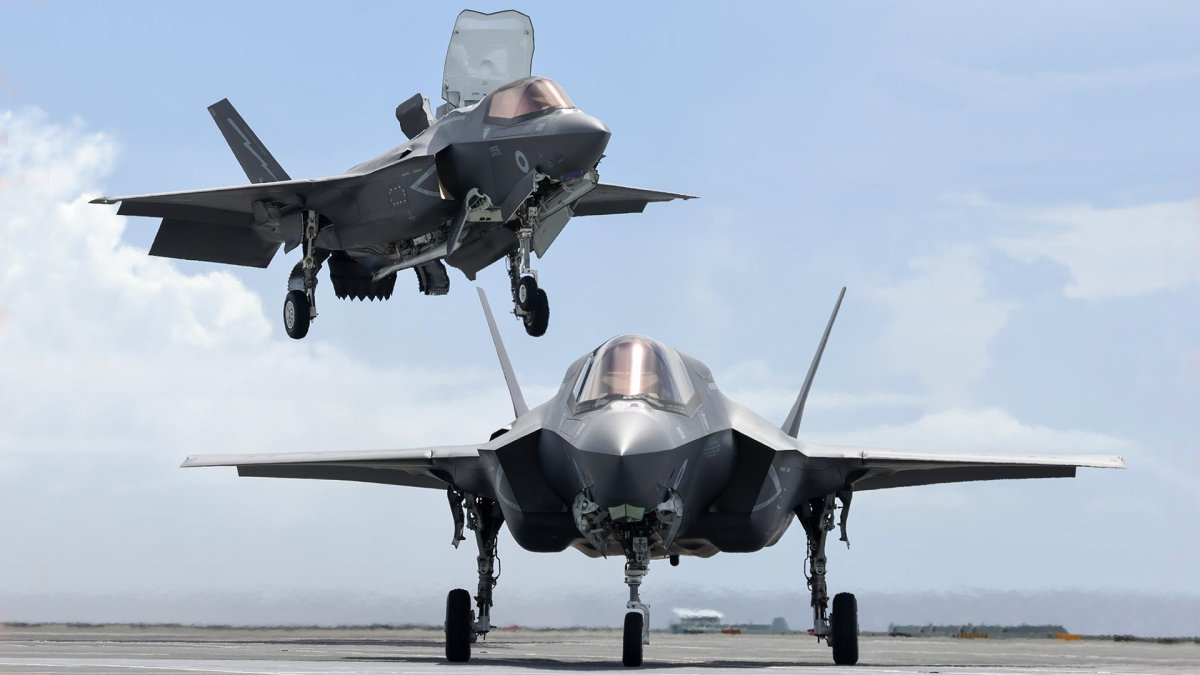
British F-35Bs To Bring Vertical Landing Abilities To Highways
The U.K. Royal Air Force has announced plans to demonstrate highway operations for both the F-35B and the Typhoon.
TWZ
136 points · by clouddrover · 3y ago · 314 comments
Similar strips exist in Finland, Poland, Sweden and Switzerland. Though most of the German locations are now retired and removed.
To add - this is a more trodden upon path than many realize. The RAF trained extensively on establishing dispersed airfields for the Harrier force. They dedicated a lot of resources to being able to conduct dispersed operations from modified fields (fields, not airfields) https://youtu.be/QOf1AAf1yqc.
The US Marine Corps’ F-35B community has limited experience with what I’d semi-austere forward arming/refueling points(FARPs).
F-35B landing at FARP. https://youtu.be/le4W1Pk-Dn8
There is enough here about the challenges of fast jets off of roadways and poor condition airfields. I’ll just add that a jet is only as capable as its ground crew, spares, available munitions and fuel stores, so getting those things to a remote strip and protecting them is a big challenge and resource drain. The UK armed forces are already stretched quite thin for personnel so how operable this concept is TBD.
People with an interest in dispersal should watch this video https://youtu.be/MNak9lB_q00 and read this wiki - https://en.m.wikipedia.org/wiki/Bas_90. The nordics really expect much of their aviation infrastructure to be destroyed in a conventional conflict and plan accordingly.
Here's another video talking a bit about the costs of dispersal, and costs basically being the reason for not doing it https://www.youtube.com/watch?v=q-lcu2kBXQI
Setting up redundant hangars and staffing them with trained aircraft mechanics is way, way more expensive than just pouring some extra concrete. Stocking them with the missiles your F-35s are going to need to actually perform missions also requires staffing, perimeter security, hardened bunkers...
It can be done, and is probably a good idea. But it's not a "one easy trick makes your air force invulnerable"-style lifehack.
The Ukrainian Air Force has found a new clever way to keep using normal air bases. After a hangar got bombed by cruise/ballistic missiles they would print a 1:1 aerial/satellite picture of the rubble, hang it over the actual rubble and then clean up under the print. It took quite a few weeks for the Russians to understand this ruse.
The doctrine of always having air superiority in NATO (and thus not needing makeshift runways) is so far rather justified given the hilarious level of incompetence shown by the VKS. Although the RAF seems to be more anxious about it, they definitely know much more than me. We do need a lot more air defense though, it's clear that before the next NATO-Russia confrontation they will have a rich arsenal of flying trashcans like the Shahed, as well as some decent missiles.
This sounds very interesting! Any sources?
As far as I could tell after a bar argument, this is more or less an urban legend[0]. While the referenced article only debunks the "Every 5 miles" myth, further (brief) reading led me to believe if there were ever any designed airstrips into the interstate system they were short-lived and likely very one-offish style programs.
[0] - https://highways.dot.gov/public-roads/mayjune-2000/one-mile-...
That's disappointing. It sounded so cool! The part of this story I recall is that overpasses were spaced widely enough to avoid interfering with airplanes should they need to find a landing spot.
In Czechia we are replacing Gripens that can operate from almost anywhere. It only needs a few hundred meters of road, and single truck to refuel and restock ammunition.
Our new F35 will only be able to operate from a single runway in entire country!
And yes, for full maintenance, you do need need a proper airport and hangars. But for a quick refuel/arm and launch, you don't need that much. It's a trade off in capabilities: do you want to have a highway strip launch capability, or do you want something that is much less likely to get shot down. It's doubtful that the F-35 will only be able to operate at a single runway, unless your country only has one runway. It should be capable of operating off nearly any concrete runway you have (highways are typically not constructed to the same standards as a runway).
There are also civilian airports, but we would propably run out of those very soon. And using civilian infrastructure for military purposes (like bombing foreign country) would not be politically very digestible!
I don't know where you heard that but it's completely untrue. Some older radar absorbent material required intensive maintenance but the F-35 is not like that. It's not that much more difficult to maintain than a previous generation fighter. It would be completely impractical to operate if you needed to completely overhaul it every flight.
That the airplanes will be hard to maintain, aren't as rugged, can't handle street landing and improvised conditions. There was a huge scandal because one of the F-16 was flown from USA to Poland and did emergency landing on the way because of some minor technical issue.
20 years later and we lost two MiG-29 to bad maintenance and no F-16.
The efficiency of turnaround is something that is incomparable to all other fast jet systems of which I am aware.
The most informed analyst on this matter appears to be Justin Bronk [0]
If I was an F-35 buyer, I would also buy some more Gripen-C if at all possible. That should be the "High/Low" mix in 2023 and beyond.
If I was king of "The West," I would have had sent all available Gripens to Ukraine months ago.
[0] https://www.rusi.org/news-and-comment/in-the-news/ukraines-t...
[oops, around the Economist paywall] https://archive.is/gOKqZ
Never any seen any Čech actually use that silly term...
"AM-2 matting consists of 1 1/2" x 2' steel rectangles coated with a epoxy nonskid material, available in both 6 and 12 foot lengths, and are assembled in a brickwork pattern to form runways, taxiways, parking and other areas required for aircraft operations and maintenance. Thirty ISO containers can be constructed to form a 1,500 square foot vertical, short landing and take off airfield and can accommodate up to a total of eleven CH53, UH1, AH1 and AV8B aircraft. " [1]
I wonder about FOD. i.e. all the crap in and around a highway that could damage the engines..
They did this before as part of an airshow demo. The Royal Engineers (Army co-operation!) had built pads at RAF Fairford for RIAT then the F-35B flew in, engaged STOVL mode (i.e. lift fan door open, rear engine nozzle pointed down etc.) and landed vertically on it then took off again.
Can't remember what year it was; Google suggests the MoD released PR saying they had done the same thing at Marham in 2018 but it's possible the demo was by a USMC F-35B.
https://ascelibrary.org/cms/10.1061/(ASCE)MT.1943-5533.00016...
They would send out personal to remove FOD (foreign object debris) before any operations and before laying those mats, I assume.
[Numbers found by google search :_) ]
30 ISO containers for just the runway, = 30+ vehicles, + munitions, spare parts, maintenance personnel, that computerized logistics thing - ODIN/ALIS, food and water, security for the personnel, generators to power all the computers to support the aircraft, . would there need to be SAM support? anti-drone support?
Fuel would seem to be a real issue especially - an upgraded refuelling tanker-truck holds ~20k litres, and an F-35b can take ~10k litres I think. One refuelling tanker-truck = two air sorties.
The other thing that they would do is to even out the surface - decades of frost heave has left said concrete slabs pretty uneven, even in a car, never mind a jet, landing.
One of the impulses for changing surfacing methods for runways in Soviet Union was early jets ripping asphalt off the surface, for example, though later planes had higher-mounted exhausts that caused less problems.
As for road landing in Ukraine (and other Warsaw Pact countries, and Sweden), it's a mix of special road segments and special aircraft design (for example, consider MiG-29 with its intake shields that close when it's on the ground, and sturdier landing gear on many aircraft)
It’s going to take a while to go anywhere, but in the meantime I’m working with a couple of aerospace engineer friends/family on solidifying the concept. If nothing else I’m having fun figuring out how to make something the size of a skyscraper fly with next to no energy expenditure.
> AM-2 matting consists of 1 1/2" x 2' steel rectangles ...
So, are they aluminum or are they steel? Or some structure involving both?
I wonder if the F35B’s thrust would rip up a highway like SpaceX’s first starship launch.
https://news.usni.org/2014/01/15/sna-2014-heat-f-35-mv-22-co...
There's an internal BAE project to give them updatable computers which can be ripped out and replaced every few years. Like the Gripen the idea is to separate the flight critical software, which needs lots of certification, from everything else which can then be updated much more easily and rapidly.
They've also been flight testing a radar that can do electronic warfare as well as its normal job and the Typhoon, like the Gripen and Rafale carries the Meteor BVRAAM which is exceptionally good because it has a long range and a lot of energy to maneuver at the point where its nearing its target.
The Harrier and Gripens can and kinda were designed with that in mind. The F-35? I doubt it.
I'm sure on paper someone will write and another one will approve, but in reality and in a real war scenario I have serious reservations.
For this, the US has the A-10 which was designed with this exact war in mind. It takes off from a short runway (and it can be a pretty rough runway because the engines are so high), requires more basic maintenance, and is proven to take MANPADS hits then still make it back.
A few airframes have taken missile hits during Middle East conflicts and made it back to base. Those then took months of extensive maintenance to restore to operational condition, and in some cases were written off entirely. A-10s are not at all survivable against modern Russian air defenses and would be mostly useless in Ukraine.
That's the best option when all you have are shitty short-range Soviet-era missiles and unguided rockets / bombs from the 1980s and radars that can't see anything past 35km.
If you have low-observability or stealth aircraft, with powerful radars, and weapons with 80km+ range, you would absolutely rather use anything else.
It doesn't matter if your plane is "highly survivable to MANPADS" when A) the enemy has a lot of MANPADS and larger AA weapons, and B) you run out of functional planes because they all got shot up. Not getting hit is strictly better than getting hit, regardless of how "survivable" the plane is.
Everything that's commonly said about the Gripen performing admirably in rugged conditions and the F-16 being particularly vulnerable to foreign object damage is certainly true, but Ukraine would happily throw people and resources at the problem of maintaining intact and clean runways.
Unfortunately the Gripen is the plane everyone talks and loves but "nobody" buys them. The Rafale is in a similar situation. AFAIK there are many minor reasons but the main one is: "Nobody got fired for buying IBM", aka the F-16, it's all fine and good, NATO, etc, etc, but America has A LOT of pull when someone wants to buy planes, they tend to be "persuasive"..
https://www.thedrive.com/the-war-zone/43367/the-uae-has-just...
All of the above under the caveat of needing it now.
Edit: wow apparently as-of 2010 there were around 4,500 F-16 delivered around the world.
I nearly broke a spring from a dipped pothole on the M6 south.
Not to forget all the smart motorway signs every 100 meters and signboards overhead, will make a landing "interesting".
I'm sure the exceptionally canny operators of motorway service stations would find a way to make some extra money off them then. Come for a coffee, stay for a jet launch.
With Ukraine you want the plane to take off from Ukraine, not the UK, or else it is seen as direct involvement. So the plane takes off from the UK, lands in the motorway somewhere near Keeeev and then the Ukrainian pilot hops on, to carry out the mission.
He then lands on the highway again, the plane stays still for the British pilot to get in, he does so, flying up to meet a tanker over Poo land to then get home by teatime.
He lands on a regular runway.
We can disperse the fighter jets without needing to resort to landing on roads.
[1] https://en.wikipedia.org/wiki/List_of_airports_in_the_United...
https://www.thedrive.com/the-war-zone/30405/behold-sikorskys...
They claimed it would be half the price of the V280.
Since the Raider X is based on the same platform, it doesn't seem unreasonable it'd be competitive after they fix the documentation. And there might be a tendency to split the winners to sustain multiple builders.
Reviews of the F35 are vague. Israel is buying them but it's essentially getting them for free. So why not? Anyone have a true read on if the F35 is actually a dominant platform?
Sure, there are a few 4th generation airframes still in production and they are useful for certain limited missions like homeland defense and counterinsurgency. But those are dying platforms with little capacity to take upgrades and poor survivability against peer threats so it doesn't make sense for countries like the UK to buy more.
Lots of countries are buying the F-35. It hits a sweet spot of multi-role fighter with a big bonus of stealth. Also, there is VTOL F-35 variant that the US Marines and other countries with smaller carriers are buying.
The F-22 is still better in many ways. The F-35 is what is available now. The Air Force and Navy are working in two separate programs for replacing F-22 and F/A-18E/F respectively. The result should be much better than F-35, but also more expensive.
This won't work, it'll fail for the same reasons the proposals to use highways for the Harrier fell apart in reality - too much damage to use it at any time other than wartime, resulting in no training for landing on highways, so it'll never happen even in wartime. Besides which, if you're at war where you need a defensive air force to be able to use make-shift airbases, you've almost certainly already lost.
Also, the "almost certainly already lost" situation is exactly what small countries are facing if Russia attacks them. Their main air bases are going to be attacked. Regular relocation of equipment may be the only way to survive more than a few hours.
But of course highways, infrastructure, is a relevant thing to destroy in war.
Look at Civilian vs Soldier dead for various major wars.
Only ONE war has WAY more soldiers killed than civilians. If Russia is trying to target Ukrainians, they are doing a worse job than any war you can name.
                 Civilians  Soldiers
    WW1              10M         7M
    WW2           50-55M     21-25M
    Korea           2.7M       0.8M
    Vietnam         2.5M       1.1M
    Kosovo          1-5K     0.5-1K
    Afghanistan     500K[1]    100K
    Iraq            135K[2]     40K

    Ukraine[3]        9K    65-250K
[2] Another definite lie. Studies done in 2004 and 2006 published in Lancet showed around 1M excess deaths of which almost all were directly attributable to the war and at least 31% were directly attributable to US forces. Who knows how many people died in all the conflicts that followed in the next 15 years. The US officially rejects these studies as flawed, but the British MoD considered it to be robust and adhering to best practices. Further, it used the same methodology and team the US considered to be stellar when doing the exact same thing the exact same way in the Congo.
[3] From the Ukrainian MoD and/or Ukraine-leaning groups, so the likely bias is to overstate Civilian deaths, overstate Russian KIA, and understate Ukrainian KIA.
Off-topic, but the F-35 VTOL design is amusing to me in that it was designed by Russia, but they never made more than a prototype and sold the tech to the US where we've now used it to make planes to take on Russia.
And it might just provide better cover. Western europe has hundreds of places like this. The enemy has to work out which building you are using in a group of fifty other non-descript buildings.
In any case, highways make much more sense logistically and operationally.
Who was it pushed NATO right up against Russia's border. Despite repeated statements from the Russians that there would be push-back. --
coob > “NATO have always been on Russia’s border.” (deleted)
On the Soviet Unions border. When the Soviets relinquished control of the client states to the west, they were given an understanding that NATO would not expand east.
(and modded down)
1. The client states weren't client states. They were de-facto annexed polities with centuries of distinct characteristics. After Soviet Union fell these countries could resume their legitimate existence.
2. Russia has always been an imperialistic, genocidal and brutal country, incapable of creating anything of lasting value. A country on the Russia's border has no reason to be categorized under "russian dominion".
Legitimate states have unalienable right under international law to guide their own path, regardless who their neighbours are.
If your neighbour is Russia, you really want to ally with a larger party.
"Who was it pushed NATO right up against Russia's border."
Nobody PUSHED NATO. This is what is wrong about the posting above. The CCE countries, Estonia, Latvia, Lithuania, knew very wall what Russia was and that it had not changed.
They wanted to join NATO exactly because they knew Russia would one day again attempt to annex them.
Unless Estonia was in NATO, Russian armors might very well be now in Tallinn.
Wow dude, that is quite deranged.
>Unless Estonia was in NATO, Russian armors might very well be now in Tallinn.
Russia borders 14 countries, and I don't think it fought with any except over the issue of NATO membership.
Incredible.
NATO was an excuse.
The war in ukraine is colonial and genocidal war with the intent of eradicating Ukrainian language and statehood and subvert the fee will of Ukrainian people under Russian yoke.
Russia: aggression
Beyond that central theme, certain things don't pass the smell test in my opinion. For example:
- Lancets are winning the war. Who is winning the war is debatable but usually I hear that artillery is the decisive weapon of this war. Additionally Ukraine is winning on artillery attrition, with some claims of a 3:1 ratio of attrition, so drones are not significant on this, at least not significant enough to overturn the attrition rates.
- Russia has swarms of drones that home in on RF sources. I have seen no such thing although I am open to being proven wrong here. My understanding is that jamming has been effective for both Russia and Ukraine EXCEPT for offensives where the attackers need to extend beyond the protection of EW.
- Western weapons get less useful by the minute. This one is technically true as all armies adapt to new challenges. However I wonder what the condition of the Crimean bridge is today.
This is a laughable claim. Lancets are awesome weapons, cost effective, accurate, and productive. But they cannot win the war on their own in any sense. They require certain intelligence to use effectively, intelligence that Russia is getting less of than Ukraine through NATO. More artillery is being destroyed by other artillery than Lancets. They just aren't made in the quantity that 152mm shells are.
>Russia has swarms of drones that home in on RF sources. Why do you state this and then immediately say you have seen zero evidence? You can't just release a swarm of RF seeking drones into the sky, you'll blow up all your own people and stuff too.
>Western weapons get less useful by the minute. Could you provide ANYTHING to back up such an assertion.
CAS is critical to advances. It is somewhat stopped by MANPADS, but stopped very hard by SAMs. When flying close to the trees, physics make it so that a SAM radar can't detect a plane until they are within 5-8 miles. This means intercepting a plane or helicopter attacking the front lines (launching missiles from a distance) puts the radar very close to the front.
Lancet has a range of about 30 miles, so if you place your SAMs close enough to intercept the planes, they are now in striking distance of the Lancet. Because the Lancet flies in so low and has such a tiny radar cross-section, intercepting it is incredibly hard. Even if it is intercepted, using a $4,000,000 missile to destroy a $35,000 drone is a terrible deal. This deal is even worse when you consider Ukraine can't get any more S-300 rockets and Patriot missiles are of very limited production per year (500 or so IIRC).
Going further, our newest 155mm artillery is the M777 and we've given a bunch to Ukraine. Setting aside the maintenance issue (we admitted 30% are in the shop at any given time which isn't surprising given the reliability issues our marines have had with them), their maximum range is under 20 miles which puts them in the range of a Lancet too.
Russia has had to rely on Kornet ATGMs for most of the war. These are direct fire, so hitting the weak top of a tank is almost impossible. There are videos of a Leopard seeming to take a couple Kornet hits and still being serviceable. In contrast, the Lancet offers Russia the ability to do downward attacks at the thin top armor. We have videos of them doing exactly this to take out a Leopard or two. This issue exists not just for tanks, but for artillery and other vehicles based on the Leopard chassis.
Circling back around, this leads to the artillery attrition. Russia has been consistently shooting 5-10x as many shells as Ukraine. Ukraine is basically out of Soviet 152mm shells and doesn't have a great way to replace parts on their Soviet artillery anyway. NATO has basically given all the spare 155mm shells we have. We're ramping up production, but we won't be matching Russia's advantage for a couple more years at the earliest. This is one of the reasons Biden wants to send cluster munitions -- we're out of everything else.
The Russian drone swarms stuff is just propaganda. There's been no evidence of anything like that. The closest to this is definitely Ukraine with all the small suicide drones they've been pushing out which don't work well against armored targets, but work very well against personnel (and you can't hold ground without people).
Western weapons is more about perception than anything. We in America have a superiority complex when it comes to our equipment. When you aren't facing people with AKs and outdated RPGs, our equipment is a lot more vulnerable than people want to believe. Tanks, IFVs, MRAPs, artillery, etc have all been only a little better than Russia's stuff because ATGMs, drones, and mines are proving to be so powerful. On the flip side, Patriot, MANPADS, and Javelin ATGMs have been and continue to be absolutely stellar.
Based on the crushed Ukrainian offensive (still haven't reached the first true defensive line), I can say without reservation that what Ukraine needs is: attack helicopters to work on defense, more ATGMs, 10x as many man-portable EW systems, and an attack drone that actually works.