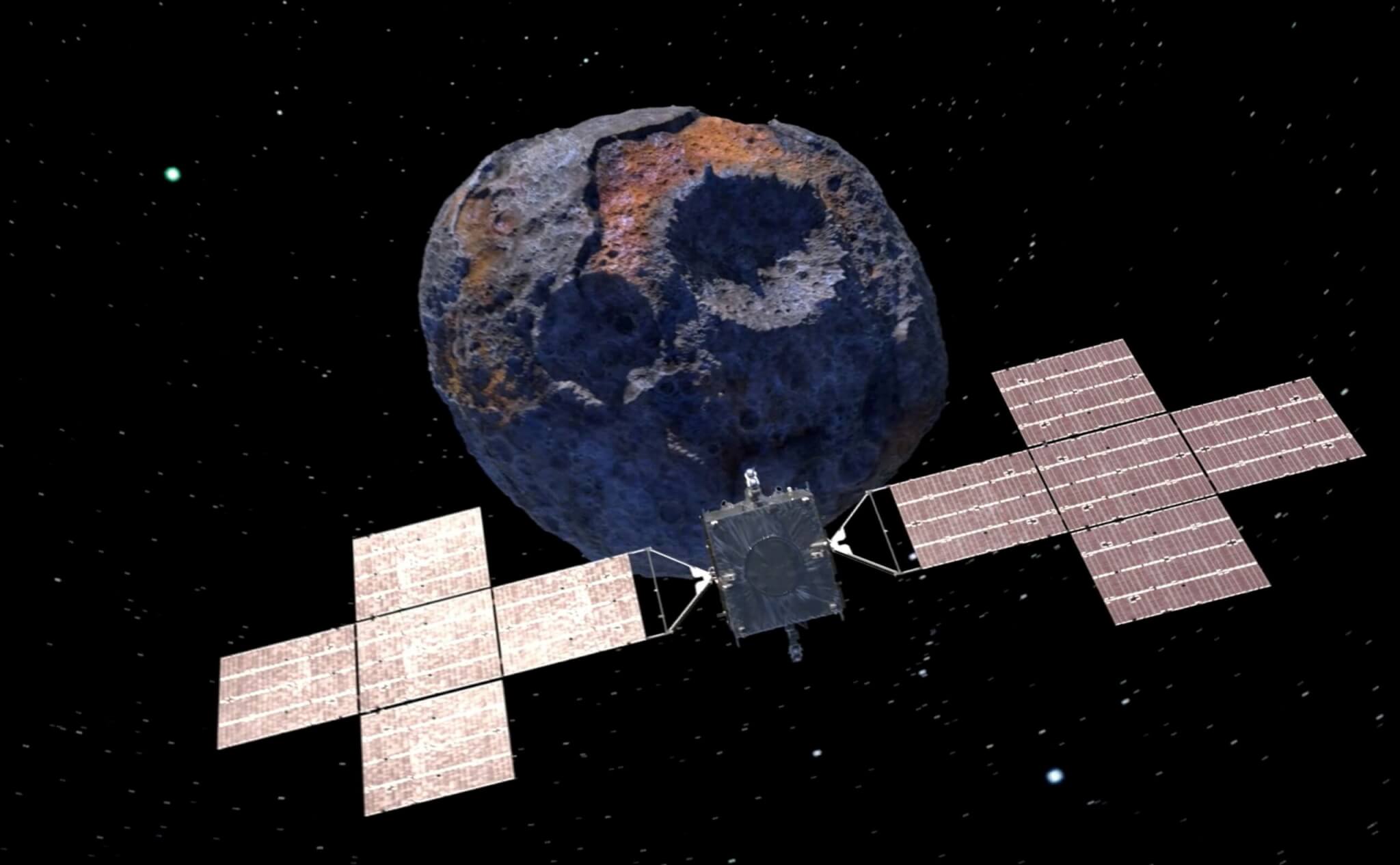
NASA enters 'home stretch' in mission to reach golden asteroid worth $10,000 quadrillion
The preparation is taking place at Cape Canaveral, with the Psyche spacecraft's liftoff scheduled for Oct. 5.
StudyFinds
46 points · by Brajeshwar · 3y ago · 90 comments
The really juicy targets for exploitation are carbonaceous asteroids and the wet asteroid Ceres, the latter of which could be cut up into a habitat for a population larger than Earth can support. People have this obsession with technology and metals but really it is Carbon, Hydrogen, Oxygen and Nitrogen that drive civilization in terms of human bodies, cattle, fabrics, plants, food, plastics, chemicals, etc.
Colonizing Mars looks unimaginative and unambiguous in comparison.
If only the US government has access to it then it's up to them how much gold costs surely.
This is how the DeBeers diamond cartel works.
It will be interesting to see how this plays out. On one hand, a single country can't just flood the market with a valuable material. But at the same time it can't hoard it indefinitely, as other countries will want a piece of the pie.
Can you elaborate? A few centuries ago Spain extracted so much silver and gold from the American continent that the price of those precious metals suffered in consequence.
https://en.wikipedia.org/wiki/Element_79_(anthology)
That story foreshadows the way many think the UK economy was saved in the 1980s by the discovery of oil in the North Sea. (As opposed to Margaret Thatcher.)
Why not? Seems like the start of the path to post-scarcity civilization. Once nothing has value and everyone has everything I'd say that's a win.
Carbon, Hydrogen, Oxygen and Nitrogen would be essential to establishing habitats in space but close to useless if brought back to Earth.
The Moon and Mars are relatively deep gravity wells. The economics of extraction in a deep well are totally different from those on light platforms. For an asteroid, over the long run, transport costs are minimal. (You can move mass very slowly and thus efficiently when you have that much of it.)
Unlike on Earth, where various processes have concentrated the precious metal into some deposits where they are much more abundant than on average, e.g. in alluvial deposits in river beds or in magmatic sulfide deposits, on such an asteroid the precious metals are dissolved in iron and spread uniformly through all the asteroid.
Therefore even if the total amount of precious metals is very great, a huge quantity of energy is required for its extraction. For instance, in order to produce one kilogram of gold more than four hundred tons of iron will have to be processed (e.g. by first producing hundreds of tons of some acid used to dissolve the iron and the other non-precious metals).
So it is very unlikely that we will see any such mining operation soon. There are other metals much easier to mine in such a place, e.g. iron, nickel, cobalt, germanium, chromium, gallium, manganese (but which are not worthwhile to be brought back to Earth).
Perhaps an icy asteroid could help, if it was parked in orbit and slowly dropped rain on the deserts.
But then the sea levels would rise, and the water vapor would act as a greenhouse gas.
Which of the precious metals would you choose to make abundant? Are any more useful than gold?
The future is exciting.
One might say that strange huge bets in the futures markets would be the signal of a credible future mission - but BBs, CBs and BIS do that all the time, because they can put illegal naked shorts and rehypothecate where necessary (i.e. print paper gold contracts as if they had really mined an asteroid).
Asteroid mining is kinda the plot of Goldfinger, but in reverse. Don't go long and restrict supply with a nuclear detonation in Fort Knox (not that it has any unencumbered gold LOL), just short the metal and flood supply from the heavens.
https://www.jpl.nasa.gov/news/solar-electric-propulsion-make...
>But the rest of the journey, once Psyche separates from the launch vehicle, will rely on solar electric propulsion. This form of propulsion starts with large solar arrays that convert sunlight into electricity, providing the power source for the spacecraft’s thrusters. They’re known as Hall thrusters, and the Psyche spacecraft will be the first to use them beyond the orbit of our Moon.
>In fact, the thrust is so gentle, it exerts about the same amount of pressure you’d feel holding three quarters in your hand. But it’s enough to accelerate Psyche through deep space. With no atmospheric drag to hold it back, the spacecraft eventually will accelerate to speeds of up to 124,000 miles per hour (200,000 kilometers per hour) relative to Earth.
US quarter is 5.670 grams * 3 = 17.01 grams
0.01701kg * 9.8 m/s2 = Force of 0.166698 Newtons
And if you ever needed to slow down, you'd need to burn even more fuel.
Not that we have the technology to move a dense space object that's "173 miles at its widest point" to a useful place.
What would that useful place even be? Would you put an object "173 miles across" in LEO next to the ISS? I doubt it. We also don't have the technology to land it in a controlled way.
Would that really be out of reach for what we can currently do? Naively I would think that strapping a few boosters to a rock to nudge it in a direction closer to Earth, and then decelerate it to keep it in a stable orbit, seems like something within our capabilities. It might take a lot of time and resources to accomplish, but I've heard crazier ideas from Elon before. Any reason why it wouldn't work?
That said, are there nearer and smaller objects we could mine first? Any ideas why NASA decided to focus on precisely this one?
Naively. I would say yes. I think you're far far underestimating the thrusts needed to move big rocks and match orbits. But please go ahead and do the math if you think that this extra-ordinary idea can work.
Having a 173 mile metal object in LEO is also a non-starter - getting it there and keeping it there are both insanely dangerous if anything goes wrong. The ISS's orbit is not stable without periodic booster thrusts (1). And higher orbits where there is not-one around - how useful are those exactly? They could become useful, maybe. but that's not what we can currently do.
1) https://www.universetoday.com/155694/watch-what-happens-to-a...
And this wouldn't have to be anywhere near LEO/HEO to be useful. Getting it somewhere in the order of the distance to the Moon, or even much closer than Mars, would make mining and transportation that much cheaper.
We could even blow and transport chunks of it at a time instead of the whole thing, as a sibling comment mentioned. It's not much worth to us in its current location, so these missions are merely exploratory.
NASA is not focusing on only this rock. Here is the current state of asteroid sample return:
https://www.nasa.gov/osiris-rex
https://www.nasa.gov/feature/goddard/2022/1st-nasa-asteroid-...
https://en.wikipedia.org/wiki/OSIRIS-REx
The sample size is "between 60 g and 2,000 g".
Here is the current state of moving asteroids: proof that it can happen at all has occurred.
https://www.nasa.gov/press-release/nasa-confirms-dart-missio...
https://en.wikipedia.org/wiki/Dimorphos
The target asteroid Dimorphos is 581 ft across, and is a loose, soft pile of debris, so it is very much unlike 16 Psyche.
https://www.nasa.gov/mission_pages/tdm/dsoc/index.html
> ...increased data rates throughout the solar system with 10 to 100 times the capacity of state-of-the-art radio systems currently used by spacecraft.
.
> Ground systems: A high-power near-infrared laser transmitter at the Jet Propulsion Laboratory’s Table Mountain facility near Wrightwood, California, will uplink a modulated laser beam to the flight transceiver and demonstrate the transmission of low-rate data.
> The uplink laser will also act as a beacon for the flight transceiver to lock onto. The downlink data sent back by the DSOC transceiver on Psyche will be collected by the 200-inch (5.1-meter) Hale Telescope at Caltech’s Palomar Observatory in San Diego County, California, using a sensitive superconducting nanowire photon-counting receiver to demonstrate high-rate data transfer.
It should say "Asteroid found will make gold under $1 per ounce"
Step 2: Announce a credible space mission to mine a gold asteroid
Step 3: After the price of gold tanks, sell the put options
Step 4: Cancel the space mission
Step 5: Profit!
How long until this business plan works and millions of people’s life savings are wiped out?
Looks to me this journalist is not aware distances in space are not constant.
Talk about crashing markets.
Years ago I did some back-of-the-envelope commodities analysis on this. (Of course, the firm I worked for didn't represent it as such.)
It's worth more than "very little," though obviously not quadrillions of dollars. In the long run, the dominating component of unit costs are refining, not transport. The latter is amortized over a large mass; the former limits the rate at which commodity hits the market.
In the short term, measured in tonnes, it would be transport. Scaling such that the short term, in tonnes, is a short amount of time, in present dollars, defines the venture's economies of scale and thus minimum viable configuration.
They really aren't capable of capture. It hasn't been done yet, even for much smaller space rocks. This mission will "observe" i.e. fly by or orbit the rock.
That's all we're capable of now, so the valuation is quite moot and selling the mission on that basis is close to deceptive.