200 points · by headalgorithm · 3y ago · 326 comments
That was more evident in 1989 than when people were wondering whether it was a massive waste of money in 1969, and certainly than in 1959
[1]the sci-fi optimists' predictions of it leading to permanent colonies and starships within a generation or two have aged worse.
NASA has been promoting that claim for years. But it's not real. Freeze-drying goes back to at least the 1930s and was used for medicines in WWII, but cost too much for wide use.[1] Flight computers came from the USAF missile programs of the 1950s.[2] Nor was NASA responsible for Velcro, Teflon, or Tang.
[1] https://pubmed.ncbi.nlm.nih.gov/801137/
[2] https://www.afmc.af.mil/News/Article-Display/Article/2190783...
(I'm not saying this is the case, but you're also not saying that it's not.)
Probably.
IMHO, the US military was and is probably far more effective at making emerging technologies "practical" than NASA is. Their budget's bigger and they buy more stuff, often mass-produced. NASA does a lot of one-off and small-run projects.
Not an insult. I'm highlighting a business branding issue. A mistake Apple, for example, would never have been so careless as to make.
Okay, so... the tech existed but was too expensive to actually use, NASA threw a bunch of R&D at making it practical, and now it's cheap enough to use. I'd say that's a great case for NASA getting credit for making the tech useful; that they didn't literally invent it from scratch seems rather beside the point.
From Institute of Food Technologists (IFT):
Freeze-drying was invented by Jacques-Arsene d’Arsonval at the College de France in Paris in 1906. Later, during World War II, it was widely implemented to preserve blood serum. Since then freeze-drying has become one of the most important processes for preservation of heat-sensitive biological materials. During the 1950s, industrial freeze-drying of foods began. Freeze-drying is currently used as a preservation method for foods, pharma-ceuticals, and a wide range of other products.
https://www.ift.org/news-and-publications/food-technology-ma...
AGC was also one of the first machines to use integrated circuits (to keep it light, no doubt) so you could say that the apollo program also advanced computer research by quite a bit.
Apollo had to solve many technical problems, but often specialized ones, such as how to handle liquid hydrogen in bulk and how to get stable combustion in a big engine. A major criticism of Apollo is that it produced too much specialized technology that was never used again.
The Space Shuttle had a different set of problems. It was supposed to be a practical space transport, but only the orbiter was re-usable and it needed a months-long major overhaul after each flight. Not until the Falcon 9 did something cost-effective finally get built.
Space-romantics tend to wildly overestimate the benefits of space colonization relative to the difficulty and cost.
Space is... kinda shit. Including all the other rocky bodies in our star system. In the best case, it's like if Earth suffered a half-dozen biosphere-ruining apocalypses and was yet worse than that, even.
The "why?" needs a damn good answer, and we just don't have one, certainly not for long-term human habitation. Even "colonize Mars as a humanity backup" isn't great. There are cheaper ways to achieve most of that supposed benefit, and maybe do it even better, possibly even involving space in some capacity, most of which projects we could kick off today if we really wanted to—yet we don't bother with any of those, no, we fixate on Mars because of the romantic and pop-culture appeal, not because it's the most efficient solution.
Colonizing Mars or the clouds of Venus or putting dome-cities on the Moon or whatever is undeniably cool as hell, but when you sit and really think about it... eh.
Very little of the expense of historical exploration was undertaken just so people could scratch their exploration itch. Besides, we have a pretty good idea of what we'll find most of these places, now, without having to send people there, and certainly without needing them to live there. We don't have a strong history of bending entire economies to support these kinds of projects just for exploration's sake, but for expected returns. We can do most of the preliminary exploring of our star system cheaper with robots and closer-to-home remote sensors, now.
Would we have funded so many expensive expeditions, in the age of sail, to explore the Arctic and northern Canada if we'd had satellites to tell us there was no Northwest Passage? Just for the sake of exploring in-person? I doubt it, but that's the conclusion one must draw from the "the need, deep in the human heart, to explore is enough justification! It's our nature!" (see the romanticism?) position if one supposes that justifies massive human space exploration and colonization programs, today, barring new information.
People similarly laud military research, but it's not as if you need the military to carry it out. Governments were just willing to fund the research as part of a military effort.
I really love the book "The decision to go to the moon" because it chronicles not apollo itself, but the years leading up to the decision to do it.
Remember: The soviets had just successfully launched sputnik and were years ahead of the US. It was perceived to be a matter of national security and pride, we had to do something.
The choices were:
1 - do it, but as a secret CIA/Pentagon thing focused on military power, objectives, run by the military leadership.
2 - Do it as it was done, as a civilian, public thing for us all to share in.
I, for one, am very grateful they chose 2.
When you place an objective like the Moon in front, at the least your research has to result in it getting closer. The hope is that this broad objective results in something as opposed to something narrower you might want.
The corresponding risk is in the resulting cargo cult around arbitrary constraints whose reasons were forgotten. I bet if we committed to building the Panama canal with only spoons we'd have ended up with a lot of amazingly useful spoon-platform earth moving technology, and the commercial sector would've ended up with highly optimized spoon-based machines, and it'd all be very stupid compared to what we got instead.
The mission to go to the Moon wasn’t just a mission to go to the Moon, it was also a mission to come back from the Moon. This was basically a blank check and a massive cross-disciplinary exercise.
Our next focus should be on Mars with exactly the same criteria: get people to Mars and also get them back as part of the same mission. It will be much more difficult than getting to the Moon and back and that’s exactly the reason to do it.
For half a century we have been massively slashing science spending. From a peak of 2.5% GDP in 1962 steadily down to about 0.5% today. There's not much left.
That's not to say you shouldn't invest in abstract research with no obvious goal at all, but probably you should consider it a much higher risk investment and not fund all your research that way...
There's also the fact that money now is more valuable that money later even if you adjust for inflation (one of the reason countries run a deficit) so the expected return should be much higher than $1 to be worth investing in.
Next, there's the fact that investment is finite, so the expected return has to be higher than the expected return you would get elsewhere.
Finally there's the fact that as you invest more, the effects of all three of those factors increase, so it has diminishing returns.
Cold War spending probably kickstarted Silicon Valley:
Even a 700% IRR can be not worth it, if you have alternatives with similar or lower risk with a higher annual return.
Sorry to derail, but I'm utterly confounded that cancer research, life extension research, brain-computer research, etc. haven't been given this "by-all-means" approach. It's one thing to defeat a geopolitical rival, it's quite another to escape annihilation for just a bit longer.
One might assume religiosity is the cause, but atheist nations aren't investing in it either.
If anything was deserving of another moonshot / Manhattan project, I think that would be it.
The Manhattan project and the moonshot were implementation problems, not theoretical ones. By 1939 we knew that a runaway nuclear reaction was possible and Werner von Braun probably could have worked out the fuel you’d need to get to the moon on the back of a napkin. It took a lot of ingenuity to get there, but both problems seemed achievable given enough resources.
On the other hand, we don’t even know where to begin to “cure cancer”, because it’s thousands of different diseases with different causes and prognoses. There are cancers that essentially are curable with enough of a headstart. Of the ones that we’ve “cured” there’s little in common in their origins and they all have wildly different treatments. Curing cancer isn’t dumping money at solving one achievable problem - it’s an open-ended investment in tackling thousands of independent problems.
There are ideas for universal treatments for cancer and aging - hundreds of them. Which ones do we dump our billions and billions into investigating?
I'm pretty sure Apollo was a political model for this ongoing "war on cancer" launched in 1971.
"Cancer" is a nebulous area. You can't really study "cancer". Cancer isn't a disease. It's a class of diseases characterized by a breakdown of your own cells' reproductive process. Not to mention, it's a breakdown that can just happen. You can take every precaution, avoid every carcinogen, and still get cancer. The biggest predictor to whether or not you will get cancer is time. The longer you live, the greater your chances.
And we might "get" cancer far more often than we realize. It's just that our bodies do have ways to excise cancer from our own bodies. It's just that sometimes, it's not enough.
And there is a lot of research that goes into cancer prevention and treatment. But it's not like one day we'll have the anti-cancer pill. That's just magical thinking.
Life extension research is also in a weird place. Because, like cancer, there isn't just one thing that ends our life. It's a host of things. And a lot of those things are being looked into. And we've already made amazing strides. We are able to get way more people to advanced ages than before. Prior to modernity, it was basically luck as to whether or not you'd make it to 60.
And I don't even know what you want to mean by "brain-computer" research. But I assume it would eventually involve fucking around with living brains. You absolutely cannot make a mistake there. You don't go poking around in the brains of healthy people unless you want to make them very unhealthy, very quickly.
So each of the things you've picked out are vague and/or fraught with their own perils.
Chucking a meat-filled metal tube at a space rock and getting the meat back is an objective with a clear goal.
And also, I'd like to point out, that failure was an option. Michael Collins was trained in everybody's job just in case he had to come back alone. During the first orbit, when he was out of contact with everybody for 48 minutes, he had no idea what he would find when he came back around. That and this was a process of years. The mission that landed on the moon was Apollo 11. Preceded by the Gemini program, whose main purpose was to lead into the Apollo program. 8 years for the singular goal of having a man go to the moon and return.
"Curing cancer" is not the same. "Brain research" is not the same. "Life extension" is not the same. Pick one thing. One simple goal. Not "cure cancer", but something like "make non-nauseating chemotherapy". Then dedicate 8 years to achieving that one task, no matter the cost. Which is something they do do. Any time you see something about "targeted cancer medications", that's to end-run around chemotherapy. Because chemotherapy is kind of like setting your house on fire to get rid of termites.
Outside of blowing stuff up, the NSF distributes roughly $10 billion a year to research. And while a lot of that funding gets redirected back to universities, a healthy amount of it goes directly towards research that all of us benefit from tremendously. Think about how much open source software was developed at universities, funded directly, or indirectly via NSF or similar grants.
One of the problems with indiscriminate spending on science is people who oppose to the spending will attack it. We often see news articles like, "government gives professor $4 million to study of shrimp". Of course, the article is biased, so it ignores that half that that money goes back to the university to pay for "research facilities" or that the research may have direct military application. So people get the impression that there's these scientists out there playing around with aquariums and getting paid millions to do it.
It's a crime that all of that money isn't accessible to people outside of universities...
> So people get the impression that there's these scientists out there playing around with aquariums and getting paid millions to do it.
I mean... that's the optimistic case. At least in your imaginary scenario there's actual work happening from 9am to 10:30am and from 3:00pm to 5:00pm...
It's hard to really grasp, kind of like insurance which I swear a lot of people also don't really get but in reverse (where you throw a lot of money seemingly down the drain until possibly the day where it completely makes up for it).
How do you tackle budgeting for something with zero guarantees? Not very easily.
Invisible in rich coutnries like the US, I mean. The USSR space raced itself into recession.
Did they? The USSR had a lot of expensive losses, from the war in Afghanistan to the cleanup of Chernobyl. But I'm not sure the space race fits in that category; like in the US it pushed tech advances within the USSR as well, and their launch capabilities generated a lot of revenue for them down the line.
http://www.energycrisis.com/reynolds/SovietDecline.htm
> To summarize, the period 1988 to 1992 was the world's third oil crisis in 20 years. This one brought down the powerful Soviet Empire.
freeze dried food predates the space program by decades.
Any money spent on a goal that leads to valuable side effects, could instead have been spent on researching the valuable side effect directly.
What a wonderful tautology.
These things were researched because they were necessary. You don't just sit down and think of new things to invent, you invent things to fix a problem. Without a problem to solve, how is one supposed to suddenly decide what to research?
See perhaps:
These days unfortunately the conspiracy theorists of the world have made their own discoveries like internet forums and Twitter which just help propagate their points of view far more than a mimeograph of dense text and filled with arrows and diagrams stapled to a telephone pole ever did.
If I have $100 then I can choose to spend it on say a book. I have a book, my $100 is clearly gone.
But when the govt spends say $400 mil on a lunar landing, they get the lunar landing, but they also get a bunch of money back. Firstly, a chunk of that money goes to salaries, so a decent chunk comes back as primary taxes (income tax etc) and secondary taxes (sales tax, gas tax, taxes on booze and smokes).
What isn't taxes is mostly then circulating in the economy (generating yet more taxes) while giving the economy a nice boost.
Now we can argue about opportunity cost etc, but the govt has no issue borrowing all the money they like - so there's no real lost opportunity.
We can quibble about edge-case budgets all day long, but its hard to avoid the jobs program that is "military spending". In truth what does all that money buy? The lunar program, the Mars program, curing cancer, these are rounding errors compared to the military budget.
I'm gonna get crucified for saying this, but what do invasions of Iraq, or occupations of Afghanistan for 20 years actually really achieve? Instead of picking on NASA it might be time to wonder what the Defence trillions get us?
Which brings me back to my first point- most of those trillions circle round in the economy anyway, so its all funny money.
I think both are basically wasted, but that's because I don't buy the premise of your argument. Money is constantly circulating, at a given velocity. Each economic actor chooses a balance of investment and consumption, and spends at a certain rate (some take longer to allocate funds than others). The question for me is whether another actor would have either allocated the money faster, or towards an investment with a higher positive externality. My answer is yes.
Did it provide security? I remember 2 towers collapsing...
My guess is defence spending is much lower speed than NASA or medical programs.
First, the government might not have issue borrowing infinitely, but deficit spending/printing cash from thin air leads to inflation. And considering how 'beautiful' that past couple of months have been, I wouldn't dismiss its impact on livelihood.
Secondly, the government might distribute money into the economy, but it's always done inefficiently. That's where we get $20k trash cans [0] and $28 million spent on camouflage uniforms that don't blend in (for use in Afghanistan).
Arguing that government spending is mostly good because it gets money into people's hands is just the broken window fallacy at work - that cash could have been used for more productive investments in the private sector.
Thirdly, I wouldn't trust the ROI figures published by a government agency, especially since the US government has a 'use it or lose it' approach to budget allocation. They have every motivation to just make up figures to channel more cash their way.
This part entangles monetary policy with gov’t spending, which to some extent is politically inevitable, but IIUC is a very bad idea in general[1–3].
[1] https://johnhcochrane.blogspot.com/2020/07/magical-monetary-...
[2] https://www.cato.org/commentary/magical-monetary-theory
[3] https://www.greaterwrong.com/posts/tAThqgpJwSueqhvKM/frequen...
If you're a well paid 'military spending' contractor then you can take a nice vacation to the EU and see what the US could afford were the US not spending it all on it's military. Free* health care, free* college, public transit, etc.
This can't be true forever, and to me it seems like it is the underpinning of the entire modern world order. Something seems fundamentally warped, I'm just not educated enough to know what it is.
I'm going to answer with another question. For the past thirty years, how many countries have traded crude oil in currencies OTHER than the dollar, and of those countries, which ones have NOT been invaded by the United States?
Petrodollar explained: https://www.wallstreetmojo.com/petrodollar/
This doesn't really have anything to do with NASA budget but deserves a lot more scrutiny than it gets, IMHO.
Could you share this source? I want to read more analysis
Flight computers predated Apollo- they were originally developed for missles. most of the folks who worked on the AGC had previously developed very successful flight computers already.
Also – billions? Seems like an overreach.
The modern process was invented in 1890, and used extensively in WW2.
Might as well not send any boats out to find new continent, they will be discovered anyway!
We have far more real technology today than we would have, all thanks to us moving some made up money around 60 years ago...
> Don't bother doing something because it will be done eventually anyway.
If it was "basically a photo-op" it wouldn't have generated so much economic activity in the long run, even if perhaps it wasn't the most cost effective way to get there (in some eyes)?
Because not spending that dollar on putting a guy on the moon could have generated 20 dollars elsewhere.
They were extraordinary customers — willing to fund R&D, patient with bad results but extremely demanding. Without them, I suspect we'd be at least one to two decades behind in your computing timeline. Given how many lives these machines save on a daily basis... it's not hard to do the math.
"basically a photo op" is such a strange way to think of that.
This poem is certainly good at getting it's message across, but that message is racist degenerative trash.
> Every gun that is made, every warship launched, every rocket fired signifies, in the final sense, a theft from those who hunger and are not fed, those who are cold and are not clothed. This world in arms is not spending money alone. It is spending the sweat of its laborers, the genius of its scientists, the hopes of its children. The cost of one modern heavy bomber is this: a modern brick school in more than 30 cities. It is two electric power plants, each serving a town of 60,000 population. It is two fine, fully equipped hospitals. It is some fifty miles of concrete pavement. We pay for a single fighter with a half-million bushels of wheat. We pay for a single destroyer with new homes that could have housed more than 8,000 people. . . . This is not a way of life at all, in any true sense. Under the cloud of threatening war, it is humanity hanging from a cross of iron.
Now admittedly this is talking about about the cost of the military industrial complex rather than the cost of scientific pursuits. But I'm sure someone could make a case for the Apollo program merely being an ICBM manufacturing program in a trench coat.
Sure, perhaps a black person should have been among the first involved, I can certainly get behind that criticism. But that's not what the poem critiques, and it's not what activists who protested the moon landing asked for either.
So yes it's racist, the real kind.
As a counterpoint, there's Home on Lagrange: https://www.youtube.com/watch?v=dRns6u5bHuw
Oh, give me a locus where the gravitons focus
Where the three-body problem is solved,
Where the microwaves play down at three degrees K,
And the cold virus never evolved.
(chorus)
We eat algea pie, our vacuum is high,
Our ball bearings are perfectly round.
Our horizon is curved, our warheads are MIRVed,
And a kilogram weighs half a pound.
(chorus)
If we run out of space for our burgeoning race
No more Lebensraum left for the Mensch
When we're ready to start, we can take Mars apart,
If we just find a big enough wrench.
(chorus)
I'm sick of this place, it's just McDonald's in space,
And living up here is a bore.
Tell the shiggies, "Don't cry," they can kiss me goodbye
'Cause I'm moving next week to L4!
(chorus)
CHORUS: Home, home on LaGrange,
Where the space debris always collects,
We possess, so it seems, two of Man's greatest dreams:
Solar power and zero-gee sex.
--Home on Lagrange (The L5 Song)
© 1978 by William S. Higgins and Barry D. Gehm
http://www.jamesoberg.com/humor.htmlI think that was the point. White Americans and Black Americans weren't living in the same world in the 1960s.
And you're not providing a counterpoint, you're answering a community's outrage at the literal interplanetary scale gulf of racial inequality (the US was still dealing with desegregation at the time) with twee nerd humor.
The moon race created an extremely public success/fail benchmark, where everyone from the greediest corporate CEO to the lowliest painter on the launch towers understood that losing would for-sure carry a very high social cost. Millions of people, who were already motivated to win the race, were concentrated in certain areas, industries, and labs - providing positive feedback and intense motivation. Yes, it was very expensive, and there was some profiteering, goldbricking, excess bureaucracy, and waste. But compared to most huge government-funded projects, that crap was pretty scarce.
To paraphrase Napoleon's supposed maxim on war: "The moral is to the budget as three to one."
Lord Darlington: A man who knows the price of everything, and the value of nothing.
Cecil Graham: And a sentimentalist, my dear Darlington, is a man who sees an absurd value in everything and doesn’t know the market price of any single thing.”
The cost of Apollo program is $178 billion in today's money. I personally don't think NASA would've survived to today if Apollo program wasn't successful.
And the cost of Afghanistan/Iraq (in money) was $3,000 billion and yet, somehow, that project survived for twenty years.
I don't want to make light of the human tragedy that was Afghanistan/Iraq but I think it's interesting to put the Apollo spend into perspective.
--eisenhower didn't think it was fiscally sound to lower taxes. Here was a Republican who understood the strategic importance of the Moon landings, and was not afraid to say to the rest of his party- and the wealthy class- that they need to stop whining about tax cuts. Well we know who won that argument, ultimately. The tax base in the early 60s was VERY robust compared to today, despite the explosive growth of the multinationals and megacorps.
Robert Weiner warns about expecting computers to make moral decisions. Seemed paranoid in context, but really it was eerily prescient. Especially considering developments in the last year.
In that light, I think it was an incredible feat of engineering for the late 60s, and early 70s. Keep in mind, Japan was unable to land a probe on the moon as recently as last year.
Do I think it was worth it? That's debatable, but the engineers and scientists involved accomplished something pretty fantastic and that alone deserves some merit.
A conspiracy between the powers to allow numerous US moon landings and returns to be faked while the Soviet program failed is beyond belief.
It happened so often that public got bored of it and so funding for future missions was withdrawn. Now we've largely forgotten this fact.
It always astonishes me that people speak of THE moon landing, as though it only happened once. One of the greatest achievements of humanity and we undersell it. It would be like Ancient Egyptians thinking there was only one pyramid.
I know there were flying simulators which attempted to simulate 1/6G in earth gravity but I still find it an amazing feat, and a great tribute to everyone involved, particularly, those with their hands on the controls.
I suspect the semi-conductor industry thinks it was worth it.
And by extension (he says typing on his laptop) I think it was well worth it.
That was the USAF, which at one time was the largest purchaser of semiconductors. They pushed the technology. Especially on the reliability side. The USAF was into naming and shaming vendors. They had a reliability unit which would take failed transistors apart down to the microscopic level and publish pictures of flaws in Aviation Week.
Some USAF generals were rather annoyed when, in the 1980s, commercial uses and technology passed military ones and the semiconductor industry stopped catering to the USAF.[1]
Good example, but it's interesting how the world is mostly dependent on Taiwan and not the US when it comes to semi conductors.
I'm curious - what caused you to question it ever happening?
For argument's sake, imagine that everyone at NASA was working to fake the landing instead of landing. With a unified purpose, it would be enough. The theater would be grand enough. The political pressure to accept would be grand enough.
Any group working toward a goal is a conspiracy. NASA actually working to go to the Moon was a conspiracy.
The fake Gulf of Tonkin Incident that was accepted for decades is proof that big lies are possible. Extrapolating to an "unbelievably large" amount of people that it would take to pull of the hypothetical of a Fake Moon Landing conspiracy isn't an actual argument against. It just means that you'd be willing to quote whatever number would be minimally "unbelievably large".
By staking the existence of the entirety of Apollo missions to something that is logically proof of a small part, the validity of the larger claim is diminished to someone who is not already invested the validity.
That said, it would have been pretty silly to waste as much money as we did in the rocket program if the goal was to fake it all along. Plus, the Soviets weren’t exactly knocking on the moon’s door.
Of course, there is extraordinary evidence for this one.
Some things never change, eh?
I’m definitely glad we did it.
However, the Apollo program was expensive. It was 2.5% of GDP for 10 years.
https://www.herkulesprojekt.de/en/is-there-a-master-plan/the....
Imagine today if we said we were going to try and cure cancer(s) in 10 years by spending 2.5% of GDP over the next decade.
Think people would support that? Doubt it.
Yeah we built fancy new labs and educated a new generation of scientists, but what does it matter that we made an algorithm that can cure each individual person's cancer? Those people would have studied something else, and you can just git clone the cancer algorithm nowadays.
The whole cure for cancer project was nothing but a tumourdoggle for big research. Hospitals and universities across the country feasting on public money. Labcoat manufacturers and those guys who make beakers, suddenly getting wealthy off what is essentially a photo-op where where we stick it to the Chinese.
[edit]
Upon closer reading I think it means that over a 10 year period they spent 2.5% of the annual GDP, which would work out to a 0.25% GDP spend each year.
https://www.theguardian.com/news/datablog/2010/feb/01/nasa-b...
2.5% of GDP would be... 500bn a year?
Coordinating that would be wild. What about a race to negative emissions for 2.5% GDP? With the promise of well paying jobs, cleaner air (long term saves money due to reduced asthma, etc), reduced foreign energy dependence, and increasing the number of products we can sell abroad (long term positive), reducing climate impact (long term saves money in reduced disaster relief).
Fuck cancer.
Of course that’s half of people going forward…forever
And what is it that put America in the forefront of The nuclear nations? And what is it that will make it possible to spend twenty billion dollars of your money to put some clown on the moon? Well, it was good old American know-how, that's what, as provided by good old Americans like Dr. Wernher von Braun!
Putting someone on the Moon takes a certain number of people, and it's a thing, and you can do it and be done with it. Less than a hundred thousand people, probably. A fixed budget.
Addressing climate change means suddenly stopping everyone from doing certain things. It's much broader in scope and involves forbiddance, long-term. It's a near-endless stream of don't: don't burn that coal, don't leave that light on, don't drive so much, don't use that plastic bag, don't have that many kids, and so on. This goes across billions of people and it won't ever end.
They're not even comparable.
Addressing climate change largely doesn't require personal sacrifice, and personal sacrifice may in fact be counterproductive. We have to identify the actual major sources contributing to it and fix those. There aren't really that many! They're just rich and powerful and they want you to feel like changing a lightbulb in your house is actually doing something. And it is, but it's not doing as much as grounding Musk's private plane forever would.
https://amazingstories.com/2016/12/thank-you-for-saving-1968...
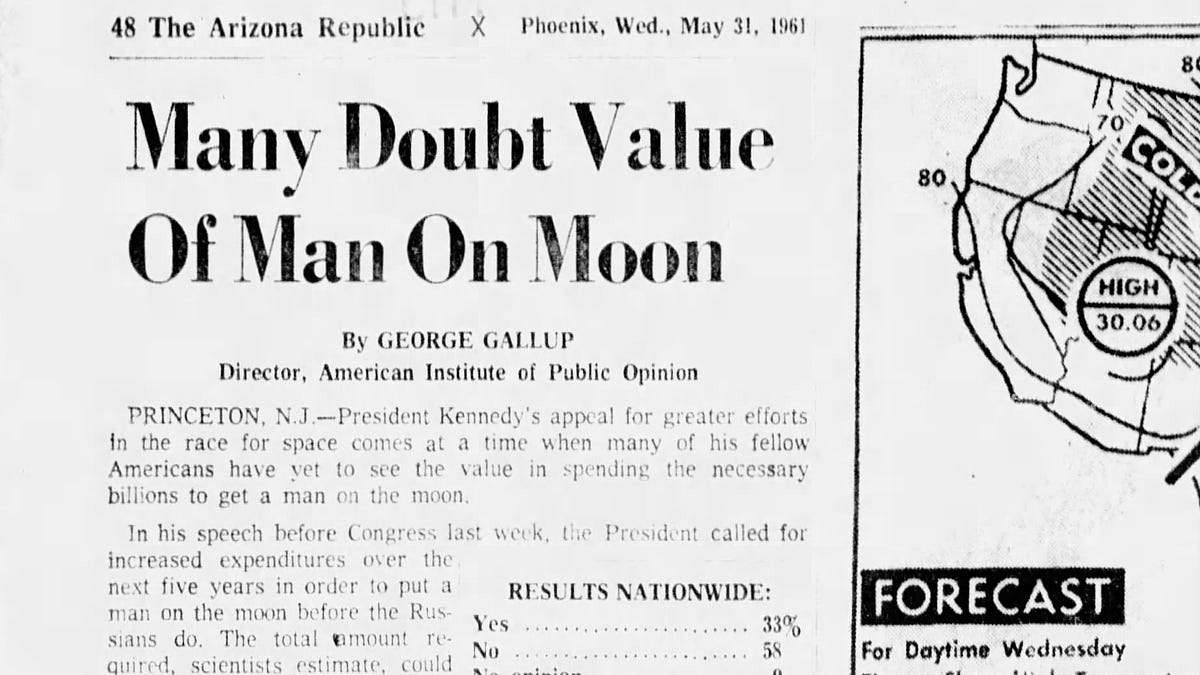
1. I love stuff like this. I think about it with elections all the time; even in the biggest landslide elections there’s always about a third of the population that wasn’t on board. A good reminder about winners writing history books.
2. I’m in my 30s. The first time I ever was given an idea that people weren’t all about the Moon landing was a Larry Norman song[0], of all things. (“They brought back a big bag of rocks / Only cost thirteen billion. Must be nice rocks”) I was definitely an adult by this point.
3. I’m curious about the wording, but it seemed like the survey question was focused on cost. Americans never like things when you ask about cost. If the question was “should we develop rockets strong enough to beat the Commies” it probably would have polled a lot better.
4. Americans also always seem to be cool with public works-y stuff once it’s actually built. No one liked the Big Dig until it was done. Part of that is the cost concern, but I think there’s also the disbelief that things are possible, and fears about what the bad side of the thing could be.
I guess SF had the "advantage" of an earthquake to eliminate its issue.
You're actually vastly underestimating the amount of the population that wasn't on board.
In 1972, Nixon was reelected with 60.7% of the vote from 56.2% voter turnout, which amounted to only 34% of eligible voters.
In 1984, Reagan was reelected with 58.8% of the vote from 55.2% voter turnout, which amounted to only 32% of eligible voters.
Incidentally, Biden in 2020 was also 34%: 51.3% of the vote from 66.6% voter turnout.
Why would you count these people as "on board"?
Moreover, even among the people who do vote, there are a lot who plug their noses and vote for what they consider to be the lesser evil, against the other candidate rather than with enthusiasm for their own candidate.
If there's some thing I've learned in the past 6 or so years is that when morons attach their personality to a certain claim and then they're proven wrong, they just double down. So I can totally imagine that a very large fraction of those 66% who opposed it couldn't just be proven wrong and instead attack it. It can't be that I was wrong and landing on the moon was actually awesome, instead it must be fake! Didn't happen!
Consider that people who opposed going to the moon still may not think that it was "awesome."
It's patriotic bullshit that political scoundrels turn to, but is at least not as horrific as war. Although if the money spent on the moon landing had been spent on starving children, many of them wouldn't have starved, so maybe it's a sort of an inverse war to burn cash like that?
Nationalists are childish. Trump declares a Space Force, and turns half the people who thought he was the antichrist into his defenders.
If there was no war, the perception and support shifts. If there was also less other social unrest, the perception and support shift again.
If you don't know it you should listen to to that link of Gil Scott-Heron reading it, but here are the words if you prefer not to youtube:
A rat done bit my sister Nell.
(with Whitey on the Moon)
Her face and arms began to swell.
(and Whitey's on the Moon)
I can't pay no doctor bill.
(but Whitey's on the Moon)
Ten years from now I'll be paying still.
(while Whitey's on the Moon)Who is the "you" in this sentence? Are you speaking as the King? Of course the King doesn't have to justify his expenditures to the peasants.
Smashed the back button and chose to read the comments instead.
https://www.google.com/search?q=was+the+American+revolution+...
History is not a linear journey from point a to point b. Capitalist republics are not inevitable and liberalism is not assured. We could indeed all be bowing to Charles right now.
Canada: 51,987.94 USD
USA: 70,248.63 USD
That places Canada's GDP per capita at about 74% of the US's.
The British administration of Canada was different to begin with because Britain acquired Canada from conquering New France and so had a completely separate culture. And the way France ran then-New France / now-Canada was completely different to how the British 'ran' the colonies ('ran' is used loosely, as there was minimal oversight since they were each basically commercial ventures).
For some interesting research on how the administration differences resulted in the cultural differences (even though the countries are right next to each other), see the book The origins of Canadian and American political differences:
* https://www.hup.harvard.edu/catalog.php?isbn=9780674031364
* https://www.goodreads.com/book/show/3286270-the-origins-of-c...
But I also agree, I'd prefer to stay in the US than move to Europe. But I'd even more prefer to have some universal healthcare and also live in the US.
Could you be more specific? There are many countries in Europe, of course.
> I would never take the flip side of my move
I wasn't talking about moving; I was talking about having UK-style health care here in the US.
> you can rest easy knowing you have that option
Which option?
> If you don’t know people who have expatriated to some degree out of the US, invest in widening your social circle.
What was the purpose of this sentence?
catholicism is how rome beat down the 'barbarians', which ended up as the germanic holy roman empire
But it would seem the cost ascended to what would now be $280 billion, adjusted for inflation.
CERN's Large Hadron Collider cost 4.75 billion. International Space Station? A cool 150 billion GPS costed 12 billion to put in orbit. James Webb telescope, 10 billion. Human Genome, 5 billion.
Now, there is a point to be made that maybe we just don't do other very valuable, very expensive projects, and you can always compare it to the US defense budget if you want to make the number look small, but I really wasn't aware of the sheer amount of money poured into this. Damn.
Also, humanity is always going to spend a good whack of money on defence - it's just the cost of running a civilization. Lawful behavior is what keeps us on an upward trajectory, and laws are backed up by guns.
If Ukraine had nukes, there'd be no invasion.
If France invaded Germany right after Germany invaded Poland in 1939, there'd be no WW2.
If the Allies didn't invade Nazi Europe, Hitler's son/grandson would be ruling that continent, and possibly a couple of other ones as well.
I fully agree on your point regarding big, valuable projects though.
Isn't anything that isn't humanitarian aid technically a waste of money?
- Henry David Thoreau
Of course they were a waste. The reason we like them is because we didn't have to pay for them and we marvel at those who did. I like the moai on Easter Island; should we do more of that?
NASA is like the government's R&D arm with the excuse (marketing) that it's all about space.
As long as we have
colleges and universities pour money into sports, taxpayer subsidized NFL stadiums (not having to pay taxes is also a subsidy, we don't have to hand them buckets of cash, just waiving taxes is taxpayer subsidy)
and really any corporate welfare at all
I don't want to hear how investing in science is a waste of money.
That's not how it works. Colleges and universities break even or make money from sports.
> taxpayer subsidized NFL stadiums (not having to pay taxes is also a subsidy, we don't have to hand them buckets of cash, just waiving taxes is taxpayer subsidy)
This is just standard institutional legal criminality. States and cities issue huge bonds for the sake of private organizations with no ongoing payments, only a giant balloon payment at the end. When they sell these bonds, they magic them into being tax-free for the owners. When the balloon payment approaches, they issue another huge bond to fund the balloon payment. Eventually if they declare bankruptcy, the state or city has committed to paying off the bonds for them.
Doesn't have anything to do with sports. If you're friends with the right people, you can get this done for adding an expansion to your french fry factory that you promise will allow you to hire 10 extra people. Except there's no compliance enforcement, and instead you filled your new space with a machine that allowed you to lay off 20 people.
When it comes to sports, the government has special carveouts in antitrust law for the NFL (and the like.) It's simply corruption.
> I don't want to hear how investing in science is a waste of money.
This is a strawman. If I say that I oppose funding for your search for the angelic healing properties of bleach, it doesn't mean I'm against science. If I don't think your search for the cure for baldness is worth $50B of public money, I also mean that without reference to however much people who like football waste on football.
I'm all for science spending, and a moon shot is probably about as good as any other way to funnel money to scientists and engineers. But let's not be disingenuous that this program was the only possible way to spend money on science.
There wasn't a market demand for computers that would justify the R&D budget that Apollo was given to develop computers to the level that was required to get us where we are today.
Public schools for black kids must have been really amazing.
Here's a clue[1] at no cost.
The majority of a large population is always and without exception a dumb herd. It's the rare context where you should listen to what that type of majority says or claims to want. The wisdom of crowds is one of the more idiotic concepts popularized in the past 30 years.
Even more than intelligence is a very scarce attribute, being competent at utilizing reason and generally being rational (by intent, wilfully; being focused on purpose in the direction of being rational and working to maintain that orientation, which requires persistent effort, while the median person is exceptionally lazy).
It's why you shouldn't bother asking people what they want when it comes to building the future. The masses have absolutely no idea what they're doing with their own lives most of the time, much less have any grasp of what's possible when it comes to assembling the future (as referenced Henry Ford & faster horses).
People will say: well then you're invalidating Democracy by ignoring the majority! No. Concepts of rights as in the Bill of Rights are specifically created to protect the minority from the irrational, dangerous majority; it's overwhelmingly meant as a restraint on the ill behavior of the majority. It helps (emphasis) to prevent the majority from voting your rights as a minority individual out of existence just because they have that majority vote.
We need things like the Bill of Rights precisely because the majority are so often dumb, dangerous and irrational (and they're not irrational + dangerous 24/7, the tendency is for them to go on rampages historically, so they must be caged by something like the Bill of Rights to try to prevent that behavior).
The view to which I am responding renders the American Revolution baseless: a waste of time and effort that was only to shift under which aristocrat(s) the colonists were to be governed. To them, it would have been of little consequence. Excepting for the important issue of War deaths.
Last, you begin from an argument of government and justify it with a conclusion that appeals to individual rights. It doesn't follow. There's zero conflict between democracy and the Bill of Rights that anti-populist rulership solves. The term "populism" being from the brand of propaganda that likes to have the word "democracy" constantly oozing out of its mouth while excusing itself to serve mostly special and politician dynasty interests.
Don't get me wrong. I don't believe that we've ever had a democracy. At the same time only a fool would allow self-styled aristocrats to claim historical just-governance. It's just not the case. Again, all this argument does is nullify most of the proposition for the American Revolution.
> Concepts of rights as in the Bill of Rights are specifically created to protect the minority from the irrational, dangerous majority
They're not meant to protect the rulers from the citizenry, even though the rulers are a minority. In our form of government, they're meant to be representatives of the popular will, not a special interest group. What you're talking about is monarchy.