50 Years of Text Games parses the rich history of a foundational genre
Zork and MUD? Sure. But also Universal Paperclips, AI Dungeon, and Lifeline.
Ars Technica
67 points · by KnuthIsGod · 3y ago · 28 comments
I had preordered it as a kind of semi-donation, to be honest, because I’ve never been that much into the various text gaming genres (and because I just spend too much on books that I want to exist but maybe not read that much).
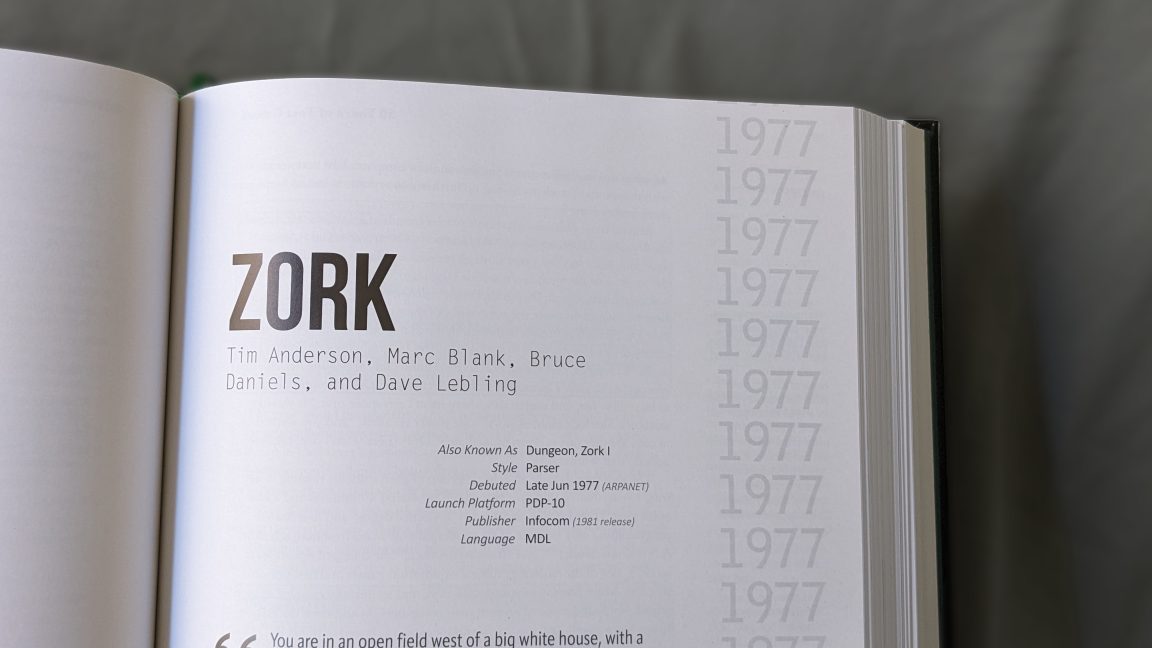
But this book is so well curated and written, I found myself itching to play several of these games from 1985 onwards. There’s a rich history of digital literature that I’ve completely missed.
The author also looks into the various games’ implementation strategies and engines, even showing code samples. Unexpectedly fascinating.
Z Machine games. The mentioned games are all available. Use Frotz to play them under Unix, Winfrotz under Windows, Lectrote under Android. http://ifarchive.org/indexes/if-archiveXgamesXzcode.html
The only problem was that I was too young to really get the genre, it was difficult, so I only ever beat the easier ones, Zork Zero, Wishbringer, Enchanter, Sorcerer and Spellbreaker. The others completely wailed on me, I could barely get a third of the way through the original Zork without being eaten by a grue
I have felt this for years, and was an early Infocom customer. There exists (I think) a defensible space part-way between a book and a graphical game, which we are no-longer exploiting.
I've been thinking about writing a text adventure for/with my son (in our native language, not English) for this exact purpose: fair enough, he's a gamer, but let's also deepen his understanding of the structures of written word.
There a whole universe of "text games" (literally, games consisting of text only) and in that universe there is a galaxy of "text adventure/interactive fiction" type games. For me personally, the latter are games that are predominantly defined by being parser based games; think "go north" type games.
The Nordland trilogy (not even sure if it was ever translated to English) is a parser based role playing game; Oregon Trail is a choice based simulation game, Empire Wargame is an ASCII based strategy game, and so on and so forth.
And there are still text based games of all coleur being released today.
Here is the link. I would love some feedback while we are ironing it out. https://quantico.alwaysdata.net/static/game_text/game/index_...
Ps: not mobile friendly yet and there are english errors to be corrected.
But this is about text "adventure" games.
Therein lies the fatal flaw: the output will be formulaic. Most important, the output won’t have any artistic content at all. You will NEVER see anything like literature coming out of deep learning AI. You’ll see plenty of potboilers pouring forth, but you can’t make art without an artist.
This stuff will be hailed as the next great revolution in entertainment. We’ll see lots of prizes awarded, fulsome reviews, thick layers of praise heaped on, and nobody will see any need to work on the real thing. That will stop us dead in our tracks for a few decades. "
from https://www.erasmatazz.com/library/interactive-storytelling/... (2018)
But it is very funny to think of a system requiring massive amounts of compute being used to try and replicate a genre as old as PCs itself.
More than funnny, it's shameful. And a huge waste of resources. I mean, if they used AI's for parsing papers helping bioinformatics and medicine, that would be a great case. Not for text adventures, where with Inform6 and basic logic you can create a game in a month. A week to write a good script (literarian script), another one to code it and two weeks polishing things and bugs here and there.
To start, it could be as simple as giving GPT the list of valid commands for the user state and location and having it translate if the user asks for something that is equivalent but doesn't match the command exactly.