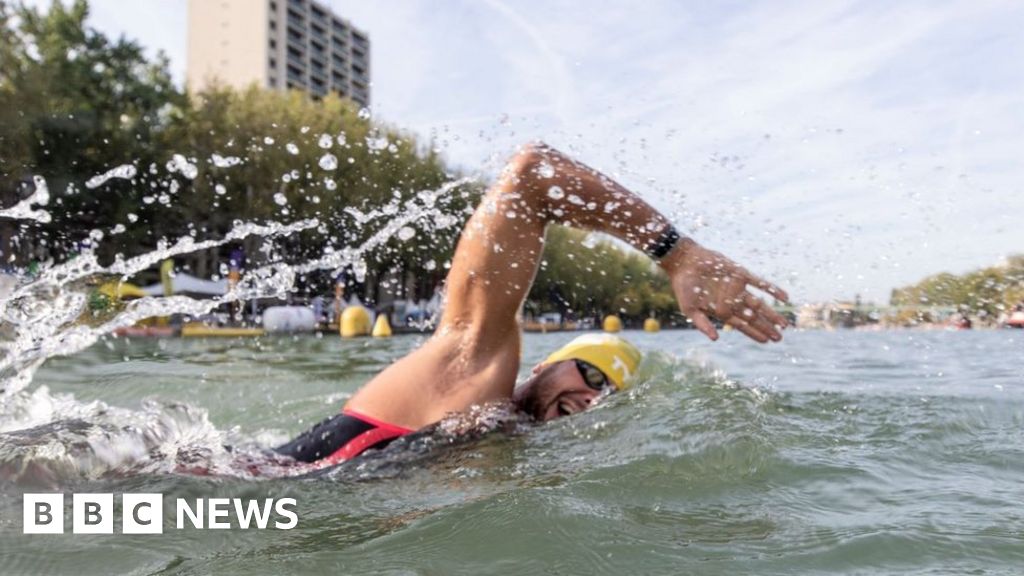
Paris to bring back swimming in Seine after 100 years
Banned for a century because of filthy water, bathing is to resume in parts of the river.
bbc.com
275 points · by divbzero · 3y ago · 228 comments
But... No matter what they say about bacteria measurements and other high quality quantitative indicators, there will still be swimming bags of potato chips and cigarette cartons and beer cans and receipts, and all the other junk Parisians tend to toss in there, even the occasional Vélib' bicycle. The thought of going for a nice swim only to whack my foot on a rusted underwater bicycle gear and then leave the water with a sandwich wrapper clinging to my back isn't very appealing. So I wonder how this will be managed, and how separated the three proposed swimming spots will be.
With that said, I went swimming in the Ohio River as a child, and I guess I'm still alive, so ¯ \ _ ( ツ ) _ / ¯
Given that the article mentions that there will be officially held races/ marathons, I suspect that there will be a lot of money being put into keeping the water clean and safe. It seems like the city has been very invested in improving the water quality of the Seine and I expect that to continue with the additional pressure of human swimmers.
Time to enforce littering fines.
Seriously, as a French person living in Belgium, I am disgusted with how little of a shit people give about keeping their own city clean.
If we start enforcing littering fines a bit more in western europe, this shit will stop within a couple of years. It's 100% cultural and this is something we absolutely have to change in our culture.
Things have recently changed for the worse. eg. I was in Paris, and I could see a stark contrast between now and 10 years ago. Also, parts of Italy seem to be backsliding, and then you have parts of Croatia that look better than many western parts.
Ps. In the US, NYC and SF are pretty 'dirty' overall, but then you have mid tier cities such as Miami, Boston, D.C., that are and feel very clean overall.
How about some education and trusting people to act as grown-ups?
(Disclaimer - I live in Sweden)
I heard several years ago the picture was similar to neighboring countries (not good). This indicates that the cleanup is possible without introducing total surveillance.
Some level of perceived enforcement is required, but in reality it just needs to be a sign with a high fine on it. And finally some level of public funded cleanup groups and you can get pretty far with keeping spaces clean.
People there don't regularly assault people on the street, brandish firearms, or drive vehicles without number plates. There is a possibility for law enforcement to set social expectations around dumping such that people don't actually do it out of fear of serious legal consequences.
In my observation a mix of culture and working cleaning services is a better predictor of clean streets than fines. It matters a lot if people want to live in a clean environment or they don't care. I have an empathy gap here and it's hard to understand why but I see that some people either don't mind garbage lying around or too lazy to carry it to a place where it can be disposed (nearest litter bin if they exist in this area or home if not).
I cannot emphasize enough how important this part is. I have a major incurable health issue from ignoring this rule.
And what is the background here?
I lived in Key West for half of my life. I got addicted to swimming daily and would always go, no matter what. Now I have sinusitis caused cluster headaches. When I trace back events, the first one happened about a year into the swimming. Now they are truly debilitating.
I would even add not swimming during an out-going tide if the water passes by nasty land. (nasty = like seemingly lovely mangroves where birds live or bird poo covered rocks)
Now I always check water quality reports to find the cleanest water on vacation as well. Most places do them, even if not advertised.
https://en.wikipedia.org/wiki/Tunnel_and_Reservoir_Plan
Some more reading about the river cleanup project:
https://interactive.wttw.com/chicago-river-tour/can-we-swim-...
Anyways - yes - lots of cities near watersheds have this problem. I would say most - fecal coliform counts have been high enough to justify warnings a variety of places I've fished or vacationed. Sometimes not that big of cities.
The "good" spots are highly desirable and usually privately owned (or on a very long-term lease), and you often need to buy a boat to get the mooring spot beneath it. (A buddy of mine in London ended up with 3 boats while upgrading his mooring spot.)
Another options is to vagabond it, where you move your boat to a new area every week or two -- this is usually unserviced, so it's more like camping, but lets you use unofficial spots and is free.
(The last option is to find goofy loopholes. E.g., in some areas of the Thames, you can create a nesting habitat for an endangered bird on your boat, and then once the bird settles in, they can't force you to move, since doing so would destroy an important habitat. Sounds stupid but a surprising number of permanent city boats are there on some sort of loophole.)
Seems like the fix for that would be to force you to leave the boat where it is, but to stay off of it so as not to disturb or disrupt the bird's habitat while at the same time leaving you responsible for rent and the boat's upkeep. That way you'd have an expensive boat you can't use but must also pay for and maintain. The plus side being that nobody in their right mind would try to attract endangered birds, the downside being that in order to avoid the costs, a cruel person might harm the bird if it happened to build a nest on their boat naturally (not sure how often that actually happens when people aren't intentionally building habitats for them).
It's possible that discouraging that kind of thing just isn't worth it. Maybe the people taking up space with their houseboats aren't as big a problem as there not being enough nice habitats for a struggling species, and the loophole is a net good for the restoration of the bird population without being a major problem for others.
Many are also "fixed" restaurants, bars / nightclubs.
[0] https://twitter.com/yohannmultipass/status/11181422507883151...
I also live in Meudon (in the hills); I recently bought an inflatable kayak to try it on the Seine but have not dared use it yet, and so far also failed to convince my kids to try it with me ;-(
    Here we are, born to be kings
    We're the princes of the universe
    Here we belong, fighting to survive
    In a world with the darkest powers
    Heh
    And here we are, we're the princes of the universe
    Here we belong, fighting for survival
    We've come to be the rulers of you all
Going down the Aare river from Thun/Uttigen to Bern is a hugely popular activity to do in summer, but every year a few people drown. Even so, I'd recommend it.
https://madeinbern.com/en/stories/along-the-aare-river-2#:~:...).
https://www.visitcopenhagen.com/copenhagen/activities/baths-...
It might have a slight upper hand in cleanliness with being directly connected to the sea.
To any tourists visiting Aus, please only ever swim where locals swim and only between the flags if on the coast
Not open water, but salt, and an absolutely gorgeous location.
I guess it's open water unlike the Seine, but it did surprise me, I felt like I was sat in quite an industrial area when a couple walked past in swimming costumes and towels.
On the other side, Arve coming down from France is muddied right at the source by Mont blanc range, which is mostly granite. You can see the exact spot where specific stream comes into play, very gray, and it doesn't get much better afterwards.
Its enough to get big river like Rhone dirty all the way to Mediterranean sea. Also, after Jonction Rhone becomes pretty cold to just swim in even in warmest summer days. But yes many tkae it down during summer on inflatables, including us.
while the thames can be swam upriver of Putney Bridge, there are conditions as the Thames is a busy river. but there are other spots in London where one can do wild swimming.
for example:
london royal docks https://loveopenwater.co.uk/swimming-london-royal-docks/
canary wharf: https://canarywharf.com/whats-on/open-water-swimming/
the famous ponds in hampstead heath: https://www.cityoflondon.gov.uk/things-to-do/green-spaces/ha...
the famous hyde park lido: https://www.royalparks.org.uk/parks/hyde-park/things-to-see-...
There are lots of canals and rivers all across The Netherlands and people are swimming in them more and more. When I used to live in Utrecht the idea of swimming in the Oudegracht was disgusting. But I was visiting last month and saw people doing it. I still wouldn't swim in that canal.
We had a rubble beach and the river only was 1m deep for half its width.
Was pretty nice. The water was colder than in the lakes and it came with a natural counter-current system, so you could swim in-place.
I'm from northern Italy and we have a lot of small rivers and lakes here, from the outside most of them seem pretty innocent but there are drownings every single year.
Most people that drown here are immigrants that don't know how treacherous an alpine river or lake might be, it usually happens in the summer and is always a sad story to hear. A couple of weeks ago two people died in my province: the son went swimming, an undercurrent pulled him under the surface, then his father tried to save him and got pulled under in the same way.
Please be careful!
Most currents can't pull you under the water. There are notable exceptions such as obstructions, dams and rapids which can form "keepers", or sudden depth or width changes that can make the water flow extremely fast and turbulent beneath the surface (such as the strid), but those sorts of situations aren't that common.
Most drownings in rivers and lakes where someone was apparently pulled under are actually due to cold water shock. The water beneath the surface of a river can be extremely cold, which can immediately paralyse even the most experienced swimmer.
Worse, sometimes the water can be a lot colder than other times, or colder in the middle than at the sides, meaning the river could be safe sometimes and not other times, and it might seem fine when you first get in, only to find you rapidly fatigue as you move further away from the bank.
That's why most drownings around here happen to immigrants: local people know that it is crazy to go swimming in some places, because they know that something bad happened to a lot of swimmers over the years in those points, but if you don't know that history it is easy to make that possibly fatal mistake.
It's in England it is called Bolton Strid. I'm not in England myself I just read about it.
They might look all calm and placid, but they are really deep with steep shores that are pretty irregular, think of them as a valley between two mountains filled with water with water coming in from one side and going out from the other (that's exactly what they are actually). The water flows more rapidly beneath the surface and creates turbulences due to the irregularities of the shores, so now there are two things:
- those turbulences might pull you under very rapidly, many meters below the surface, and that might cause you a shock. If you pass out when that happens, well... you're dead.
- those turbulences and the currents sometimes detach boulders or other chunks of rock, when this happens water needs to fill the void left by the fallen rock and if you are unlucky to be in that water it can pull you down for tens of meters. 10m of water on your head increase the pressure by ~1atm, if you get pulled under by 20/30m in just a second you will pass out for sure and as in the other point... you're dead for sure.
If you go to one of those lakes and want to swim you must stay close to the shore and you must enter the lake where the shore is not steep or else you'll be risking it.
Lake Garda, Lake Idro, Lake Moro and other are very much safe on the other hand. That's why asking a local person is often wise: it just takes a couple of minutes to find someone and ask, after you know you're safe get into the water and enjoy :)
> One of the main problems has been the 19th-Century "single system" drainage infrastructure, which unites household waste water from kitchens and toilets with run-off from rain on the street.
Big cities came up with their canalization in the 18th century in two ways: open or closed canals. A closed canal system (with proper tubes) would be safe, no dirt (street dirt, mostly dog shit) could overspill on heavy summer rains into the canals and river, but this would require about 10x larger tubes, just for the few summer days (about 10 days a year). And a normal river with normal oxygen levels can easily fixup itself after such a spill. I.e. a flowing river, no dams near cities. And no industrial sewage directly into the river (which does not happen in civilized countries since the 80ies).
Almost every european city uses an open canal system, where in those few heavy rain days during the summer (and this can likely happen during summer olympics), the canal gates need to be opened so that the street water can overspill into the river, and it mixes with the dirt water from the open canal. So you do have heavy shit pollution in the river for about 3 days. No swimming, bad smell, E.Coli poisoning, rat bacteria (black plague).
So what a few richer cities, or the stupid ones which destroyed the natural cleaning abilities of the river by building dams near their cities for electricity (such as my city Graz, Austria), had to do, was to build such huge overspill cylinders or side canals to keep it from flowing directly into the river, but into their water treatment plant instead.
With more southern cities this would be impossible, as the rainfall is too heavy. E.g. in Houston you'll get a downpoor for 20minutes, with streets and canals flooded, cars need to stop, but then it goes on. In such subtropical cities you cannot think of building closed canal systems or such side spill reservoirs. The peek volume is way too high to be able to control it. And their rivers do contain poisonous snakes and alligators anyway.
Alligators and poisonous snakes are not as much of an impediment to swimming as you would think. Here in Florida, we have plenty of people swimming in springs, lakes, and rivers that have gators in or nearby. The gators know to stay far away from people whose splashing and noise disrupt the fish and small animals they eat.
You can go to springs that get absolutely packed full all summer long, to where you can't swing your arms without hitting someone else, canoe 100yd outside the (unmarked) swimming area, and see gators sitting idly by near the banks without a care in the world.
There is a logic step I'm missing here. I fail to see how a closed canal system is safer. Will the dirty water not, by definition, end up in the lowest point anyway, i.e. the river? Whether the canals are open or closed? I mean, the dirty water is not just going to disappear, is it?
In an open system, too, but the open system can overflow into nearby watersheds.
Felt a bit sorry for those guys.
What you did was illegal. Boats are not allowed to discharge waste into water inland or at sea unless 10 miles out at sea (USA and I'm sure most other nations). If caught the fines are quite severe. You must flush into a holding tank which is emptied by vacuum while at port. OR discharge once far out at sea.
Though since you rented this was likely operator error due to inexperience. Some boats have different plumbing systems with a Y valve that diverts to holding tank or overboard. Some boats have no Y valve so they flush directly into a tank that also has a macerator pump that empties the tank while at sea. The pump switch is usually on the dashboard OR sometimes in the bathroom and people mistake the macerator pump button for the flush button. Or they try to turn something on the dash and hit the macerator pump switch by accident.
Next time you rent a boat please make sure you are familiar with the sewage system function. The rental facility will show you how it operates properly.
I was surprised as well, but there was nothing we could do. Flushing the WC directly triggered the thing.
next time drop the bilge....in a spot that common sense would dictate.
https://www.thelocal.fr/20210224/paris-mayor-anne-hidalgos-s...
I mean that Anne Hidalgo is a woman.
https://www.npr.org/2023/07/26/1190123421/after-100-years-pa...
Paris like most older cities has a combined storm and sewage system. The problem always is when there is too much rain the treatment plant can't handle the volume so it get dumped into the river untreated. To fix that they're building a huge holding reservoir so they can capture sewage + storm water and feed it slowly into the waste treatment plant instead of dumping it into the Seine.
Added. I've read elsewhere that the Seine is often safe to swim in already. Hope is this will turn often safe to to always or usually safe.
Agree that it’s a great result overall!
Ken Livingstone, former mayor of London. It's not for the athletes, but it's because of them.
I can imagine that having a clean river is good for many things, and they will keep using this facility?
Here's an article with more details: https://www.bbc.com/news/world-europe-66238618
It’s fairly standard practice for triathlons to dump a whole bunch of bleach into a lake or river to make it safe to swim in for a couple of days, but without continual treatment it quickly goes back to normal.
I'm not sure where this might be standard practice, but this would be very illegal in most of Europe. So that's not what is going to be done (as explained in the article).
Or any near-urban seawater after a first rainfall after dry spell. Because of runoff.
No obnoxious currents (generally or due to recent rainfall) for example.
No debris. No disease. No sewerage. Rocks. Sudden depth changes. Things that will eat you.
What about boats? Locks?
Is it legal?
Even then probably would want a life jacket anyway.
That said back at 20 I’d just jump in on the basis that if someone else has it is probably ok.
But watch what they do when a baby poos in your local aquatic centre. They don’t fuck around. Everyone is out in seconds.
The water was freezing, she spent a month sneezing, but said she would do it again. Here's to the ones who dream, foolish as they may seem. Here's to the hearts that ache, here's to the mess we make.
Brisbane (where I live) the river is affectionately called 'the brown snake' mainly because of silt. Even though sand mining/dredging has ended, the river is silty still. Is that why swimming isn't recommended? No: its because upstream on oxley creek, major industrial and agricultural runoff issues during historic floods in the last 10-20 years have raised contamination, fecal coliform and other problems such that you risk serious antibiotic resistant bugs if you accidentally ingest too much, or get it in cuts (I know because I row, and a rowing colleague wound up on IV antibiotics with amputation being discussed from a deep cut)
When it floods in brisbane, associated creeks continue to leach the effects of 100+ years of industrial waste and effluent into the water. Nearby cities have land which is capped 2m deep over what was septic tank discharge, it is said that shigella is still a significant risk if you dig into the soil. I don't know, I thought it died, but perhaps it persists?
Well.. that and the bullsharks but we're talking about pollution.
Yes, the Thames is coming back to life and significant fish numbers have risen in the last decade, we're miles off "the great stink" which caused Bazalgette to construct the sewers on the riverbank. Is it always entirely safe to "be in" -well no. Sources upstream occasionally dump sewage overflow along the length of the Thames. Its meant to be emergency only, but sewage overflow has to be dealt with pretty rapidly. They try not to. What do you do, when the system is overloaded?
I am amazed Paris has been able to restore river health enough to do this. Well done!
Bazalgette 2.0 - post millennium mega sewer on steroids.
We’re building a 25km Super Sewer under the Thames to intercept those nasty spills and clean up our river for the good of the city, its wildlife and you.
Impressive and hopefully enough for a few years. It's a massive project with many tunnel lines, deep sink holes to pump stations and tunnel boring machine launch and recovery points etc.
Until then - don't flush those f-ing wet wipes!! :-)
Super Sewer: https://www.youtube.com/watch?v=fZszSTjZ-i4
Thames Water alone dumped raw sewage into rivers 5,028 times in 2021. I wouldn't call that 'occasionally'!:
https://www.theguardian.com/environment/2022/apr/20/thames-w...
But there are still lots of other rivers where remediation takes still place, e.g. because the rivers was used for raw sewage.
You may not want to look up if swimming in the Thames is safe.
> You may not want to look up if swimming in the Thames is safe.
The Thames is in England
They said "liberal European...". As much as (some of) the English might hate it they are European...
I think your assumptions around liberal European countries is seriously flawed.
You have to understand that the current-day environmentalism is only a recent phenomena, while the waters have been getting polluted for centuries. It just takes lot of time and effort to turn that around.
It has been discussed every now and then, but it's always too complicated, or the solutions available aren't liked by the people in charge.
"Our river is so dirty, it's too dangerous to swim in there. Let's build a swimming pool into the river!"
Here's a link to a "BeSafe" app to help you navigate Paris without being pickpocketed or shanked! https://apps.apple.com/us/app/besafe/id425631096
This is what I think of whenever I see the Seine in the news.
Internet Archive has the full movie:
I'm in my 40s, and river pollution started decades if not at least a century before I was born. You just weren't as aware as a child.
a) was the Seine (or any urban river) really that much cleaner 100 years ago?
b) since most cities with a polluted river tend to be situated down-stream – what actually did mayor Hidalgo really do in order to demand the praise here? I assume not much other than stop enforcing restrictions?
_Cleaner_? I'd assume it was _far_ worse 100 years ago.
I'm not sure what the mayor being socialist has to do with it. All across Europe, in every political system, there are water cleanup projects. Pretty much any big old city is going to have these problems unless you do _serious_ remediation.
Socialists tend to be more interested in public access to common goods. Swimmable rivers seem relevant. A neoliberal mayor would probably prefer people to pay to swim in commercial swimming pools.
Although the mayor who actually does it is socialist, it was initiated by a right-wing mayor (Jacques Chirac, who went on to become president) famously announcing he would himself swim in the Seine in the 90s (he didn't).
a) it was probably not cleaner 100 years ago, but that's the year when swimming in the Seine was banned because of pollution
b) Paris is not really downstream of any large city on the Seine and most of the pollution by far is produced by Paris and its suburbs, not by Troyes 150 km upstream.
What they are doing to reduce pollution is explained in detail in the linked article.
This word doesn't have the same meaning in Europe, than it has in the US. "Socialist" mainly describes some sort of social democratism, even when some people calling themselves socialist won't accept that label for themselves.
On the other hand in the US you seem to call everything left of the republicans "socialist" and everything left of right wing democrats "marxist". And you even label totally unrelated things like gender expression "marxist".