372 points · by wawayanda · 3y ago · 307 comments
1) The AMOC is one of the most studied parts of the world ocean and predictions about its collapse have been made since Stommel in 1961. I think in general any study on its imminent collapse should be taken with a grain of salt and it would be wise to wait for further replication and the consensus of the community. You can google AMOC collapse and find articles stretching back decades.
2) This may be my bias a dynamacist but I am skeptical of purely statistical models of AMOC collapse. The AMOC is complex and trying to predict the time of a complete collapse is a significant simplification (especially when, as the authors note, a slowdown rather than shutdown of the AMOC seems more likely from our current understanding).
Nevertheless this is a very interesting study and contribution to the field.
Edit: @abathur posted a wonderful link below that I wanted to spread further: https://www.sciencemediacentre.org/expert-reaction-to-paper-...
I felt the article was clear collapse is not imminent, not even in this century.
I felt it noted focus was not on imminence, but on changes worth mentioning in aspects of interest.
Perhaps the difference is this article is talking of timing for transitions of significance, rather than the forthcoming collapse more likely to arrive sooner after such transitions?
Rushing to comment has deep effects on HN, the threading incentivizes appending to the top comments rather than replying. This will now be a philosophical debate about scientific trust for hours just because people assume the article says "collapse is happening shortly by X date", but its just a statistical model :(
Don't mean to make you feel bad or call you out, most people don't read the article if it's popular. It's my attempt to give a little back to the community to note it, been here a very long time, and when people try calling it out coarsely it isn't constructive.
[1] sort of: they understood it was a statistical model but spent so much time hand-wringing about Nature publishing a statistical model that it came off like there was something wrong with the article, causing a rush of replies of "how can I trust anything??"
"DOOM ITS THE END OF THE WORLD!" is a tale as old as time... revelations has been screaming the end is near for thousands of years now.
It's "accurate to say" that prophets and prophecies are notoriously wrong which is why signs that the ice caps will be gone by 2000 have been removed from state parks.
hint: they aren't gone.
Ocean currents bring lots of warm water from the south towards Europe making it quite a bit warmer than other places at similar latitudes. Cities in Europe are quite a bit further north than most people think.
Lots of other side effects as well would happen but be less known or surely predicted by models.
During the night, the lack of cloud cover also means there is less insulation to trap the heat accumulated during the day.
This can lead to hot days and relatively cooler nights, which can be characteristic of certain climates, like in arid or desert regions.
AMOC is part of a tremendous thermal-energy circulation system from the tropics to the arctic within the Atlantic Ocean, and tying to global ocean circulation patterns. Specific impacts are difficult to identify, but could well be hotter tropics (and likely: stronger and more frequent hurricanes and extreme storms), colder North Atlantic (including a loss of the moderating influence of the Gulf Stream on Northern European climates, hence potentially far colder and more severe winters). There are also likely impacts on marine life, agriculture, general wildlife patterns (plant and animal), amongst others. Regional sea-level rise is another possible impact (through thermal expansion if I understand correctly).
Effectively: a predictable and beneficial pattern to which human and nonhuman life and existence has evolved over many thousands of years, if not longer, may be on the verge of complete disruption. That's an event without precedent for on the order of 10,000 years (since the end of the last major glaciation period).
<https://en.wikipedia.org/wiki/El_Ni%C3%B1o>
More on prospective impacts of an AMOC collapse:
<https://en.wikipedia.org/wiki/Atlantic_meridional_overturnin...>
<https://www.nature.com/articles/s41586-019-1181-8>
<http://phys.org/news/2016-01-greenland-ice-sheet-affect-glob...>
I right read about AMOC back in 1997 while in university. It was fascinating and frightening back then. Still relevant today. It would be sad if it did actually end up happening in my lifetime, but humans are notoriously bad at reacting to bad things that might happening in the future - https://en.wikipedia.org/wiki/Tragedy_of_the_commons. We tend to only really react once the bad thing has happened.
Global warming is the effect of decreased solar radiation (as compared to how much solar energy is absorbed), thus more energy added to the Earth. A new ice age in Norther Europe might slightly increase that area's albido, which would increase solar radiation and in theory mitigate global warming. But truth is, the effect of that change in albido will be very small compared to the effect of the atmospheric CO2 (which traps the solar radiation).
Europe may be colder, but somewhere else is going to be much, much hotter.
You want to both use your credentials to be taken seriously in your posts, but also you want to avoid too much scrutiny of who you are.
Apply some philosophy on top of your "science" and you may learn something new and potentially interesting about your claim.
Not sure why people are eager to believe literally some guy on the internet. Maybe the people are afraid to believe the other guys, you know, the ones published in Nature.
When I say physical models here by the way I'm referring to physically-based mathematical models as well as numerical models.
It seems that the authors have done a good job in developing their model. My issue is with Nature deciding to publish it. If this paper was not published in Nature it would receive little attention within or without climate science - in fact many such statistical models are published each year without much comment. However, Nature have published a paper that I think many ocean scientists would feel draws dramatic conclusions from a weak basis but will now inevitably draw much more attention than more insightful papers.
MIT professor Carl Wunsch accused Nature in 2010 of near-tabloid science with a tendency towards sensational papers built on weak foundations. However, I've felt that Nature's choice of publications on climate in recent years has been high quality. This paper feels like a big step-down from that standard.
Question for the community: how does one navigate such uncertainty?
Treat it like the weather prediction for next month, if it happens it happens and then you can react. If it starts to show up in the weather prediction for tomorrow it is time to factor it into your present day decisions.
if you are concerned about something it does not mean you must be non stop stressed or forever abandon your life for single cause. You can be concerned and act in constructive ways (lead by example, talk about it, raise the issue, vote, etc), making strategic sacrifices but also living life. In fact you will probably be more satisfied this way than if you just felt you can't do anything and tried to not think about the white elephant. And it is the only way things change...
Not climate scientist, but researcher in ML (another highly hyped and arguably more noisy field).
After Bourbon, the hard truth is expertise + don't.
Unfortunately journals/conferences/venues are an extremely noisy mechanism which in general aren't realistically much better than arxiv (at least over here). Peer review isn't journals/conferences, it is peers reading and evaluating the works. Reviewers are doing a service and often not giving a work significant time as they got other stuff to do. The only real way to know if a paper is valid or not is to be an expert in the subject matter (more focused than the field) and to read it __and the code__. All too often it is a nuanced point that is the crux of a paper, and would be entirely missed if you're not deep in that subcommunity. I know this answer sucks, but that's what it is.
Fwiw, I wouldn't realistically change your strategy as a layman. It's probably the best you got. Maybe only thing is don't think "journal publication == 100% true" but rather "journal publication == probably right." The process is noisy and there's no way around this.
For me, this summary is a lot different than the way I see this aspect talked about in the media (and on Twitter, etc) even by climate scientists.
Using that is like using 'Someone raised a concern in a meeting' as a basis for believing something.
Anyone can raise a concern, or publish a paper. What matters is whether or not other people are convinced by the paper. Consensus.
Use 'scientific consensus' as your weather-vane. (PS. The scientific consensus on climate change is 'things aren't looking great, we need to turn the bus around, we aren't turning the bus around'.)
... Or go learn and become an expert in the field for yourself. It should only take ~20,000 hours of making a lot of mistakes along the way.
This thread is a good example: the person you're replying to isn't saying it's bad work, or that the work claims certitude. In fact, it disclaims it, it's a statistical model. It's just that pop "scientists" may overestimate it its in Nature and people don't read.
This is one of the key reasons I come to HN. Yes, for the news, obviously ;) But mostly for the various insights on that news.
I spent a few years studying climate models. I have lots of background in mathematical modeling and numerics, but not climate per se, so this was a big undertaking but possible. I have to admit that -- although I can now read and understand papers better -- it hasn't been particularly illuminating.
The global climate is changing. The long-term impact of these changes is difficult to know, particularly because there are many plausible bifurcation points. Beyond some basics, the TL;DR is "we just don't know exactly what will or won't happen, or when, but it's probably not going to be good for most people on the planet and things are probably going to start getting bad within 1-2 hundred years".
In my mind it's really just a case where being a conservative is the best approach.
That's a very strange take when we're seeing serious consequences of climate change now.
Also, the criticism is primarily a comment on methods (stats vs physical models) which can be based on lots of consideration and experience outside the context of any particular paper.
E.g. I can tell you that you've probably used the wrong optimization algorithm for particular task without spending much more than an hour glancing through your problem formulation and results. Doing that without the benefit of decades of experience would require weeks or months, but with experience I can make that determination quite quickly given a detailed write-up.
(FWIW: I think dynamical physics-based models are probably over-emphasized in climate science consensus, but I'm admittedly a complete novice whose opinion you shouldn't trust.)
Well, thankfully it is not.
There's no need for one side or the other to "win," especially at this point. Instead, likely, debate will continue until a more-nuanced view is better understood and accurately disseminated.
(Not necessarily a view "in the middle." Sometimes one side is just Right, Full Stop. But a more-nuanced view when there's strong disagreement on both sides is usually helpful for more people to understand _why_ there's disagreement.)
How would one possibly do that here?
However, I’ll offer an alternative perspective.
This paper identifies that IPCC does not expect a collapse in the 21st-century. That alone should be our largest biasing factor when we’re asking - from a time horizon perspective - what should we be doing?
So then, why now? I think it’s compelling that they identified two preconditions for a collapse they have been monitoring, and now are indicating that we are on the trajectory towards collapse, given what we were looking for for indications and warning.
As a former military officer, the key thing that you get from intelligence is long-term forecasting and indications and warnings for negative or dangerous actions by your adversaries and risk-taking by your allies.
So following that same logic, then if two of the largest indications and warnings for a future energy transfer collapse/flip scenario, based on the best modeling we have today, are indicating that we are on that trajectory, then it seems appropriate for the most well respected journal to relay that fact.
I feel like "a chain is only as strong as its weakest link" is in play here in a very big way.
If Congress and the President agree to what you consider a “4-6 year lag” in whatever response we take then, the best Service and COCOM chiefs can do is give advice and then execute orders.
Call and vote for your congressperson if you want lasting change in the use of the DoD.
They can't have a clickbait journal where they use their name to lend it credibility it would otherwise not have, and then claim no this isn't "Nature" and try to keep their credibility.
It sounds like the 150-year-old scientific journal of record has been taken over by private equity, or by MBAs with KPIs to optimize.
Simpler models can yield better predictions than complex ones, even when the complex model is more "realistic". The many tunable parameters and complex feedback loops can increase uncertainty compared to a simple model.
See for example "To explain or to predict?" by Shmueli (2010, https://doi.org/10.1214/10-STS330)
Their model equation (1) has 4 parameters. Do you have any papers at hand that model AMOC in a more physically constrained way, with a similar number of tunable parameters?
Other experts on the AMOC also cautioned that because the new study doesn’t present new observations of the entire ocean system — instead, it is extrapolating about the future based on past data from a limited region of the Atlantic — its conclusions should be taken with a grain of salt.
Source: https://www.washingtonpost.com/climate-environment/2023/07/2...
So can this happen “sooner than expected”, along with the massive raft of climate change outcomes that are cropping up 20, 50, and even 100 years “earlier than expected”?
Let’s just say that if climate change was on the stock exchange, I’d be dumping serious money into its futures. Nothing seems to be truly “off the table” anymore, even the truly outlandish outcomes are becoming terrifyingly prescient.
> If a paper is rejected from one Nature journal, the authors can use an automated manuscript transfer service to submit the paper to Nature Communications via a link sent to them by the editor handling the manuscript.
> Article | Open Access
It's not worth anything, since the conservative rear guard and even outright deniers say the same thing these days. If you mean to separate yourself from such people, you'll have to put it differently.
Would help taking your observations seriously if you provided some credentials, studies published, etc. Otherwise, and of course I say this with all respect, you're just some guy on the internet (spreading FUD, but that's another story)
Did Einstein rocket off at the speed of light before coming up with relativity?
All those things were later refined as they were the correct cognitive framework with inaccurate physical models behind them.
Quick dash over to wikipedia [1] and I find out that...
> The Atlantic meridional overturning circulation (AMOC) is part of a global thermohaline circulation in the oceans and is the zonally integrated component of surface and deep currents in the Atlantic Ocean.
While I am not a scientist, I consider myself fairly well-read and not an idiot. But when the first sentence of a Wikipedia article needs an ELI5 translation by ChatGPT... you know you're in for a reading adventure.
(But by the 3rd paragraph Wikipedia has a relatively understandable "what if this goes wrong" breakdown)
[1] https://en.wikipedia.org/wiki/Atlantic_meridional_overturnin...
The abstract also says that the collapse would impact the north Atlantic region, but in what way? Assuming the prediction is accurate, what changes could we expect to see in that scenario? Wikipedia suggests that temperatures in northern Europe would drop significantly + sea levels would rise, but is that all? https://en.wikipedia.org/wiki/Atlantic_meridional_overturnin...
And while the AMOC is powered quite a bit by water cooling down in the Arctic etc. the other streams are also to a huge degree powered by earth rotation AFIK.
In other words they won't stop, and likely won't slow down that much either. And that is if the AMOC stops instead of just slowing down quite a bit.
E.g. the rotation consisting of Gulf, Canary, N. Equatorial stream and N. Atlantic drift won't stop, but it will reach less far north and potentially colder. Similar for the other "rotations" like that (e.g. Brazil<->Africa) which the overturning stream overlaps with, through some parts might somewhat change their forms and water temperatures.
Or in other word while the absence of the AMOC can cool down GB/Ireland it won't remove all effects.
Expecting similar climate to other (coast) areas on the same latitude is ... not that useful. There are many different ocean current not affected by a stopping overturning current affecting the weather, additional even on coastal areas the wetter isn't always dominated by the ocean climate but can sometimes be largely affected by a constant strong weather front from the country side (both hotter and colder) and in some places that is a common occurrence due to the geography.
It still will likely be ... unpleasant in various ways.
To be clear, it's never too late to improve our fate, but by the time something like the AMOC shutting down destroys Europes climate, you've already signed up for an incredible amount of climate pain. Maybe such an event will wake us up enough to prevent out right extinction, but if this happened the collapse of industrial civilization would be virtually guaranteed.
Depends on the drop and the rise.
Open a world map, and draw parallels passing where large Northern European cities are. [1]
E.g. Canada's Montreal roughly corresponds to Paris.
[1] Or this gif from reddit: https://preview.redd.it/dm7xwsmp3aa81.gif?format=mp4&s=a1673...
Think about New York, is at 40 degrees N latitude. This means that if NY would be in the Atlantic coast of Europe would fall in Portugal! a little North to Lisbon! (38ºN). Sometimes Is easy to forget that NY is "Southern Europe" league. Southern than the North Coast of Spain.
Now lets see Quebec (53ºN). Well, London is 51ºN. Without the sea current bringing hot tropical water, London should have practically the same climate than Quebec, and 90% of UK is higher than London, so would enjoy the full whole Canadian winter experience.
Also geography making it more, or less, likely for constant wind from the inland affecting the wetter can also affect the normal expected wetter noticeable.
E.g. UK being a island means there are much less affected by inland wetter moving over to them then many typical Canadian comparison places. (And from-inland wind is the main cause of very hot summer or very cold winter wetter in many places e.g. cold weeks in north Germany, or e.g. the main source of Blizzards in the US).
So IMHO comparisons like "this city is on the same latitude and also on the cost so it will have similar weather" without the overturning current are pointless (which doesn't mean that they can't happen to be correct, but they as much can happen to be fully wrong).
So when we think about major changes in how the ocean absorbs and distributes heat, we’re also thinking about how sea level will change in certain areas vs others. If the ocean starts storing a lot more heat around Cuba than Great Britain, Cuba will experience more sea level rise than Great Britain does.
If the conditions that create the heat differential are persistent, the height difference will persist as well.
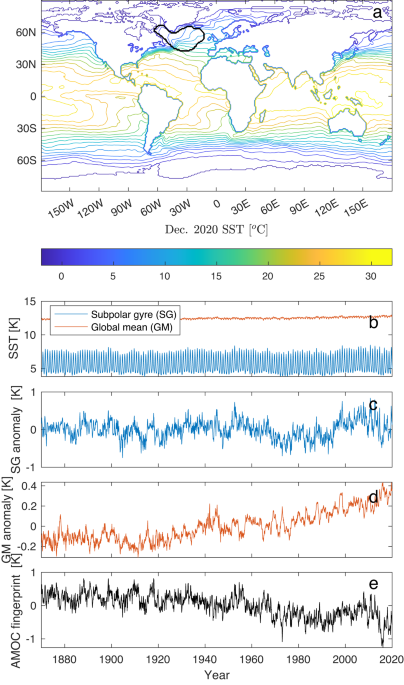
"We estimate a collapse of the AMOC to occur around mid-century under the current scenario of future emissions."
"The mean of the bootstrapped estimates of the tipping time is 〈tc〉 = 2050, and the 95% confidence interval is 2025–2095."
> Climate scientist Steffen Malskær Olsen (specializing in ocean currents at the National Center for Climate Research under DMI) questions the predictions made by Peter Ditlevsen and Susanne Ditlevsen (authors of the study) about a potential collapse of thermohaline circulation. He cites limited data and uncertainty about the correlation between surface temperatures in the Northwest Atlantic and the thermohaline circulation as main concerns. Despite this, he acknowledges the study's importance for demonstrating the potential of advanced mathematical models in predicting climate phenomena. He believes that the IPCC's prediction, which deems a collapse highly unlikely, remains the most reliable. Peter Ditlevsen accepts this uncertainty, arguing they are working with the best data currently available. (https://nyheder.tv2.dk/klima/2023-07-25-danske-forskere-med-...)
TLDR: if slowdown occurs, temperatures could drop by 5C in Europe and North America. What a 5C drop actually looks like they don't say.
https://www.livescience.com/planet-earth/climate-change/gulf...
I suppose you could compare this to one giant heat pump, circulating a heat source to Europe and North America that makes life livable.
If the AMOC collapses, that heat will presumably stay in the tropics, and North Western Europe will cool.
I'm guessing it's hopelessly naive to assume it'll just... kinda cancel each other out?
I'd expect averages might drop in spots, and raise in others, regionally. But the variance will be all over the map. And already is.
Summer heat waves, droughts, intense tropical storms.
And then winters with unusually warm days followed by record lows.
For Northern/Western Europe, with the gulf stream interrupted I'd imagine the could expect a climate closer to what the northeast of the Americas already get: erratic inconstant weather patterns with lower lows than they're used to.
Remember that the northeast and midwest is quite a bit further south than many western & northern European cities, but suffers far more brutal winters.
Here in southern Ontario, we're at the same lattitude as northern Italy or south of France, and our summers can be just as hot, and growing season about as long (and way more humid). ... But in the winter there's episodic lows below -25C, -28C. And I can tell you, you can't easily grow e.g. vitis vinifera grapes with those patterns, and certainly not figs, citrus, etc.
I don't think Europeans are mentally prepared for this, if it's coming.
Edit: a decade.
Which for reference a 5C drop should mean that New York is covered in glacier according to this source https://xkcd.com/1732/
That's not the same thing as Europe and NA cooling by 5C.
That chart shows global averages, ie, the whole world was 5C colder. NY might have been much, much colder than that.
So, I think this "5C" drop in East NA and West Europe will be absorbed throughout the world. So those regions will still have higher ave temp then say 1950, just a bit less than the rest of the world.
Humans will be playing mental gymnastics and politics for quite a while before any true changes to move the needle are made...but all other biological things can just make the adaptations...given enough cycles to recognize that something is different(the last 3 seasons were much wetter or colder or hotter, etc...).
I imagine these adaptations could be earlier/later migrations, reproduction habits, hibernation patterns, food gathering. Not necessarily changes in DNA.
That only works with enough time, and changes are happening too quickly. Here's how animals have been adapting in just the last 50 years: https://phys.org/news/2022-10-wildlife-populations-plunge-ww...
According to this one[1], they're adapting by leaving later, and flying faster/taking less breaks to make up for the lost time. The result being that less of them make it to the breeding grounds (6% decrease in survival rate).
[1] https://news.cornell.edu/stories/2023/04/risky-strategy-help...
Of course, more or less comfortable summers might not matter much with half of Europe starving to death from crop failure.
~3-5 degree drop in temperature at the coasts?
https://commons.wikimedia.org/wiki/File:NCDC_temperature_tre...
- https://www.youtube.com/watch?v=LnV9oq_AewI
- https://www.youtube.com/watch?v=j2ETr6X1lOk
suffice to say the implications of this system changing will be felt globally.
> There are, however, model biases toward overestimated stability of the AMOC, both from tuning to the historic climate record, poor representation of the deep water formation, salinity and glacial runoff.
The article goes in to say why they disagree with the cmip assessment, and rather believe it could happen “around mid century” of the current century.
The climate change "hype" comes from journalists and editors. The actual research papers are generally very conservative in their estimations, and we've been exceeding the predicted outcomes for decades without making any real changes to improve our situation.
https://www.scientificamerican.com/article/climate-science-p...
Most scientists can still have historically been overly conservative even if you can find a few that made over the top predictions. It should be perfectly obvious that the presence of a few outliers doesn't invalidate the median of the sample.
https://en.wikipedia.org/wiki/Incorporated_(TV_series)
Majority of people will live in "dystopia lite", and top 1% and people they need ("slaves"?) will live in a better environment.
And if it isn't I'm sure they'll just magically figure out economically viable fusion or spray some aerosols into the atmosphere or somehow just magically fix everything.
I'm sure everything will be fine. That's why I'm not having kids.
/s
My guess is it's pretty close to 50% - otherwise they probably would've studied those variables.
But predicting the future is basically impossible. So who knows.
We're all basically guessing.
There's a misconception that the biosphere is a delicate machine that will have a catastrophic internal failure if we don't follow the maintenance bibl^H^H^H^Hmanual, which apparently some experts have access to.
In reality, it is a highly dynamic, self-repairing living organism, which we are a part of. There are at least as many negative feedback loops as positive ones. And we should act to maintain our survival, but doomsaying is not part of that. Doomsaying and fearmongering is about power.
Organisms are self-repairing (to a certain extent) because they evolved to be so due to natural selection. The Earth as a whole and its climate are not subject to evolutionary pressure (they don’t reproduce) and thus are nothing like that.
This is the only planet that supports life (that we know of). That's because it's natural properties endured through billions of years to support life.
It's not exactly an arms race. And it's a different, but similar mechanism. But I think the underlying principles are the same.
In this case, evolution won't look like the earth changing over time. It's more like, there are billions of potential earths out there, and over billions of years, some of them will more subtly change to support life.
So, we may destroy our earth, but that doesn't impair the ability for other earths to evolve. We just may not see it.
Because every warning is about power dynamics, and obviously not about things being dangerous. We should get rid of that "can cause death if ingested" cartel that's putting all of those warnings on household products while at it.
The question is whether humanity will continue to exist within it.
https://earthobservatory.nasa.gov/images/151188/a-massive-se...
When the AMOC collapses, they may not have much use for your €10,000.