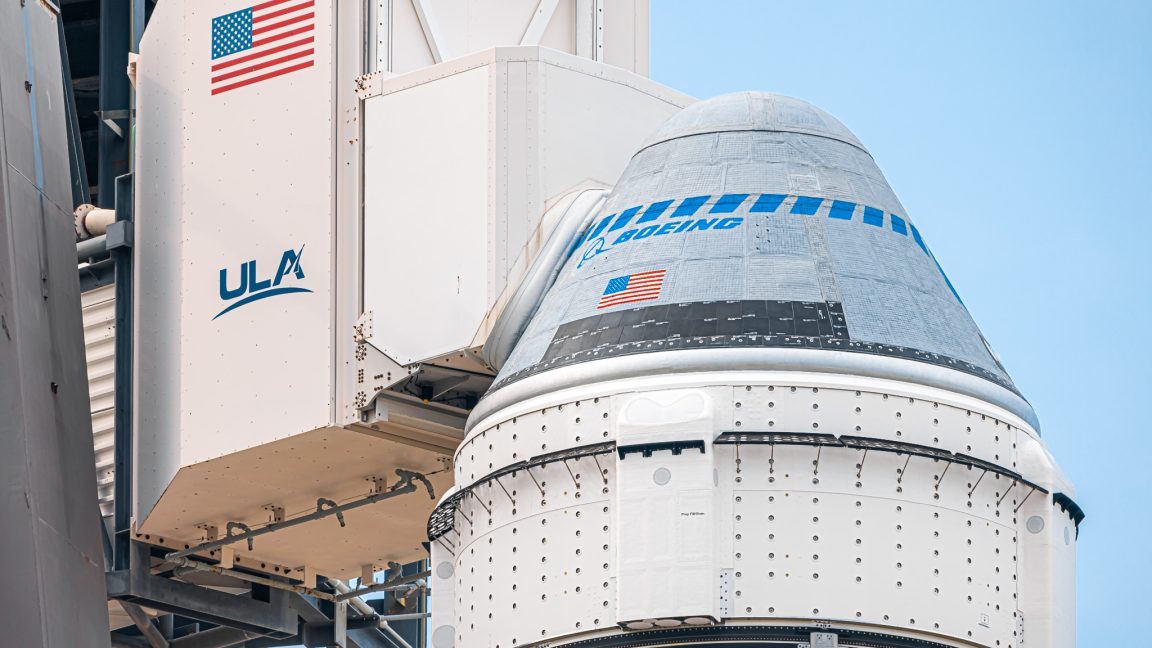
Boeing has now lost $1.1 billion on Starliner, with no crew flight in sight
We're not really ready to talk about a launch opportunity yet."
Ars Technica
250 points · by Brajeshwar · 3y ago · 218 comments
Palmer Lucky actually started a defense company after seeing just how inefficient and bloated those big companies were, and is already worth 10 billion! Highly recommend watching this interview he had about the future of all this.
Whoever it was in NASA that got that into the contract deserves a promotion
Boeing wouldn't need to pay anything.
Pretty sure SpaceX is cheaper, so NASA will be the only customer.
There is some pretty horrific anti-Boeing spin.
> Throughout this spring, NASA and Boeing had been working toward a July launch date of the spacecraft, which will carry two astronauts for the first time.
> Asked whether Starliner might be able to launch this year, Stich did not offer a concrete timetable. "We're not really ready to talk about a launch opportunity yet," he said. "We're going to work the technical issues first, and then we'll sit down with the Boeing team when the time is right and pick a launch target."
Reasonable and responsible as a response. However, Ars spins that response into:
> Such an answer suggests that Starliner's launch on an Atlas V rocket ... may very well slip into 2024.
I mean, a few month delay on a brand new space vehicle isn't "OMG, Boeing failed!"
But even that is not enough: Ars doubles down, and now NASA's refusal to provide a concrete updated launch date means not only is it "[slipping] into 2024", but apparently almost to 2025:
> Given the ongoing delays, it is now possible that Crew-9 flies next fall, before Boeing's first operational mission, Starliner-1.
Which is hilarious (ambiguity about launches) as NASA doesn't even know when in 2024 (except that it will be at least Spring) Crew-EIGHT will launch... (and neither NASA nor SpaceX itself has made any communication on Crew-9 launch timeframes.)
All 100% speculation. The "ongoing delays" in this context are "in June, Boeing announced that it would push back the July launch".
I also question Ars' framing of this as "losing money"... it's R&D expenditures.
Ars (and its Space editor, Eric Berger, who has written books about SpaceX) are pretty heavy proponents of SpaceX (which I generally am too, despite being less enthusiastic about its leader), and this article just reeks of subjective opinion, more so than objective neutrality.
The hubub is not about the few more months of delay just anounced.
The starliner and the dragon 2 started development around the same time to deliver about the same thing. The first crewed dragon 2 launched in 16 November 2020. It is not about the months of delay, but the years.
Anybody who is guaranteed a job with a decent salary for life and a great retirement plan is not incentivized to perform except by some personal drive. Anybody who wants onto the gravy train is motivated to do whatever work it takes to get a seat at that table. And they are motivated to do it as fast as possible.
It is not wrong to prioritize safety over speed. But you can use the safety excuse to drag things out for as long as people are willing to pay you without producing results. While space travel risks involve the obvious threat to human life, those risks can be generalized like any other risk. Usually, the lower the risk, the lower the reward. Unless there is something interfering. Interference that manipulates the risk/reward ratio often has the smell of corruption in the minds of many people.
“On September 16, 2014, NASA chose Boeing (Starliner) and SpaceX (Crew Dragon) as the two companies to be funded to develop systems to transport U.S. government crews to and from the International Space Station.” https://en.wikipedia.org/wiki/Boeing_Starliner
The pad abort test resulted in a parachute not working - they forgot a pin. https://spacenews.com/missing-pin-blamed-for-boeing-pad-abor...
The first orbital test failed to reach the ISS because it accidentally burned too much propellant. A second error nearly made it burn up on reentry and had to be fixed in orbit.
The second orbital test failed to launch because the craft's valves couldn't handle humidity (despite being designed to launch from Florida). When it finally went (after a complete rebuild of those valves), multiple thrusters from two different systems failed in orbit.
The third orbital test - the first crewed - has been now indefinitely delayed.
It is well behind schedule.
The comments section of any Ars Starliner article is a must-read for me. These guys were devout Boeing haters and would endlessly praise SpaceX - that is, until Elon become public enemy #1 last year and they suddenly and abruptly shifted their hate and derision the other way. Not a single independent thought on that entire forum, unless you sort by most critical and painstakingly weed through the hidden comments. The articles are crafted to be red meat for their core readership. At least The Register is unashamedly a tabloid and doesn't pretend they're not. Interesting to see how they spin this.
Richard Branson is a billionaire who tried to do spaceflight long before Elon and Virgin Galactic hasn't launched anything useful (before SpaceX) as far as I know. If someone thinks a suborbital flight is impressive I highly recommend them to play KSP and find out how easy that is compared to getting into orbit.
edit: they have reached orbit; I stopped following Virgin after it became clear they can't do the job https://en.m.wikipedia.org/wiki/LauncherOne
So many people want to erroneously believe Elon is some child with the mental capacity of a 3 year old with access to billions of dollars because they don't want to like him or give him credit for anything.
It takes more than a pile of money to run a successful space program and how nobody can see that by now is beyond me.
I think the contrast between Musk's SpaceX and Twitter experiences is largely down to whether the organization grew up around Musk. SpaceX has an immune system built up for the nutty stuff, from Gwynne Shotwell on down. Twitter got thrown into the deep end with zero staff powerful enough or with the experience to do the post-idea cleanup work.
It's a huge mistake to say "Elon had nothing to do with SpaceX's success". It's also a huge mistake to say "SpaceX's success means Musk's Twitter plans are good".
Vs. Boeing still has not finish assembling a Starliner capsule that meets NASA's safety spec's. Right now, "speculation" is saying that Boeing will ever successfully fly a Starliner mission.
Hell, the launch article for Crew-1 (https://arstechnica.com/science/2020/11/weather-permitting-t...) literally did not once mention that that launch was delayed, let alone 3 separate year+ delays. Just about SpaceX "saving" NASA from "wandering around in the wilderness with no access to space".
SpaceX is at Crew 7, Starliner isn't even close to Starliner-1
> But even that is not enough: Ars doubles down, and now NASA's refusal to provide a concrete updated launch date means not only is it "[slipping] into 2024", but apparently almost to 2025:
A few month delay? It was originally supposed to fly in 2017. with Crews in 2020.
Keep in mind that Boeing was awarded $4.2B, compared to $2.9B for SpaceX, for the same number of flights. Not to mention that NASA was accused of favor treatment for Boeing during the development phase - See What we found section of [0]
> Which is hilarious (ambiguity about launches) as NASA doesn't even know when in 2024 (except that it will be at least Spring) Crew-EIGHT will launch... (and neither NASA nor SpaceX itself has made any communication on Crew-9 launch timeframes.)
Such is an ignorant take. The rotation of ISS mission is currently 6 months, so there are always two missions a year, in the Spring and the Fall, barring extraordinary circumstance such as with Soyuz MS-10. Crew-8 will fly in the Spring, to be followed by the first Starliner operational flight. However if Starliner upcoming test flight continue to be delayed it's entirely possible that Crew 9 will fly instead.
> I also question Ars' framing of this as "losing money"... it's R&D expenditures.
It's not Ars' framing. It's common knowledge - [1], and reported by Boeing itself - [2]
Boeing on Wednesday reported a $257 million charge in the second quarter for its Starliner astronaut spacecraft program, bringing the program’s to-date overrun costs to $1.5 billion as delays continue.
The aerospace giant blamed the charge on its decision last month to indefinitely delay the first crewed Starliner launch.
> and this article just reeks of subjective opinion, more so than objective neutrality.
The article is very short. Everyone should read and judge for themselves. I think it's mostly matter of fact without sensational takes. Can't say the same about your post (horrific anti-Boeing/reeks/hilarious).
[0] - https://oig.nasa.gov/docs/IG-20-005.pdf [1] - https://www.cnbc.com/2023/07/26/boeing-has-lost-1point5-bill... [2] - https://boeing.mediaroom.com/2023-07-26-Boeing-Reports-Secon...
> I mean, a few month delay on a brand new space vehicle isn't "OMG, Boeing failed!"
Atlas V . . . is America's longest-serving active rocket. In August 2021, ULA announced that Atlas V would be retired, and all 29 remaining launches had been sold.[ As of 10 November 2022, 19 launches remain.
Kinda new, because it has seen 2 flights, of which 1 a mission failure (failed to insert into target orbit due to software issues, several other issues identified hours before a potential hard mission failure), and the other an uncrewed test flight.
The "brand new space vehicle" is the Starliner.
> that there were two serious issues with Starliner. One of these involved the "soft links" in the lines that connect the Starliner capsule to its parachutes, and the second problem came with hundreds of feet of P-213 glass cloth tape inside the spacecraft
    * parachute "load limit data wasn’t correct and restest showed failure at a loading point"
    * wiring tape "flammable and will need to be replaced"
    * thrusters again: "Boeing also found more valve problems on the Crewed Flight Test capsule, as they were getting ready to load propellants onboard."
source: https://www.nasaspaceflight.com/2023/06/twis-20230602/#more-...
Boeing announced in May 2016 that their first crewed flight would be delayed to 2018 due to issues related to Starliner's Atlas V N22 launch vehicle. [0]
Starliner's problem isn't delays--it is a failed program. The only thing delayed is terminating the program and selling those high value but soon to depreciate Atlas V boosts to something worth doing. (7 of 29 remaining Atlas V (as of 2022) are allocated to Starliner. To get past 7 requires a whole new integration/test/certification for Starliner.)
Each contract required four successful demonstrations to achieve human rating for the system: pad abort, uncrewed orbital test, launch abort, and crewed orbital test. [0]
  Test                   Boeing [1]          SpaceX [2]
  pad abort              2019-11-04      2015-05-06
  uncrewed orbital test  2022-05-19      2019-03-08
  launch abort           N/A             2020-01-19
  crewed orbital         N/A             2020-08-02
How does the craft get built and you just discover this now?
Given Boeing’s history here this feels like the right kind of contract for this sort of work. Ensures all incentives are aligned
The issue is that incentives absolutely aren't aligned. The moment Boeing thinks it has achieved a certain part of the contract but NASA does not you have a huge problem on your hand where one side will try to get work done for free and the other has absolutely zero interest as they are not getting paid.
If cost overruns are too great Boeing might also (depending on the contract) choose to withdraw, as the continuing development cost will be greater than any penalties from the contract.
Who besides Spacex or ULA can reasonably bid for it? Or are you also looking at foreign options?
It might not be Starliner but it seems like it'd be good to keep ULA in the game, just to make sure that Spacex is not the only option.
[1] https://arstechnica.com/space/2023/06/weirdly-a-nasa-officia...
If you're doing some low risk building, say a 10 mile road on flat ground with known soil, replacing a previous road, that is well-known to current specs with set-in-stone requirements (no pun intended) it is easy to pitch that firm fixed price because the contractor will know exactly what to do, and there are 20 road building companies that could do the work.
Now, building an advanced spacecraft with a host of uncertainties in a vastly more complex environment that may require novel technologies development and a great deal of engineering is very different if you want to pitch that firm fixed price because the contractor perspective is that is very risky, and there are likely going to be changing requirements.
The contractors will want to make the Govt pay for that risk, since they are on the hook for it. All risk is on the contractor. The contractor will also fight for $ for every changing requirement.
By comparison, in a time & materials contract, the risk is on the government, and changing requirements don't matter much, if you change them, risk is still on the government.
This explains why firm-fixed price is not always the best approach, and sometimes time & materials contracts may make for a more economical acquisition approach - because risk and changing reqs can translate into dollars.
Software has the same problems. An unreasonable expectation of being able to predict the future (except the bits they don't want you to know about), and a lot of whining when we run into unexpected issues.
https://arstechnica.com/science/2022/05/nasa-chief-says-cost...
Any contract type where the political leadership can't terminate a contract for cause due to excessive political pressure, or is forced into paying through the nose, is untenable.
The solution for that is not Firm Fixed Price or T&M contracts - but instead larger budgets and also multiple award contracts where you have simultaneous efforts competing against each other. When there are 5 options, all having company skin in the game, all as viable paths forward, and 1 option loses out, terminating for cause, enriching the other 4, no harm no foul.
It is depressing to work for a company that seems immune to wasting $billions$ and countless human resources wandering around lost.
When there are no consequences for failure there can be an amazing culture of innovation. There can also be a dumbfounding culture of negligence and mismanagement. Sometimes we only distinguish between the two based on survivorship bias.
And the are continuing to build it not because of innovation but rather because it would be an utter and complete embarassment for them to give up. They would lose all credibility as a space contractor and would have little chance to ever bid for another big NASA project again.
https://arstechnica.com/science/2022/09/nasa-will-pay-boeing...
RIP Boeing.
The fascinating thing is that the lack of competition allowed the space launch industry to switch from "invent" mode to "monetize" mode way too early. It is also what makes the Starship work both more credible and more interesting. There are a lot of technical problems to work through on Starship between now and it being as reliable as say Falcon is, but if (when?) they get there, the ability to put 100 tons into LEO for just the cost of the propellant and some depreciation on the vehicle? That really changes the economics of having things in space in a way that is hard for folks to imagine.
One of the things I've always looked for in hiring people is the ability to "unconstrain" ones thinking by "rules." Those are the kinds of people who can think about a world where we have a technology to say, "nullify gravity", and what impact that might have on what we do or how we do it. Constrained thinkers will say, "There is no way to 'nullify' gravity so it isn't worth wasting any time thinking about what we could do if we could."
This capability shows me someone who is able to step into a different frame of reference with their reasoning skills intact and sharp. As a result, when there is an "unexpected" discovery or event, they waste little time in cognitive dissonance says "This can't be happening" or "That isn't possible what I'm seeing" and instead jump right to "Hmm if we can do that then <x>, <y>, and <z> could be done too!"
There are a lot of things to dislike Elon for, but one thing that he shares with Steve Jobs is if he believes a thing he is "all in". Sometimes it takes that to get to the other side of an "unthinkable" change.
If the only capability is incredibly expensive and highly reliable, no demand that only works under cheaper and relaxed reliability exists.
Luckily, the market's caught up pretty quickly.
Which means overruling Citizens United and campaign funding reform.
Boeing though has so many government contracts that are used so often for other projects you can’t shut down so you are correct.
As for the 2x part... it's cause their bid was 2x what SpaceX bid itself. And both got their bids accepted.
Mostly.
NASA did just give Boeing extra money for some pretty dubious reasons.
> NASA instead requested Boeing “propose prices for additional flexibilities to fill an anticipated crew access gap, including shortening its lead times for rocket and spacecraft production,” the report states. After what OIG described as “prolonged negotiations,” NASA agreed to pay Boeing an additional $287.2 million for those mission flexibilities.
> The OIG report concluded that much of those payments were not necessary, since there were other methods to provide schedule flexibility to mitigate gaps in crew access to the station. The report specifically notes that, five days after NASA agreed to the additional payment to Boeing, the company submitted a proposal to NASA offering to sell five Soyuz seats it has acquired from Russian company RSC Energia for $373.5 million.
> The report concluded NASA’s payment of $144 million to accelerate the timetable for two of the four Starliner missions was unreasonable, and that it overspent by $43 million when it granted Boeing authorization to proceed on one Starliner mission a year earlier than necessary.
> OIG also criticized NASA for not giving SpaceX, the other company with a commercial crew contract, an opportunity for offering its own proposal to address any gap in crew access to the ISS. “In our judgment, contacting both providers would have been a prudent approach to maximize the Agency’s options while also ensuring fairness,” the report concluded.
https://spacenews.com/nasa-inspector-general-criticizes-addi...
Actually, a multiple award approach for a very high risk, technically challenging widget makes perfect sense, and is the same thing seen for similarly challenging weapon systems e.g. the Advanced Tactical Fighter F-22 vs F-23 https://nationalinterest.org/blog/the-buzz/americas-f-23-ste...
> The report specifically notes that, five days after NASA agreed to the additional payment to Boeing, the company submitted a proposal to NASA offering to sell five Soyuz seats it has acquired from Russian company RSC Energia for $373.5 million.
This looks like Boeing was doing some horse trading that could have been pretty financially risky particularly considering the value of money.
> The report concluded NASA’s payment of $144 million to accelerate the timetable for two of the four Starliner missions was unreasonable, and that it overspent by $43 million when it granted Boeing authorization to proceed on one Starliner mission a year earlier than necessary.
Sometimes when thinking about the Industrial Base of the United States, there is a good rationale for keeping an incumbent's design & engineering capabilities active, while bringing competition to the table and potentially displacing it with a more agile competitor.
If truly getting the best and most efficient designs out there was the true goal, there should have been more awards, and for funded development to enable a greater diversity of competitors with designs being put forth.
As a Washington state resident that used to be proud of Boeing, now days, I just despise them. I work with lots of fine ex Boeing engineers at my current place of work. I feel for all of the fine individuals that still work at Boeing, but other wise, I wish them the same death I wish on IBM now days.
No "Rest In Peace" from me. More of "Don't let the door hit you..." feeling.
It's worth a case study - why didn't they try to pay Gwynne Shotwell 10x more + CEO role + (M\B)illions worth of stocks? Even if they did, why didn't she accept? She would certainly have turned their fortunes around.
What gets in the way is that the US has several replacement space station programs in the works while Russia knows very well that they almost definitely can't get a comparable replacement station up with how hollowed out their industry is.
Plus, since the start of the war, NASA has been investigating options for taking over the tasks the Russian side of the station handles with the various supply vehicles just in case.
The orbit raising has been performed by the Progress resupply vehicles from Russia and Shuttle and other vehicles from the US. As of 2018 the Cygnus resupply vehicle from the US was capable of performing the orbit raising mission.
While the Cygnus was still docked at the space station's Unity module on Tuesday (July 10), the spacecraft fired its main engine for 50 seconds as part of a test to determine whether the cargo ship can be used to raise the space station's orbit, Frank DeMauro, Vice President of Advanced Programs at NGIS, told Space.com.
About the size of a short bus, the Cygnus may look puny compared to the ISS, which is as big as a football field. But its powerful Delta-V engine provided enough thrust to raise the space station by about 282 feet (86 meters). "The burn went extremely well," DeMauro said. "The spacecraft behaved exactly as we expected."
https://www.space.com/41172-cygnus-leaves-space-station-orbi...
Ok, let’s break this down from the start. Russia has launched 10 space stations. The ISS was built using modules that were built for the Mir-2 station. The ISS was built on top of Russian modules.
Meanwhile, NASA wasn’t even able to fly their own astronauts to the ISS for a decade until Musk stepped in.
Russia has also demonstrated that they continue to have this capability as they added the first expansion to the ISS in over two decades recently.
I would hazard a guess that Russia’s capability in this area is much more… capable than the US at this time. They are also far more likely to be able to come to a collaboration agreement with china than the US is at this time. They also helped india kickstart their space program recently.
In conclusion: Russia bad? Maybe. But they weren’t stupid enough to outsource their manufacturing and allow the loss of institutional knowledge that the US has.
However, that does bring to mind something I never thought about. There is talk of privatizing ISS since NASA doesn't want to continue funding it. How do you privatize something made by multiple nations? Or is that precisely why the privatization isn't taken seriously?
Antares used a pair of Russian RD-181 engines. The first stage was built in Ukraine (Dnipro). This sort of cooperation is basically dead.
> Some of the most unique missions clearly don't need multiple capabilities in this country, and if we talk about fair and level competition, is it two companies, is it three companies, is it four companies? When does it stop, and how do you limit other companies from wanting to participate, and taking a niche of the of the product?
This was the same hearing in which Gass gave a last ditch defense of Russian engines, and fought Musk in favor of cost-plus and ULA's ~$800m/y subsidy for existing.
Even the people that follow newspace probably normally don't realize just how rotten through the industry and its governance had become.
They do.
Allegedly the development of the F35 cost about $35 billion according to one 2020 study. (Which I think was estimated at the start to about $400 million in non-inflation adjusted dollars)
If I look at it through that frame, spending $1.1B on developing a rocket seems ok (I Know they are not done so the cost will keep rising)
This is about developing and building Starliner spacecraft, putting them on Atlas V rockets, and after successful acceptance tests putting people in them to fly them to and from the ISS.
https://en.wikipedia.org/wiki/SpaceX_Dragon_2#Crew_Dragon_fl...
It isn't all billionaires but they are part of the picture as it is probably around $55 million per seat for orbital flights though the exact numbers are not disclosed.
Axiom's last mission had two Saudi astronauts (Saudi airforce captain and a biomedical scientist) funded by their government.
The next Axiom mission will be flying astronauts for the Turkish space agency(air force colonel), Italian defence force (test pilot) and Swedish space agency/ESA (test pilot, esa astronaut) as well as their Axiom commander who is a legendary ex-NASA astronaut.
Even the upcoming Polaris Dawn which is funded by billionaire Isaacman will have two SpaceX lead operations engineers and an ex-USAF fighter pilot onboard and Isaacman is a respectable pilot himself. They are going to be pushing private spaceflight to new limits.