Walmart Didn’t Kill the Small Town, It Is the Small Town
Big-box retail’s secret is not its car orientation but its (indoor) car-free urbanism
discoursemagazine.com
39 points · by nickwritesit · 3y ago · 174 comments
Walmart isn't good for small towns no matter how you look at it because they turn entire small town economies into a line item on a gigantic global multi national's ledger. And once done, there is no going back.
They build a new store and then sell at a loss to bankrupt the competition. They can do this because they have billions of dollars in reserve and are subsidized by other stores. How can local businesses compete? Once they all go out of business and there are no choices left Walmart is free to raise prices and recoup their losses and more.
Then there are the jobs. Low wage, dead end. They create the new working poor where you can't survive even with a job so you go on government assistance as well. Subsidized serfdom.
And to top it all off, if they aren't profitable, they won't hesitate to close up shop and leave a smoking crater in the economy of that same small town that is near impossible to recover from. There are no more small business and it's near impossible to start them again because local employees have been subsisting on starvation wages.
Sure, if you ignore all the horrible realities of the Walmart lifecycle, it sure is nice that they provide a convenient way to buy lots of cheap garbage!
Which is to say, I know they don't take a loss on stores, even news ones. They may have loss leaders, but they make a small (and I mean small) profit on most things sold in the store. Its all about volume.
Their labor practices are quite abhorrent. Not to mention they employ enough people to make a small city (2 Million+ last I checked). I don't know if they been good on balance or not, I do know they are the epitome of Corporate Exploitative Practices[1]
They also have an entire division that exists just to extract tax favor-ability for building in places. They've gotten really good at pitting towns against each other for their business.
That said, all of this is true for Target too. All of it. It just doesn't have the same poor brand reputation and it being the smaller of the two it gets less media attention for its poor practices.
[0]: I really resent them after working there though. I haven't stepped foot in an WalMart since that time period. It worked for that time in my life and I had one of the "better" jobs for sure, but it was rough to see what they did to associates and being part of that machine.
[1]: Its well studied that they have an enormous amount of their workforce on government subsidies / benefits. To the point that they have handouts to help people get on assistance that work there, rather than pay them a living wage. Its nuts when you really think about it.
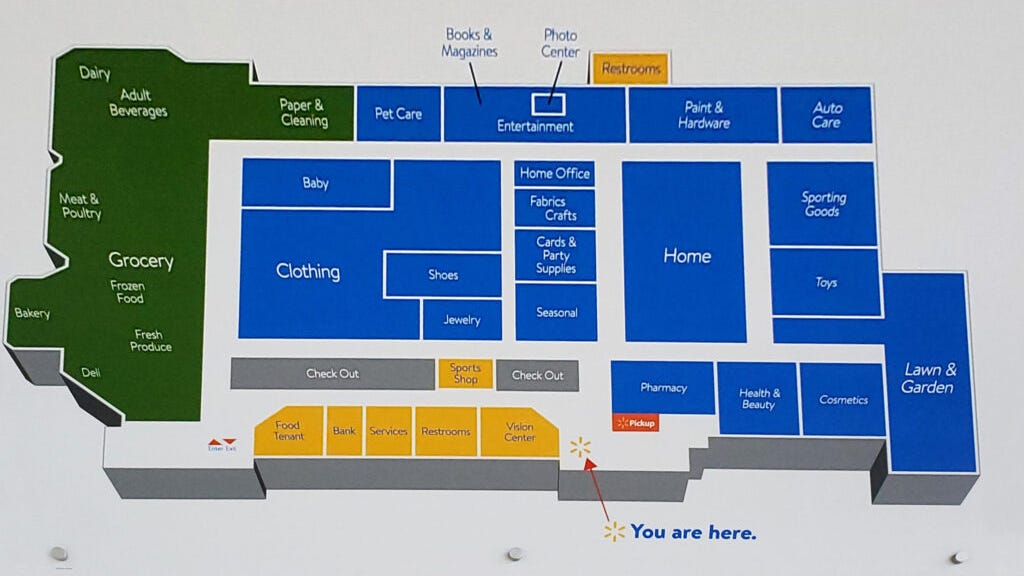
But given that base assumption, this is a discussion of a novel explanation one of the reasons why Walmart got successful, and a suggestion for how downtowns could replicate that factor. Many have mentioned that one of the reasons that Walmart is successful is because they're easier to get to for the average car-driving American. But once there, they're convenient because you don't have to dodge traffic while navigating between departments.
Wouldn't downtowns be a lot nicer if, like Walmart, they were easy to drive to, but impossible to drive through? What if getting from the boutique to the restaurant to the theatre was easy as crossing the aisle to a different department in Walmart?
No matter how big their local profit is, the only money reliably returned to the local area is a portion of those minimum-wage incomes.
And of those, a not-insignificant amount comes right back in to Walmart as the employees shop for basics. The rest of the money gets pulled out for corporate capital expenditures never to be seen by the local area again.
Walmart basically runs like a giant cash-vacuum.
They don't even necessarily need to sell at a loss. They can also just get economies of scale that don't work for tiny local businesses.
Still has the same effect in the end.
Brought to you by the same folks who denied global warming for years like Cato to shill for corporate interests at the expense of our survival and that of all life.
I recently purchased some land in one of the rare US towns that does not have a Walmart (or any big box store). In fact, there are no big box stores within 100 miles of this town. It's a town with about 2,500 people, all within the town core, almost no population in the outlying areas. Not enough population to support a box store.
The business in this town is absolutely booming right now. For example, the coffee shop I was at the other day had eight employees working at the time I was there, and it was quite busy. Main Street is lined with retail merchants that appear to be doing well. Restaurants are packed. People are really nice.
I'm even building a business there.
About 100+ miles south is a larger, but still isolated, community with a Walmart. It took me about 30 minutes of driving around to find a coffee shop, and the one I finally found was understaffed and mediocre. Most small retail strips were deserted. People in this town seemed miserable.
I think there are multiple reasons why the first town is doing so well right now, but the thing that struck me immediately when I came to this town was that there was no Walmart. I really believe that is the main reason this town is thriving.
The fact its that small, and thriving, and I hope has a reason COL, makes it a rare gem.
I'm curious too, do you have fiber internet out there? An interesting phenomenon we had in the midwest is that rural-ish areas got fiber to the home years faster than most major urban or suburban metros did because the cost to run the fiber was cheap and often the ISPs out there are co-ops
Yes, COL is quite reasonable, food costs about 60-75% of what it does in the metropolitan suburb area that I'm coming from. The only drawback to the area is that the hospital closed many years ago, but they are in the final planning stages of a new one. So medical emergency costs are temporarily higher.
And yes, there is fiber internet. I just looked up the company that provides it, and it's registered as a Cooperative with the Secretary of State.
Well yeah - Walmart (or any major corporation) is extractive. Profits from your small town will not stay in the small town. But where else will the coffee shop owner invest their profits back into if not their business and community?
I learned this decades ago when I worked for Walmart setting up stores and training folks. It was explicitly made clear to us this is what the layout was designed to elicit
I have always gone to big stores and malls (and now online shopping).
What WalMart hates the most is that they can’t get people of affluence who want to save money to shop at one though. When I worked there the complaint out of HQ I heard the most is that Michelle Obama and Oprah would shop at a Target but never step foot in a Walmart despite having identical goods but Walmart has better prices
target isn't a whole lot better, but at least they have more staff wandering around to ask for help. I'll pay an extra 20 cents on my megapack of paper towels every time if that gets me out of the store faster.
Maybe they can fix that first.
I do my normal shopping at a grocery store where everything is probably 10-15% more expensive. Why? 5 reasons.
1. Paper bags. I hate plastic ones.
2. I'm not forced through the self checkout. Walmart has almost no cashiers any more, and the two that they do have (for all 30 registers) are hidden, except for the fact that there's a huge line of people there, all with overflowing carts.
3. I'm tired of having to wait 20 minutes just to stand in a checkout line. It happened so often at Walmart (even with self-checkouts) that I was fed up with it. The longest I have ever had to wait at the grocery store is 5 minutes, and often there's no wait at all.
4. Carry-out. It's nice for some young kid to have an after-school job helping me load water into my car. It's nice not having to find the carousel to return the shopping cart to. It's nice having a quick conversation with someone. It's standard at my 24-hour grocery store. It's an act of congress and a long wait at WalMart.
5. Walmart treats you as if you're trying to steal everything everywhere. They put cameras up everywhere that ding at you as you pass by. They take pictures of you as you use the self-checkout. They check your receipt when you try to leave. I'm sick of being treated as if I'm a criminal when I haven't done anything wrong. So I refuse to go there.
I can choose to spend $100 at Walmart, or $115 at a grocery store without having to put up with 1-5. I will choose that any day of the week.
Inflation is doing the trick[0]. For several quarters, they've reported marked increases in the share of higher-income shoppers, especially for groceries.
[0]: https://www.axios.com/2023/05/18/inflation-walmart-prices-ea...
I guess you can't be everything to everybody...
Then again there are a lot of cities/towns on the east coast that predate the car, so there's probably an increased concentration of "main streets".
Just completely unnecessary ad hominem. Why?
I understand it, though. There very much was a main street downtown in my college town. It wasn't literally called "main street", however.
Growing up in Metro Detroit, there were "Main Streets" in most of the Cities/townships and IIRC it's a pretty common term. I'd argue most people under 60 and 50 know what "Main Street" means just to counter.
You know it doesn't have to be named "Main Street" to be a Main Street
I only ever remember going to Walmart, Home Depot, Costco, Best Buy, malls, Kroger, etc.
I've lived in cities since I've been an adult and every neighborhood I've lived in still has a main street for our small community inside the city. Granted this is only 4 different places, but most cities have many smaller communities inside of them with their own "main streets"
The neighborhood I currently live in, is considered by its residents to be its own little town inside of the city with everything being walkable along the main street.
We even talk about leaving our neighbourhood to go to other places within Toronto.
Maybe it's more of an Eastern US term?
Low price demonstratably rules in everything from plane tickets to groceries to basic services to clothing as it enables a life of abundance and mental ease.
A friend loves Walmart as it means he no longer has to maintain his lawnmower. He just throws it away and buys a new one annually at the start of the season. He can still mow his lawn while abandoning the need to maintain mechanical knowledge.
I love Walmart as I no longer need to really consider how many of an item I need. When socks are $5 a pair at some of the more expensive stores, buying a huge pile is pricy. Walmart let’s me buy 40 pairs of socks for like $20 and just not keep track of their wash status or where they are in the house.
Walmart makes it so that everyone can solve their problems with a bit of money.
Small stores can’t replicate any of that due to economies of scale. Sure, their workers might be experts in lawnmowers, but when lawnmowers are so cheap as to be single season items, that expertise no longer has value.
It's hard for me to respect this as a valid choice. Waste and consumption concerns aside, the justification of not knowing (or wanting to know) how to perform simple maintenance is alien to me. Why even own a lawnmower at this point-- just pay someone to mow your grass for you. The milk and honey has flowed so freely for so long that when the tap turns off, people really won't know how to take care of themselves.
The lawnmower is so cheap that it is the same price as two mows.
It is indeed wasteful, but that isn't a problem you deal with directly.
Buying two lawnmowers is vastly more wasteful (to the world, not to your pocket) than buying one and maintaining it.
When the mowers are cheap, it's rational. They get the lawnmower out of the shed the first time in spring and it won't start, it would cost a significant amount to get it fixed, and they have to waste your time and wrestle a dirty lawnmower in and out of your car. So they buy a cheap new one and throw the old one away.
Paying someone is still more expensive than doing it yourself.
I don’t disagree with you about waste, but I’m assuming you haven’t priced lawn services lately. Even with a small yard and fairly cheap service you’ll be spending enough to buy a (cheap) mower every 4-6 weeks.
Different topic: As a foreigner, really every visit to a Wallmart left me with a very strange feeling, because almost every employee had a zombie like appearance one or the other way, demotivated, sad or emotionless looking, slurping slowly through the shop.. like employees super abused or completely lost and aimless. Nowhere else, even in cheap fast foods or similar I got that, why?
For what it's worth, in my area (a midsize Deep South city; the customary environment for Walmart), I don't see this. But it is also a city experiencing some amount of growth with a viable future. Starting pay at my local Walmarts are the same as starting pay at a McDonald's or any other entry-level retail job.
I'm curious, where were the Walmarts you visited? I've been to "sad" Walmarts like that, and in my experience it correlates most strongly with the general sadness of the town -- places ravaged by the opioid epidemic, with few jobs and no hope in the residents' hearts.
When I worked there, the job felt pointless. It's a neverending pile of meaningless work that you can never make progress on. You're disrespected by customers, paid little, and know you're really just a cog in the machine. I didn't show up for work for a week before I quit. Nobody noticed I was gone and they were as surprised when I quit as I was that I wasn't fired. Every time I clocked in, I was hit with the feeling of purgatory. The useless drag of another day-- all for the benefit of -- ?
every time, yup.
>demotivated, sad or emotionless looking, slurping slowly through the shop.. like employees super abused or completely lost and aimless. Nowhere else, even in cheap fast foods or similar I got that, why?
Wal mart tends to attract some of the worst folk, and they aren't only there for 5 minutes to pick up a burger. That plus a dead end minimum wage part time job with zero hopes of progression dont make for happy employees
I almost feel like our way of life (artificially cheap) is going to hit a brick wall once gas stops being cheap (peak oil).
There's the rub. Perhaps our rampant inflation is essentially the result of "real" peak oil, except instead of gas prices steadily increasing, the US economy is taking excessive actions to keep our petrodollar supreme and causing massive inflation.
Especially as challengers to petroleum economy arise: Solar/Battery/Wind/EVs - it's possible the only way to stay solvent is to massively devalue $$.
and these are cheap sub $200 machines
Once a year I buy like a 50 pack on Amazon and it’s great. 10/10 would recommend.
"What do you see when you look in the mirror?"
"I? I see myself holding a pair of thick, woolen socks."
"One can never have enough socks. Another Christmas has come and gone and I didn't get a single pair. People will insist on giving me books."
Or what happens to all those socks when they’re disposed of?
Also tossing lawnmowers every year seems beyond stupid.
I can’t imagine the cost of replacing a mower every year being cheaper than buying a $300 ryobi that will last you for years to come.
Lawn equipment ain't complicated enough to maintain to justify throwing out every season. This is insane consumerism.
However, let's say you make some common mistake like leaving the engine filled with gas during the winter (assuming you're in such a climate). How would you go about getting it fixed? Assume the carb is gummed up -- it's a $10-20 part, plus labor, plus the hassle of finding a small engine repair service to fix it, dropping off, and picking up. It's this vs. going to the Walmart website, clicking a button, and having the lawn mower show up at your house in a day or two.
I always bias towards maintenance and repair but there are tons of people with no knowledge of how to fix something and no desire to learn to. With services costing more and more, buying new is often a more appealing choice, sadly.
I could spend hours learning to do this, and then buying the tools and materials to actually do the maintenance, plus the few hours of effort of actually doing it. Walmart has several mowers listed under $200, I can see why someone would find it not worth the time/effort/money to maintain a mower and just buy a new one. Hopefully, they are setting it out on the curb with a sign that says free for someone that does find that tradeoff worth it.
Build strong, local communities and economies instead: https://ilsr.org/ | https://www.epa.gov/smartgrowth/how-small-towns-and-cities-c...
(it will not be extremely economically efficient, but you are trading efficiency for resiliency and local governance and control)
In my view, a necessary part of this is decreasing central control, both at federal and state levels. A good example is the response to Covid; state laws in places like Michigan forced small flower shops to close, leaving them to watch as people bought flowers from the Home Depot garden center instead. And more broadly, the whole pandemic was a gigantic gift to Amazon's bottom line, at the expense of every small store owner.
I agree that as a society we've trended too far in the direction of efficiency at the cost of resiliency. In restoring the balance, we must also shift the locus of control more to the people and the localities they live in.
I also love your point that what we're talking about here trades economic efficiency for resilience and local governance. Always pushing for growth is eventually going to hit a wall when either there's no more room to grow and no more good land to grow food on.
There's also the fact that Walmart is infamous for its vampiric strategy of stringing workers along on part-time schedules that guarantee poverty-level income to avoid benefit overhead costs, relying on local and national social safety net programs to keep their workers afloat. This sort of workforce and benefits management strategy isn't nearly as prevalent among independent and small-chain businesses.
> Bernie Sanders
> "Taxpayers Subsidize Poverty Wages at Walmart, McDonald’s, Other Large Corporations, GAO Finds" - November 18, 2020
> https://www.sanders.senate.gov/press-releases/taxpayers-subs...
GAO = Governmental Accounting Office.
This 'enshittification' isn't some random internet goober decrying it. Enshittification and self-enrichment has been beaten to death on political trails, news, ted talks, social media, etc.
You can believe whatever pie-in-the-sky bullshit you want. The dangers are real. You're covering up the rotten and stinking corpse of reality with scented semi-transparent tissue paper, with all that implied scenario would accomplish.
It's like anything with life, cities are comprised of people, people don't just stand still, being contemporaries in any generation you must necessarily survive and do what it takes to progress. There is no formula in any generation that you turn the crank and things just work, life takes work, and its non-formulaic and full of surprises.
https://podcasts.apple.com/ca/podcast/the-strong-towns-podca...
In the cities the only reason why the big-box model works is exactly because it inverts the urban paradigm with a suburban one. Walmart's model would never work in an urban core exactly because the costs of property (and taxes) to build such on inefficient marketplace would be way too high, and could never compete with the cheap, edge-of-town model that they have built.
The irony, of course, is that much of the value of the suburban model is exactly in the form of subsidy capture. So while folks are happy to get discounts at Walmart, they will likely have to pay the difference 30 years later in taxes on an inefficient suburban wastewater system that must be developed to support this type of infrastructure.
Urbanism is more efficient, thus it should be cheaper, but it's the second, and third order effects that will eventually cause the rustbelt-ification of much of the United States. At least this is the thesis of books like Strong Towns that focus on the acceleration deterioration of finances and bankruptcies in many american municipalities.
The author's focus seems to be more on Walmart's walkability indicating a desire of the public for walkable areas, but I wonder how much of the difference between Walmart and Malls is due to decreased costs versus the monolithic bargaining power of Walmart. As the author points out, malls were originally modeled by Victor Gruen off of shopping areas like Ferstel Passage in Vienna, with the intent to have the mall be a part of an overall urban space with parks and apartments nearby, but the urbanism never came. Malls became versions of these "shopping arcades" replicated quickly, cheaply and at scale.
Instead of being one step down the ladder of cost, and closer to a small town layout, the greater distinction between a mall and Walmart seems to be customers and suppliers only having one potential avenue to go through with Walmart.
Which is why suburban Americans spend all their time at the shopping mall . . .
/s
edit: that is not to say opening big supermarkets is great, just that once they are there that's why people skip local stores and go to the big supermarket
I guess what Americans are missing from how smaller towns work in other countries is that they tend to be more dense, with more mixed zoning. Not as overfilled with way too big parking lots, way too wide “stroads”, and endless suburban sprawl. So the trip to town is shorter/faster, you go into town more often, for more different kinds of activities, and so you don’t have to buy everything all at once.
Take a look at the Strong Town initiative and the YouTube channel “not just bikes”.
Being in town - to me - is a part of living life. It’s where you’d have a third place, where you’d do various activities, meet people and discover new things. If you’ve felt the need to optimise your life to maximise your time at work and in your house.. that feels really sad to me.
Well I'm not american and I lived in village and in small town. If I have supermarket in "range" I will go to supermarket, choice is bigger and prices are lower.
Sure, if I have store nearby and want to get an icecream or something, or forgot to buy something on weekly shopping trip I'd buy it there.
> Being in town - to me - is a part of living life. It’s where you’d have a third place, where you’d do various activities, meet people and discover new things.
...when going on grocery shopping ? And for some reason you're prevented from speaking to people in supermarket ?
> If you’ve felt the need to optimise your life to maximise your time at work and in your house.. that feels really sad to me.
I dunno from which arse you've got that conclusion. Do you have nothing more interesting to do in your life than going around shopping ?
Groceries are chore not a fucking adventure, regardless of shop size. And saving money means I can spend it on things I actually enjoy and places I actually want to go to.
Probably, I live in a California Suburb. There really is no such thing as "walkable" here in the same way some older eastern US cities and other countries have them.
>Being in town - to me - is a part of living life. It’s where you’d have a third place, where you’d do various activities, meet people and discover new things.
Yeah, that doesn't exist here. We don't really have a "community" in my town. Or perhaps I'm too old and too young for that part of community. No kids to bring to activities but way too old to simply show up for "community activities".
>If you’ve felt the need to optimise your life to maximise your time at work and in your house.. that feels really sad to me.
well the cool thing about land in the US is that it's also huge. I'm in a 1600 ft house, so if you have friends it's great for arranging get togethers and house parties.
Instead. You get to enjoy one corporation, that does anything it wants, pays horribly, employees have no choice, you have no choice in what garbage you buy. And your downtown now consists of 8 banks.
Yup. You're living the dream!
Walmart is the extreme end of satisfying consumers above all else. Customers get a single, climate-controlled location to take care of nearly all their shopping, with good prices; but it comes at the expense of the employees, local community, and factory workers. Unfortunately, most customers don't know or care about those downsides because the experience is catered so heavily for them, and it's hard to get people to sacrifice material comfort for benefits that appear so abstract.
That does not follow. Small stores carry the same shit as big chain stores. Because of their smaller scale and more limited purchasing power those items are more expensive than a chain and they can only afford to carry high throughput items. The only way small stores can deal with long tail items is if they're super specialty and neat a large enough metro area to have enough sales to survive.
I'm not saying small stores are bad but there's a decided small store tax. Without economies of scale they have a very hard time competing against chains. They have an even harder time competing against online sales.
Not always. Go to a dedicated board game store and you'll see such a wider variety than the branded Monopoly sets on sale at big box stores. Plus they usually have an area dedicated to actually playing games, something you'll never find at a chain. This community charm is paid for by the small store tax, but the benefits far outweigh the cost.
You're lucky to have a dedicated bakery that actually makes bread, or maybe you just live in a big city? There's probably twenty bakeries in my midsize city, but they all bake cakes, muffins, confectioneries, and whatnot. None of them actually bake bread.
Walmart bread is truly awful, with the only thing going for it being that it's cheap and consistent. My preferred choice in my area is the sourdough bread from Aldi, which at least only has the ingredients that bread should have, with no sugar or soybean oil or other junk.
   Walmart:  Everstart $180, 4 year "free replacement" warranty.
   Napa:     house brand $250, Odyssey $371  (both 3 yr warranty)
   OReilly:  house brand $250, Optima  $290  (both 3 yr warranty)
   AutoZone: house brand $250, Optima  $290  (both 3 yr warranty)
Yes, Walmart is evil./s
They open multiple Walmart's, the small town stores go out of business, then they can close some percentage of the Walmart's to consolidate into a few stores in central locations, now all of the small town people have to drive farther to get anything at all. And the small town dies.
It is _incredible_ the difference it makes on town culture, and _how much better it was_
Not all small towns have a major research university or other dependable benefactor around - most of the small town representatives can easily be bought/bribed by a major chain.
Chapel Hill, NC has a Target smack dab in the middle of downtown, and everyone would agree that it's an idyllic college town with a wonderful culture.
The main benefit of small towns is that social capital matters and reputation matters. Of course those are disadvantages to misbehavers.
But not all towns are like that.
I guess technically, if a store can't be re-started today is kind of like also saying, if the small town can't re-start itself, then that points to question, why would a small town need to exist at all today.
Think the end of this line of reasoning is that small towns have no reason to exist, so let them go?
Walking more is better for your health. Or are you saying you walk too much already?
Just because there are 8 stores doesn't mean that everyone has to use all 8 of them. It does mean that anyone could use any of them. Sounds like a win to me.
to be fair, the people did choose. I know it's out of vogue to blame the general populace for the actions of coporations, but at the end of the day corps can do this because it works. Every single time.
Not sure if anything can be done, but I think it's also worth considering WHY people don't consider much past their immediate convenience when shopping.
In the end, consumers get to choose to support Walmart exclusively or to support a variety of businesses. Walmart doesn't get to make that choice. If you are unhappy with the outcome, is it right to blame Walmart?