303 points · by wawayanda · 3y ago · 212 comments
> Rocket engines spray water (H2O) and carbon dioxide (CO2) into the ionosphere, quenching local ionization by as much as 70%. A complicated series of charge exchange reactions between oxygen ions (O+) and molecules from the rocket exhaust produce photons at a wavelength of 6300 Å–the same color as red auroras.
> Once rare, ionospheric “punch holes” are increasingly common with record numbers of rocket launches led by SpaceX sending Starlink satellites to low-Earth orbit. Ham radio operators may notice them... These effects may be troublesome, but they are shortlived; re-ionization occurs as soon as the sun comes up again.
Edit: It also somewhat changes the scatter/delay characteristics of GNSS, which may or may not cause a somewhat significant error of the GNSS fix (it probably should not, but it can).
Doesn't sound too local to me.
That undoubtedly deserves its own article, which will unavoidably be confused with this one and be considered old news.
Apparently, angstrom was invented exactly for measuring light wavelength.
Its (arguably more common today?) usage for atoms and other microscopic structures actually came after that.
I get what and agree with what your trying to say but a better comparison is needed
Furthermore it’s an issue that affects all launches, by ULA, NASA, ESA, whoever, not just SpaceX.
But sure, go ahead and ignore all of that and make a thoughtless dig against one person, in one country, running one rocket company for the crime of being successful at it.
Journalists are not scientists.
Did you mean FAA rather than FCA?
The FAA did ask SpaceX to do a lot of additional ground level items: https://www.cnbc.com/2022/06/13/faa-spacex-starship-environm...
The reviewers at th ed FCA were unlikely to be in the thousands, the rest mentioned I would completely discount.
The "crime" is that one person is not stopping to ask whether we should. There is a lot of hubris is there. Regardless, nobody should get a free pass to wreck the earth (but this is kittens, putting tons of C02 in the air is generally free, so... yeah...)
Looks like the biggest "green" issue is the rockets burns tons of fuel. Thd FAA review was a green light. This phenomena of punching holes was hopefully considered by the FAA (but at this point, can only hope that everything was at least considered)
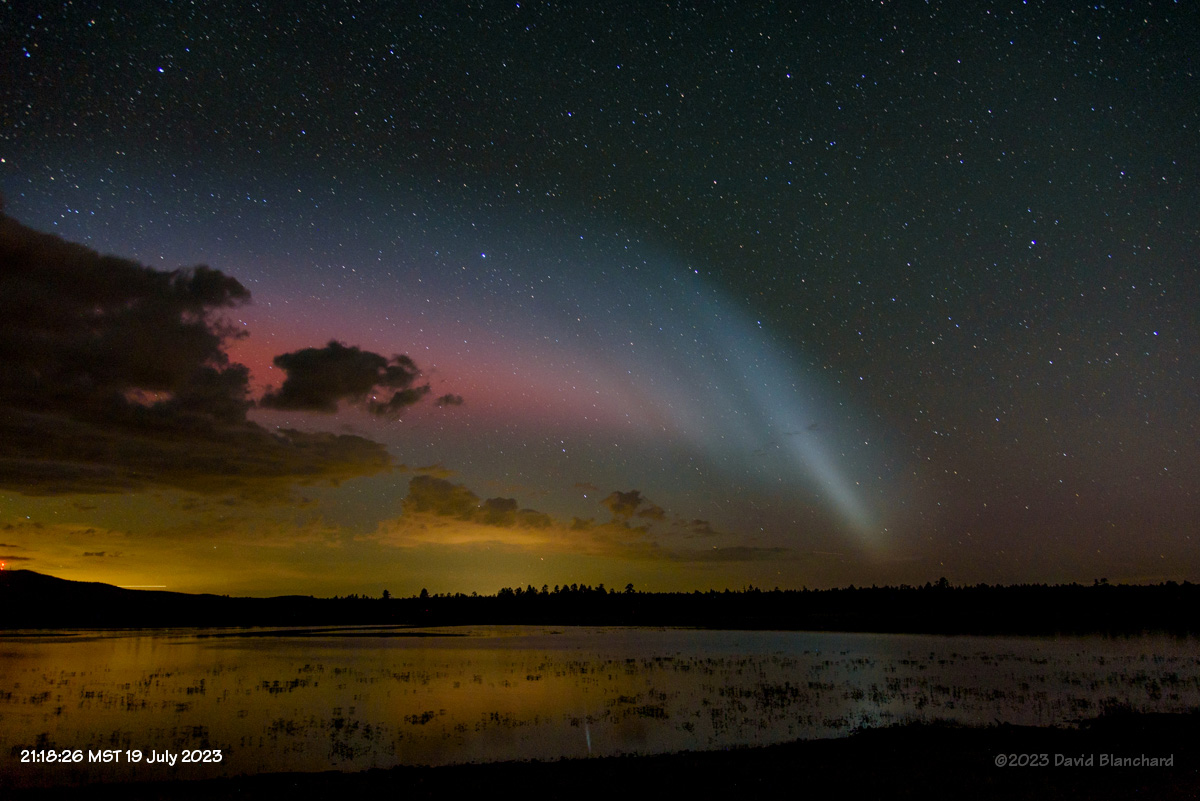
I'd like the ability to visit space at some point in my life, and I'd like our species to become experienced at doing things in space. Like, if we need to be able to deploy something in space to decrease the amount of heat we're taking in to try and buy more time to decarbonize before we're completely F'd because of all the people venting potent greenhouse gasses from their HVAC systems, it'd be nice if we already had a space industrial complex capable of supporting that goal.
We humans are stupid. We always underestimate the consequences of small stuff that simply adds up over time. This is a pattern. We polluted the planet with forever chemicals, lead, and tons of other pollutants that our descendants will have to deal with and suffer from!
All this needs to be regulated, a risk-benefits analysis made, and there needs to be a huge excise tax for all such activities!
Anyone else have this use of Ångström trigger an exception in their brain? The unit of default for wavelength is nm, not Å… (1nm=10Å)
Anecdotally I've only really heard angstroms used in material science / condensed matter physics, where most small structures are small integer numbers of angstroms across.
And the Starlink sats are so low that they dont really turn very meaningful debris ever.
And in general, yes LEO can handle millions of sats.
We have like 150k cars in a single tiny country on earth right now.
Is that right? Scientific American seemed to think it could be a problem in 2019[1]. Space.com says Starlink satellites orbit at an altitude of about 342 miles (550 kilometers)[2]. And the Wikipedia article on Kessler Syndrome[3] (which is a chain reaction of satellite debris) mentions an incident at 555km that was problematic:
"In 1985, the first anti-satellite (ASAT) missile was used in the destruction of a satellite. The American 1985 ASM-135 ASAT test was carried out, in which the Solwind P78-1 satellite flying at an altitude of 555 kilometres was struck by the 14-kilogram payload at a velocity of 24,000 kilometres per hour (15,000 mph; 6.7 km/s). When NASA learned of U.S. Air Force plans for the Solwind ASAT test, they modeled the effects of the test and determined that debris produced by the collision would still be in orbit late into the 1990s. It would force NASA to enhance debris shielding for its planned space station."
[1] https://www.scientificamerican.com/article/spacexs-starlink-...
The real concern for meaningful space debris issues is in the regions where decay requires 100+ of years.
The articles mentions the ASAT because that's what they used to study orbital behavior and decay.
Also generally, Space.com is universally agree to be the single worst 'space news' page known. I would never use it as a source for anything.
The real danger is space junk that's at much higher altitudes. OneWeb and Telesat Lightspeed (in planning) operate at 1000+ km, where space junk will take 1000+ years to deorbit on its own. And OneWeb has already had a satellite failure where it can't deorbit the satellite.
Compared to that, anti-satellite missile bust a satellite into pieces and carry indeed the danger of creating a Kessler syndrome. In case these would be used on a large scale, WW III would be imminent anyways. Apart from that, missiles are too expensive to knock out Starlink satellites, and the latter are comparatively easy to replace.
It’s pollution of the upper atmosphere on a huge scale and we don’t know what side effects that will produce
That’s fun! Of course, we do already have something analogous to FAA altitude separations. But that requires everyone everywhere to cooperate in real-time, and mandates some degree of maneuverability. I guess orbital decay is only a concern for aircraft when they aren’t trying to land.
What you have to watch out for is the eventual rise of the Kessler Cult, who (according to me) will seek to block all access to space intentionally ;)
(They can just be awfully hard to count, no matter who counts.)
Astronomy is already a casualty as the sky stops being "dark". I guess who cares about fundamental knowledge when there is profit to be had.
[1] https://www.space.com/astronomers-urged-protect-dark-skies
The more reassuring answer could be "there's already regulation Y that stops any single company from causing too much damage."
https://news.ycombinator.com/item?id=33762492 ("North Korean ICBM launch detected using GPS")
When we fly drones especially BVLOS operations we sometimes encounter some GNSS anomalies, that in some cases we just cancel the mission that day and the next day it’s with no issues. Could it be that’s the reason? Who knows, but it might be an issue later with crewed drones.
Getting what is probably the cheapest tier of spectrum analyzer and investigating that behavior seems somewhat prudent.
The term "punching a hole" is absurd, IMO.
Does anyone else feels it’s a good thing?
On one hand, Science™ sez it fixes itself every morning. On the other, Elon Bad and Planet Good.
So, I'm torn.
The signal might propagate and alert other intelligence that we are attempting something challenging.
Hopefully they send help.