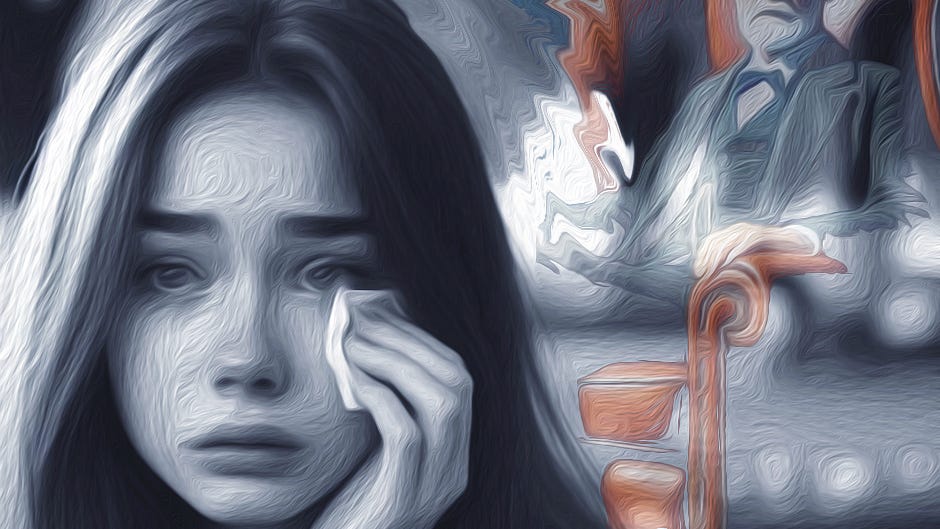
The Psychotherapy Myth
Contrary to the claims of the psychotherapy myth, humans can be resilient and tough-minded; they can suffer the slings and arrows of life without expensive interventions from “experts.”
aporiamagazine.com
99 points · by mpweiher · 3y ago · 233 comments
Furthermore, of course, depression does not occur in a vacuum, and in my case it was the tip of the iceberg, and future sessions would progressively refine and broaden the diagnostic landscape.
Most of all, the positive experiences I have gained from psychotherapy are not simply talking to a professional guy and having him validate my feelings, but rather I've learned practical tools for coping and alleviating symptoms. You may work out of this year's depression, only to find yourself depressed again in five years. If you had taken drugs, then you come crawling back to the psychiatrist and the pharmacy again and you get back on drugs. If you had taken psychotherapy, then you may not need to return to the psychotherapist, if you have been equipped with the right tools, you could have them in a notebook still, and then you just do some checklists, you follow steps, and you've got your skills for coping back at your fingertips again.
Granted, I don't believe that psychotherapy is the be-all-end-all of curing mental illness. In fact, psychotherapy was invented in competition to, or perhaps as a replacement for, auricular confessions to a Catholic (or Orthodox) priest. The Protestant Reformation had eviscerated Germany's ability to cope with the mind's inmost challenges, and the common people had lost their most trusted human confidants, the ones who ministered in the person of Christ. So Freud and his Freunde came up with a way to whisper secrets to a man, have them held in confidence, and maybe even get some advice in return. But essentially, it was just a secular façade to compensate for a sacrament which had been efficacious for thousands of years.
I'm fascinated with Americans who discover Catholicism though. Suddenly the religious parts of Europe become what Japan is to anime enthusiasts - a mythical land of perfection.
Catholicism is the largest single denomination in the United States.
> Suddenly the religious parts of Europe become what Japan is to anime enthusiasts - a mythical land of perfection.
Not really; very few American Catholics, cradle or convert, mainstream or “trad”, idealize “the religious parts of Europe”. American Trads idealize a fairy-tale vision of pre-Vatican II Catholicism which they are very aware does not reflect the present of Europe, and most American Catholics don’t idealize any particular alternative time and/or place in human history, current or past, real or imagined.
By affiliation, Protestants make up 66% of Christianity-derived religions in the US. 29% are Roman Catholic. Evangelical Protestants alone are 36%. (Source: https://www.pewresearch.org/religion/religious-landscape-stu...)
Religious affiliation is also highly geographically variable in the US, so many places would have relatively little cultural awareness of Roman Catholicism.
> In fact, psychotherapy was invented in competition to, or perhaps as a replacement for, auricular confessions to a Catholic (or Orthodox) priest.
Thank you for showing me a positive aspect of Catholicism. Their 7 deadly sins are just symptoms of people trying to numb their emotional pain for me. Shame makes people feel worse though. The threat of eternal punishment in an imaginary hell is a lousy deterrent to bad behaviour.
The words ascribed to Jesus, whos' story was written down 40 years after his "death" for the first time, work well though. Forgiveness works, the person that practices it benefits the most. You can do it for purely selfish reasons, to stop burning your energy being angry at people. Even if you practice Satanism after Anton LaVey, the first religion without a god.
Can you share some of those or are they rather personal?
Collecting this info was a homework because you can’t do it right in a session. The final homework was to consciously break “I/they must” attitudes. Specifically, I intendedly was several times (1) late for something, (2) went somewhere completely unprepared. As you may have guessed, I had two separate anxieties of being late or unprepared (among others). Ofc it’s not that I’m always late or unprepared now. But my own pathological anxiety feedback loop is no more in these cases.
These methods aren’t secret and every <insert type of psychotherapy here> book describes them in detail. You don’t even need to go to a therapist to use them, like you don’t need a programmer to use scandisk or memtest. But detecting inconsistencies in yourself is much easier when you talk to a different person.
Observe your thoughts.
Replace B/W "all or nothing" thoughts with logically correct ones.
Wear a rubber band around your arm. Every time you have counter productive thoughts, snap it lightly. Their frequency will go down.
The Happiness Trap by Russ Harris. It is about the very effective Acceptance and Commitment Therapy.
Investigation revealed the context of this single mention is a claim that it is a lie to say the modalities are different. This context is created for a claim that [recent metastudies] showing therapy effective are falsified, proof being the modalities are all moderate to high effectiveness.
The reading of it is a polemic against a They, starting as "experts" in the subtitle and continuing throughout, leaving a generally correct GP versus a narrow claim that a modality name is mentioned once.
Psychotherapy is about the relationship. This point is of such importance, that in Germany (where psychotherapy is covered by the mandatory health insurance) patients are allowed to have a couple of test sessions with several different therapists and then choose to continue with the one they feel best.
Also - as already pointed out - there’s a multitude of schools or types of psychotherapy (CBT, Psychodynamic, etc.) with statistically significant benefits. Of course, some are more suited for some cases than others. The OP treats psychotherapy as a monolith.
One way to look at it, is, that many people weren’t raised with competent-enough parenting (or mentoring) to acquire the skills to cope with some issues on their own - i.e.: the “just deal with it”. And this is the role of the therapist: not to become a parent, but to play the prosthetic role of a very competent parent, or mentor. So that the patient can increase self-awareness, self-reflection, and emotionally grow into being able to better deal with the situation at hand.
However, perhaps the biggest takeaway message here is that we need to educate Society - as we educate kids to learn to recycle - on how to choose a good therapist, what good therapy feels like, the importance of accredited and evidence-based methods (so people don’t rely on astrology and other quacks for - and therefore avoid properly dealing with - their emotional health needs), as well as, what should NOT happen in therapy sessions.
PS: And also educate about what is black & white thinking ;)
Classifying a detailed article as either "science" or "science denial" is certainly black and white thinking.
I also don't think it's true that the role of the therapist is to be a mentor. I've had mentors, therapists, and parents, and those roles don't overlap as much as you seem to think.
I've been in therapy since 2010. Those roles do, in fact, overlap more than YOU seem to think.
Have you had this fact checked by a cognitive therapist? They are, apparently, the arbiters of reality.
If so many people lack parenting that gives them the skills to tough it out and deal with it, that psychotherapy is necessary, why were so many people able to function prior to psychotherapy? Psychotherapy is only 100 years old, hell it’s only been socially acceptable for like 20 years. But people functioned just fine.
Were they? If you look at statistics for harmful behaviours like heavy drinking or interpersonal violence, people in the West were absolute basket cases just 100 years ago by current standards. The incidence of such behaviours is much lower today than back then. A general awareness of psychology might be part of it. Not too long ago we were executing soldiers for cowardice after psychological breakdown due to PTSD. Think about how ignorant that is, compared to what we know today.
Anecdotally, mental illness runs in my family. I have the same personality / emotional instability problem almost all males on my father's side of the family have. He did better than most else of ancestors and I've done much better. And I chalk some of it up to psychological awareness of my parents and teachers etc. about how to work with that kind of kid. Good feedback at all stages. I think I would simply have been expelled from school in an earlier era.
Can you explain why society being able to function prior to psychotherapy contributes at all to considerations about its efficacy and validity to science, or is in any way relevant to discussions about modern science? Walk me through your thought process here, because I'm similarly confused as to why we need all these antibiotics, for humanity survived just fine before they were invented in 1940.
Especially considering:
1) There are many documented cases of mental disorder throughout history that were either poorly-understood mislabeled.
2) Most psychiatric disorders don't have a completely-debilitating effect on those afflicted.
3) The existence of people being able to function does not say anything about the number of people who died/removed themselves from society due to being unable to interact. History is an interesting lens presented only by the people who succeeded enough to produce it.
There are loads of natural phenomena we don't understand precisely, but nature doesn't care. We don't understand how many drugs work. There is no book that explains how thalidomide helps with multiple myeloma but is that a reason to say pharmacology is not science?
That argument is a strawman as it works with anything that can't be falsiefied.
People who believe in astrology/chakras/etc. will also frequently tell you science will "one day" discover that "it's true". "We're just not there yet."
Also consider what someone may say in a hundered years:
It took almost a century before we figured out that psychotherapy didn't work. Didn’t stop anyone from taking pshychotherapy though. ;)
One possible view is that Society has drastically changed in recent generations with industrialization, mass media & consumption, and minuscule families - it used to take a whole village to raise a child.
And to answer your final question, not so long ago, most people also did not know how to read and write, yet “people functioned just fine”.
…does that make mass literacy worthless then?
Well, you can for CBT. CBT goes by the assumption that a lot of depression comes from negative thoughts and it tries to change the way you think and therefore the way you feel. And CBT is the most scientifically backed up form of psychotherapy. So it looks like that works.
Sure, we don't fully understand the brain yet, but we are making progress.
Some sciences are characterized by their inability to perform isolated and repeated experiments with identical initial state: Economics, biology, climate, and anything based on humans. They’re still sciences.
Moreover, what's most onerous, if anything, about the psychotherapeutic mindset is the implicit "broken / fixed" distinction (usually framed as something like "health" or "well-adjustedness")
Another framing with regard to experience would look at "development," "growth," "abundance," "depth," "truth"
There is much to unfold and discover in this life, and psychotherapy is a sliver of a broader set of practices—which have been with humanity for the entirety of recorded history—for doing so deliberately
What's most interesting about this article is the demonstration of a high form of a certain current in conservative culture: intolerance for (read: anger and fear at) the "sensitivity" of others. The internal script is something like "I can't handle that other people are sensitive and lash out at me for how I am." The projection is self-evident.
Which is not to say psychotherapists don't do anything right. Maybe they do something right. But it may be almost by accident, or maybe much is not needed for you to feel someone's got your back.
These trends, of solving a given problem a given way, are largely cultural. I wouldn't be surprised if one day we see present day psychotherapy as flawed as we see alchemy today.
Also, my argument doesn't "boil down" how you present it, you're severely misrepresenting what I said. The point is just because some people think it has helped them, doesn't mean it did. We're trying to attribute cause to effect, but we're often wrong about it. Our brain works by association, and associations are commonly misattributed.
This is why studying the field scientifically is important, rather than relying on "proof by testimonial". Especially the testimonials of fragile, suggestible people who would look for someone to lean on and trust by the very definition of their conditions.
It absolutely does not. The GP dismissed the usefulness of studies and posited that personal anecdotes were sufficient.
Another version that doesn't require endorsing esoteric practices is just acknowledging the effects of confession and things like faith healing, the "born again" phenomenon, etc. Here you see people reaching sustained ecstatic states through entirely mainstream Western practices.
Regardless, research does seem to show that methodology contributes very little to the effectiveness of therapeutic intervention. This is basically true in my experience. The most effective therapists have cultivated a certain quality of presence. If you want to look at it in a materialist frame, you could say they have a calm nervous system, which allows the clients nervous system to entrain to calmness and reinterpret challenging psychological material in an environment of held safety, similar to being held by a securely attached mother as a child.
Little about healing will be truly understood at the 'New York Times pop psych article level' of understanding until Western psychology fully integrates the insights of the great wisdom traditions, psychedelic medicine traditions, etc. This is currently happening very quickly and most advanced practitioners in the wild are well past the Overton Window.
Maybe, and I know this seems like a crazy idea, we should look into that? It seems like a pretty big blindspot to dismiss all of that outright because the mechanism of action isn't yet understood or because it clashes with philosophical views that were common among some academics who died last century.
<sigh>
One would hope that most HN crowd would hopefully stop reading after this sentence.
Where to even start?
Maybe reading the rest of the comment is a good start
The rest of it the comment is discredited by the line I quoted.
It already contains two biases verbatim. So that without even considering those that can be deduced/assumed further it can't be taken seriously.
Replace 'psychotherapy' with 'astrology' and reconsider OP's sentence:
"I don't need studies to validate the hundreds of incredible results I've seen within the population I have direct access to (and myself)"
Mind you, I am talking about the comment here. My opinion about the article the discussion is about is a tad more nuanced but that is beside the point of my reply.
We certainly wouldn’t want data to get in the way of our confirmation bias.
So it seems like the best solution is emerging: there are Christian Health Sharing ministries which impose requirements on the morals and faith practices of their members, and they also disallow sharing of costs for treatments which contradict or deny Christian doctrine, as delineated by the ministry's guidelines.
So, people are free to associate with a health sharing plan that is not insurance, and promises to observe the tenets of shared beliefs (Christian or not). It works more like a mutual benefit society.
In fact, there are a significant number of psychotherapists and other practitioners (natural medicine too) who do not accept any form of insurance. The health sharing ministries work with their patients to pay the bills.
Most depressions indeed go away on their own, and perhaps are even helpful - they can force a person to reconsider and rearrange their life. The heavier ones probably have to be treated with everything that the patient and their environment can muster, all at the same time. And since the patient usually can't do much, it's up to the environment (friends, family, health care, mental hospitals). Please keep that in mind and force your depressed friends to go for walks, or do anything else at all, repeatedly. All the +5% basics like physical activity or smalltalk really do add up. Though the depressed person will not be able to see it for a while.
I don’t know if it’s even possible for other people but what I ended up doing out of desperation was just logic-ing my way out of it. I would sense it coming and start directly countering thoughts and waves of emotions with reasons what I was feeling was not true and things I was grateful for. It was literally like arguing with my own thoughts and telling them to shut up. It shortened the bouts by a ton, stopped me from spiraling and eventually they stopped all together.
Maybe that will help someone else super analytical like myself? I genuinely don’t know. In more recent years, did not help my wife with her struggles at all.
Logic-ing or grounding is also something I recognize myself doing. And it can all be such simple accessible things to make it happen. For example, looking at a picture or video of my young nephews playing works wonders. Probably more than any talking session, although one has to also get the dirt work out of the way. The hard work of fixing stuff, and then relaxing by grounding work.
But guess what - those methods also have a limited effect. Perhaps a bit stronger than the more common methods, but not by a lot.
If the science was clear in that depression would be heavily contained if the sufferer engaged in physical activity, good sleep, good diet, good general routine and zero stuff like social media or mindless entertainment, then how man people would actually follow through?
We criticize psychs for their love of giving pills, but we are the first who are lazy and stupid and would never actually do what's best for us
At this point, writing a good-faith rebuttal to the article seems unnecessary.
Personally, it is possible that there are supportive communities where coping skills are widely taught at an early age and that those skills are better for complex trauma than those developed by therapists (e.g. EMDR) but I am pretty confident those types of communities are far from the norm.
> Comments should get more thoughtful and substantive, not less, as a topic gets more divisive.
> Please don't post shallow dismissals, especially of other people's work. A good critical comment teaches us something.
> Please don't use Hacker News for political or ideological battle. That tramples curiosity.
> Please don't pick the most provocative thing in an article or post to complain about in the thread. Find something interesting to respond to instead.
The topic of the article is divisive, so according to the guideline you came up with, comments should get more thoughtful and substantive.
I am sure you can see why I reached the conclusion that bpm140 was not familiar with the guideline.
There's a chance I'm missing something here and, if so, I would love you to help me out by pointing it out.
> The demographic groups involved likely have an average intellectual quotient (IQ) under 85, an aspect that's seldom discussed openly in France. What is the cost of silence?
Under all the studies cited and the scientific analysis there's this subtle, yet clear, gnarly conservative discourse that can be summed up as "Therapy? Be a man, would you?".
And if that's not enough, there are all the ... I lost count how many, subtle logical jumps that seem reasonable for the sake of argument and brevity, but if you spend more than a second on it make you go "wait, that's right".
The manifesto on "race realism" (!!!) is enough to convince me that the authors of this piece would shoot me dead if they ever got the chance.
They can kindly fuck off back to the 1920s with that nonsense.
> W spends most of his time on Twitter talking about _ and the alleged evils of _. He commonly retweets _ and other so-called _. W identifies as a member of the _ which is basically an attempt by _ to re-brand themselves as political moderates.[ref]
That is profiling work. (Not just "Ad hominem".)
--
The clash with the name "rational-wiki" is too strong not to be noted.
--
(Sniper, put some argument there: you are qualifying yourself. Not in a good light.)
I find RationalWiki to be directionally useful, with maybe just a little bit of extra clicking. If they say somebody is, say, anti-vax, you can usually quickly determine from the cited sources whether that's a reasonable claim, or somebody willfully misreading an ambiguous statement on Twitter at some point.
[1] https://forum.effectivealtruism.org/posts/ALzE9JixLLEexTKSq/...
You apparently think it's okay to attack RationalWiki, so what is the distinction?
Then don't fucking link it.
I'm not saying Encyclopedia Dramatica is an authoritative source but you might find it a useful starting point to learn about Rational Wiki - https://encyclopediadramatica.online/RationalWiki
The reason for both is that the entire wiki probably has about dozen editors, some of them way more powerful than others. So you might think that "wiki = something edited by lots of people", but for many topics there was one person who decided whether something was okay or not and wrote the article accordingly, and everyone else only added details afterwards (or disagreed and was banned).
From my perspective, the greatest problem is the local cultural norm that once you decide that someone is a bad guy, it is allowed (even encouraged) to exaggerate about them, and complaining about exaggerations can get you banned. Which means that when a mistake is made, it becomes very difficult to fix it, because of course after the exaggerations anything can look stupid.
Let's at least be honest.
"Winegard clarifies his above comment and concern is specifically only countries below sub-replacement fertility (2.1 TFR), meaning (excluding a few countries in East Asia i.e. Japan, Singapore and Korea), the whole of Europe.[33] This a key obsession of white nationalists (such as Brenton Harrison Tarrant, the perpetrator of the Christchurch terrorist attacks, whose manifesto called for white Europeans to increase their fertility rates above 2.1)."
Winegard says make more babies, you know who said that too? Christchurch terrorist! Ridiculous.
And then, you only need help until you’re unstuck.
Teach a man to fish, and all that…
That isn't really a view of therapy as a specific intervention, but as an almost mandatory practice for adults, kind of like going to the gym. The view of the psychologist you mention is actually sadly rare. Obviously, I think the widely shared view of therapy is a total bastardization of any worth therapy might have had in the first place.
The reality for women on dating apps is pretty terrible, and therapy is a signal for "focused on self-improvement". In a dating pool filled with emotionally immature people, it can be useful to find other people who are similarly committed to self discovery/improvement.
And if you're dating in your mid 30s, a time when people are probably back in the dating pool because of a failed relationship, everyone is looking for evidence that a budding relationship isn't doomed to the same kinds of failure as the last one.
There aren't may ways to socially signal "I'm focused on (internal) self improvement and I'm serious about it".
It's not people often, it's some people sometimes. Not everybody gets traumatized by the same things, not everybody needs help to process them. But some need help and for some psychotherapy helps.
It is obvious that the author is ignorant of the topic (psychotherapy).
It sounds like a hardware engineer dismissing software engineers and strongly affirming that all bugs can be solved with hardware solutions.
Some problems are indeed due to psychic issues and not physiological ones. Yes, you can probably workaround symptoms with drugs, but that does not really solve the problem.
If you have mental blocks and a shitty life that makes you depressed, and alleviate the depression with drugs, you still have mental blocks and a shitty life.
I wish that both disciplines were not as independent from each other as it is today. Having experts at both subjects could probably do wonders to help people and make proper progress.
Option 2: Confront your mental blocks and shitty life with less depression (due to pharmacology).
Option 3: Confront your mental blocks and shitty life with a guide and less depression (due to pharmacology and therapist).
Option 4: Wait for the law of averages. https://youtu.be/3s_BqdZrUbE
I'm taking option 3 all day, every day.* (e.g. I agree with you. They should always be done in tandem / there is no silver bullet).
*It's very important that your therapist shares your zeitgeist or directly counters it as a devils advocate. The drugs... not so much.
Option 5: Convince yourself it's worth suffering through your shitty life because if you're a good moral person, you can keep your eye on the prize (eternal afterlife in paradise with all your dead relatives and loved ones in eternal abundance and joy), also historically achieved via religion.
"According to their analysis, religion is positively associated with life satisfaction, happiness and morale in 175 of 224 studies (78%). Furthermore, religion is positively associated with self-rated health in 27 of 48 studies (56%), with lower rates of coronary heart disease in 12 of 19 studies (63%) and with fewer signs of psychoticism (“characterized by risk taking and lack of responsibility”) in 16 of 19 studies (84%)."
https://www.pewresearch.org/religion/2019/01/31/religions-re....
As someone who has dealt with mental health issues stemming from complex trauma for most of my life, it's difficult to take this seriously. What the author describes is a laughable caricature of the field, and seems pretty far removed from the realities that many people face.
I see therapy as a commitment to focusing on root causes, and retraining maladaptive patterns of thought. I see my relationship with my therapist as that of a teacher/student. Someone who can help me reframe things and see other perspectives until I can do the same thing for myself. Coming from an abusive environment that hammered certain attitudes into me from an early age, I've found incredible value from establishing a trust relationship with a person who can act as a conversational sparring partner and can point out the patterns of thought I can't see in myself. I didn't have other people in my life who I trust this deeply, probably because of the underlying reasons I'm seeing a therapist.
I've found that some of the most helpful ways to improve my mental state have nothing to do with those sessions. Sleep, exercise, time in nature, social connection, artistic outlets, etc. are all critical. But those are the things that I didn't know how to actually do. I wanted to want these things, but couldn't navigate the mental blocks that kept me stuck where I was. And for whatever immediate physiological benefit these activities bring, they don't undo decades of conditioned thought that needs to change. Using sheer willpower to force myself to exercise only worked for a short time, and I couldn't establish lasting habits until I had unwound associated unhelpful patterns.
To present these things as better than or as effective as therapy is to completely misunderstand the point. Therapy is also not some panacea, and most of the real work happens outside of session.
> Patients can expect to pay somewhere between 60 to 250 dollars per hour for a therapy session. (A jog in the park, a church service, a long walk in the woods are all, of course, free.) In many cases, insurance covers part of this; however, therapy can still be expensive for the patient, and therapists—men and women who often espouse dubious, even risible theories—are handsomely remunerated.
As a kid, I grew up going to church services. Services in which I heard "spiritual leaders" rail against the sinfulness of homosexuality (among many other things). Around age 12, I heard earnest conversations from elders in the church about such people deserving to be stoned to death according to scripture.
This was rather confusing and terrifying to hear from people who were supposedly worthy of my attention at a time when I was coming to grips with the fact that I felt attraction to both men and women.
To deride psychotherapy and casually offer "free church services" as an alternative in the same sentence is pretty humorous to a person who has had life changingly positive experience with therapy...therapy that arguably became necessary after years of indoctrination and instilled existential dread by those free church services.
I'm not railing against all churches, and there are some great organizations. But it seems only fair to point this out in an article that calls therapy to task for those instances when it doesn't work.
I, for one, am grateful for therapy. It saved my life (literally), and has been an incredibly positive force in my life.
Is that a scientific judgement or a cultural one?
I don’t deny the effectiveness of therapy - I know of great successes personally and anecdotally and I understand self-reported well-being is improved broadly. And yet it’s not quite science or medicine. There is no real understanding of purely materialist mechanism of how it works.
That said, scientific endeavors revise themselves when they learn that they are wrong, as was the case with the removal of homosexuality from the DSM.
The many fields of science and medicine went through periods of growth during which they’d be laughed off as “not scientific” or “not medicine” by today’s standards. The mind is a lot harder to measure. There are often answers in principle but not in practice. This gap doesn’t make the entire thing unscientific, but in need of more progress.
How would you classify drugs that are proven to work for a given issue, but for which we have a limited or non-existent understanding of the mechanism of effect? Are these not medicines?
Exactly. And scripture is notably not revised when it is found to be wrong. I ask, which worldview should you trust more based on this observation?
I felt that the article is written is a style typical of conspiratorial literature, i.e.: presenting lots and lots of evidence for a false or straw-man claim.
The true message of the article seems to be buried in the subtext. they mention the cost of therapy (to the individual and to society) and they mention churches too.
To me it reads like this: I don't want to pay for your expensive psychotherapy through my insurance. Go to church instead (where, depending on the church, we might also get a chance to fill your mind with our regressive version of christian values.)
I don’t see the AMA voting to declare something that is a disease is no longer a disease. (Although maybe I’m wrong — alcoholism and addiction are now a disease.)
Psychotherapy is a tool, it's not a panacea, but ultimately if it safely helps people feel and live better then why throw so much shade ?
A week later he send me the number of the therapist. I didnt write her yet, I think I dont need it as badly as before.
Those 30 mins were key. I am highly introspective and logical, I only needed to orderly speak my problems.
But yes, I will have to go eventually.
Feelings are less important than the big picture of your life. Fuck mental health care for convincing me to prioritize my feelings in the moment over my long term happiness.
I suppose if being happy and functional is your goal, it makes sense to do whatever you can to improve your chances. Personally, I prefer to experience reality and find truth even if it isn't happy or beneficial. I never hear them give advice that makes people unhappy or ask people to sacrifice for others. Furthermore, fundamental views and values I hold are likely very different from any therapist, so they can't qualify to advice me (and many others). Based on what I know about human nature, it's pretty damn scary how much people trust therapists.
Check out century of the self, a documentary I found on HN actually that documens how freudian psychology and modern marketing and capitalism aligned and worked together in the 20th century to create the world we are in today:
IMO, many cultures long before freud used religion and other means as part of mental health treatments.as I alluded earlier, I take objection to the approach he championed where psychoanalysis is done by people who don't consider belief and world view compatibility and goals that are wildly different from their own. How can you fix a problem for someone if you don't even know what the root cause for that person is and what they want the solution to be? This is a highly subjectivr field where reductivist (why they call them shrinks) approaches only work as a matter of statistical success, not correctness of the approach.
Again, just my opinion and observation.
In my experience, just understanding the mental world someone lives in is a huge undertaking. Two people can look at the same thing and have thing mean wildly different things.
Pretty simple: legal barriers to revealing that information creates an open space for discussing those thoughts that you don't feel comfortable revealing to friends or family.
I mean, some shit I wouldn't even dare speak out loud anywhere near a smartphone or network connected device. These days, you say the wrong thing and they'll put you in a 72hr psych hold and ruin your life (having to explain that to your work/spouse!).
Beyond that, these people are experts at manipulation (to an end they consider good), they could take that information and get you to think in a way that is undesirable to you.it could be life changing but it that change does not have to be positive. Your putting your faith in a lot if humans and a lot of processes and checks working right.
I assume most people here are very skeptical about homeopathy. And yet, there are plenty of statistical studies that "show" that it works. The interesting thing about them is that the more rigorously the studies are done in terms of conforming to best practices for minimizing the risks of confounding errors, the smaller the statistical affects are, until they get to near zero for the most rigorous ones. Which is exactly what you'd expect to see if the effects of homeopathy are actually nonexistent other than placebo. Which I believe them to be, since the "theory" behind homeopathy makes no sense at all to me.
The article we're discussing here purports to show a similar thing: Studies that correct for more confounding factors show smaller effects. I can't judge how factually true analyses found in this article are; the writers may be making it all up. On the other hand, it could be a mistake to dismiss it out of hand just because its conclusions are not consistent with today's common wisdom. Also, we should note that anecdotal reports from individuals, here or elsewhere, about what good it has done them don't disprove the author's point. Psychotherapy can work for some people but still not have a great average effect size.
Personally, I'd be very surprised if psychotherapy is actually worthless on average, although I think that the therapy I had in my late teens and 20's, for years, probably did me more harm than good, other than just having a group therapy group to talk to. Which WAS valuable. But most of the good came just from talking to other people who happened to be in the group, not from the therapist. (I had individual and group therapies during that period. I think the individual therapy was probably worth less than nothing; there were definitely harmful things that came out of it that I am very clear on decades later.) But my personal story is just another anecdote. It seems logical that if someone is trained in helping, and someone wants to be helped, then on average there would be positive results.
But they may not be as much as is commonly thought to be the case in today's world.
I definitely won't be engaging with this evidence, basically: I don't want to be sealioned.
The ones that were less rigorous might be ones that you would count is "non-reputable". But they are considered reputable to people working in the field of homeopathy, who believe them, and the article included studies with control groups. But, for instance, studies that weren't double-blind, even if they had control groups, got more "results" showing that homeopathy "worked" than studies that didn't.
And note that you can't really have double-blind studies for psychotherapy.
I myself have tried going down that route several times and come away disgusted by how bad it was. At best… at best it was emotional intelligence and self care at a grade school level. Talking to the provider was like talking to a robot or someone reading a script in a call center. The providers consistently effected a tone not unlike how one patronizes an unruly toddler. It was impossible, literally impossible to get them to switch to speaking to you like a person.
I have known several people who went into to psychology mostly to serve their own navel gazing. Have heard several explicitly say the opportunity of manipulation (yes using that word) excited them.
I’ve studied the history and present level of knowledge, the quality of the science backing it, and come away more concerned the more I know.
Folks generally need people to talk to about the difficulties of life.
The medical profession on that topic is… not that great. You don’t have to be a political whackjob to have serious concerns.
Thats a lot better case then people studying psychology to become psychologists because they are trying to heal their own severe emotional and mental issues.
I think it's worth examining, but only to see how right-wing cranks cosplay as scholars.
1) They keep using passive voice, like "Scholars say..." to introduce their critiques. One could be bad writing but multiple times is suspicious. WHICH SCHOLARS??? This is a sure sign of someone trying to obscure the motives and origin of their critique. The white nationalist author identifies himself as an independent scholar, which suggests strongly he really means far-right cranks like themselves.
2) The authors never clearly identify their target. Who are they attacking - popular representations of psychotherapy, or the validity of psychotherapy itself? They introduce the topic with culture war tropes, gesturing vaguely to what elites talk about at "cocktail parties" (what is this, the late 1960s?) and incredibly, the movie "Ordinary People" (1980!).
Anyway, they assert that there is a myth in popular culture and then tear down the most simplistic version of the argument - that therapists are superhuman engineers of the soul. Strawmanning heavily here, and presenting a false dilemma - one can only be self-reliant or only depend on therapy.
But so what. Popular culture gets a lot of things wrong.
3) In any case, by a somewhat crooked road, they proceed from there to some critiques of the effectiveness of psychotherapy, itself. And it's worth considering. All of social and medical science is undergoing a huge replication crisis.
They rely heavily on meta-studies. Unfortunately, those studies show the opposite of what they are claiming. So by various techniques, they try to mathematically weaken the conclusions of those meta-studies, coming up with surprisingly precise numbers about how wrong the studies are. (This, by itself, is already a hallmark of the right-wing crank.)
Is psychotherapy just great all the time? No. I've had my share of therapists that I'd consider pretty awful. But anecdotally I've found that the more academically qualified, the better the therapist is, and the closer they adhere to evidence-based therapies. If the Winegards' critique was true that the field is rotten, it should be the opposite.
I can't help contrasting these author's arguments with a book I happen to be reading right now, The Body Keeps The Score, by Bessel van der Kolk. This is a best seller which may have done more than any other book to inject concepts like trauma into contemporary consciousness.
I'm just in the first chapters, where van der Kolk works in a VA hospital where there are many divots in the wall, due to Vietnam veterans flipping out and punching it, often over trivial frustrations. These are conservative and military people, and they have tried hard to do what the Winegards prescribe - going to church, not dwelling on their past experiences - and they fail, because their trauma keeps reasserting itself. van der Kolk later sees some of the same signs in his civilian patients, and as a young intern assigned to monitor patients on the late shift, hears many confessions of abuse that are never repeated to the doctor in the morning.
The Winegards attack the concept of psychotherapy as if it's quack medicine for trivial ills, the kind you can shrug off with a little grit. And their critique remains at a safe distance from the problem, through their own vague perceptions of pop culture and browsing the internet for meta-studies.
If the Winegards could show some examples of people overcoming trauma by just manning up, praying or, suppressing things and getting on with it, then maybe I'd be interested. Or if they wanted to talk about the eroding of medicalized terms through popularization, like "trauma", I'd be at least partially on board. But they don't, and they won't.
Like all right-wing cranks, they aren't concerned with what you might assume; that is, the health of patients. they're concerned with knocking down "elites". You know you're dealing with a right-wing crank when they characterize their enemy as an elite that is both contemptibly weak and inexplicably strong. They offer no explanation as to how their enemy's cultural power was achieved and maintained. It certainly couldn't have been because it kind of works or because the need is great. It's always because of the masses being hypnotized by messages in the media - like, you know, Ordinary People (1980).
Beware this sort of thinking, because it leads to reactionary solutions.