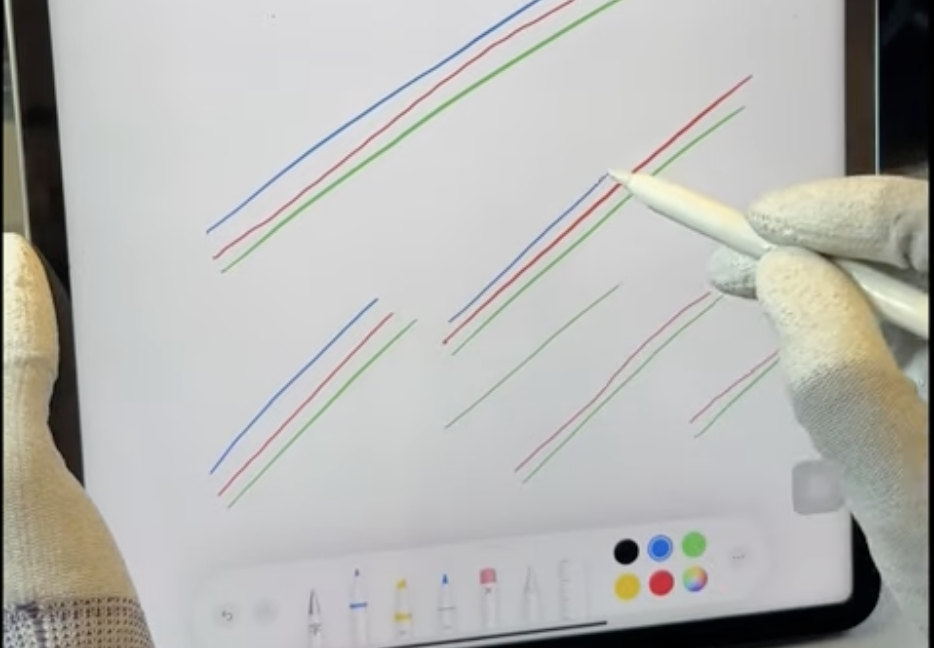
Apple Pencils can’t draw straight on third-party replacement iPad screens
It's similar to the Face ID failures of the iPhone 13's screen, later fixed.
Ars Technica
141 points · by dataflow · 3y ago · 158 comments
More reading: https://www.reddit.com/r/gadgets/comments/15cxwaa/apple_penc...
One sane person comes up with the more likely explanation:
> That implies to me the calibration is unique to each screen and a proper repair has a calibration setup step?
And someone just dismisses that perfectly logical explanation completely out of hand, declaring 'all the hardware is identical'
> No that is not the case. Its not a calibration that really happens here because the screens and the hardware are identical.
Tell me you don't know anything about mass production without telling me you don't know anything about mass production...
Their reply is further sense:
> If Apple wanted to prevent unauthorised replacements they would have no reason to cause erratic behaviour, they could just disable it.
I am so tired of people who interpret Apple's actions purely as anti-consumer fuckery. Even to this day, people still claim that "apple made people's phones slow down as they got older, so they would have to buy new ones" despite it being widely covered that Apple, like other phone manufacturers, slows down the CPU when they detect the battery's internal resistance rising to prevent brownouts so that the phone is usable for a longer period of time and all you have to do to restore original performance is replace the battery, apple or no.
You point that out and without admitting they were wrong, they shriek "well apple should have TOLD people that's what they were doing." No other manufacturer was telling people, either. Plenty of Android handsets just randomly start crashing as the battery's internal resistance goes up. I had one. A Google Nexus 6. It took me months and multiple re-installs of the OS to figure out what was going on before I read others saying that new batteries fixed their crashing.
You just can't win.
Don't get me started on how superior the lightning connector is for daily use - predominantly charging - compared to USB-C, but apparently Apple are "dicks" for not going to a more fragile connector literally designed to break just like every USB connector before it. People even have the nerve to complain about Apple "taxing" cable manufacturers and their burdensome certification, ignoring the whole "random USB-C cables will fry your laptop and phone" problem and the fact that the USB alliance charges a license fee on every single product that bears the USB logo.
Do you have any evidence USB-C is literally designed to break? That seems like an extraordinary claim to me.
https://cdn.vox-cdn.com/uploads/chorus_asset/file/8059819/ve...
In fact, it's remarkably easy to clean a Lightning port and the common advice is "just stick a toothpick in." There's almost no risk of damaging the pins inside. It's also very easy to inspect for debris.
Meanwhile with USB-C, you have a very, very thin piece of plastic in the center with contacts on either side, coming out very close to the face of the connector, so you end up with shit like this happening:
https://hackaday.com/wp-content/uploads/2022/11/hadimg_usbc_...
Further, the retention mechanism for Lightning is incredibly simple and durable. A large clip that snaps, either side, into large detents on either side:
http://cdn.arstechnica.net/wp-content/uploads/2012/09/6wSwQD...
On USB-C they do something kinda sorta similar, but instead of being around the outside of the connector and thus nice and beefy (and protected - there's no way to bend or deform the ends), it's tiny little prongs inside the connector, completely unsupported mechanically and exposed to being bent by debris in either connector, or something being jammed inside.
Further: look at the plugs and connectors. The male lightning connector? Really it just needs to be the right thickness and the pads need to be in the right places. The female connector is similarly very simple. The retention mechanism is also very obviously low-tolerance.
Look at the design of the USB-C connector and imagine the long list of tolerances needed to get it to work right because you have the entire working guts of the device-side connector in the center of said connector going into the plug.
This is correct. On the internet you really can’t win because it’s not a debate, or even a conversation with another individual. You’re talking to an anonymous mob of unknown size and composition.
I don't even move them around much, but now I'm forced to use my Switch's USB-C cable to charge both. At least there are a lot of USB-C cables now that many things use them. Hopefully I don't end up using my headphone USB-C cable to charge everything.
The controller on the replacement screen has no calibration whereas the controller from the old screen has been calibrated to the old screen, apparently sufficiently close enough to the necessary calibration of the new screen to not show noticeable issues to most people.
The real test would be grabbing two screens with calibrated controllers and switch the controllers out, then compare accuracy after the swap with accuracy before the swap.
This similar to color calibration on your TV. Replace the panel of your TV and reset all settings and a good chunk of people is going to notice that the colors are off. Plugin the color settings used when calibrating the original panel and most people won’t notice it’s off by a little, only trained eyes might notice that it needs further calibrating to perfect the color output.
Another analogy would be new uninflated tires. Put them on your new car and everyone sees there’s something wrong.
Grab inflated tires from your old car and put them on your new car however and most people don’t notice that they need more/less air appropriate for this different make/model/weighted car.
But it is because they don't care about it working after a third party repair. They're trying to profit twice: once from sale, once from hardware repair support which is very expensive (lol, 600 EUR to replace a MBP 2014 screen ..) inflates the price and warrants the higher price of a new device.
> Don't get me started on how superior the lightning connector is for daily use - predominantly charging
Depends on the device. You can charge a smartphone wirelessly, too, and you might want to use wired for transferring data. Yes, I know, it is a cloud world but that isn't my choice. And if you want to transfer data via lightning... prepare for the fun experience of 480 mbit/sec called USB2.
> People even have the nerve to complain about Apple "taxing" cable manufacturers and their burdensome certification, ignoring the whole "random USB-C cables will fry your laptop and phone" problem and the fact that the USB alliance charges a license fee on every single product that bears the USB logo.
Indeed, I do, because Apple wants to earn large margins on everything. I also recommend against using random cables, see e.g. O.MG cable.
In a world where Apple wasn't trying to dynamite the repair industry, they'd have a website with all their calibration tools and low level format documentation on it. Things that actually need to be paired for security reasons (e.g. fingerprint sensors, TrueDepth cameras, the angle sensor, etc) would have a click-through notification saying "hey, if you didn't get this part fixed someone might be spying on you" and simple tests to verify that the new part works, instead of just permanently disabling the associated features (Touch ID, Face ID, the ability to put your MacBook to sleep).
The phrase "undue burden" is probably going through your head. The problem is that Apple wants you to think it's an undue burden for them to make their devices more repairable. Their process for locking out repair shops is to find a plausibly deniable reason to do so - i.e. security - and then half-ass everything associated with that. So the actual security rationale gets implemented but all the 'ecosystem stuff' Apple is normally very good at just... isn't there.
Releasing calibration tools for this sort of thing would be a rounding error in Apple's accounting. And it would improve people's perceptions of their products, too. The thing is, I already knew about this problem despite not knowing there was a calibration step involved. /r/ipad would regularly get posts once a week about people whose iPads just couldn't draw lines straight, and I just assumed I'd gotten lucky with my iPad Pro M1. Turns out, they all had gotten their screens replaced at one point or another, and there's ZERO indication that doing so will fuck up your Pencil digitizer.
People assume Apple's actions are anti-consumer because Apple - and, as you pointed out, the entire industry - has eroded their own trust by gaslighting users. No buddy, it's for your safety and security that we fuck up your pencil and break Face ID if you get a screen swap.
The users might as well gaslight Apple back.
> Don't get me started on how superior the lightning connector is for daily use - predominantly charging
USB-C as an ecosystem is hilariously poorly thought out but charging is the one thing I can reliably do with it. The only problem I've had is getting USB-C cables that will carry video or charge at high voltage. That last one miiight sound like a point in Lightning's favor except for the fact that it's only a problem at laptop charger levels. Apple switched their entire laptop range to USB-C back in 2016 and the only iPad that still charges with Lightning is the last-gen model. If Lightning was superior for charging Apple would have used that on their laptops instead.
You can get dodgy Lightning cables from the same people selling dodgy USB-C. Both will be uncertified knock-off garbage made by people who probably aren't paying royalties to anyone - neither Apple nor USB-IF.
hahaha like that's so easy! At least the EU seems to be heading towards fixing this specific issue - easy battery replacement will be mandatory.
What they did was chase thinness and so they didn't include an adequate power source for the processor they were using.
> What they did was chase thinness and so they didn't include an adequate power source for the processor they were using.
Your comment might apply to Apple, but an iPhone was hardly the only handset that crashed as the battery stopped being able to keep up under load.
But if you have a better battery design, feel free to patent it and get insanely rich.
Has tablet computer really improved since the last Google Nexus 7 tablet, which was released in 2013?
Seriously, I was in the market for an affordable tablet, and quite bizarrely the tablet computers today have significantly underwhelming spec compared to a phone of the same price point.
There is no budget tab from known manufacturers. Even at IPad level prices, the android counterpart is quite underwhelming. I don't how it happened by it seems like IPad is the only tablet computer to get. For people on a budget there is no other viable option then to get a used IPad and news like this makes me kinda mad.
What the heck is even going on? Like in 2012-15 era there was bunch of variations of tablet computer of different price points. These days everyone from toddlers with their padded covers and graphics designers with an apple pencil is using an IPad.
I did have a Nexus 7 and it was great. I used it to hold my cached maps on motorcycle adventures. But these days you can get a "phone" that's practically as large as a Nexus 7 was, has way more storage, better battery life, and better performance. A Pixel 7 Pro has a display 80% as large as the Nexus 7, but in 40% of the volume.
If the UI didn’t tell me it had a battery I might not even know.
With Android there has been a long period of stagnation with only Samsung doing custom stuff like DeX, multi-tasking stuff and striking deals with various productivity apps for Android ports to make Android viable for tablets, otherwise they're only very recently starting to come out of it with Google working on a Pixel Tab.
I hadn't intended for it to be much more than a portable drawing, reading and note taking device when I bought it, it just sort of fell into the laptop replacement role.
Motorola has phones that do the same and without a proprietary dock.
Haven't tried with phone though.
Though I used to use this on phones with a dedicated micro-HDMI port so I'm not sure if just any phone can be hooked up to an external display (maybe most of the ones with USB-C?) but it's definitely not OEM-specific.
It only works on Samsung models that have USB-C video though. My mid-range Samsung phone doesn't have either feature.
They are so unresponsive that each has been abandoned, then Siemens buy us a new, higher spec one. They all behave the same. Laggy, unresponsive and actual junk.
This IS changing now that Google has a pixel foldable smartphone.
How is performance? Mind recording a video of average browser/application speed?
So yeah, budget tablets are not great but there's certainly some improvement on the higher end.
I wouldn't know, I'm still using my second N7 with Lineage OS.
At the higher end, things like the Pixel tablet and Galaxy Tab are pretty good, but IMO they are hard to justify vs the ipad at the same price point.
Other option is that Apple bakes in calibration details of all possible serial numbers in every iPad sold which doesn’t sound like a plausible scenario.
At software level iOS registers some calibration data (after some factory calibration) tied to that specific serial number (as calibration makes sense only for that specific instance of the panel anyway) so when serial number changes iOS can't find calibration data on device and continues uncalibrated instead of trying to use calibrations for another-serial screen (from the OS perspective).
It makes sense, if there actually is some sort of calibration going on in the first place of course.
Printer manufacturers have been pulling the same trick with storing (approximations of) ink levels in chips in the cartridge, claiming that it makes it easy for users to swap cartridges and continue to have accurate quantities and in that case there's a little bit more truth to the argument, but not this one.
Just bake the one that the device is bonded with, using the display serial number as a lookup key.
Then, if you change the serial number of the display, the lookup would fail, and fall back to whatever "default" values are.
That said, I see a generous explanation that I can't rule out based on what they're describing. It seems like the only test this Redditor mentioned was that you can modify the serial number and cause it to go from correct behavior to misbehavior. But I would think the reverse direction is the real test, since otherwise this could just imply that the device is looking up some embedded calibration information for that serial number and not finding it, and therefore falling back to some default behavior?
So, if it's just a matching serial numbers problem, why aren't they programming the new screens with the serial number of the old screen, and thus the problem goes away?
They were a genius grunt and their penchant for drawing conclusions on incomplete information is exactly why they aren’t trusted to perform manual calibration that hinges on their manual interaction with the screen.
If you read their other comments then you see that they believe that all components used are identical and thus wouldn’t need calibration.
Never mind the fact that different vendors are used to supply screens depending on the model in question, even between “identical” screens there’s plenty of subtle variation.
The controller holds calibration information in the form of offsets for touch and color amongst other things. The controller is married via serial numbers and if there’s a mismatch it’ll default to no offset.
This also serves as a clear indicator, with other indicators, that calibration is needed in an effort to prevent the calibration from being forgotten.
Despite not every screen being identical, the accepted tolerance makes it so that offsets for one screen are often “good enough” for another screen to the point most people won’t notice it’s not perfect, provided they’re from the same vendor.
There’s no other super secret mystery to it.
Which is an even bigger issue caused entirely by apples anti-competitive anti-user practices.
At any rate, I continue to be unamused by how difficult it is for normal people to service their own Apple devices.
They're a more valuable target for theft the more parts that can be "cleanly" sold.
The fact that chop-shopping is a thing with phones now does not excuse Apple's parts serialization shenanigans.
That's the goal apparently, and it makes sense.
If you go to aliexpress you will find tons of used, original Apple components. Where do you think they came from?
I support the right to repair, but there are real issues that should be addressed. Steps like stamping catalytic converters with the cars VIN really can help.
That being said, I can’t think of a reason for blocking correct pencil functionality. It doesn’t seem like something that would need individual calibration
People are making a lot of bold claims with absolute certainty without so much as a test rig... how they can determine that such precision doesn't require any calibration or that using the old controller with a new screen is "accurate" is a very interesting question. I'm not sure drawing a few lines in one app is sufficient to draw such strong conclusions.
And if it does it would damage the reputation of Apple's products (iPad and Pencil) as they won't work accurately and will glitch, creating a subpar experience which Apple would obviously not want to be associated with their products.
Changing tires for same brand and model car came from the dealer. Car no longer drives in a straight line, steering wheel feels wobbly at certain steering angles.
You saying its a wheel alignment issue.
Replacing TPMS sensors with ones from the old wheel set. Car magically starts driving straight and no more weird wobbles.
I am also a proponent of being able to self-repair (but can sort of see what risks Apple are minimizing by how they're doing it now). However, I would say most "normal" people are fine or would prefer to just go to Apple service centers. It is only with the more technologically-oriented communities where I see that preference. Of course this varies across communities across countries.
thats a slightly different interpretation of the situation than what the mighty apple has :) and I suspect thats where most of the "confusion" is :)
Discussion from a few days ago: https://news.ycombinator.com/item?id=36903865
https://www.youtube.com/shorts/0sWmBNj6Eok
A genuine screen from another iPad will cause this issue until you swap the chip from the old screen to the new screen.
I don’t have any inside knowledge but I suspect authorized Apple repair centers have access to a tool they can use to recalibrate the screen after replacement that the mom-and-pop shop doesn’t have.
More disturbing is the realisation that there are people working at Apple to implement stuff like this.
"Truth is found in the weeds" ;-)