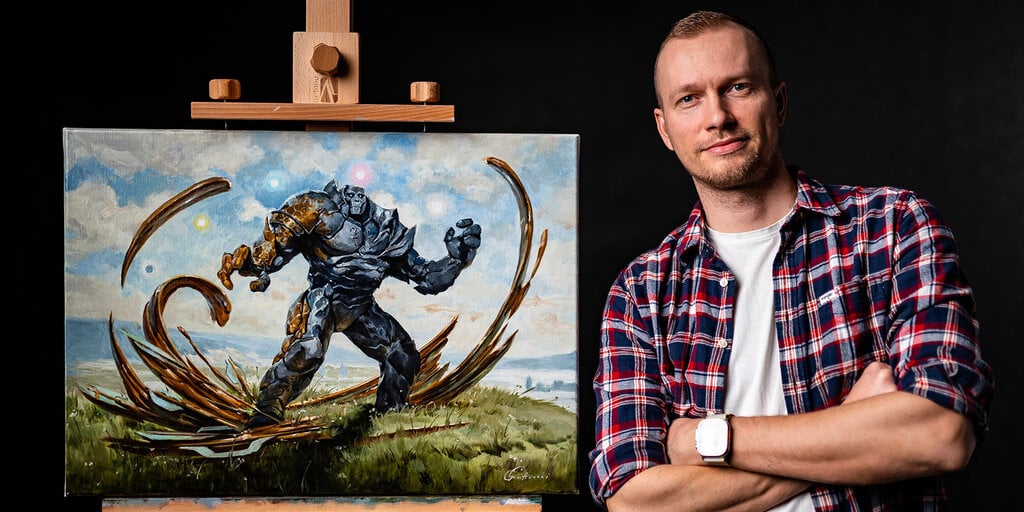
Greg Rutkowski Was Removed From Stable Diffusion, But AI Artists Brought Him Back - Decrypt
His style has been requested over 400,000 times, even surpassing legends like Picasso and Da Vinci—all without his consent.
Decrypt
59 points · by ecliptik · 3y ago · 58 comments
My interpretation of the article is that the entire reason this person created this was because the artist had objected to being in a generative model. When the artist was removed from the popular generative model, this person created a model/tuning specifically to put the artist back into one, and distributed it. They seemed to do this well aware that the artist didn't want to be in a generative model.
That sounds aggressively adversarial and abusive, and so the quote above sounds disingenuous.
Consider the analogy of a bully who is hitting a victim, and the bully demands that the victim ask the bully nicely to please stop. Humiliating the victim, and making the victim acknowledge the bully's power over them. Also, this is only after much damage is already done to the victim. And, in this case, after the bully has called over a mob to also beat the victim, and knowing that, even if the bully stops, the mob will continue.
The person in this case might not have the self-image of a bully, but is instead thinking of it as the usual Internet get-out-of-jail-free card: such as when you post someone else's content, when you're pretty sure they don't want you to, and without even trying to get permission, but you think it's all OK if you say "I'll take this down if they ask me to". (Related: The YouTube copyright violation disclaimer "I don't own this! All rights to the owner!", maybe even referencing the "All rights reserved" of a traditional copyright notice.)
Wherever you stand philosophically on copyright and related matters, and whatever jurisdiction and economic conditions you're under, it's maybe also helpful to consider the bullying question. One can stray into that accidentally, and that's harder to justify.
In this context, putting an artist back in the model is a pretty sensible form of disagreement/protest. I admit the "I'll take this down if they ask me to" is strange, but mostly because its too weak; the LoRA should just stay up, not demand another no from someone who already made their opinion clear.
If you want to educate yourself on how to refer to different art styles you can start here: https://en.wikipedia.org/wiki/List_of_art_movements
> If you remove artist names from the training data, you lose the ability to describe those styles
It's almost as if artists develop their own styles that are just as uniquely theirs as any one work produced by them in that style, if not more so! When people put "by Greg Rutkowski" in their AI art prompts, they are not asking for results in a style that exists independently of Greg Rutkowski despite his name somehow being the only way to identify it. They are, in fact, asking for results in the style of Greg Rutkowski in the sense that works by Greg Rutkowski were labeled as such and fed into the training process, programmatically creating a digest of works by (at least) Greg Rutkowski that we call a "model", and that model is as a result capable of mimicking the style of Greg Rutkowski specifically. They are asking for results that look like they were painted by Greg Rutkowski, and they care enough to ask for Greg Rutkowski specifically because Greg Rutkowski is a highly skilled artist who developed his own distinctive style which is the central pillar of his intellectual property as an artist, and his competitive advantage.
Intellectual property law as it stands today obviously couldn't have anticipated this technology, and didn't. However, if this kind of thing is still legal in ten years, that will represent a major systemic failure of copyright and trade secrets law to protect the core intellectual property of artists in the same spirit as it currently protects intellectual property in other domains.
>> It's almost as if artists develop their own styles that are just as uniquely theirs
Hard disagree on this. Styles do not and should not have ownership, legally or otherwise. Not in painting, music, film, games, or any other kind of art. Anything else kneecaps derivative styles and erects a massive barrier to the advancement of culture. Straight copies are mostly avoided because they add nothing over the original.
You're also misunderstanding the typical use of Rutkowski and other names. Most prompts I've seen and used use multiple artists for a unique blend of styles (including the much maligned and overused Rutkowski + Mucha), not just straight copies. While asking for Rutkowski indeed asks for a very specific style (as well as any themes etc common to his work), its usually in combination with other equally specific and somewhat contradictory styles, each guiding the result in some direction and adding elements but none of them being exactly the desired end result. Just asking for straight up Rutkowski was a short lived cargo cult and is now more of a meme than anything else.
Sometimes, but not always.
Lots of people prompt by cargo cult -- you find lots and lots of images generated by peppering the list with stuff like "masterpiece, best quality, 8k, award-winning".
Are all of those found in the training set? Do they actually have the right result?
It's statistics, not magic. The machine doesn't know what you mean, it only knows what's in the dataset. Some tags are not well represented enough to have the result you'd expect from the name.
Googling around suggests "masterpiece" mostly translates to higher contrast and saturation.
> they are not asking for results in a style that exists independently of Greg Rutkowski despite his name somehow being the only way to identify it.
Some might be. There's not always a tag for every kind of aesthetic, so one possible solution is to find an artist that uses it.
> which is the central pillar of his intellectual property as an artist, and his competitive advantage.
And which copyright law says he doesn't have. Style isn't copyrightable.
Do you?
With base SD1.5, “by greg rutkowski” produces extremely similar results to “detailed realistic muted fantasy”. Except for the case where what you are actually trying to do is directly mimic the work of an artist with a strong unique style that is very heavily represented in the source data (Rutkowski, IIRC, has extremely little representation in the SD training data, leaving aside question of whether the other parts of that description apply), I don’t think you are losing the ability to refer to styles without artist names.
I'd have had more respect for this person if they'd just said "Sorry not sorry." instead.
Bitter truth is though, it's not going away. The genie is out of the bottle, and if you are a talented artist, you absolutly need to embrace AI. If you take a look at DeviantArt AI section for example you'll see: The bar has been raised. It's masterpiece next to masterpiece now. Talented artists + AI = Simply stunning work.
It feels heartless, but what can we do, will you be able to stay competive without AI? It feels you'll be just hampering yourself for idealistics reasons.
What makes this so much worse than things like chess AI is that chess is done for fun and the final output is useless. While art is mostly for the output. While the process is fun, it’s fun because of the value of the output.
No, we've opened up the ability for someone who writes a short textual description of an illustration to obtain an illustration ostensibly matching that description for a much lower cost than they might have paid for it before these technologies were available, e.g. by commissioning an artist.
You're right that technique can be abstractly separated from other aspects of the artistic process, but you miss how the inability to guide the application of technique will cut your capacity for expression off at the knees. The prompt is the art, such as it is, and the ability to iterate on versions of the prompt and parameters of the model to random-walk your way to a result that approximates what you were imagining is a very poor substitute for the ability to lay down the brush strokes yourself.
Yes, that is the new art form which has been invented and opened up to a wider audience. By analogy, some people used to complain that DJs were not real musicians, because they just play records made by other people. While technically true, this observation is not interesting, because selecting and mixing records to create a larger sonic flow is its own art form.
I think to be commercially competitive, you need to embrace AI. But to just do good art, you can still get there the old-fashioned way. It's similar to CNCs in that you can get a computer to do it for you, but you many, many people still do it completely by hand. And some people go half-and-half.
Months on from the release of the new Zelda game I still can't find any on-model AI art of most of the distinctive characters. They just can't do it without a LoRA, and you can't make a LoRA without many existing examples, so they never could have put those characters to paper using AI if the design only existed in their head. Conventional artists have to do it first so that AI artists can follow.
They are obscure for the same reason most artists are obscure.
But most "AI artists" you are talking about are would-be consumers looking for something specific, not creators looking to pull something novel out of their head.
A fan artist must observe a character's official depiction before they can produce their own variants of it. Most humans do not produce art in a clean room, either - we all produce a synthesis of the existing art we've been exposed to. A LoRA or dreambooth model incorporating a novel concept is conceptually similar to a fan artist being shown a new character so they can produce new derivations of it.
You could produce "police sketches" of a previously unseen character based on shared description, but it would likely fail to capture the nuance of the individual just as police sketches would.
I've yet to see a LoRA produce a meaningfully diverse and high quality range of interpretations based on just a single piece of character key art, or brief appearance in a trailer, the way the conventional fan-artists do. What actually happens is that those conventional artists produce a wide variety of interpretations, someone scrapes those hundreds or thousands of images, and then trains a model using that dataset instead. The model needs the variety and novelty that the human artists bring to the table, otherwise it would just over-fit to the official art.
When I was looking for examples of Zelda AI art I noticed there is a LoRA for Purah, and the first version was posted on CivetAI not when her TOTK design was revealed, nor when the game came out, but a month later when there was a wide enough corpus of existing fanart to scrape together a decent model with. It only works by piggybacking off the non-AI artists effort.
I'm not gonna say that it's perfect, but as an interpretation of the character based on exactly two nearly-identical screen grabs trained for a whole 400 steps and some amateur prompting? Not too shabby at all. It hit many of the distinctive points of the character - darker skin, blonde hair with ringlets, the forehead emblem, the tear tattoos under the eyes, even the laurels under the hair. It missed the bell earrings and the secret stone necklace, but given the limited source material, I think it's quite good. With a few more varied screenshots, I'll bet that it could do quite impressively.
I rather suspect that you can get more variation than you'd think from a homogenous dataset, though - I've trained a LoRA on myself that can produce photorealistic renderings of me, as well as anime, Disney, Pixar, and Dreamworks styles, all of which actually feel pretty "me"; I don't have any human-produced drawings of myself as a Disney character or renderings of me in a Pixar movie, but the model does a good job of projecting what I'd look like given what it knows about "Disney-style" drawings, plus what I've taught it about what I look like.
I don't look at that kind of artwork all that much, but Rutkowski's pictures seem to have a very D&D/Tolkien-ish quality to me, to put it in some words. I'm pretty sure other artists made works in similar styles.
I do recall purchasing a poster with a similar look around 20 years ago, when he'd have been 14-ish. He might be a prominent artist in the genre now, but he's far from the first or that unique.
His name worked in the text encoder released by OpenAI, but it was more like a synonym for "concept artist". The image encoder didn't see any of his images.
So if he's not in a newer text encoder, you could find him again with textual inversion.
Sounds pretty unethical. :(
> “If he contacts me asking for removal, I'll remove this.” Lykon said.
... as if Greg hadn't taken a clear stance.
There's no stopping this technology, but we can do without all of fake "for the good of humanity" stuff. If you want free pictures in someone's style without paying an artist for them, just be honest.
Fun fact: we have yet to reach the one year anniversary of the initial announcement of Stable Diffusion [0]. A lot has happened in one year!
Right now it's not given that it's legal. Most people are assuming that it's ok under fair use, but until the SCOTUS rules on it it's an unknown.
Given the potential economic impact on the original artist, the mechanical nature of the transformation and the fact that extracting the style of an artist's work could be deemed substantive, fair use is not in the least bit a slam dunk.
One could argue that use of this sort of AI robs the original artist of the fruits of their labour, neutering copyright protections, and produces works that substitute for the originals, without adding any creative input other than commanding the output from a machine. Given the intent of copyright law, judges would likely be receptive to this argument.
Is this hyperbole or did he actually say this? How could someone spend tens of hours meticulously painting something and then not be able to tell if he did it?
Not that he forgot what he drew and what he didn't.
Uh, not really like that. The original was about value in comparison, not an absolute value. I don't really see what's immediately wrong with an idea that anything digital has questionable value compared to its clones generated by a trained neural network (but absolute value of those could be still very high). It could be wrong - but it's not immediately obvious to me.