Cops still take more stuff from people than burglars do
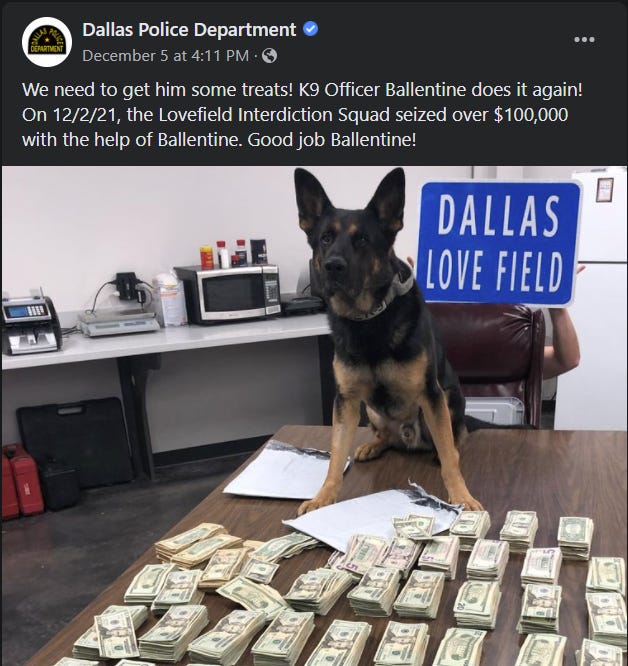
Let’s get one thing out of the way: it’s not normal to stuff $100,000 in cash into a suitcase and then check said suitcase on to a domestic flight.
thewhyaxis.substack.com
480 points · by wahnfrieden · 3y ago · 286 comments
I've read articles about how some police departments are training their staff to engage in this behavior and using forfeiture as a profit center. What they are doing is wholesale theft.
No time limit nonsense, get a warrant. Charge them with a crime. That's the law no matter what the idiots running courthouses in this country think, your precedent has no power here.
Unfortunately, unreasonable is subject to interpretation. I'm not saying it's right, but some could plausibly interpret civil forfeiture as "reasonable."
But. You naively assume judicial philosophy must be bound by rules, logic, common sense, ethics, public interest, or precedent.
Strike: ~~The Bill of Rights applies to people, not property. To rationalize civil forfeiture, the reactionaries created a legal fiction that property has agency unto itself. Further, property can be suspected of wrong doing, even by just by existing.~~
Edit: To rationalize civil forfeiture, the reactionaries claims the Bill of Rights applies to people, not property. Further, they created a legal fiction that property has agency unto itself. So property can be suspected of wrong doing, even by just by existing.
Worse, the rules for civil forfeiture are flipped. Whereas people charged in criminal court are presumed innocent until proven guilty, somehow property must be proven innocent. Apparently courts can prove a negative, even if logic cannot.
IANAL. Trying to grok the judicial philosophies of the r/iamverysmart reactionaries breaks my brain. These helped me kinda grasp what's happening:
Bennis v. Michigan
"On this week’s episode of 5-4, Peter (@The_Law_Boy), Rhiannon (@AywaRhiannon), and Michael (@_FleerUltra) talk about civil forfeiture, the practice that lets police seize private property if it’s suspected of being involved in a crime."
https://www.fivefourpod.com/episodes/bennis-v-michigan/
Civil versus criminal forfeiture
"...assets are seized by police based on a suspicion of wrongdoing, and without having to charge a person with specific wrongdoing, with the case being between police and the thing itself, sometimes referred to by the Latin term in rem, meaning "against the property"; the property itself is the defendant and no criminal charge against the owner is needed."
https://en.wikipedia.org/wiki/Civil_forfeiture_in_the_United...
For this to make sense, civil forfeiture and in rem proceedings against property would have to postdate the Fourth Amendment and be a reaction to it, but they don’t.
No criminal charge against the owner is required because criminal punishment isn’t sought, not because it is an in rem proceeding. Its not an end run around either Fourth Amendment search and seizure protection or Fifth Amendment due process, both of which apply. As does the Eight Amendment Excessive Fines clause.
Also while I am ensured of this right by the constitution, the passage "The right of the people to be secure in their persons, houses, papers, and effects..." affirms that these rights are not granted but instead fundamental. Like the first amendment and others this is one of the "certain unalienable rights" granted by our creators.
The 4th ammendment gives individuals the protection from unreasonable siezure of property.
Then look at Capitalism. Exploiting labor to drain any opportunity of wealth building from the working class and transferring it to those with wealth.
People have this twisted idea that America is a moral or ethical place. It's not. We live in a toxic culture and it has always been and it will continue to be. There is no escape.
It's not like I have a suitcase of money in my trunk and I've been pulled over by the police without cause and I can refuse to give consent.
Therefore I don't think the 4 amendment applies.
Isn't the argument for CAF that the mere possession of the large sum of money is just cause to confiscate it? That's why a time limit would work. DUring that time period, they could try to get a warrant. The judge would not give a warrant if that is the only evidence. Then the assets would be returned.
If I sign up for an account on Facebook, then I agree to waive my first-amendment rights.
If I walk into any number of stores or churches or government buildings, I agree to waive my second-amendment rights.
Sixth amendment? Just keep redefining "speedy" and make enough excuses for trials delayed and justice denied.
Tenth Amendment? If a state passes a law judged odious by the Federal Government, then kiss your funding sources bye-bye!
You can consent to searches all you want without giving up your rights to not have your stuff taken.
The government suspects someone of committing a crime? File charges and bring them to court.
At the very least, CAF should require a warrant. Cops should not be able to seize assets as part of a typical traffic stop.
I just can't see how CAF has survived so long without being ruled a violation of our Fourth Amendment right against unreasonable searches and seizures.
The police exist to maintain and protect existing power structures, including the police themselves.
A lot starts making more sense in that context.
Police exist because they were funded by governments. They are the way they are because of the various incentives, organizational politics, their day-to-day experiences on the job, and the minds of the people who staff them. Rather than declaring them part of a fascist plot, why not just try to think about where improvements can be made?
Police has lots of problems in USA. But go live in the country without effective police force first, and then talk about how police isn’t here to enforce laws and justice.
The cops can get a warrant. If they can’t convince a judge then they don’t need to seize anything. The police serve us, not the other way around.
They know who they serve. Seems to be themselves.
It doesn't go into a budget. It doesn't fund anything else. Anything collected goes to victims or it goes back to the people.
This would stop ALL of the perverse incentives.
That would help a ton though.
I'm really tired of seeing internet commentary on "tough on crime" attitudes where people think victims are basically judge and jury, possibly omniscient, and their hurt and revenge fantasies should decide policy for millions of unrelated people, supersedes the needs of everybody else, like our need to have an impartial justice system and prevent wrongful conviction.
But getting back to your comment, if you want to know where the "perverse incentive" is in your proposal, it creates incentive for someone to falsely present themselves as a victim of a crime.
We have fundamental concepts like equal representation and equal treatment under the law that clearly show CAF to be wrong.
The idea is that let us say the normal price of electricity would be e.g. 10c / kwH. To incentivize people to use less electricity we charge 20c/ but the extra 10c go to the fund which at the end of the year is split evenly between all electricity consumers.
So basically everyone pays 20c x consumption -10c x (average consumption).
This is more difficult if 100% of it goes out the door. Hypothetically you could still get ecosystem issues, though. Where an org argues for more fines so that their existence is justified and that they don't shrink. etc.
I think you are slightly confused. Civil asset forfeiture does not require any crime (hence civil asset forfeiture, rather than criminal asset forfeiture), and the government charges the property itself, the owner is a third party claimant.
The language of the clause means you can't disconnect persons, houses, papers, and effects.
People are secure in their persons, their houses, their effects.
It's not a weird quirk of some conflicting criminal/civil law.
It's part of the document that binds all other laws.
Making people a third party to their effects means you could also do that to their person, which is complete nonsense.
> Civil asset forfeiture does not require any crime
But it certainly does require suspicion of wrongdoing. You can't just walk up and take something from someone just because you don't charge them.
That's because it's civil forfeiture. There is no presumption of innocence in civil law; it's part of criminal law.
From my perspective, “cops can take your stuff unless you prove your innocence because it’s not a criminal proceeding” is a distinction without a difference. Cops shouldn’t be able to just take your stuff.
The government has to prove suspicion of wrongdoing on a preponderence of the evidence.
Edit:
You can show up to a civil forfeiture case as a claimant, refuse to answer other questions under the 5A, and walk out with the goods if the judge doesn't think there's any wrongdoing.
Edit: rhetorical question as I don’t think you’re actually of the opinion that it’s reasonable.
So naturally, because in most civil cases its the other party's inaction that's supposed to be punished, courts adopt "guilty until proven otherwise" stance. Now it's the other party that has to show a receipt signed by you, or to show their bank statement that says they've transfered money to you, etc. That's one reason why there is so much paper trail in business and commerce — so that's when someone sues you, you could use all that paper to cover your ass.
The difference being that who needs to prove what can be quite flexible.
In civil contexts however, the legal standard is the much lower "preponderance of evidence" (https://en.wikipedia.org/wiki/Burden_of_proof_(law)#Preponde...).
E: Oh that's how you do italics on HN.
You have to prove the cash did not commit a crime. This sounds absurd, but it's easily prove, the cases are named things like United States vs. $117,000 in Cash and State of Missouri vs. Gold Jewelry Worth Approximately $1400.
But if that's not absurd enough for you, boy do I have some good news for you! Since the case is against the property, you the previous owner of that property don't automatically have standing. Court cases in the US are based on common law (except maybe Louisiana, who knows what goes on in that Bonapartist shithole), to appear in court at trial, you have to prove that you're actually a party to the case. It's automatic if you're the defendant in a criminal trial (or plaintiff in civil), or the prosecutor... but third parties are usually told to pound sand. And the case clearly names the property as the defendant.
Don't let me overstate it... as far as I know, no one's ever been denied standing when petitioning this, but it's another hoop to jump through. One that will cost you money.
If they seized less than $10,000 or so, forget it. It'll cost you that to get the stuff back. So they tend to target lesser amounts now days, knowing that no one will bother. And if it's a higher amount, they'll often try to settle... "hey we know it will cost you another $5000, so why don't you take half and we keep the rest?" Of course, you're still paying the lawyer a few grand to get that far, and it will come out of your $5000, and not their (using that word pains me) half.
If you haven't retched in your own mouth a little, then I still haven't properly explained how bad this is. Go read.
But why? You lose your presumption of innocence, you lose a guaranteed defence attorney, and you still face years of prison and maybe even the chair... there is a reason why offences with gravest punishments (that is, crimes) have pretty strict procedures and proof requirements set up around them.
0 - note that if this happens to your property, it sure will feel like it is happening to you. Lawyers will be happy to lawsplain their BS theory[2] to you for a nominal hourly fee. This will not make you feel any better for having been robbed at gunpoint.
1 - https://en.wikipedia.org/wiki/In_rem_jurisdiction
2 - Spoiler alert: the theory is exactly as stupid as it sounds.
Imagine that it's 1804, and a ship shows up in port carrying contraband. The sailors on the ship didn't know about it, they just make sure the boat doesn't sink. The owners are nowhere to be found, they live in London or Paris or Antwerp or something, and you'll never be able to arrest them for it (this is the pre-extradition world).
What do you do with the contraband? You need a formal law to deal with seizing it. And this serves as the framework for our modern civil forfeiture laws. A case would be entered into the dockets something like "State of New York vs. 152 Gallons of Whisky" or whatever. The whisky itself committed no crime, there can't be a criminal case.
Next time on the program: why "assault" in "battery and assault" doesn't actually mean the same as "assault" in colloquial speech.
But there are plenty of stories out there of people having very large amounts taken from them on their way to buy cars or whatever. The story probably picked a bad example but the police are definitely just taking whatever they can get without any regard for justice.
It really doesn't matter: if someone wants to carry a large quantity of cash on a plane, this is still an open society and freedom must be defended.
I agree there probably are times that it happens, but it's very unlikely. There are much better examples where the police steal large amounts of cash even when there's an obvious legitimate explanation.
He and everyone suspected one classmate. Cops searched him and found the phone and other stolen phones. They were all taken into “evidence” and refused to give it back no matter how many times we asked.
We had to buy a new phone.
Fuckers.
https://www.lawyers.com/legal-info/criminal/criminal-law-bas...
This is a pretty big freaking caveat. If you actually look at the DOJ source, about $1 billion a year comes from low-level seizures (https://www.justice.gov/d9/pages/attachments/2020/02/09/afp_...) Almost all of the rest comes from huge white-collar busts.
The white collar seizures almost work the exact same way. Toyota was never charged with a crime over their accelerator pedal issue. But the government just seized 1.2 billion from them and kept a huge chunk of it for themselves.
That is certainly true. But how do you measure legitimate vs illegitimate taking of property?
With burglary, it is fairly trivial. But otherwise? I'm not aware of statistics breaking down the amount of money and assets that get taken without any charges.
Most of the time, the people who are robbed by the police can't afford or don't know how to get their property back.
That is, this is much less concerning if the numbers are such that 90%, say, is proven illicit.
To get the money back, it must be fought in court. Legal fees are not returned if the case is won, and if lost, you must cover the defense fees. In Illinois the median forfeiture was about $1k, with many <$100 forfeitures clustered in the poorest neighborhoods, while lawyer fees are ~$3k for state/local police cases. Federal seizures are much more expensive to fight.
There's no process where the police further verify the provenance of the cash they seize and return it without it being fought for in court. It's taken and they celebrate it and move on. So as with most police oversight, the numbers you're asking for don't exist.
Bernie Madoff had his assets seized. That's not wrong, illegal, or unconstitutional.
but that is the clearest depiction of this caste system. people that can obviously fight do not have their cash and effects seized.
Maybe we need a "NRA" for money, property, and encryption.
one that the 4th amendment doesn't apply because you haven't proved its yours. the text says "The right of the people to be secure in their" so it applies after you prove it is something you have the right to be secure of to begin with! and if there is something illegal you incriminate yourself in the process and it switches to a criminal charge against you and the associated criminal asset forfeiture.
but our new supreme court will re-examine it more decisively, lets wait till next year and see what happens!
Wow, that's almost literally the logic of a playground bully: "well you can't prove it's yours therefore it's mine".
Likely alerted to the scent of drug residues on the bills, which is supposedly on essentially every bill in circulation.
So, perhaps the owner of the cash might have been better off by first putting it in a washing machine with soap, i.e. physically laundering the money?
If contraband or other crimes were involved, then I say seize property, but the police shouldn't be the Sheriff of Nottingham looking for citizens to rob.
If you decide to simply take $20 out of the till to pay yourself - that's criminal theft. You get arrested, go to jail, and have to fight criminal charges.
It's one of the more blatant examples of how the laws of the United States are written to unjustly empower those with wealth that I am aware of.
Yes, it is, in California, at least (and, as of this year, if it was over $950 instead of $20, it would be felony grand theft of wages, rather than a misdemeanor theft.)
Of course, criminal process has a higher proof bar and requires a public prosecutor to care enough to do something, doesn’t improve recovery for the victim, and is usually slower, so actual recovery is probably going to happen through civil/administrative process even if a crime is on the books and applicable.
Wage theft really should be a strict liability crime -- only proof necessary to convict is that it happened, not that it was intended.
The most blatant thing for me will always be the tax code.
Alone way that W2 income vs long term capital gains is taxed (not to mention that losses are fully tax deductible) makes the message very clear.
If a contractor takes your down payment and then never installs the toilet is that criminal theft?
If a contractor installs your toilet without advance payment and then you never pay her, is that criminal theft?
To the extent that the funds were entrusted to the contractor on the premise they would be used to purchase third-party goods and services on your behalf, the crime would seem to me to be embezzlement, which is usually distinct from theft but often punished similarly and part of the broad family of property crimes. Advanced payment for services to be rendered, I’m less sure of fitting into that.
> If a contractor installs your toilet without advance payment and then you never pay her, is that criminal theft?
In California, the wage theft law applies to contract as well as W-2 employment.
Note that in either case, there may be a compensable civil wrong without the intent requirement for crime, even if the general scenario described can fit a crime.
I suspect most people would be perfectly happy with people facing criminal punishment in large scale wage theft cases. The same probably isn't true for toilet installation disputes.
You would then have to make sure to include a consideration of conspiracy in the case where the owners pressured the manager - just as you would consider conspiracy in a case where a thief was hired by someone else to execute a theft.
That doesn't require wealth as much as it requires equity. We get wealthier every year but we don't get more equitable, and our investment in things like education, health care, and infrastructure is definitely not rising accordingly.
It has never been the case that we simply weren't wealthy enough to build a just society, it's that our society is structured to promote inequality and maximize the influence of the wealthy.
Sometimes that causes companies to abruptly shutdown and not meet payroll.
It should be criminal to sign a term sheet and not wire funds, and even in the case of a handshake deal employees should have recourse to get their last paycheck with that investor AND extend their H1B validity for an additional 6 months to find a job.
* Time theft causes U.S. employers more than $400 billion per year lost in productivity.
* In a survey done in 2015, 43% of employees admitted to deliberately committing time theft. And, 25% of employees admitted to reporting more hours than they actually worked 75% to 100% of the time!
"Time theft" should be stealing the employees' time, by not paying.
Pretending to work could be called "wage theft" too, as the employee could be comsidered stealing wage from the employer.
Edit: Oh ... ye ok got it. "Time theft" works both ways too.
How? Isn't this a whataboutism?
And do your bullet points have sources? They sound like the sort of thing a corrupt business would falsely report.
I am trying to parody the point that as soon as we decide that theft can mean whatever we wish it to (for presumably good reasons), then that implicitly allows everyone (including people you’d rather didn’t) to use theft to mean whatever they want it to.
Civil forfeiture is not theft (although it certainly feels like it to victims, and there are similarities between the two concepts).
Thread root claims wage theft is a bigger problem, and I am balancing that with time theft.
Sorry for stealing your attention.
edit: and evidently are topics that will get articles nuked off the front page here
Civil asset forfeiture needs to disappear completely and forever.
But I think in this case the issue is not the tool to freeze or seize assets in itself, which used pragmatically helps society, is the accountability of those who exploit it
I have vibes regarding this like those who said ok there are some shitty cops who shot people, then let’s defund the police
> In practice, however, civil forfeiture is often wielded against regular people who aren’t doing anything wrong. In many states the typical cash forfeiture amount is in the hundreds of dollars — $423 in Michigan, or $369 in Pennsylvania, according to the latest data from the Institute for Justice, a law firm that represents forfeiture victims and tracks the practice nationwide. In many cities police departments have been known to make seizures of less than $100 on the flimsiest pretenses, typically concentrated in the poorest neighborhoods.
The usage of 'typical' sounds like they mean 'average', for such precise numbers.
I don't really see how that matters. Most people tried for murder are guilty, but that doesn't mean they shouldn't have their day in court.
you keep saying this but you have no data whatsoever to support this claim.
"Although there are accessible statistics of seizures at the federal level, it often happens that the totals of forfeitures from both criminals and innocent owners are combined; for example, one report was that in 2010, government seized $2.5 billion in assets from criminals and innocent owners by forfeiture methods,[16] and the totals of assets seized incorrectly from innocent owners was not separated statistically. Further, since the United States is a federal republic with governments at both the national and state level, there are civil forfeiture seizures at the state level, which are not tracked and recorded in any central database,[12] which make it difficult to make assessments, since state laws and procedures vary widely."
- https://en.wikipedia.org/wiki/Civil_forfeiture_in_the_United...
Torture might be an effective way to get most criminals to confess and getting a slam dunk conviction when going to trial where a jury may mistakenly exonerate them, but that doesn't mean that it's the _right_ or even _moral_ way to do so.
Further, ask yourself this - what is a crime? Answer - it's whatever the legislature says it is, and as a political body they are influenced by what the dominant group in power wants.
Of course, I guess, fentanyl et al. are a thing because more benign drugs were criminalized for so long. However in no way does that make hard drugs comparable to caffeine though... Do you believe that all substances must be legalized and widely available?
I think most of the popular drugs should be legalized with various levels of access and greater restrictions for the drugs we known are most prone to serious abuse, such as opioids and speed (along with nicotine and alcohol). There's simply no reason a grown adult shouldn't be able to smoke a joint or eat some mushrooms or do some lines of coke in their own home - and buy them safely and legally without undue fear of impurities.