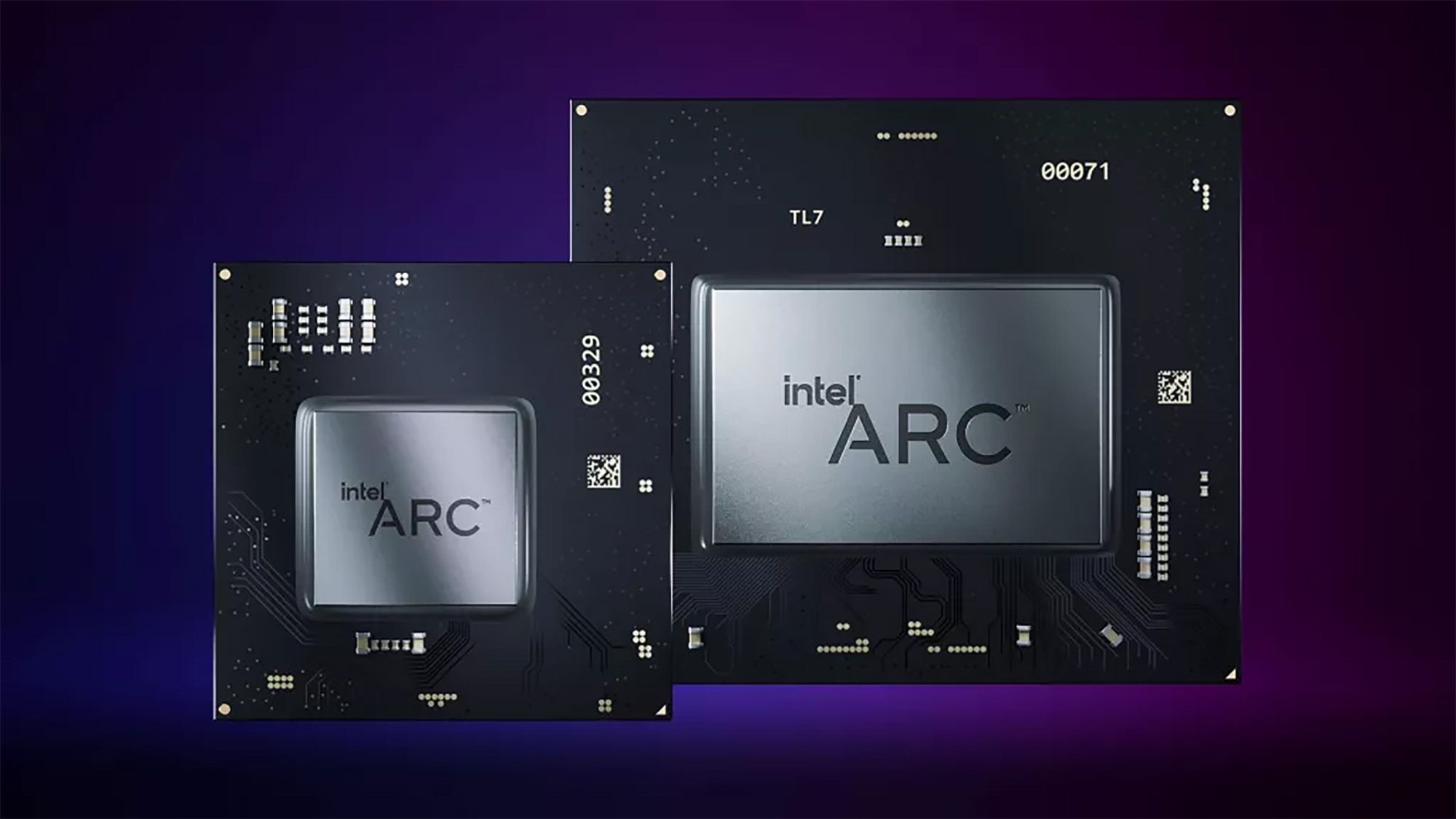
Watch out AMD: Intel Arc A580 could be the next great affordable GPU
The Arc A580 could be a great budget GPU
TechRadar
160 points · by mikece · 3y ago · 220 comments
If Intel is patient to compete for lower grade GPUs for a few years without killing its GPU line, then we might see them competing for the top in the future. And the top is where the big money is. They'll also need a CUDA compatible API to stand a chance, but they have time.
The only thing that saved Intel until now is that Nvidia can't legally produce x86 CPUs, although they tried.
The more competition, the better.
So competing on server grade gpu might be more difficult for intel.
I would love to see Intel get somewhere but they are dead last among the major players.
CUDA isn't that important any more.
The weird one was that Aurora at 2 exaflops using.. Intel Max?
Arc already has an extremely good value proposition: hardware AV1 encoding - so you can keep your existing GPU (let's face it: it's probably still more than fine) and augment it with a cheap Arc.
Slow developments are fine with me; it's a beautiful card.
I guess CUDA compatible would be fine, but for myself, I'd buy their cards for compute workloads as long as they have some reasonable API regardless of whether it's CUDA or not. If they have something usable based on OpenCL, SYCL, whatever, they would have a shot at getting my money. Ideally that would also include then providing some support to make sure there are usable backends for PyTorch, Tensorflow, etc.
Ah well. Let's see if they can figure this out. Between Intel and AMD, you'd think somebody could step forward and give NVIDIA some serious competition.
They also have arguably pretty good OpenCL support, as well as downstream support for PyTorch and Tensorflow using their custom extensions https://github.com/intel/intel-extension-for-tensorflow and https://github.com/intel/intel-extension-for-pytorch which are actively developed and just recently brought up-to-date with upstream releases.
But the bottom is where volume and profits are. If the PC market has shown us anything, it’s that only producing for the top of the market gets you outcompeted.
Getting paid a small yearly salary for every one of your products may look really nice but the size of the market makes it a precarious business.
Intel competing in the midrange is far from a nothingburger.
I really wish someone would give Nvidia some effective competition, but I just don’t see that being Intel.
Seem unreasonable to me. Even without a legal protection there is some degree of protection for the original creator something as complicated as a CPU.
I believe that the person you're replying to is referring to an attempt to produce x86 compatible processors that Nvidia undertook when they bought the license that Via owned.
IIRC that didn't go so well for Nvidia because the license didn't include new parts of the instruction set like the 64 bit instructions that AMD made in the mid 2000s and AMD wouldn't license them.
I'll say I had a miserable time trying so setup oneAPI for VS Code on Windows. Their website made it seem like it was possible, there are even plugins, but I never got it working. Eventually I just gave up and downloaded Visual Studio.
Getting oneAPI to work on Arch Linux, where it's not even officially supported, was also tricky but considerably easier.
Haven't been able to successfully get PyTorch or TensorFlow code to utilize the GPU but did get some DPC++ working with oneAPI. All-in-all it's not a terrible experience but could be a lot better.
As far as stable diffusion I read a guide on setting it up using WSL and it never worked. No telling what's wrong because there's just very little info about these GPU's out there.
I don’t mean to start a holy war but this is why people buy consoles. I feel like the entire PC video card universe is so disconnected from reality. A PS5 or Xbox Series X is $499 and is a fully functioning device.
And you don't get a fully functioning work PC out of it... Which is stupid, as both consoles would be great PCs, especially the XSX with bigger RAM ICs. They are kind of like high power Mac M1s.
I agree with your first point. However a plus on the console side is that I can actually still own my games instead of licensing them (if you buy physical).
Discrete gpu involves paying for all the memory costs, all of the cooling costs, all of the video outputs and BOM costs, all of the testing and validation costs, and then just doesn’t do the last little bit that makes it a fully functional PC. Instead you are expected to buy a second set of memory, cooling, fans, etc and ship them all individually with total packaged shipping size of a small pallet, compared to a console shipped in something the size of a breadbox. It’s literally the most expensive way to build a computer with the most redundancy in system design and the most waste in shipment and validation.
So it’s not surprising that console costs and midrange dGPU costs are convergent. They are 90% of the way to a console, just missing the last few bits!
(But thats what PC gamers get from clinging to an outdated 1980 standard for computer design, and the form factors it provides for expansion cards. Just ask people to buy a new backwards compatible power cable string for their gpu, and provide them with a free adapter, and then watch the tantrums flow. The religious reverence for the ATX and pcie add-in-card form-factors is absurd and people get what they deserve when the pc designs that shake out of it 40 years later are incredibly poorly-fit to the real-world needs. Everything has changed, gpus dominate the system now, we deliver up to 400W through an intricate network of 75w/150w “aux” connector, and we still design cards and cases and motherboards like it’s 1980 and a gpu and cpu can both be passively cooled…)
You can build a Steam Console much cheaper, but it will also involve some sacrifices the PC community hates, like soldered (GDDR6/7) memory and no CPU/GPU upgradeability. But it’ll be 1/4 of the price, so it’ll be worth it even if you have to replace the whole unit to upgrade. That's why consoles are built that way, and not as an ATX PC.
The next google result was that one on Newegg. I saw it was out of stock and said I’ve seen all this before and gave up.
How much do the console games cost? PC and console gamers tend to spend more on games than hardware, and PC games are offer more bang for the buck when amortized over playable time. Additionally, consoles are not backwards compatible with games for earlier platforms, so one has to re-buy versions of games they already own.
Consoles are appliances, and I understand the appeal of their simplicity. However, until consoles offer the flexibility of playing a game I bought 10 years ago[1] or the latest and greatest AAA title, I can't abandon PC gaming.
1. Or a 10-year old title on sale for $3.99
Gaming consoles also seem to have fewer cheaters.
A console also compartmentalizes video gaming away from your compute/Internet stuff. (Both technically/security/privacy-wise, and in terms of distraction.)
(Source: Uses only a PS4 Pro for gaming, even though I have a PC with an RTX 3090 and gobs of RAM, sitting usually idle.)
So I just play single player and use tools to give myself bullet time in every game, edit resources to escape grind. This is only possible on a PC. For content tourist style gaming, consoles are a no-go.
I do like the compartmentalization aspect of consoles though. Sooner or later Steam games will start being a security hazard. I don't want to do banking on a computer with games installed.
I play Modern Warfare II almost exclusively with a mouse and keeb.
They can play games and nothing else. So completely worthless comparison.
They’re not very good at the former, but given the apps available for both, they’re at least serviceable.
Except they cost less than a high end video card (not to mention the rest of the PC) and your games are guaranteed to work.
> Console and PC are very different gaming experiences though. One is no substitute for the other.
That's absolutely correct, but innovation in PC games is on the indie side and those aren't so GPU hungry. Most AAA titles are the same on consoles and PC these days so might as well get them for the console.
Maybe that's what hackers should target then.
Having only 8GB of VRAM seems to be the biggest crippling factor for this A580. I was looking at A770s on eBay and on good day you can get them for quite a good price.
https://www.youtube.com/watch?v=fISiTHe89eA
The RX 7600 costs $270, has 8GB of VRAM and AV1 encoding, and outperforms the 8GB a770. So I really don't see an objective reason to buy the a770 aside from supporting a 3rd player in the gpu market (which is a good reason IMO).
Who should one get a video card from these days if the main goal is good Steam/Proton performance on Linux?
Atm I have a PS5 and this Linux box with a Ryzen G series (and a Mac Mini but that's off topic). If i want to use it to play games through Proton what vendor should I get a video card from for the least hassle? Note least hassle not best fps.
Although come to think of it, I haven't even attempted to try and see what I can get out of the integrated graphics... console backlog is pretty big so the Linux box is only used for work and doesn't even have a monitor connected :)
"Nvidia - fuck you!" - Linus Torvalds
And this is 6 years after Raja has taken their GPU team lead ( and now left ).
I don't get it. Intel have decades of relevant expertise, and have been printing money for years due to AMD's effective absence from the top-class CPU market between 2005 and 2015.
And yet years and years and years go by, and Nvidia is now the world's fifth most valuable company, far surpassing all other chip manufacturers (except Apple), and nothing is happening on the market.
How the fuck is this even possible?
Intel hires about half of the graduates from my uni, everyone who likes coding fled to startups or super specific teams.
There are strong engineers in Intel for sure but it has a pretty awful culture.
Nvidia’a isn’t great but it’s heaps better in terms of actually taking results into account.
My personal experience is only with the local (Israel) branches of both.
Note: I dislike much of what Nvidia does (proprietary drivers, insane prices, ghetto anti-competition tricks, etc). But you gotta give it to them as far as innovation and quality of engineering goes.
> I don't get it. Intel have decades of relevant expertise, and have been printing money for years due to AMD's effective absence from the top-class CPU market between 2005 and 2015.
Noone gets it. From an armchair-expert point of view, anything nvidia can do, anyone else can do, they only need money, and they (Intel, Qualcomm, FAANG) have it.
Probably indeed noone was interested in competing, it didn't seemed to be a good deal, until the past few years.
It's just not a good architecture. The Arc 770 has ~22 billion transistors to compete with a 3060 with ~13billion transistors. Power usage is much higher too.
Gamers will accept this since we don't have our PCs on all day. But they're years off an architecture that can be competitive in a data centre scenario.
there are still plenty of arm models available. many of which are really just tablet hardware in a clamshell. which, so are many of the intel models if you look closely.
it isn’t so much intel occupying the low end laptop space, as commodity tablet hardware.
It’s a testament to how good of a card it was though - up until LLM’s hit us, I never felt the urge to look for something else. It would drive my 49in monitor and run anything I cared to play at good settings.
Here’s an interesting system with AMD Zen2 CPU and GDDR6 memory, salvaged from XBox: https://www.tomshardware.com/news/4800s-xbox-chip-shows-us-w... As you see, high latency of GDDR6 memory ruins the performance of CPU-running code.
My current GPU has 484 GB/second memory bandwidth. It would require 7 channels of DDR5-8400 memory (the fastest one currently defined by these specs), and GPUs aren’t yet large enough to fit 7 slots of SO-DIMM.
Some chips are moving towards having the ram on the same die package as the actual GPU as one integrated chip.
Mature drivers, and better tested alongside AMD cpus.
Also, I never liked Intel[0].
Already Ratchet & Clank in FHD has a >50% performance advantage when you compare the 16GiB 4060TI version against the 8GB version, when comparing avg. fps P1 it rises to +70%.
This is the biggest outlier, but many other games suffer badly with just 8GB [0]. It will only get worse going forward, so don’t buy a 8GB card if don’t have to, it will age badly.
[0] https://www.pcgameshardware.de/Geforce-RTX-4060-Ti-16GB-Graf...
I don't disagree, but also I think the A580 mentioned, at it's price point of 150-200 dollars is firmly entry-level. The low-end market dedicated GPU market is basically gone with integrated GPU being good enough nowadays.
However, isn't this specific game you're mentioned just a case of a crap port from consoles?
Personally I wouldn't try any traditional console franchise on a PC. They're just not designed for it, even if you plug in a controller.
Point being that a lot of current-gen AAA games already benefit from more RAM, and this is not going to get better. Consider that frame generation and raytracing also consume lots of VRAM, and FG will be essential to keep 4060Ti level silicon competitive in the future.
Here is a Youtuber making the same case, that no, its not just that one badly optimized game: https://www.youtube.com/watch?v=_-j1vdMV1Cc
Does this affect all games? No. But this won't help you if it affects a game you'd like to play, now or in the future.
I tried passing the link through google translate and it skipped the banners unfortunately. I have a feeling it wanted me to make an account though. I uninstalled Chrome on this laptop so I can't use the in-browser translate option.
> Point being that a lot of current-gen AAA games already benefit from more RAM, and this is not going to get better.
Point taken. Wasn't aware of that because I get the few AAA games I'm interested in on console anyway. Most are series that started on consoles so the company is likely to be more experienced on that platform.
Edit: and to be a bit snarky, I could argue that ports from console that don't take into account the amount of VRAM on common PC video cards are a case of crap console port.
If they could throw some forwards compatibility in (maybe an FPGA?) so that users could do future real-time encoding of h266 or av3? That would be an easy sell.
Every single personal computer with an Intel CPU since 2010 has an Intel GPU inside.
"Intel Quick Sync Video is Intel's brand for its dedicated video encoding and decoding hardware core. Quick Sync was introduced with the Sandy Bridge CPU microarchitecture on 9 January 2011 and has been found on the die of Intel CPUs ever since."
That's blatant misinformation, this A580 seems on par with RX 7600, same price, AMD has lower TDP, it was released May 2023, and the journalist dare to say AMD has been slacking off?! What Intel doing for releasing same GPU as competition 1 year later?!
Let me go through why it's hard to release GPUs at the right time as someone who's done this at a different company. Development probably started 3-5 years ago, before COVID. They would have estimated what AMD/Nvidia's performance would be that far out and what TSMC's process would look like, then sketched out something that might meet a reasonable performance/cost target, with random guesses at a bunch of important and completely unknown factors like driver quality. Then COVID hit and the entire manufacturing world descended into utter chaos for the better part of 2 years. This is probably a large factor behind why Intel didn't manage their initial 2020/2021 estimates, with another part being that management at any company has no idea how to estimate silicon timelines. On top of that, the 10, 20, and 30 series all had completely different performance increases, probably generating a few revisions of that performance target on their own. Every time they revise the design to keep it competitive though, firmware is screaming at them about stability, and software is screaming at them about timelines, and leadership is screaming about costs.
But somehow despite all of that, they manage a relatively timely release and it's competitive in the low end after a few months of driver improvements. Unfortunately there's another problem. These things are fabbed at TSMC, not Intel. Intel doesn't have that many wafers at TSMC compared to Nvidia/AMD and meaningfully increasing that is expensive. So instead they make the rational decision to release the higher-margin stuff first and let the drivers bake some more. Everything else can get price-adjusted (and minimally design-adjusted) before it releases to make it competitive, which is why the article doesn't have actual pricing.
  - [1] https://opendata.blender.org/benchmarks/query/?compute_type=OPTIX&compute_type=CUDA&compute_type=HIP&compute_type=METAL&compute_type=ONEAPI&group_by=device_name&blender_version=3.6.0
- [2] https://en.wikipedia.org/wiki/GeForce_20_seriesOverall, I'd call it close enough in performance that I'd be interested in giving it a try. On the work side, I worry more about being bitten by lack of CUDA (although I like the look of SYCL that Intel/Kronos push as an alternative), and on the gaming side, I worry more about how if DX10/DX11 titles will ever really get sorted out. Still, when I get a desktop that supports Resizable BAR, I will likely put an Intel GPU in that machine to give it a try.
Alternatives based on C or shading languages, have already lost before the game has even started.
CUDA supports C, C++20 (minus modules currently), Fortran and has Python bindings, additional plenty of alternative toolchains for PTX bytecode exist, some of which with NVidia's official backing, for Haskell, .NET, Java, Futhark, Julia, and whoever wants to target PTX.
And there are other specific efforts like Embree (which now supports Intel GPU rendering), and Vukan ML efforts like Apache TVM and MLIR-based projects.
CUDA does things like depend on specific scheduler behavior for GPU threads in order to guarantee forward progress, allowing more efficient single-pass computation routines. Or allowing CUDA kernels to launch additional kernels or allocate GPU memory from within the kernel, without host communication. Or checking the GPU architecture and performing specific micro-optimizations designed around that hardware's internal design.
GPU's are nothing like CPU's, in that the x86 architecture is fairly stable. There's not a _ton_ of difference between different CPUs. Sure, performance characteristics and cache sizes might be different, but generally they have the same instruction set. Each GPU generation is basically a completely different architecture, much less between GPU companies. That's (partly) why Vulkan is so complicated - it tries to support the lowest spec 2013 mobile GPU, and the highest spec 2023 desktop GPU in one single API.
The corresponding GPU software complexity is something that feels not quite appreciated. Yet if we are going to see the massive adoption of GPU's that the market projects, with multiple providers of hardware, we'll need some serious advances of the software side.
https://community.amd.com/t5/rocm/available-now-new-hip-sdk-...
The real question is why doesn't TSMC charge more? How can a customer using the most cutting edge fab get 60% margins? (Similar for other customers).
Clearly there's a lot of pricing power on the fab side that's not being asserted.
> a TBP of 175W.
The RTX 3060 was 170 Watt, the RX 7600 is 165 W. So it's on par efficiency wise as well, it would seem.
Does it have closed-source firmware blobs?
https://www.intel.com/content/www/us/en/docs/graphics-for-li...
https://wiki.archlinux.org/title/Intel_graphics
^ The repo ships with dual licenses and exceptions, have not read the details.
its already a highly demanded product, you don't need this kind of marketing to boost sales.