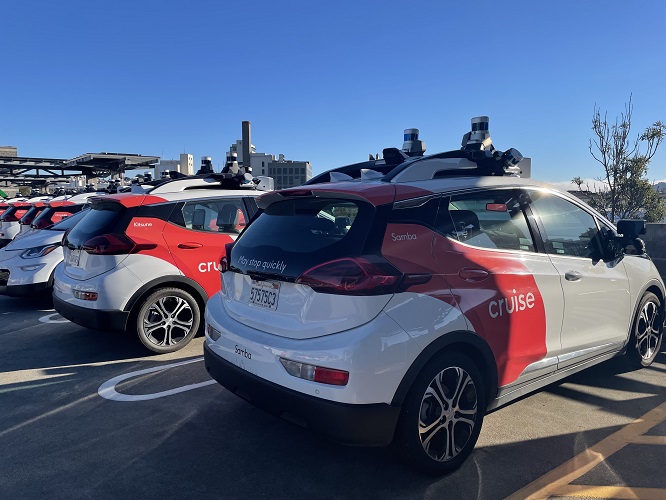
SF cops, firefighters vent before big vote on driverless car expansion
Days prior to a vote on whether autonomous vehicle can expand in SF, firefighters and police officers urged the state to slow down.
Mission Local
33 points · by wpietri · 3y ago · 62 comments
I came across another example a couple of days ago. A guy was telling a story about he was out walking his two bigger dogs in the evening. Across the street, a tiny dog started barking angrily. The tiny dog got away from its owner started to cross the street, heading into traffic. So the guy with the big dogs stepped a bit into the street, waving to attract the attention of an oncoming driver who he thought might not see the small dog ready to run under the wheels.
I have no idea what a robot car might make of that, but I certainly wouldn't want to be the one who has to write the sort of social processing that determines the guy is trying to signal something, so we should stop until we figure out what the signal means.
We should determine how to handle driverless cars based on their overall safety, not edge cases. If driverless cars have significantly fewer injuries/accidents/etc. per mile driven than human drivers, we should push to expand them. If they only drive better in certain areas, we should geofence them.
If they're safer than human drivers but would hit the guy with the dogs in this case, we should still allow them. The opportunity cost of the other accidents that would've occurred if self-driving cars weren't allowed very much matters. Plus the guy with the dogs shouldn't be stepping out into the street (and the guy with the small dog should be able to maintain control of a small dog).
Also, in a world of self-driving cars, the guy doesn't have to try to get somebody's attention out of fear they won't see the small dog, because self-driving cars don't have the limited visibility issues that a human does.
Your heuristic for allowing them where they're demonstrably safer is not a bad one, but too limited. Even if they become equivalent in deaths-per-mile terms (something not demonstrated, and something not currently demonstrable given how opaque and secretive these companies are), other factors matter.
And your fantasy of a world of self-driving cars is a little too fantastical to me. Are current self-driving cars better able to avoid hitting a small dog that runs out into the street? It's possible, but I would doubt it. Will they get and remain there? Again, it's possible. But it's also plausible that some manager's spreadsheet will decide that the lawsuits from owners of dead small dogs will be cheaper than better sensors for a billion self-driving cars.
What other factors? I think you're wrong about this - at the high level, what matters is do these cars save lives/prevent injuries overall. If you're saying that's not the only thing that matters, what is more important than that?
> Are current self-driving cars better able to avoid hitting a small dog that runs out into the street? It's possible, but I would doubt it.
The way cars are engineered, humans generally can't see a small dog directly in front of the car. Tough to be worse than that.
Remember that most of the complaints about self-driving cars are that they just stop when they don't know what to do. If them stopping too much is the problematic behavior, it's weird to me that you and other folks here are using examples where they might run someone over. It just seems like an attempt to find theoretical fault, which is easy to do.
2x, 10x, 50x, 100x?
If it's 10x or higher then it would almost certainly need to take into account edge cases like a dog owner waving down a car.
it's tough to hold onto it (as a human) when you're being threatened and/or injured/maimed/killed by robots.
the idea of yelling at a robot and having it ignore you is pretty fucked up, especially if it's squeezing your coworker to death, or running a dog (or human) over, etc.
We're not, so let's say more than that, but it certainly shouldn't be 10x. If you have the ability to replace a car that kills 2 people per 100,000 miles driven (not a real number, just an example) with a car that kills 1 person per 100,000 miles driven, and you don't do that, you're needlessly causing a bunch of people to die.
But absent even a single policy proposal or timeline, and considering the Taxi Workers Alliance board member's involvement, it's difficult to craft a compelling case for why safety is actually--versus theoretically--impeded.
I never said as much. We're extrapolating potential safety risks from anecdotes of interactions. I'm just saying maybe that extrapolation is off.
But if you can't make a case for a world where there's zero safety impact, then it seems like it would be pretty easy to make a case for a world where there's some safety impact.
Personally, I'd say that a bunch of people whose whole job is public safety saying that public safety is impeded is a decent case that public safety is impeded. But since you apparently believe otherwise, I'm looking for your explanation of how there's zero safety impact.
[1] "‘Blanket the city’: CEO says SF can handle 10 times more Cruise driverless vehicles": https://missionlocal.org/2023/08/cruise-origin-waymo-robotax...
Give firefighters a way to completely take control for 10 miles or something with a relatively low barrier to entry seems like a perfect way to eliminate vast numbers of weird scenarios
At least this thread, no one has yet suggested a shootable kill-switch area that police are supposed to aim for on a misbehaving vehicle.
SFFD and SFPD should know that by now; that falls under basic knowledge required to do their jobs.
We have learned to ignore and work around those issues, but it's hard to do the same with novel issues that we give people the power to block and delay.
Tesla has a fleet of millions of cars, collecting 1m+ miles per day of real-world data. When Cruise encounters a novel situation, it halts traffic. When a Tesla running FSD does, the human takes over, it gets reported as an edge case, edge cases are labeled and bucketed by frequency and tackled in that order, failing unit tests are written, the entire fleet is queried for data on similar situations, the models are trained, the edge case is fixed, and an update is pushed to the entire fleet over the air.
Not this particular problem, no. Tesla has other problems, like trying to drive into pedestrians, or semi-truck trailers, or fire engines...
But at least Teslas don't slow down traffic!
In seriousness, though, it would appear that Tesla's handling of edge cases isn't quite as neat and clean as your comment implies. That might be the spec, but the implementation appears to this outside observer to be a fair bit different.
When an autonomous vehicle encounters a situation, it will initially attempt to resolve it automatically. Sometimes that fails, so it will fall back to asking a human for guidance. Depending on the company and the vehicle there may or may not be a local safety driver available as a secondary backup.
In either case, that situation will be flagged. The amount of detail varies depending on whether there's a human taking notes. One major difference from Tesla here that all of the high resolution cameras, the LIDARs, the radars, etc will be recorded and made available, alongside the full logging data for the ride. Depending on the car and the software it's running, stack tracing data may also be available.
Some of the consumers of this data collect these incidents into buckets to identify issues. This is used to determine things like rollout success (any particular company will have multiple "fleets" running the equivalent of canary/beta/stable) and for finding edge cases. Once one is identified (say through a news story), they'll search for similar events. From there, they can generate simulated test cases based on real incidents or do things more manually. There are multiple kinds of test cases as well. All subsequent updates will run against those test cases. Updates will be deployed to the vehicles when they're not on road. The exact frequency varies, but it's typically higher than Tesla's update cadence.
How do you square that ethically?